
 Last update date:




Global Capability Center (GCCs) have become a central pillar of enterprise growth strategies. In 2026, they no longer exist to deliver cost efficiency alone. Today’s GCCs drive innovation, accelerate digital transformation, support core business functions and influence enterprise wide decision making.
At the same time, the complexity of building and scaling GCCs has increased sharply. Enterprises must navigate global talent shortages, evolving regulatory frameworks, rising cybersecurity risks, sustainability mandates and pressure to deliver measurable value faster. As a result, GCC success now depends less on intent and more on enablement.
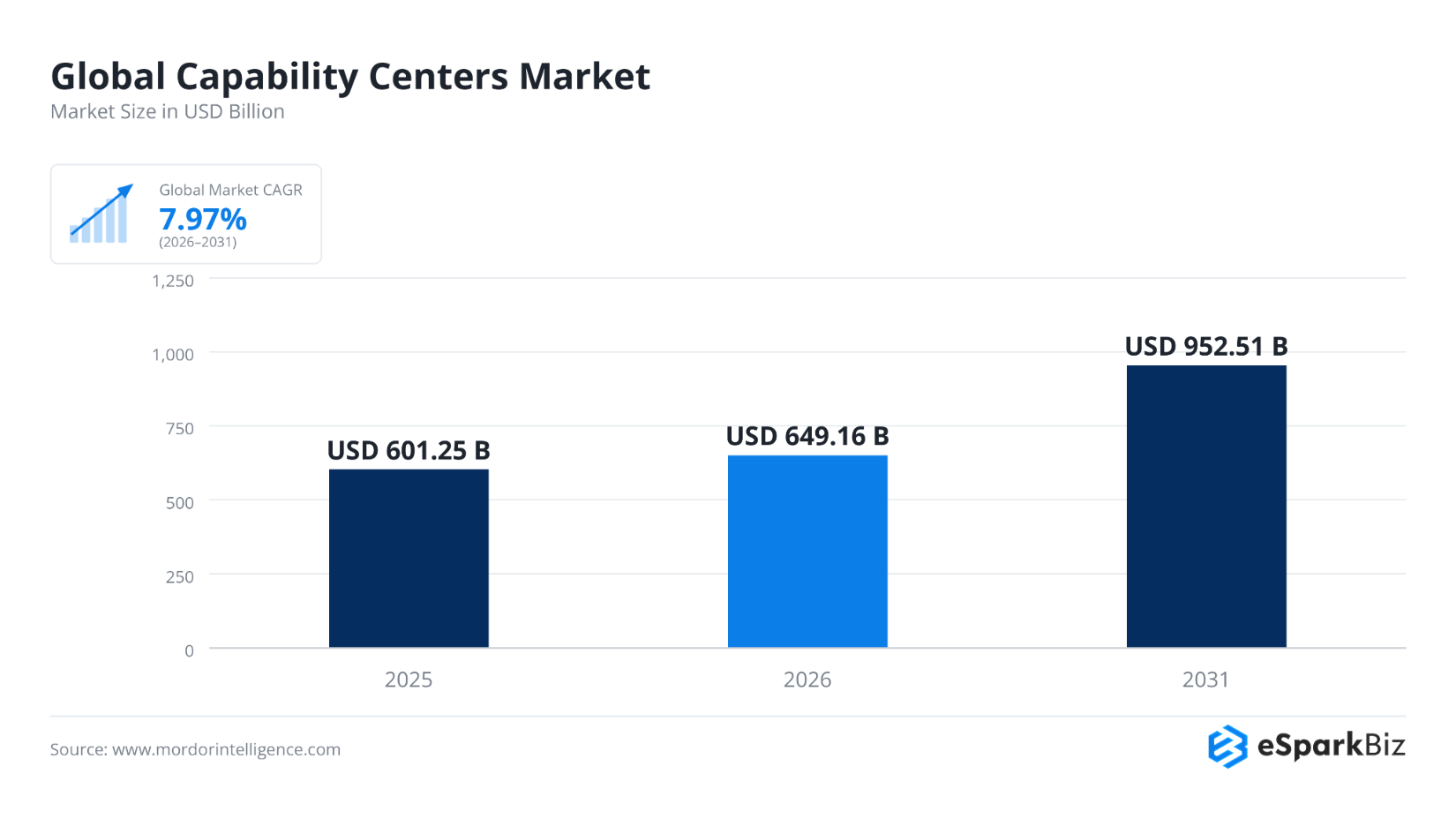
The Global Capability Centers market is valued at USD 649.16 billion in 2026 and is projected to reach USD 952.51 billion by 2031, growing at a 7.97% CAGR during the forecast period.
This is where GCC enablers play a defining role. High impact global centers are not built in isolation. They are powered by a structured ecosystem of enablers that provide the expertise, infrastructure and governance needed to scale with confidence and control.
Why Enterprises need GCC Enablers in 2026?
The GCC operating environment in 2026 is fundamentally different from earlier phases of offshoring. Enterprises face a combination of speed expectations and structural risk that internal teams alone cannot manage efficiently.
GCC enablers help enterprises address five core challenges like
- First, speed to value has become critical. Boards and executive teams expect GCCs to contribute within months, not years. Enablers bring proven frameworks that reduce trial-and-error execution.
- Second, risk exposure has increased. Regulatory compliance, tax surveys, data privacy and cyber security requirements now vary widely across regions. Enablers reduce risk by embedding authority and legal compliance in GCC operations from day one.
- Third, talent competition has intensified. Accessing and retaining high quality GCC leadership and digital talent requires local market expertise and long term workforce strategies.
- Fourth, scalability matters more than initial setup. GCCs must expand across functions, geographies and capabilities without breaking governance or culture.
- Finally, strategic alignment has become non negotiable. Enterprises expect GCCs to support innovation, ESG goals and enterprise transformation not operate as standalone delivery units.
Without the right GCC enablers, even well funded GCC initiatives struggle to expand sustainably or deliver expected outcomes. This highlights how technology driven GCC models are becoming central to enterprise strategy.
Things to Know: Enterprise application platforms also play an important role in GCC productivity. High productivity application platforms as a service (hpaPaaS) give GCC teams low code tools and prebuilt components to develop business applications faster.
These platforms support process automation, customer relationship management, ERP and content management by cloud based or hybrid deployment.
How We Evaluated and Shortlisted These GCC Companies
To identify the top GCC companies in 2026, we evaluated 350+ companies based on their GCC-related expertise, service offerings, industry experience and eligibility criteria. We excluded companies featured through sponsored rankings or paid listings to maintain an objective selection process.
From the shortlisted companies, we finalized these 10 based on their demonstrated capabilities, relevant service portfolios, business experience and alignment with enterprise GCC requirements.
Our Selection Criteria
- GCC Expertise: Evaluated experience in GCC setup, expansion, governance and operational support.
- Service Capabilities: Reviewed expertise across technology, talent acquisition, advisory, compliance and digital transformation.
- Industry Experience: Considered relevant experience serving businesses across different industries and business functions.
- Business Credibility: Assessed company presence, professional track record and publicly available business information.
- Eligibility Assessment: Included only companies meeting our defined selection requirements, excluding sponsored placements and paid-ranking participation.
Disclosure: This article is published by eSparkBiz, which is also featured among the 10 selected companies. eSparkBiz was assessed using the same eligibility criteria applied to other companies and included based on its relevant expertise and service capabilities, without paid placement or sponsored ranking.
Top GCC Companies Compared by Expertise and Capabilities
Compare the top 10 GCC companies based on their core strengths, technical expertise and specialized capabilities to identify the right partner for your business requirements.
| Sr. No. | Company | Primary GCC Strength | Key Expertise | Ideal For |
| 1 | eSparkBiz | Engineering-led enablement | AI, product engineering and DevOps | Dedicated technology centers |
| 2 | Wipro | Global delivery | Cloud, IT operations and workforce development | Large-scale GCC expansion |
| 3 | KPMG | Advisory and compliance | Tax, risk and financial structuring | Compliance-focused GCCs |
| 4 | EY | Strategic transformation | ESG, governance and technology advisory | Innovation-focused GCCs |
| 5 | GlobalLogic | Digital engineering | Product development, R&D and analytics | Engineering-led GCCs |
| 6 | HCLTech | Enterprise technology | IT infrastructure and platform modernization | Technology-intensive GCCs |
| 7 | Deloitte | Strategy and governance | Risk advisory and business transformation | Governance-focused GCCs |
| 8 | Accenture | Technology transformation | AI, cloud and digital operations | Technology-led GCC expansion |
| 9 | Visionet | Domain-focused enablement | Data, cloud and enterprise platforms | Specialized GCCs |
| 10 | Cognizant | Enterprise transformation | Digital engineering and industry solutions | Multi-function GCCs |
Top 10 GCC Enablers in 2026 That Matter
With 81% of GCCs upskilling talent in generative AI and two-thirds building dedicated innovation teams, enterprises increasingly rely on specialized GCC enablers to translate advanced technology investments into business outcomes. Here are the top GCC Enablers as follows
1. eSparkBiz
eSparkBiz is a global technology services firm specializing in custom software development, software product engineering and digital transformation. It supports enterprises in building and scaling the Global Capability Center by providing flexible delivery models, engineering talent and technology expertise aligned with long term capability ownership.
As a GCC enabler, eSparkBiz focuses on helping enterprises establish high performing engineering teams with strong governance & IP control. Its experience across product led organizations positions it well for companies seeking GCCs that drive innovation, speed to market and sustainable technology execution.
- GCC Enabler Key Services
-
- GCC Engineering Team Setup
- Digital Product Engineering and App Modernization
- Team Extension and Workforce Scaling
- Agile and DevOps Enablement
- Technology Governance Support
- Founded- 2010
- LinkedIn- eSparkBiz
- Why They Stand Out: eSparkBiz combines AI engineering with agile team delivery to help enterprises build scalable, business aligned GCC technology functions.
2. Wipro
Wipro is a global IT services and consulting company with deep experience supporting enterprise GCC strategies across technology, operations and digital transformation. It works with organizations to design, build and scale GCCs that integrate seamlessly with global business functions.
As a GCC enabler, Wipro brings structured frameworks, domain expertise and large scale delivery capabilities. Its ability to support end to end GCC lifecycles from setup to optimization makes it a preferred partner for enterprises pursuing long term operational maturity and transformation outcomes.
- GCC Enabler Key Services
-
- End to End GCC Setup and Expansion
- Digital and Cloud Transformation
- IT Operations and Managed Enablement
- Talent Strategy and Capability Building
- Governance and Performance Frameworks
- Founded- 1945
- LinkedIn- Wipro
- Why They Stand Out: Wipro’s long standing global delivery leadership and breadth of IT and consulting services support large, enterprise scale GCC transformation initiatives.
3. KPMG
KPMG is a global professional services firm offering advisory, audit and tax services that support enterprises across complex regulatory and operational environments. It plays a critical role in GCC enablement by helping organizations design compliant, scalable and financially sound operating models.
In the GCC context, KPMG enables enterprises through entity structuring, governance frameworks, tax optimization and risk management. Its advisory led approach helps leadership teams build GCCs that balance speed, compliance and long term enterprise control.
- GCC Enabler Key Services
-
- GCC Operating Model Design
- Tax and Transfer Pricing Advisory
- Regulatory and Risk Compliance
- Financial and Cost Optimization
- Enterprise Governance Advisory
- Founded- 1987
- LinkedIn- KPMG
- Why They Stand Out: As a global Big Four firm, KPMG’s deep audit, tax and advisory capabilities help enterprises structure compliant, reliable and governance driven GCC models.
4. EY (Ernst & Young)
EY is a global professional services organization specializing in consulting, assurance, tax and strategy. It supports enterprises in establishing & evolving GCCs that align with broader business transformation, innovation and ESG objectives.
As a GCC enabler, EY provides strategic guidance across operating model design, compliance, technology adoption & sustainability integration. Its deep GCC insights help enterprises move beyond cost efficiency toward value driven, future ready global centers.
- GCC Enabler Key Services
-
- GCC Strategy and Transformation Advisory
- Operating Model and Governance Enablement
- Technology and Digital Enablement
- ESG and Sustainability Integration
- Regulatory and Compliance Support
- Founded- 1989
- LinkedIn- EY
- Why They Stand Out: EY’s global reach and integration of advisory, assurance and transformation services enable GCCs to align with innovation goals and enterprise risk strategies.
5. GlobalLogic
GlobalLogic is a digital engineering services company focused on product engineering, platform development and digital experience design. It enables enterprises to build GCCs that support advanced engineering, data driven innovation and modern product development.
Within the GCC ecosystem, GlobalLogic helps organizations establish engineering-led global centers that deliver high value digital capabilities. Its expertise in complex product environments makes it a strong enabler for enterprises seeking innovation focused and technology intensive GCC models.
- GCC Enabler Key Services
-
- Digital Product Engineering
- Platform and Architecture Design
- Innovation and R&D Enablement
- Data and Analytics Services
- Agile Engineering Practices
- Founded- 2000
- LinkedIn- GlobalLogic
- Why They Stand Out: GlobalLogic’s expertise in design driven engineering and product innovation positions it as a key enabler for GCCs focused on digital product excellence and transformation.
Did you know?
Nearly 96% of enterprises changed GCC locations or capacity over the past two years due to cost and talent pressures.
6. HCLTech
HCLTech is a global technology services company known for its strong engineering heritage and enterprise IT capabilities. It supports organizations in building & scaling Global Capability Centers that deliver core technology, infrastructure and digital services aligned with business critical operations.
As a GCC enabler, HCLTech helps enterprises establish outcome driven operating models with strong governance and platform-led execution. Its experience across large scale enterprise environments enables GCCs to evolve from support units into integrated, value generating extensions of the global organization.
- GCC Enabler Key Services
-
- End to end GCC setup and scaling
- Enterprise IT and infrastructure enablement
- Digital engineering and platform modernization
- Talent transformation and capability building
- GCC governance and operating model support
- Founded- 1976
- LinkedIn- HCLTech
- Why They Stand Out: HCLTech’s strong engineering DNA and enterprise IT expertise enable GCCs to evolve from support units into core, value generating technology hubs.
7. Deloitte
Deloitte is a global professional services firm offering consulting, audit, tax and advisory services to enterprises across industries. It plays a key role in GCC enablement by helping organizations design scalable, compliant and strategically aligned global operating models.
In the GCC ecosystem, Deloitte supports enterprises with strategy, governance, risk management and transformation initiatives. Its enterprise advisory expertise enables leadership teams to build GCCs that support long term value creation, resilience and global business integration.
- GCC Enabler Key Services
-
- GCC strategy and operating model design
- Risk, compliance and regulatory advisory
- Financial structuring and performance management
- Enterprise transformation and change enablement
- Governance and enterprise integration frameworks
- Founded- 1845
- LinkedIn- Deloitte
- Why They Stand Out: Deloitte’s advisory-led approach helps enterprises design governance driven, compliant GCC models aligned with long term business transformation.
8. Accenture
Accenture is a global professional services company with deep capabilities across strategy, consulting, technology and operations. It enables enterprises to establish and scale GCCs that support digital transformation, innovation and enterprise wide capability development.
As a GCC enabler, Accenture brings structured frameworks, advanced technology expertise & global delivery experience. Its ability to integrate technology, talent and operating models helps enterprises build GCCs that deliver sustained strategic and operational impact.
- GCC Enabler Key Services
-
- GCC strategy, build and scale advisory
- Digital transformation and cloud enablement
- Advanced technology and AI integration
- Workforce and talent transformation
- Enterprise governance and value realization
- Founded- 1989
- LinkedIn- Accenture
- Why They Stand Out: Accenture integrates strategy, technology and operations to enable GCCs that drive enterprise wide digital transformation and innovation at scale.
9. Visionet
Visionet is a technology services firm specializing in digital transformation, data, cloud and enterprise platforms. It supports organizations in building focused Global Capability Centers that address specific business functions and technology driven outcomes.
Within the GCC landscape, Visionet enables enterprises by providing domain aligned delivery models, agile execution and scalable technology capabilities. Its focused approach makes it well suited for organizations seeking targeted GCCs with measurable business impact.
- GCC Enabler Key Services
-
- Targeted GCC setup for niche functions
- Data, analytics and cloud enablement
- Enterprise platform implementation
- Agile delivery and execution support
- Scalable technology operating models
- Founded- 1995
- LinkedIn- Visionet
- Why They Stand Out: Visionet’s domain focused delivery and agile execution make it well suited for enterprises building targeted, outcome driven GCCs.
10. Cognizant
Cognizant is a global IT services and consulting company with extensive experience supporting enterprise transformation initiatives. It helps organizations establish and operate GCCs that deliver technology, process and digital capabilities across industries.
As a GCC enabler, Cognizant combines domain expertise with large scale delivery and digital innovation. Its ability to support complex, multifunction GCC environments makes it a strong partner for enterprises pursuing long term scale and modernization.
- GCC Enabler Key Services
-
- Large scale GCC operations enablement
- Digital engineering and modernization
- Domain-led technology transformation
- Workforce scaling and capability development
- Governance, optimization and continuous improvement
- Founded- 1994
- LinkedIn- Cognizant
- Why They Stand Out: Cognizant’s deep industry expertise and large scale delivery capabilities support complex, multifunction GCCs focused on modernization and growth.
How GCC Enablers work together: The Ecosystem Model?
An integrated enablement approach that drives scale, control and sustained enterprise value.
- Centralized Governance and Ownership-
Enterprises align all GCC enablers under a unified GCC operating model, confirming clear decision rights, accountability and enterprise control. This prevents fragmentation and keeps the GCC aligned with global business priorities. - Complementary, Not Siloed, Enablement-
Each enabler – talent, technology, compliance, real estate or ESG plays a distinct role while reinforcing the others. This coordinated approach avoids duplication of effort and conflicting recommendations. - Consistent Execution at Scale-
An ecosystem model standardizes processes, metrics and ways of working across enablers, enabling faster execution and predictable outcomes as the GCC grows across functions and geographies. - Compounding Long Term Value Creation-
When enablers work in concert, enterprises achieve more than operational efficiency, they unlock continuous improvement, resilience and innovation. Over time, this orchestration delivers sustained and measurable business impact.
GCC Enablers vs Traditional Service Providers
Understanding the structural differences that shape long term GCC success
| Aspect | GCC Enablers | Traditional Service Providers |
| Ownership | Enterprise-led models where the GCC remains a core part of the organization and strategy. | Vendor-led delivery where control primarily sits with the service provider. |
| Focus | Long term capability building aligned with enterprise growth and transformation goals. | Short- to mid-term project or service delivery driven by SLAs and contracts. |
| IP Control | Intellectual property and knowledge remain fully owned by the enterprise. | IP is often shared, restricted, or retained by the vendor. |
| Strategic Role | Combines advisory expertise with execution to shape GCC direction and maturity. | Primarily execution focused with limited strategic involvement. |
| Scalability Model | Designed to scale with enterprise needs across functions, geographies and time. | Scaling depends on vendor capacity and commercial renegotiation. |
| Talent Ownership | Talent is hired, developed and retained as part of the enterprise ecosystem. | Talent belongs to the vendor and may rotate across multiple clients. |
| Governance & Control | Strong governance frameworks with enterprise defined decision rights and KPIs. | Governance is largely contract driven and vendor managed. |
| Long Term Value Creation | Focused on compounding value through innovation, resilience and institutional knowledge. | Value is realized through cost efficiency and delivery optimization. |
Understanding this difference is critical when deciding whether a GCC will serve as a strategic enterprise asset or remain a transactional delivery construct. In 2026, enterprises aiming for innovation, resilience and ownership increasingly favor GCC enablers over traditional service providers.
Also Read: GCC vs Managed Services: Which Model Fits Your Long-Term Strategy?
Key Criteria for Choosing the Right GCC Enablers
Selecting the right GCC enablers early strengthens control, accelerates scale and improves long term business outcomes. What C-level leaders should evaluate to ensure long term GCC success
- Proven Enterprise GCC Experience- Review the number of GCCs launched, their operational maturity and experience building and scaling enterprise-grade GCCs. Check client references and successful implementation records.
- Strong Local Ecosystem and Market Knowledge- Deep understanding of local talent markets and operating conditions enables faster, more informed decisions.
- Ability to Scale With Business Growth- TEvaluate how effectively the enabler has scaled headcount across previous GCC engagements, supported workforce expansion and maintained manageable employee attrition rates.
- Alignment With Governance and Culture- Strong alignment with enterprise governance models and cultural expectations ensures consistency, integration.
- Long-Term Partnership Mindset- A strategic, partnership-led approach delivers sustained value beyond transactional or short term engagement models.
Common Mistakes Enterprises Make with GCC Enablers
Avoidable missteps that limit scale, value and long term GCC impact. Even well intentioned enterprises often undermine GCC outcomes by how they engage enablers. These mistakes usually stem from short term thinking, fragmented decision making or treating enablement as a transactional activity rather than a strategic investment.
In 2026, when GCCs are expected to deliver enterprise wide value, these gaps can slow scale, increase risk and dilute impact.
- Treating GCC Enablers as Vendors, Not Strategic Partners
Many enterprises engage enablers for isolated tasks instead of long term capability building, which limits alignment, ownership and sustained value creation. - Over Focusing on Cost at the Expense of Capability
Cost-led decisions to set up GCC often lead to underinvestment in leadership, governance and technology foundations. This can also create hiring and compliance challenges, weakening the GCC’s ability to scale and innovate. - Fragmented Engagement Across Multiple Enablers
Working with multiple enablers without a unifying governance model creates silos, conflicting priorities and execution inefficiencies. It can also complicate hiring, compliance and leadership coordination.
Enterprises that avoid these pitfalls and approach GCC enablement with a lifecycle and ecosystem mindset consistently achieve stronger performance, resilience and strategic impact.
Which GCC Enablers Are Best for Each Industry?
The best-fit GCC enabler depends on industry requirements, technical capabilities and domain experience. The following table maps the selected companies to relevant industries, supporting expertise and typical project areas.
| Industry | Best-fit companies | Why they fit (proof) | Typical projects |
| Healthcare | eSparkBiz, Wipro, HCLTech | Healthcare platforms, patient systems and life sciences expertise | EHR systems, telehealth, clinical data platforms |
| EdTech | KPMG, Accenture | Education-sector advisory and technology transformation expertise | LMS platforms, virtual classrooms, learning analytics |
| Real estate and PropTech | eSparkBiz, Deloitte | Property technology, real estate advisory and digital solutions | Property management, real estate analytics, transaction platforms |
| Logistics and supply chain | Wipro, Accenture | Fleet management, supply chain and transportation capabilities | Fleet tracking, warehouse management, logistics automation |
| Fintech, banking and insurance | eSparkBiz, Visionet, Cognizant | Financial services, banking and insurance technology capabilities | Digital banking, payment systems, fraud detection |
| Food and beverage | EY, Deloitte | Consumer-sector expertise and food industry advisory | Food traceability, inventory systems, restaurant management |
| AgriTech | EY, KPMG | Agricultural technology and sector-specific advisory expertise | Crop monitoring, farm management, supply chain platforms |
| Sports and fitness | eSparkBiz, Accenture | Sports technology, digital platforms and performance analytics | Fitness applications, sports analytics, fan engagement platforms |
Conclusion
In 2026, high impact Global Capability Centers are built through the right mix of GCC enablers spanning talent, technology, governance and ESG. Enterprises that orchestrate these enablers strategically achieve faster scale, stronger control and long term enterprise value.
Looking ahead, GCC enablers will define competitive advantage, not cost alone. Leaders should continuously reassess their enablement ecosystem, stay aligned with evolving GCC trends and explore deeper strategies to future proof global centers and sustain growth.
Frequently Asked Questions
1. How can businesses move outsourced engineering into their GCC without losing key talent?
Businesses should plan a phased transition to move outsourced engineering work into their own GCC.
- Knowledge Transfer: Document workflows, codebases, architecture and technical processes.
- Talent Retention: Retain key engineers to preserve technical knowledge and continuity.
- Team Hiring: Recruit skilled engineers to fill capability gaps.
- Leadership Support: Appoint experienced technical leaders to manage the transition.
- Governance: Establish clear ownership, responsibilities and performance tracking.
A GCC enabler can support hiring, knowledge transfer and operational planning to maintain engineering continuity.
2. How should businesses build a GCC business case covering attrition and IP ownership?
A GCC business case should compare setup, staffing, infrastructure, operating costs, employee attrition, replacement hiring and IP ownership against outsourcing expenses. Include projected savings, productivity gains and total cost of ownership to assess overall business value.
3. How long does GCC team hiring and setup take, and who hires its leadership?
A GCC enabler typically takes 3 – 6 months to hire the initial team and 6 – 12 months to reach steady operations, depending on hiring complexity and business requirements. The enabler can recruit initial leadership, while the parent company approves key appointments to maintain strategic control and governance.
4. Are GCC enablers only relevant for large enterprises?
No, GCC enablers also support mid-sized businesses by reducing setup risks, controlling initial investments, providing access to specialized talent and helping establish dedicated teams. They make GCC development more practical for companies planning gradual expansion.
5. What legal, IP and data protection terms should businesses include when setting up an India GCC, including GDPR compliance?
Businesses should define clear legal agreements covering entity ownership, IP rights, confidentiality, data protection and GDPR compliance. Include data processing agreements, cross-border transfer safeguards, breach notification requirements and exit clauses to protect business interests.
6. How much does it cost to set up and operate a GCC in India with an enabler versus independently?
GCC setup and operating costs in India vary based on location, infrastructure, talent requirements and operational scope. Enablers may reduce initial setup complexity, while independent setup offers greater control over investments and operations.
7. Which GCC operating model should businesses choose: BOT, managed GCC or fully captive?
Businesses should select a GCC model based on their budget, desired control and operational requirements.
| GCC Model | How It Works | Best Suited For | Relevant Enablers |
| Build-Operate-Transfer (BOT) | Enabler builds and operates the GCC before transferring ownership. | Gradual ownership and market entry. | Wipro, Accenture, Cognizant |
| Managed GCC | Partner manages GCC operations and performance. | Faster setup and operational support. | eSparkBiz, HCLTech, Visionet |
| Fully Captive GCC | Parent company owns and manages operations. | Direct control and internal capabilities. | Deloitte, EY, KPMG |
8. Which Provider Offers the Best GCC Enablement Services for Global Capability Centers in 2026?
Leading providers include eSparkBiz, Accenture, Wipro, KPMG and Deloitte. These are options for businesses seeking the best GCC enablement service provider in IT services and consulting. They also help enterprises establish suitable operating models and prepare teams for GCC operations.