
Data readiness check
Volume, quality, labelling, access

- A free data readiness check before you commit to anything
- Four model types compared, with the best fit for your data
- A written success threshold agreed before we build
30 Minutes · No Commitment · Reply within 24 hours
What you get before you commit
-
Free ↗
-
Always first ↗Baseline benchmarkWhat your current method achieves
-
Compare models ↗Model classesThe one that fits your data
-
See what changes ↗Every error has a costDifferent errors create different business costs
-
Verify ↗ISO 27001:2022 · ISO/IEC 42001:2023Audited, independently verifiable




BEFORE ANYTHING ELSE
Is machine learning the right tool?
When using ML to solve problems that aren't really ML problems, it can make problems expensive, time consuming, and hard to explain to an auditor. We have these conversations quite often, and sometimes they help us justify why we shouldn't work on a project.
DEFINITION
Machine learning technology creates computing programs that learn and identify complex patterns instead of being programmed to follow instruction sets to identify patterns. Machine learning programs learn by being shown data and telling them the correct answers, allowing them to find patterns and make forecasts.
The whole point can be summarized as follows: without instances where the outcome is known, there can be no machine learning model, thus the importance of previously labeled data for making a decision on whether a certain project can be successful.
✓
ML earns its place when
- The pattern is real, but no one can clearly define the rules for it
- There would be thousands of rules and they would be constantly changing
- You have past examples where you already know what happened
- A "good enough" answer at scale is superior to a perfect answer in a few cases
- The decision is made frequently enough that small improvements add up
✕
Use something simpler when
- A rule engine is available and it is faster, cheaper, and fully explainable
- There are only a few hundred labeled examples and no way to get more
- There is no time for a human to review the outcome
- A regulator has to see a fully explainable decision path
- Automating the process does not fix a broken system
THE DECISION THAT SETS YOUR SCOPE
Model types, and what each one actually needs
The right model depends on your data, the problem you want to solve, and how clearly you need to explain the results. The most advanced model is not always the best choice.
| Type | What It Needs | Where It Fits | The Trade-off |
|---|---|---|---|
 Off-the-shelf API Fastest route |
It doesn't require training data. Somebody else did that for it. | OCR, transcription, translation, standard object detection. | Cost per conversation goes down as accuracy increases, but the provider may update their model which can impact accuracy for conversations you previously had. |
 Classical ML The workhorse |
5k-100k rows of tabular data with known outcomes. | Forecasting, churn, credit risk, fraud, recommendations. | Images, audio and free text are not supported. The system is able to state the reason for its decision, which is required for most regulated actions in the industry. |
 Deep learning Highest ceiling |
50k+ labelled examples, plus GPU time for training. | Visual inspection, medical imaging, object tracking, audio. | Very data-hungry. Hard to put into words. It is more correct to say that data cost drivers reside in the label rather than the model. |
 Fine-tuned LLM Language tasks |
500-20k graded examples in your domain. | Document classification, extraction, assistants over your content. | Costs scale with usage instead of sitting flat, and a confident wrong answer is harder to catch than an obvious one. |
Recognise two or more? A free data assessment maps what you have, what it costs and what to fix first, whether or not you work with us.
SERVICES
What we deliver across the lifecycle
We deliver services during all phases of the system lifecycle, starting with the evaluation phase. The first evaluation is always free of charge. In most cases, our initial assessment concludes with a recommendation not to build the model.

Readiness & feasibility

Data engineering & labelling

Model development

Integration & deployment

Monitoring & retraining

Model audit & takeover
Readiness & feasibility
About one week · free
THE PROBLEM
Most ML projects are initiated based on management's perception of what is technologically possible, not what is appropriate given the data. The gap is often realized in the third month of the project when the costs of pivoting the project become prohibitive.
We evaluate your data holding taking into account volume, what labels, if any, have been applied to the data, quality, accessibility and cost (both the right and wrong answers), and the baseline your current process has achieved.
Why This Matters
- Go or no-go
- Fix this first
- We've said no
- Budget committed early
- Conversation before spend
Deliverable
Readiness report, error costing, baseline, recommendation
Free
Yours whether or not we continue
Data engineering & labelling
Typically 4-16 weeks
THE PROBLEM
Everyone underestimates this phase. Sometimes, labels don’t exist at all, and creating them often takes the greatest effort and time in a project, often leading to unexpected delays.
Feature pipelines, joins across systems, leakage checks and a labelling operation where one is needed, including the guidelines, the tooling and the agreement measurement between labellers.
What Gets Measured
- Quality caps quality
- Disagreement sets ceiling
- Measured before training
- Not discovered later
- Agreement, not guesswork
Deliverable
Feature pipeline, labelled set, agreement measurement
Checked
Leakage, before it flatters the score
Model development
Typically 6-16 weeks
THE PROBLEM
Development teams choose the most complicated architectures they can implement, and realize too late that it is difficult to communicate or document it for stakeholders. Furthermore, it is difficult for supporting teams to modify and maintain the architecture.
We start with the simplest model that could work and only add complexity where it earns its place against the held out set. Every iteration is reviewed for where errors cluster, not just whether the score moved.
How We Decide
- Simplest model first
- Gradient boosted trees
- Ships sooner
- Explainable decisions
- Your team maintains
Deliverable
Trained model, failure analysis, decision record
Reviewed
Where it's wrong, every iteration
Integration & deployment
Typically 4-12 weeks
THE PROBLEM
A prediction sitting in a notebook is worthless. Get it into the system where someone acts on it routinely, and it will take longer than building the model. This is the part that is typically left out of the time estimate.
We deploy to the cloud you already run, batch, real time API or embedded at the edge and integrate where the decision actually happens, at the latency that system requires.
Built To Last
- Swappable by design
- No app redeploy
- Batch or real-time
- Edge or cloud
- Not the last version
Deliverable
Serving pipeline, integration, rollback path
Designed for
Replacing the model without redeploying the app
Monitoring & retraining
Ongoing, or handover at no charge
THE PROBLEM
A model that worked at launch and nobody can tell you whether it still does. Accuracy erodes without a single error appearing in any log, and the first sign is usually a complaint.
Drift is monitored on input and prediction distributions, and then trained on the ground truth loop (what actually happened) to represent the current state of the system. The frequency of retraining is determined by the rate of change of the system being modeled.
What We Track
- Alerts to owners
- Named person responsible
- Runbook included
- Drift sets cadence
- Detailed on MLOps page
DELIVERABLE
Drift monitoring, ground-truth capture, retraining pipeline
OR
Full handover with runbooks, no charge
Model audit & takeover
Typically 3-8 weeks
THE PROBLEM
Something is in production, performance is being questioned, and the engineer who built it has left. Nobody can say what it was trained on or whether that still resembles what it sees now.
We determine what the product was trained on and if it has been corrupted. If the product is no longer performing to the expected standard, often retraining is not needed.
What We Find
- Fix, retrain, replace
- Or switch off
- Sometimes never worked
- Honest, even uncomfortable
- No retraining needed
DELIVERABLE
Audit report, drift analysis, honest recommendation
OFTEN
A faster win than a new project
Not sure where you are?
Tell us what's slowing you down right now: bad data, no working model, stuck in a notebook, or changes nobody's watching. We'll tell you which stage you should start with first.Solutions
Model classes. Pick one to see what it needs
Almost nobody explains this and that's unfortunate. The right class depends on how much labelled data you have and how much explainability you need, not on which one sounds the most impressive in a pitch.
Most common
Predict what happens next
(Forecasting, churn, ranking)
Risk
Spot what shouldn't be there
(Fraud, anomaly, defects)
Vision
See what's in the image
(Inspection, OCR, detection)
Language
Read what's in the document
(Extraction, classification)
10-20 weeks
Classical ML
Clearest payback
Demand, revenue, churn, failure and what to show someone next
Forecasting and tendency are the workhorses of machine learning, because the value is easy to measure. You either predict better than your current method or you don't and everyone can see which one.
The Catch:
- Test against control
- Prove real lift
- Avoid false credit
- Watch for overstatement
Measured By:
Improvement over your current baseline, in the numbers you care about. For recommendations, lift measured against a control group, never against no recommender at all.
Typical Triggers:
Stock in the wrong place, staff scheduled for demand that never showed up or churn noticed only after the customer already left.
Watch For:
- Needs full seasons
- Split by time
- Ship the baseline
14-24 weeks
Rare positives
Threshold is the job
Fraud, intrusion, unusual claims, defects, equipment failure
Finding the small number of cases that don't belong. Building the model is rarely the hard part. The hard part is that what you're looking for is rare, so accuracy means little and labeled examples are hard to find.
Hard Tradeoff:
- Both costs matter
- Threshold is commercial
- Set it together
- Review queue limits
Measured By:
Precision at your acceptable recall, plus the load on whoever reviews the alerts. An alert queue nobody can work through is a model that failed.
Typical Triggers:
Rules still catching last year's patterns or a review team that has quietly stopped reading alerts properly.
Watch For:
- Accuracy misleads here
- Design the queue
- Plan for retraining
14-24 weeks
Deep Learning
Labeling-Led
Quality inspection, medical imaging, detection, damage assessment
Turning images and video into decisions. Visual checks are done by people who get tired or sample based checks that catch defects after a batch has shipped.
Cost Driver:
- Labels drive cost
- Volume sets timeline
- Price it honestly
- Fewer labels, longer setup
Measured By:
Recall per class or per product variant, never overall accuracy. One overall number hides the exact defect it always misses and that's what destroys trust.
Typical Triggers:
Inspection quality changing by shift, or defects reaching customers before anyone catches them internally.
Watch For:
- Lighting breaks models
- Route below threshold
- Edge changes architecture
12-22 weeks
LLM or Classical
Eval Is Harder
Contracts, tickets, claims, emails, forms and everything else in a PDF
Sorting, extracting and summarizing text, plus assistants that answer from your own documents instead of general knowledge. Work that currently just waits for someone's attention.
Evaluation Challenge:
- No single score
- Experts build eval
- Score every change
- Built before development
Measured By:
Performance against a graded evaluation set built with your experts, plus straight through rate. Confidence thresholds are set by what each field costs to get wrong.
Typical Triggers:
A processing team that keeps growing with volume or a backlog that only ever clears through overtime.
Watch For:
- Layout variety matters
- Design escalation path
- Confident wrong answers
Our Featured Work
Engineering work that delivers real business outcomes
We partner with enterprises to solve complex engineering challenges combining scalable architecture, AI-driven automation, and secure delivery practices to build products that hold up under real-world demand.
Healthcare Provider enabled Secure, Remote Neurostimulator Monitoring, reducing In-person Follow-ups by 45%
A medical gadget called The Neuro Stimulator App uses non-invasive neurostimulation technology to address problems including pain. It is intended to provide electrical impulses to the nerves that produce pain signals in order to disrupt the signals and lessen the perception of pain.

Financial Institutions accelerated Business Onboarding by 75% through Automated KYB Verification
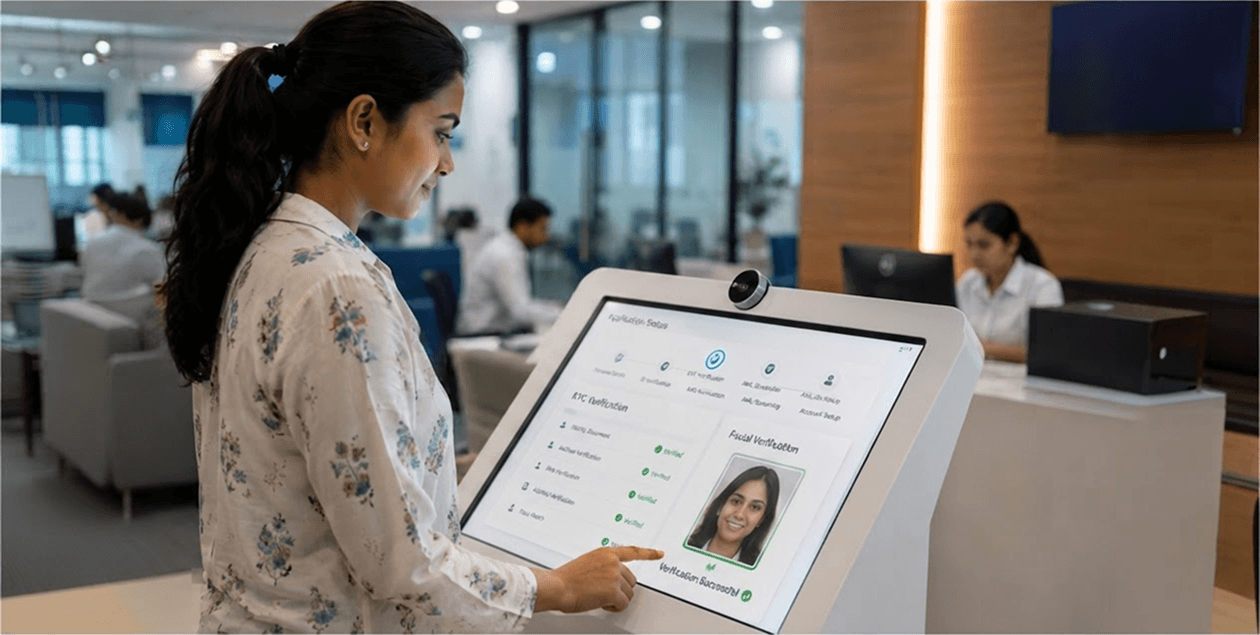
Know Your Business (KYB) is an enterprise-grade business verification and compliance platform developed by eSparkBiz that automates business onboarding, beneficial ownership validation, biometric identity verification, and regulatory compliance through a secure, blockchain-backed ecosystem.

Sales Organization reduced Lead Response Time by 65% through an AI-powered CRM built on a Scalable Cloud Architecture
The AI-Powered CRM platform delivers an intelligent CRM experience that streamlines sales operations through centralized administration, actionable analytics, and AI-driven automation.

Banks reduced Customer Onboarding Time by 68% using AI-powered KYC and AML Verification Workflows
An intelligent identity verification and AML compliance platform developed by eSparkBiz automates customer onboarding through biometric authentication, document verification, AML screening, and blockchain-based audit trails.
Facing a similar problem?
Tell us the decision you're trying to improve and what data you hold. We'll tell you whether ML is the right tool, and which model class fits.
CLIENT TESTIMONIALS
Rated 4.9 across 70 reviews, verified on clutch
We focus on making clients happy and always appreciate their opinions. We aim to provide superior services to earn trust and to become a go-to choice in the Software industry.


Nathan Veal
Imagine AI
Video

Athanassios Piliounis
RADEFY

Travis Zornoza
The ASL Shop
Video




eSparkBiz delivered exactly what we were looking for—a robust Guest Experience Platform built on time, within budget, and with exceptional attention to quality. Their skilled team, responsive communication, and proactive project management made even a complex development process straightforward. They proved to be a trusted partner from start to finish.


Award
Top Enterprise Software Developers

Award
Top Artificial Intelligence Company

Ranking
Top Software Developers India

Award
Top Staff Augmentation Company

Ranking
Top Software Developers - Logistics

Award
Clutch Best 1000 Service Provider

Ranking
Top Software Developers 2025
WHY PARTNER
Why work with eSparkBiz
With 400+ vetted professionals and 1,000+ projects delivered, we bring proven engineering expertise, enterprise-grade governance, and scalable AI capabilities to complex technology initiatives.
PLATFORM CAPABILITY
1,000+ Projects Delivered
400+ Vetted Professionals
AWS Certified Solutions Practice
Multi-Cloud: AWS, Azure, GCP
AI, Cloud & Blockchain Expertise
10+ Time Zones Served
GOVERNANCE & SECURITY
ISO 27001:2022 - Information Security
ISO 9001:2015 - Quality Management
SOC 2 - Audited Controls
CMMI Level 3 - Appraised Processes
100% NDA-Protected Engagements
Enterprise Security & Compliance
COMPANY & CREDENTIALS
Established 2010 - India
D-U-N-S: 650816981
CIN: U72900GJ2013PTC073284
HubSpot Solutions Partner
AWS Advanced Tier Partner
US Entity Registered - Delaware
Certification & audit documentation available upon request under NDA.
PROVING IT WORKS · AGREED BEFORE WE BUILD
What gets signed off before development starts
“High accuracy” is an example of a standard that can’t realistically be evaluated and signed off prior to development. Defining and agreeing upon these kinds of standards helps resolve the issue of “is it good enough” before development rather than risk sign-off at the end of the project after the model has been built.

What you achieve today
It can be a spreadsheet, rule of thumb, or instinct. A baseline is something we create to compare new models against. Setting a baseline is not about setting a goal to simply do something; it is about continuously improving something beyond doing nothing.

Usually not accuracy
Precision in recall is crucial for detecting fraud. The same can be said for predicting. For predicting, it’s important to understand the types of errors that occur. This helps one ascertain which of the trade-offs decided earlier is more acceptable.

The number that means deploy
Before any work is done, this gets written down. If it's skipped, a question will become an argument during the last step, and it will no longer be possible to make changes.

Data the model never sees
Time-based splits are used instead of random splits. Random splits may seem to work in testing; however, they do not work in the real world, especially if data is time-dependent.

Where it's wrong, not just how often
Consider the analysis of trust failures to be divided into three categories: segment, product, and time. Breaking down analysis in this way allows us to find trust failure locations beyond just the total number of trust failure incidents.

How you learn you were right
Usually the toughest part. Finding out whether last quarter's churn predictions actually held up can take ninety days to know for sure and without that feedback, you're not really monitoring anything at all.
The Question Nobody Asks
Every model gets it wrong in different ways. They rarely cost the same.
A model can be wrong two ways: saying yes when the answer should have been no, or no when it should have been yes. Those mistakes rarely cost the same. Someone decides how much of each you're willing to accept, and it should be you, not a default setting.
01

Fraud detection
Which is worse? It depends on your margins and how acceptable blocked orders are to your customers. A business with high margins may be able to take in more blocked orders. A business with low margins may not be able to learn and understand any blocked orders. Your costs and your customer value should help you determine your fraud limits.
Wrongly Says Fraud
A real customer gets declined at checkout. They’ve got to call, and then often times they don’t come back.
Costs you a customer
Wrongly Says Fine
A charge is unfairly passed on to you. You take the loss, deal with the chargeback, and go through the investigation.
Costs you the money
02
Predictive maintenance
Which is worse? Usually, the second one is worse. Hence, you have to tolerate a few false alerts. However, you cannot tolerate too many false alerts. Beyond a certain level, your team stops taking those alerts seriously. Eventually, such a system becomes completely ineffective.
Wrongly Predicts Failure
Engineers are required to regularly inspect the machines to detect any defects. However, if an engineer drives out and clears the machine alert, the team will start to question the alert.
Costs a wasted visit
Wrongly flags a problem
The machine breaks down and causes unexpected equipment failure, possible damage to the machine, and a safety incident.
Costs a production stop
03
Medical or safety screening
Which is worse? The second. In this case, “high accuracy” should not be the goal. A screening model for a rare condition may achieve a 99.9% accuracy level by always indicating that there is no condition present. Thus, in this case, the model may be essentially useless.
Wrongly flags a problem
Generate more tests and expense by falsely identifying an issue. Straightforward to resolve the issue once located.
Costs time and anxiety
Wrongly Says All Clear
A real problem gets missed and nobody checks again because the system already said everything was fine.
Costs the thing you built it for
04
Hiring, lending, and other decisions about people
Which is worse? The real issue here isn't cost, it's visibility, and that's what makes it dangerous. Only one of these mistakes ever reaches a dashboard, so models quietly drift toward rejecting too many people, without anyone deciding that on purpose. This is also why checking for fairness across protected groups isn't optional here.
Wrongly Rejects
Someone who deserves the benefit is rejected and has no way of finding out the reason for the decision. You also don’t find out you made the wrong decision.
Invisible to you, costly to them
Wrongly Accepts
Someone who shouldn’t receive the benefit is given the benefit and is later identified through an investigation.
Visible and measured
TECH STACK
The right stack for your project
A simple model that runs well and has ongoing support is better than a complex model that your team can not manage. We select the best technology appropriate to your data, cloud environment, and your team's ability.

Languages & Core Libraries
Python
R
SQL
NumPy
Pandas
scikit-learn
XGBoost
LightGBM
LightGBM
statsmodels

Deep Learning & Language
PyTorch
TensorFlow
Keras
Hugging Face Transformers
spaCy
NLTK
BERT / RoBERTa
LangChain
LlamaIndex

Computer Vision
OpenCV
Ultralytics YOLO
torchvision
Detectron2
KerasCV
Tesseract OCR
Label Studio
CVAT

Forecasting & Time Series
Prophet
ARIMA / SARIMA
LSTM
Darts
GluonTS
Temporal Fusion Transformer

MLOps, Tracking & Monitoring
MLflow
Weights & Biases
Kubeflow
DVC
Feast
Evidently
Great Expectations
Grafana

Cloud, Serving & Deployment
AWS SageMaker
Google Vertex AI
Azure ML
Databricks
Docker
Kubernetes
FastAPI
Triton
ONNX
AI governance, fairness and The EU AI act
There are different regulatory frameworks for various kinds of AI systems. For example, different rules apply to AI systems that take decisions affecting people from those that help predict and optimize inventory levels. It’s important for a business to understand these frameworks to choose the right AI model.
- EU AI Act Risk class before design
- ISO/IEC 42001 AI management systems
- Adverse Action Reasoning Why this decision
- Fairness Testing Across protected groups
- Model Cards What it does and doesn't do
- Prediction Audit Trail Reconstructable later
- Human Review Path Defined, not implied
- GDPR · DPDP · HIPAA Where applicable
- Data Lineage What it was trained on
- SOC 2 · ISO 27001 Audited controls
We'll Tell you When the Simpler Tool Wins
We maintain cloud partnerships while recommending open-source options when they better fit your budget and team skills. Unused managed services only add unnecessary costs.
HOW WE WORK
A process with a built-In stopping point
Six stages take the work from checking your data to running the model in production. Each stage has a clear purpose and a point to review the results. If the numbers do not support moving forward, you can stop there.

Readiness check before you build
In this step, we evaluate your data for quantity, quality, and preparedness for machine learning. We assess if another approach, for instance, a rule engine, could address the business need in a better way, before initiating any development or model building work.

Cost both errors, set the baseline
The cost of a mistake is judged against its potential loss to the business. This helps us set a baseline. Using this baseline, we can set more achievable goals and consider the correct priorities for further development.

Proof of concept, with a real stop
We propose a time-boxed proof of concept to see if the objective is attainable using your data. If we can’t meet the objective per the data, we stop and state why the objective can’t be met. Otherwise, we proceed with product development.

Build with failure analysis
Feature engineering, training and tuning happen here, with each round checked for errors. Our focus stays on where mistakes occur, not just the overall score. We share progress reports that explain what changed, what failed and why.

Integrate where the decision happens
The real value of a prediction is when it gets linked to the system or the process where the decision gets made. In doing so, we allow our team to integrate results as they happen and avoid situations where predictions get locked up in a notebook.

Monitor, retrain, or hand over
After the model is launched, we capture the difference with respect to the baseline. Retraining of the model is done once the drift is significant. For smoother handovers, we have developed a set of training and runbooks to help your team.
Your Model Is Getting Worse. You Just Can't See It.
Models use old data to predict future outcomes. They can appear accurate even when their performance starts getting worse. To spot changes in data, we need to understand what the model learned from. We validate models against real-world results to check performance and make sure they deliver the expected output from day one.
Industries
Proven expertise across diverse industries
We deliver tailored technology solutions across diverse business domains, addressing complex operational challenges with practical, scalable approaches that improve efficiency, strengthen capabilities, and drive measurable, sustainable business growth.


ENGAGEMENT MODELS
Three ways to work with us
Which option is best suited to you depends on how clearly defined the problem is, and if you are interested in developing the organization’s capability at the same time. We will be frank when we think your requirements are not clear enough to offer a fixed price quote.
Want to validate before committing?

This involves a time-limited build to test if your data meets the design criteria. If evidence shows that the design criteria cannot be met, then it suggests that further investment in the project should be stopped.
What You Get
- Fixed timebox
- Your real data
- Clear go call
- Stop if needed
- No sunk cost
Do you want us to take ownership of delivery?

Full project delivery
We take care of the entire data project from engineering to deployment. This includes modeling and integration as well. This is ideal for you if you need complete solutions rather than partial support.
What You Get
- Full ownership
- Weekly updates
- Eval reporting
- Production ready
- Handover included
Know your costs and want price certainty?

Build and transfer
In this case, we build the first production system with your team helping us. On completion, we give you runbooks and training to manage the system. This option helps your team build the skills to manage it.
What You Get
- Embedded engineers
- Written runbooks
- Team trained
- Free handover
- Real capability
Resources
Insights from our engineering leaders
Our engineers write these insights. They work on real client models and document their experiences with production challenges, not rely on vendor documentation or "best practices" that someone, somewhere, wrote by vague description.

Agentic AI in GCCs: How Autonomous Agents are Changing the Way Teams Work

 October 27, 2026
Agentic AI in Software Development: How It Works, Use Cases & Strategy
October 27, 2026 
RELATED SERVICES
Related services for machine learning
We offer complementary engineering services that extend your machine learning initiatives, from data readiness to deployment, so every model delivers measurable business value.

Artificial Intelligence
Align AI Initiatives with Measurable Business Outcomes

Generative AI Development
Build Intelligent Systems Powered by Generative AI

AI Chatbot Development
Build Intelligent Chatbots driving Real Business Conversations

Computer Vision
Drive Operational Efficiency with Computer Vision Innovation

Agentic AI Team
Accelerate Automation with Specialized Agentic AI Team

Data Science
Transform Data into Actionable Intelligence for Rapid Growth
FAQS
Frequently asked questions
These are some of the most common questions businesses ask before starting a machine learning project. Here are clear answers to help you understand what to expect.
How much data do we need to train a model?
This answer depends on the class of the model and the problem at hand. For classical ML, thousands of labeled examples may be sufficient, but for deep learning, tens of thousands may be required. This gets assessed during the readiness check.
How will we know the model actually works?
We agree on an acceptance threshold and a real baseline before any work is done. This means that we set a bar for model success upfront and agree to it instead of debating it later on. If the model does not clear this threshold, we speak the truth and say it does not work.
What drives the size and cost of an ML project?
There are four things that primarily affect the cost of an ML project.
- Labelled data availability
- Explainability requirements
- Integration complexity
- Ground truth latency
How long does an ML project take?
Timelines vary significantly depending on the model class and problem complexity involved here.
| Solution Type | Typical Timeline |
| Forecasting and predictive analytics | 10-18 weeks |
| Computer vision | 14-26 weeks |
| NLP and document intelligence | 12-22 weeks |
What happens to the model after launch?
Launch is the beginning, not the end. We set up monitoring, drift detection and a retraining pipeline, because a model that isn’t watched will quietly degrade without anyone noticing.
Should we build an in-house ML team or work with a partner?
It depends on your future plans. If you want ML to be a major part of your business, it’s often better to build the capability with us rather than rely on a vendor forever.
When is machine learning the wrong choice?
When a rule engine solves the problem more cost-effectively, when you have too little labelled data, when a wrong answer is too costly to risk, or when the process itself is broken.
Who owns the model once it's built?
You do. When we build a model for you, the code, docs, and training pipeline are all transferred to you,so you’re never locked into an ongoing dependency you didn’t choose.
Show more
Reviewed by
Senior Software Engineer, eSparkBiz · AI engineering and delivery governance