
Data Readiness Audit
Maturity, governance, architecture

- Evaluation and guardrails demonstrate model performance.
- ISO 27001:2022 and ISO/IEC 42001:2023 have been incorporated.
- The same team that starts on day one stays with us through year three.
- A no-obligation AI readiness audit is available for you to schedule at any time.
30 Minutes · No Commitment · Reply within 24 hours
Verification summary · all current
-
Free ↗
-
Get Clarity ↗AI Strategy & AdvisoryGet Clarity Before You Commit Resources
-
See Full Lifecycle ↗Full LifecycleStart to finish, fully covered
-
Detail ↗Evaluation MethodologyHow we'll know it works
-
Verify ↗ISO 27001:2022 · ISO/IEC 42001:2023Audited, independently verifiable
Challenges we solve with AI
Where Enterprise AI Actually Stalls
These are the common problems clients present to us along with what are typically the actual driving causes. They will often appear to be technology related problems, but hardly ever are. Below each issue described, you will find our approach and how we resolve it.

Going from Proof of Concept to Production
Many AI projects get stuck after a demo. We build the infrastructure, data pipelines, and enable monitoring so we can deploy the system at scale.

Incomplete or Poor Quality Data
No amount of AI can fix poor quality data. Our data engineers ensure your data is properly labeled and structured so that models are trained with useful data inputs.

Integration with Current Systems and Processes
A model that can't integrate with your CRM/ERP/data warehouse is of no use. We provide secure APIs and integrate AI with your current systems to maximize work process.

Uncertainty Around ROI for AI Initiatives
We ensure your AI spending is focused on the business challenges that move the needle, and work is halted if a proof of concept is not warranted.

Accuracy and Reliability
Models can and do diverge from the training data, and outputs can be flat-out wrong. We build in evaluation metrics, guardrails, and monitoring systems to ensure that you can assess your AI's performance and make adjustments if needed.

Compliance and Responsible AI
The EU AI Act and the NIST AI RMF are one of the best frameworks we have for ensuring compliance. We build these into our products from day one, so that our clients can rest assured that their solutions will hold up to regulatory scrutiny.
Most Enterprise AI projects often fail because of data readiness and integration challenges rather than model choice.
Stop Guessing Whether Your Infrastructure Can Handle AI
Get an audit of your data maturity, governance and architecture before you invest a single dollar in development. We'll tell you what's ready, what isn't, and what it would cost to close the gap. If the honest answer is "not yet", you'll hear that too.
No Cost
Delivered in Two Weeks
Yours to Keep, No Obligation
Custom AI engineering
Choose the Capability, Not the Whole Stack
Each group covers a specific set of skills from data engineering to model deployment and everything in between. Take a look inside any group to see what problems they solve. You will need to request a call to gain this information.
01

AI Strategy & Advisory
3–6 weeksAI project budgets are usually spent before success is defined, let alone measured. We first construct a business case, and then a roadmap that can survive the procurement process. This ensures that every dollar spent serves a specific purpose and is followed by a clear path to a result.
- Assess AI readiness and maturity
- Establish responsible AI frameworks (ethics, bias, governance)
- Design AI operating models and CoEs
- Perform AI cost-benefit analysis and build business cases
- Consult on model risk and compliance
- Evaluate AI technologies and select unbiased platforms
Deliverable: Prioritized AI roadmap and business case
Includes: Readiness assessment and PoC scope
Scope it ↓
02

AI as a Service (AIaaS)
6–14 weeksIt is faster to buy AI capability than build it, but only if any ownership of the integration and the maintenance of the IT systems and the costs post-implementation is assumed. We assume that ownership.
- Integrations for native LLMs (GPT, Llama, Claude, Gemini)
- Vision as a service: OCR, quality inspection, object detection
- IVR, speech-to-text, and voicebots
- Custom AI APIs
- Predictive analytics APIs for fraud and churn
- Document intelligence APIs for extraction and classification
Deliverable: Production-ready AI APIs with SLA
Running cost: Transparent inference and infrastructure costs
Scope it ↓
03

AI Platform Engineering
10–20 weeksAll too often, the infrastructure under AI initiatives is left unbuilt, and that is where we come in. We build that layer with orchestration, vector stores and scalable compute infrastructure that your team can extend after we have left.
- LLM application frameworks & integration (LangChain, LlamaIndex)
- Multi-model orchestration platforms
- API gateways, middleware & service integration
- Vector database integrations (Pinecone, Weaviate, FAISS)
- GPU infrastructure & compute optimization
- Infrastructure for prompt and context management
Deliverable: Extensible AI platform architecture
Handover: Runbooks and team training included
Scope it ↓
04

Generative AI & LLM Engineering
8–18 weeksIn the real world, prompts that are not specific to your situation quickly break down when encountered with the messy input of real users. Between your team and live hallucinations are a fine-tuned model, a RAG pipeline, and cautionary controls that are specific to your situation and Pareto's 80/20 law.
- Custom LLM fine-tuning and training
- RAG systems
- GenAI assistants for legal, marketing, coding, and HR
- Enterprise AI copilots
- Autonomous AI agents and workflows with enterprise guardrails
- Conversational assistants based on ChatGPT
Deliverable: Production-ready GenAI solution
Includes: Evaluation, guardrails, and escalation workflows
Scope it ↓
05

AI for UX and Product Intelligence
6–12 weeksWe only create personalization features if there is sufficient behavioral data to justify the personalization, as that is the only situation in which personalization is profitable. We create core features that are personally relevant to the user, and measure our impact in terms of concrete increases in conversion as opposed to simply checking a feature off the list.
- AI-driven UX personalization
- Business core planning
- Behavioral insights and prediction of heat maps
- Adaptive UI based on sentiment
- A/B testing with ML
- Conversion funnel analysis and prediction of drop off
Deliverable: UX intelligence and conversion optimization roadmap
Required: Behavioral and product usage data
Scope it ↓
06

Machine Learning
8–16 weeksWe almost never find off-the-shelf models that solve our clients’ business problems, so we build and train custom ML models from scratch. Before we deploy any models, we compare them to the simplest approach, benchmarking them to ensure we have the highest business impact. More complex models will be deployed to our clients’ live production environments only later.
- Recommendation Systems
- Natural Language Processing and Understanding
- Computer Vision Models: Classification and Segmentation
- Time-Series Forecasting Models
- Deep Learning and OCR Pipelines
Deliverable: Production ML model and pipeline
Baseline: Benchmark against simpler approaches
Scope it ↓
07

Data Science & Analytics
8–16 weeksThe pipelines that we build determine the level of trust that we can have in the forecasts that we generate. We first build the analytics foundation, and then build models that your team will be able to maintain on their own. We will not need to work with your team in order for them to maintain the models.
- Predictive and Prescriptive Analytics
- Forecasting Models: Demand, Revenue, Churn
- Exploratory Data Analysis and Interactive Visualizations
- Customer Segmentation and LTV Modelling
- Big Data Processing and Analytics Pipelines
- Statistical Modeling and Hypothesis Testing
Deliverable: Maintainable analytics pipelines and models
Foundation: Reliable data engineering foundation
Scope it ↓
08

AI-enabled Automation
6–14 weeksAutomation increases the speed of a process, even if that process is broken and causes you to lose money. We always audit a workflow before we automate anything. We will only automate a process if that is determined to be worthwhile.
- AI-powered RPA: document intelligence plus workflow
- Robotic process discovery with machine learning
- Smart bots for procurement, HR and finance
- Automated testing with AI test generators
- Anomaly detection in DevOps & infrastructure logs
- Intelligent document processing for contracts and invoices
Deliverable: Measured automation impact and savings
Caution: Automate optimized processes, not broken ones
Scope it ↓
09

AI DevOps & MLOps
continuousA model that is perfectly positioned at launch can start failing silently within a few months, typically long before anyone actually notices a drop in performance. We keep our models' accuracy from drifting with real-world data with versioning, drift detection, and continuous monitoring.
- Model lifecycle management (MLflow, Kubeflow)
- Continuous training / CI-CD for AI pipelines
- AIOps for incident prediction & infrastructure optimisation
- AI model versioning, drift detection & monitoring
- Feature store implementation & management (Feast, Tecton)
- AI code remediation: turning generated code into production software
Deliverable: Continuous model performance and monitoring
Why it matters: Prevents silent performance degradation
Scope it ↓
The lifecycle
Engage Wherever Your Project Actually Needs Us
Most firms only provide you with the middle three steps and leave the remaining steps for you to figure out. However, we know that the first step and last step of a project tend to dictate whether a project is successful or not. That is why we provide solutions for both of those steps.

Data Preparation and Cleaning
Inconsistencies are removed, missing values are handled, and your data is reshaped into the structured and consistent format that our models require before training.

Algorithm Development
While we have preferred frameworks, we will always be able to adapt to new situations. Your data and your specific business needs will always be utilized to create a tailored solution.

Solution Architecture and Design
When there are not sufficient off-the-shelf solutions, we architect a solution for you, bridging the gap with your data and workflow, in conjunction with your team.

Model Training and Optimization
We will push the edge of your model by stress testing it against your specific use case and providing it with realistic data. We will go beyond hyperparameter tuning for model validation.

Deployment Infrastructure
This is where the majority of AI projects get stuck. Our experience in delivering AI solutions sets us apart. Here, we build the infrastructure for deploying the model and related pipelines.

Integration with Existing Systems
Using the models we build, we integrate your systems in a way that requires minimal disruption to your workflow, allowing your team to use the integrated system on a daily basis.

Monitoring and Maintenance
Following the launch of the system, we continue to train the models to ensure accuracy, adapting to the changing needs of your business.
Real Enterprise Impact
Engineering Work that Delivers Real Business Outcomes
We partner with enterprises to solve complex engineering challenges combining scalable architecture, AI-driven automation, and secure delivery practices to build products that hold up under real-world demand.
Enterprise reduced Internal Communication Delays by 60% with a Unified Workforce Communication Platform
An internal email platform that lets you communicate with your team members without using external services. Here we can create, send, and track emails easily, and get feedback and insights on your email performance. It helps you to improve your communication skills, productivity, and collaboration.

Learning Platform increased Student Engagement by 3x through an AI-enabled Collaborative Education Ecosystem
Ethos Village is an educational web-based platform with various courses and activities to enrich users' lives and aid in the discovery of goals and purposes. On a single platform, different user roles like alumni, parents, coaches, teachers, and mentors are present.

Fitness Platform achieved 70% Member Retention through Personalized Health Tracking and Coaching Automation
The app is designed to help users maintain a healthy lifestyle by providing easy access to fitness information and tools on-the-go. A fitness app aims to empower users to take control of their health and fitness by providing tools, resources, and guidance to lead a more active and balanced lifestyle.

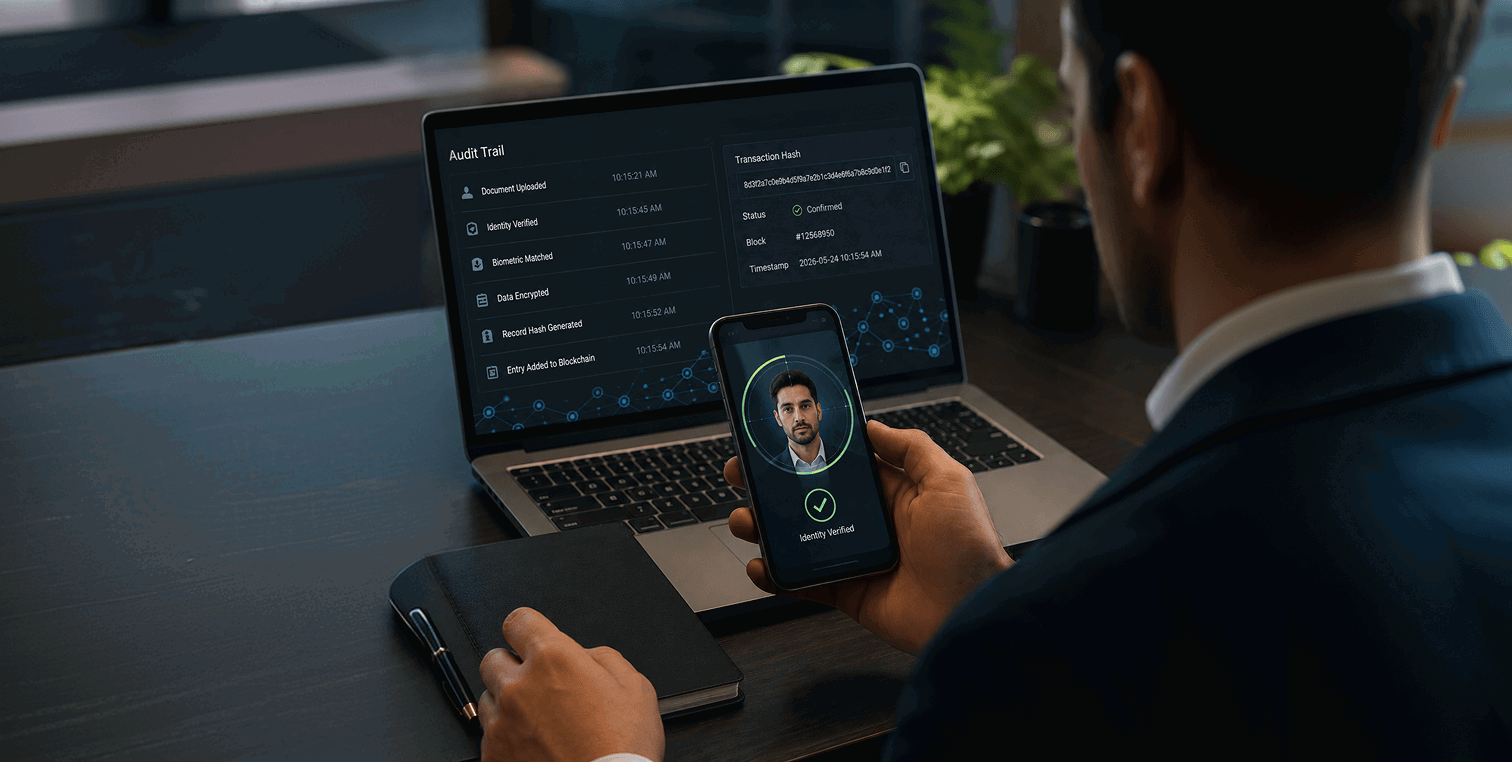
Enterprise eliminated 100% Identity Fraud Risks through Biometric Verification and Immutable Digital Audit Trails
A blockchain-backed digital agreement platform developed by eSparkBiz that combines biometric identity verification, smart contract automation, and compliance-driven contract execution into a single secure ecosystem. By validating signer identity, organizational authority, and contract conditions before execution, Pactvera delivers legally enforceable, tamper-proof agreements with comprehensive audit trails and cryptographic proof of authenticity.
Facing a Similar Problem?
Tell us where your teams lose time today. We'll show you how we approached it on projects like this one.
Client Testimonials
Rated 4.9 across 69 Reviews Verified on Clutch
We focus on making clients happy and always appreciate their opinions. We aim to provide superior services to earn trust and to become a go-to choice in the Software industry.






Onboarding speed
"
eSparkBiz delivered exactly what we were looking for—a robust Guest Experience Platform built on time, within budget, and with exceptional attention to quality. Their skilled team, responsive communication, and proactive project management made even a complex development process straightforward. They proved to be a trusted partner from start to finish.
Clutch


Athanassios Piliounis
RADEFY
"
eSparkBiz has been an outstanding technology partner. Their AI engineering expertise has helped us accelerate product development and tackle complex integration challenges while consistently meeting our high technical standards. The team is responsive, reliable, and excels at matching the right talent to our unique needs. We highly recommend eSparkBiz to any organization looking for skilled, dependable engineering support.
Clutch

Kristen Marcoe
Credo AI

Award
Top Enterprise Software Developers
Award
Top Artificial Intelligence Company

Ranking
Top Software Developers India
Award
Top Staff Augmentation Company
Ranking
Top Software Developers - Logistics

Award
Clutch Best 1000 Service Provider
Ranking
Top Software Developers 2025
Why Partner
Why Work with eSparkBiz
With 400+ vetted professionals and 1,000+ projects delivered, we bring proven engineering expertise, enterprise-grade governance, and scalable AI capabilities to complex technology initiatives.
LATFORM CAPABILITY
1,000+ Projects Delivered
400+ Vetted Professionals
AWS Certified Solutions Practice
Multi-Cloud: AWS, Azure, GCP
AI, Cloud & Blockchain Expertise
10+ Time Zones Served
GOVERNANCE & SECURITY
ISO 27001:2022 - Information Security
ISO 9001:2015 - Quality Management
SOC 2 - Audited Controls
CMMI Level 3 - Appraised Processes
100% NDA-Protected Engagements
Enterprise Security & Compliance
COMPANY & CREDENTIALS
Established 2010 - India
D-U-N-S: 650816981
CIN: U72900GJ2013PTC073284
HubSpot Solutions Partner
US Entity Registered - Delaware
Certification & audit documentation available upon request under NDA.
Industry-specific AI
Proven Expertise across Diverse Industries
We deliver tailored technology solutions across diverse business domains, addressing complex operational challenges with practical, scalable approaches that improve efficiency, strengthen capabilities, and drive measurable, sustainable business growth.

Healthcare

Finance

EdTech

Real Estate

Logistics

Food & Beverages

AgriTech

Sports
Before you commit a budget
The Advisory Work That Comes First
If you haven't assigned a budget yet, this work will keep you from wasting your money on the wrong thing. It will give you the certainty to invest money where it will be used to create a solution that will actually succeed.

AI Strategy and Roadmapping
We help you identify real opportunities, not assumptions, in your data, and provide you with specific goals with a detailed roadmap to help you achieve them.

Technology Evaluation and Selection
We will evaluate options with your goals, budget, and timeline in mind, and provide you with options that are truly unbiased and not tied to a specific vendor, to help you make an informed decision as your company grows.

Feasibility Studies and Proof of Concept
We will test the idea you have to see if it is something that is actually possible, and then we will conduct a proof of concept to validate the idea in a small, controlled environment to see what the potential risks may be, before making a larger investment.

Regulatory Compliance and Ethical AI
We will map the relevant regulations, and ensure our practices are responsible, so that we can help you build AI that will hold up to ethical scrutiny. We will identify risks and provide you with recommendations as you grow your company.
Models and stack
No Default Stack, Just the Right Tool
We work across a broad set of proven technologies, but the stack listed here isn't fixed. Every project starts with your existing systems, requirements, and constraints, allowing us to select the right tools based on what genuinely fits your long-term business objectives.

Generative AI Models
GPT
Claude
Llama
Google Gemini
Mistral
Phi
DALL·E
Whisper
Stable Diffusion

Deep Learning Frameworks and Libraries
PyTorch
TensorFlow
Caffe2
NVIDIA CUDA
Chainer
mxnet
OpenNN
Sonnet
Tensor2Tensor

Orchestration, Vector Stores and Toolkits
LangChain
LlamaIndex
AWS Bedrock
Pinecone
Weaviate
FAISS
Core ML
MLflow
Kubeflow
Feast

Embedding and Classification Models
OpenAI Embeddings
bge-large
bge-base
e5-large
textembedding-gecko
VGG16
ResNet50
InceptionV3
EfficientNet

Algorithms and Architectures
Supervised / Unsupervised Learning
Metric Learning
Clustering
Few-shot Learning
CNN / RNN
Transformers
Variational Autoencoders
Bayesian Networks
Representation Learning

Engineering Stack
Python
FastAPI
Flask
Django
Node.js
Rust
TypeScript
Next.js
Docker
Amazon ECS
SageMaker

Cloud and Partnerships
AWS
Microsoft Azure
Google Cloud
NVIDIA
Databricks
Salesforce
Not sure which AI tools fit your needs?
Tell us what you're building. We'll suggest the right AI tools based on your cost, speed, and accuracy needs, and explain the pros and cons.How it runs
Built to Move from Idea to Production
Each engagement consists of clearly outlined steps paired with an evaluation methodology that can be observed. There are outcomes that are delivered at every step. This means you get much more than just a report. You also have the flexibility to stop the engagement at any point, before significant funds are spent, with full transparency on the progress and decisions about the expenditures.

Discovery and Analysis
Precise business goals get identified first, along with where AI can genuinely help, so our solution matches the actual objective rather than whatever technology happens to be available.

Strategy and Planning
An AI strategy gets built around your current operations, data, infrastructure and success metrics, giving you a clear roadmap. This is the stage where we'll say if it isn't worth doing.

Design and Development
Architecture gets designed, then built, integrated and optimized with our team, so the system is scalable, secure and ready for real use rather than just a demo.

Training and Testing
Models get trained and tested against real conditions, with evaluation and guardrails built in from our side, so results are accurate and dependable under load.

Launch and Support
While continuously monitoring your data, we work to train and improve our systems to minimize disruption to your business.
Our philosophy
The Pillars Behind Every Engagement
Clients pick an engineering firm over a consultancy for one main reason. That is, working systems surpass paper recommendations. Clients remain loyal due to our proven track record of delivering solutions, rather than losing interest during the planning stages of the projects that we execute.

Business-First Strategy
We begin with your business goals and then integrate the appropriate technology. Your AI initiatives will deliver results in the form of improved customer experience, operational efficiency, or new revenue streams.
Beyond Advice
- Purpose leads the roadmap
- Impact over passing trends
- Results are metric-driven
- Vision directs each rollout

Pragmatic and Scalable Implementation
We take a different approach with MLOps. When building systems, we make sure they are functional and scalable, but also very easy for your team to use and maintain, even after we end our agreement with you.
Build Highlights
- Built for reliable operation
- Scales with your business
- Easy to use for your team
- Well-maintained after deployment

Responsible AI and Governance
Trust is the key to enterprise adoption. On the first day of our collaboration, we design and build together security, ethics, and compliance, and manage bias and regulations through reviewed frameworks.
Governance Essentials
- Built-in protection from Day One
- Transparent decisions
- Always monitored fairness
- Meets the most recent standards
Engagement models
Pick the Model That Fits the Work
Every project has different needs. Choose the engagement model that best fits your goals, timeline, and budget with the flexibility to scale, delegate delivery, or maintain control.
Need skilled engineers without hiring delays?

Staff Augmentation
Add skilled engineers to your team without the time and cost of hiring. You maintain control while we provide the expertise you need.
Inside the Engagement
- Senior Engineers
- Fast Onboarding
- Flexible Scaling
- Direct Collaboration
- Monthly Engagement
- Replacement Support
Do you want us to take ownership of delivery?

Dedicated Delivery Team
Get a dedicated team to manage delivery while you define the roadmap and priorities. Ideal for evolving requirements.
Inside the Engagement
- End-to-end Ownership
- Agile Execution
- Weekly Progress Reports
- Defined Escalation Paths
- Scalable Team Size
- Full-stack Coverage
Know your costs and want price certainty?

Fixed Price
Define the scope, timeline, and budget upfront. Best suited for well-defined projects with clear requirements and measurable deliverables.
Inside the Engagement
- Fixed Scope
- Milestone-based Delivery
- Predictable Timelines
- Clear Governance
- Structured Handover
- Defined Acceptance Criteria
Resources
Insights from Our Engineering Leaders
Our team has relevant information about the technology, design, and engineering solutions for enterprise software. We speak from experience working with real-life clients. These insights give practical examples of solutions that work across systems built on a massive scale, rather than stay at the theoretical level.
Agentic AI in GCCs: How Autonomous Agents Are Changing the Way Teams Work

 September 08, 2026
Agentic AI in Software Development: How It Works, Use Cases & Strategy
September 09, 2026 
FAQs
Frequently Asked Questions from AI Decision-Makers
Can't find what you're looking for? No problem. Most of the common questions have answers here, but if you have a more complex situation, contact us and we'll explain it to you one-on-one, no forms, and no waiting. We'll give you a quick answer.
What are AI Development Services?
AI development services include the entire process of conceiving, creating, and deploying AI systems, from formulating the strategy to preparing the data,model training, and integration, as well as monitoring the system over time.
Scope: Usually, only a portion of this range is employed in a given case. Some companies may need only data readiness work to decide if they should build at all, while others may need an end-to-end work from the prototyping to production integration and monitoring of the system.
How much does it Cost to Build an AI Solution?
Cost is determined by the scope of the work, the state of the data, and the complexities of integration, and can range from the low five figures for a focused proof of concept to the mid six figures for a production system and the related infrastructure.
Range: A narrow chatbot built on an existing LLM would cost less than a custom model built on a company’s own data and integrated across the company’s systems. For a focused piece of work, an estimate is given, and for an open-ended piece of work, a roadmap is created to ensure cost remains articulated as the work progresses.
How long does it take to Build an AI Product?
A proof of concept can take between 4-8 weeks, and a system that is ready for production can take between 3-6 months, depending on the quality of the data and the integration scope.
Variables: The more that a system needs to be cleaned up, or the more that a system has to integrate with other systems, the longer the timeline will be. The opposite is true for systems that have a narrow, easily accessible scope.
Should We Build an AI Team In-House or Outsource?
If AI is a core component of your product, you should build that capability in-house. If AI is a support component of your product, you should outsource that capability.
Fit: You should build an in-house AI capability if you want to embed AI into your product and maintain that central component of your product for an extended period. You should outsource AI capability if you want to develop a time-boxed product or engage in a project that requires specialized skills that you do not want to retain long-term.
Can AI be Integrated with Our Existing Systems?
Modern AI systems can integrate with CRMs, ERPs, and data warehouses, to name a few. The effort required for the integration would depend on the level of documentation and access provided by the system that you want to integrate with.
Complexity: Integrating with a legacy system would require more work up-front than integrating with a system that is cloud-based and provides good documentation. This would be assessed during a technical feasibility review.
How will We know the AI is actually Working?
We will know the AI is working because we will set a specific goal and build AI to that standard. We will not assume that AI is working after we build it. We will measure it against an evaluation set.
Measurement: A functional system must have measurable accuracy, response times, and business-impact numbers captured from day one with drift- Handling real-world data will require continuous monitoring that flags shifts. Without a mutually agreed-upon evaluation framework, the question “is it working?” will remain subjective and answerless.
When is AI not the Right Answer?
AI will not be the right answer if a rule-based system will just as well solve the problem, if the data is lacking or is unreliable, or if the expected benefit will not cover the cost of development.
Signals: There are a good number of business problems that appear to be AI problems, and usually a feasibility study or proof of concept will be done to determine if a more complex AI system is necessary, or if a less complex system will solve the problem at a lower cost.
What happens if the AI Project doesn't Work Out?
There is a stop-work checkpoint in every engagement. A project that does not produce results will be flagged and stopped, and further work will be halted pending a timeout on the contract.
Checkpoint: There will be a checkpoint early on in the project, typically after a proof of concept or initial phase. If there are no positive results, the project will be stopped and will not be allowed to continue theoretically burning down a scope of work on an active contract.
Show more
Reviewed by
Senior Software Engineer, eSparkBiz · AI engineering and delivery governance