Modernizing outdated applications and systems has become essential for businesses to minimize security exposure, enhance integration capabilities, and reduce operational costs. Legacy systems and technology not only limit business growth, but also restrict digital transformation initiatives.
The present wave of generative AI adoption has changed the modernization equation. AI can help in analyzing code, identifying dependencies, documenting, testing, and analyzing systems. Such skills can make the manual work of understanding how a complicated legacy infrastructure works easier before making architecture changes.
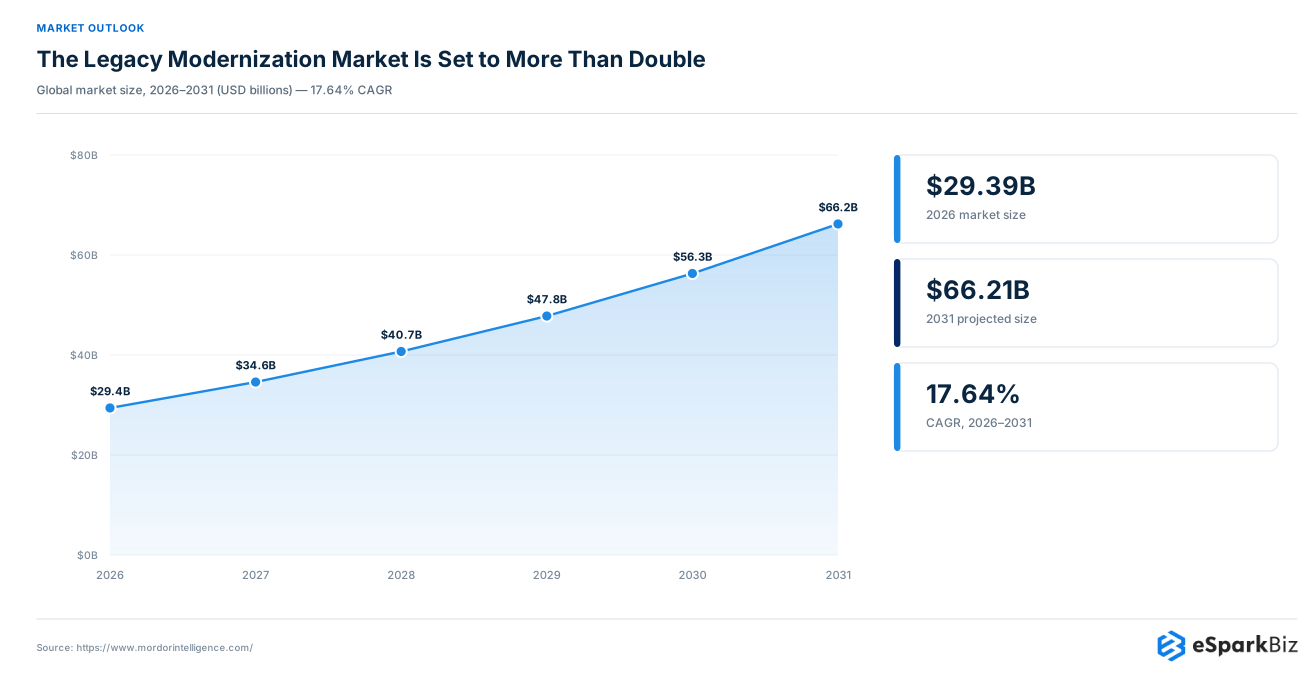
The global legacy modernization market was worth around USD 29.39 billion in 2026, and is expected to be reach around USD 66.21 billion by 2031, growing at a CAGR of 17.64% during the forecast period. This market growth is a result of growing investments for replacing or restructuring outdated enterprise technologies.
Why Legacy Modernization Has Become a Business-Strategy Issue
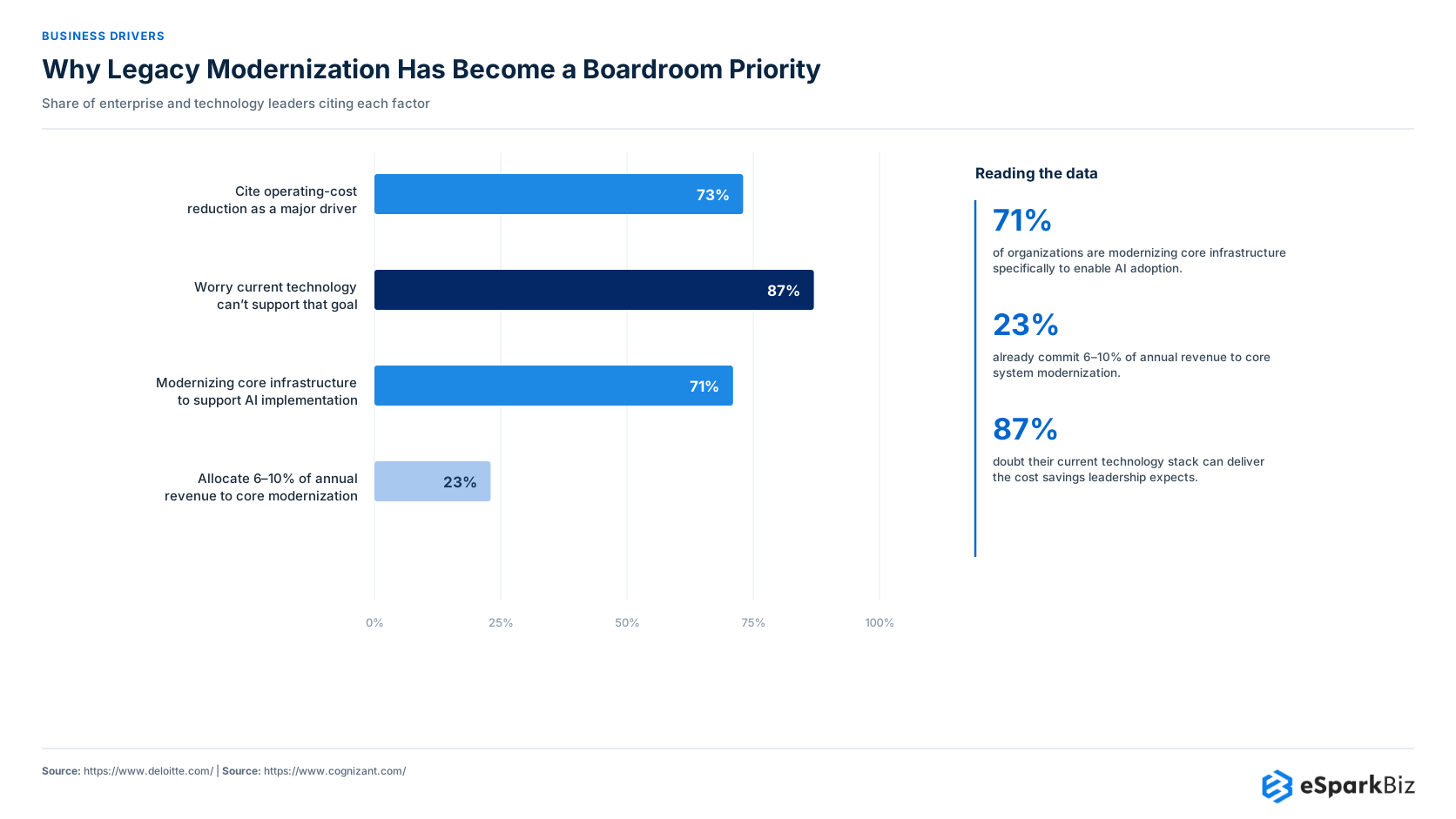
Legacy systems impact enterprise technology priorities. Deloitte’s survey found that 71% of surveyed organizations are modernizing core infrastructure to support AI implementation and 23% are investing 6% to 10% of annual revenue to modernize enterprise systems. These numbers reflect how legacy modernization is gradually becoming an integral part of overall technology strategy.
The Hidden Cost of Technical Debt
Technical debt increases when older systems require specific skills, customization, manual fixes or unsupported components. This may eventually lead to:
- Higher maintenance and infrastructure costs
- Dependence on employees with legacy system knowledge
- More effort to integrate new applications
- Increased risk of security issues associated with old components
- Difficulties in determining the effect of changes to the system
These costs also influence IT budget allocation. Funds allocated for the maintenance of older systems cannot be used for modernization efforts, and delayed upgrades may result in higher costs for future migration and remediation.
Why Legacy Debt Now Blocks AI Adoption
AI projects rely on availability of good data, consistent interfaces, and clear dependencies within the systems. Traditional IT architectures consist of scattered data, outdated integration techniques, inconsistent business rules, and lack of API support. These challenges make it hard to integrate AI software into core business operations.
🤔 Did You Know?
A key driver of modernization for 73% of enterprise leaders is reducing operating costs, but 87% are concerned that their current technology won’t be able to meet that goal.
How Does AI Actually Help Modernize Legacy Systems?
AI automates time consuming and repetitive tasks involved in modernizing legacy systems and software. These tasks include code analysis, identifying dependencies, document extraction, software testing, and refactoring. AI also makes it easy for development teams to understand legacy applications and evaluate the impact of proposed changes to business applications.
- Code discovery: Analyzes legacy code to identify business rules, application components and their relationships.
- Dependency mapping: Maps application, database, API and service dependencies to reveal hidden connections and change impacts.
- Documentation recovery: Converts code structures and observed system behavior into usable technical documentation for planning modernization.
- Code refactoring: Identifies duplicated or difficult to maintain code and suggests changes without impacting the behavior of the existing application.
- Automated testing: Generates regression tests, test setups, and synthetic test data to validate changes before they’re pushed to production.
- Code translation: Helps to translate legacy languages like COBOL to modern languages like Java. Business logic and correctness need to be reviewed by engineers.
These capabilities can also assist in cloud modernization by letting teams understand which existing workloads can be migrated without modification and which workloads need changes to be migrated to the cloud.
AI-Assisted vs. Manual vs. Hybrid Modernization: Which Approach Fits?
The choice between manual, AI-assisted or hybrid modernization should depend on the importance of the system and how much change the organization can safely handle. Speed is important, but more important is preserving application behavior and keeping operational controls.
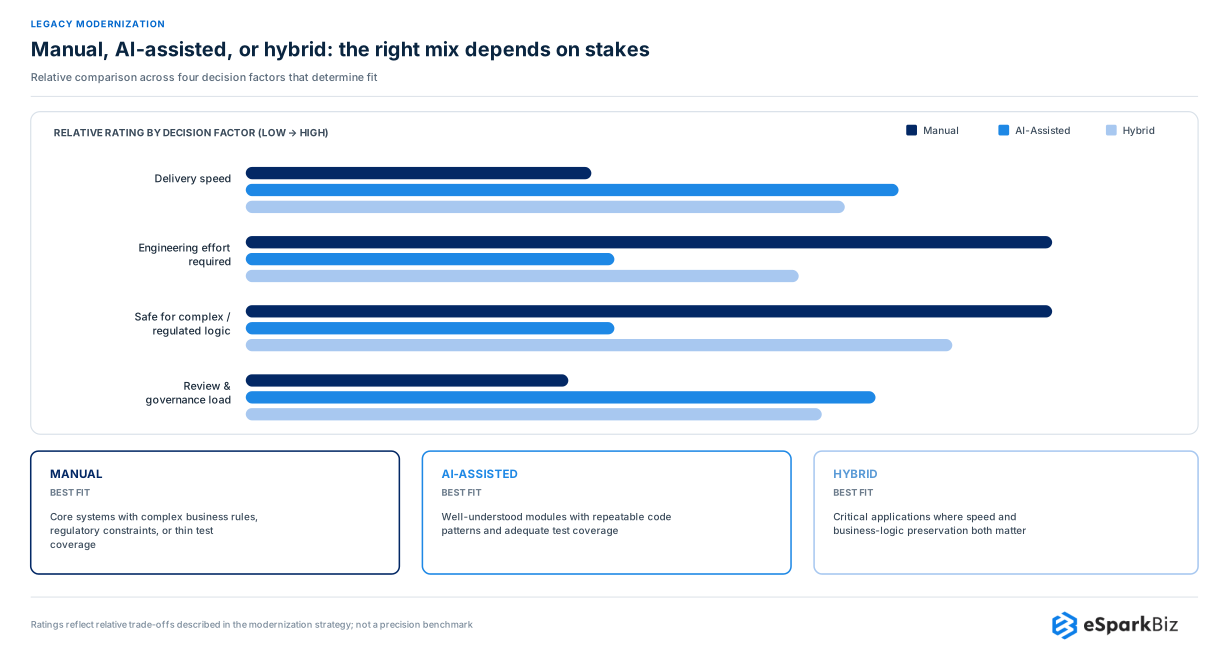
Modernization Approach Selection
The right model depends on the balance between system complexity and the level of human oversight required.
| Approach | Speed | Cost Profile | Primary Risk | Best Fit |
| Manual | Slow | High engineering effort | Specialist knowledge and inconsistent documentation can extend the work | Core systems with complicated business logic, or regulatory issues or limited test coverage |
| AI-assisted | Faster for repetitive tasks | Lower effort for code analysis and transformation | Wrong interpretation of business logic or generated code needs review | Well understood modules with repeatable code patterns and sufficient test coverage |
| Hybrid | Moderate to fast | Balanced across automation and engineering review | Requires clear ownership between automated tasks and human decisions | Critical applications where speed and retention of business logic are important |
Choosing Your Target Architecture: Monolith, Modular Monolith, or Microservices
Modernizing a legacy application does not mean switching from a monolith to microservices. The right architecture depends on domain complexity, team structure, and technical maturity of the company. Transitioning to distributed systems without such prerequisites may complicate deployment, monitoring, security, and failure management.
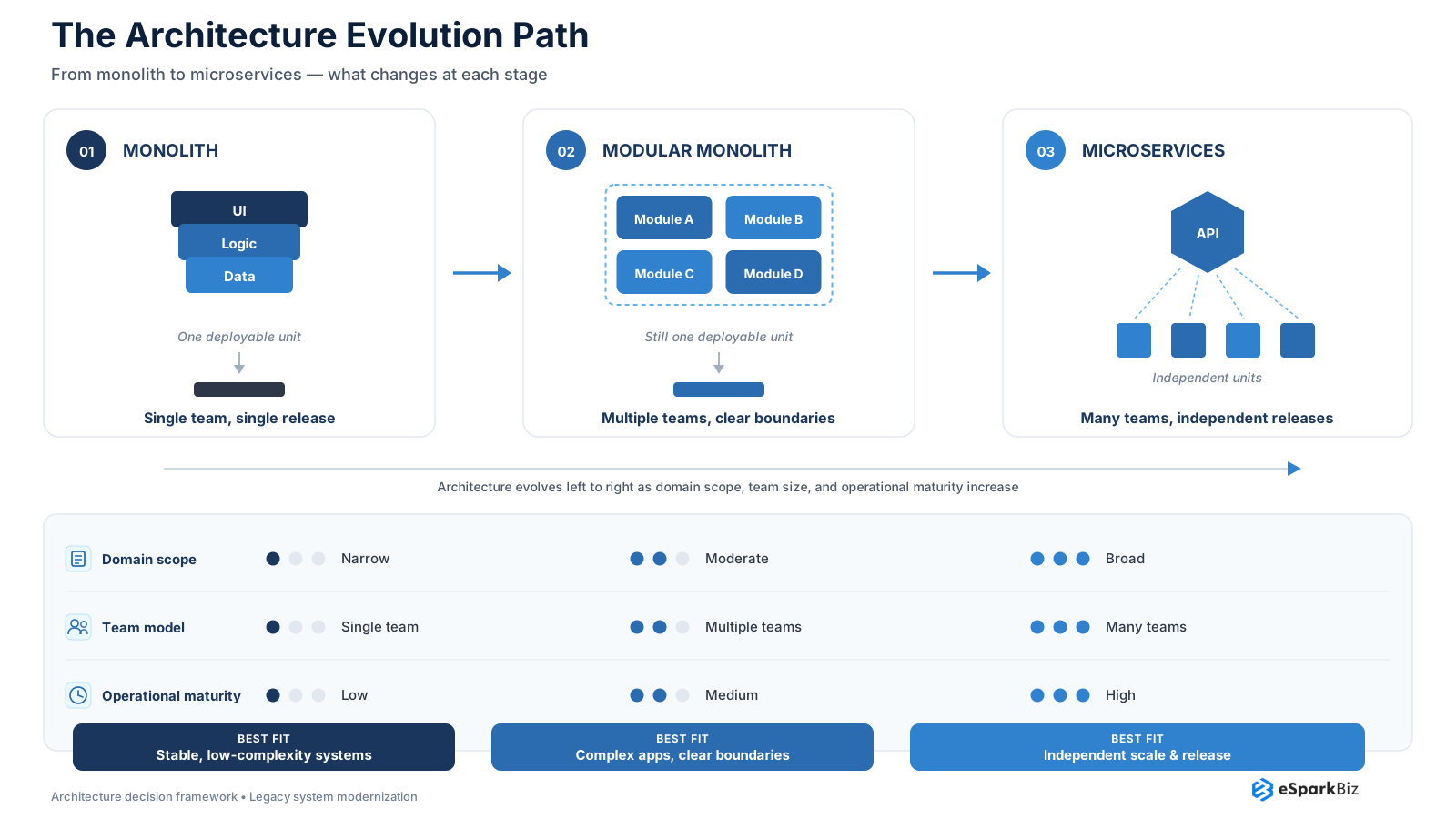
Decision Matrix: Which Architecture Fits Your Situation
A good target architecture must ensure that the system has clear domain boundaries as well as effective team ownership without adding unnecessary operational overhead.
| Decision factor | Monolith | Modular Monolith | Microservices |
| Domain complexity | Limited or closely related domains | Separate domains with fixed boundaries | Multiple domains requiring independent ownership |
| Team topology | One team or closely coordinated groups | Several teams working in defined modules | Multiple teams that need independent service ownership |
| Operational maturity | Central deployment, monitoring and release controls are sufficient | Strong module boundaries and automated testing are needed | Needs mature observability, CI/CD, incident response, and dependency management |
| Best fit | Stable applications with low separation requirements | Complex apps that want better boundaries but not distributed-system overhead | Systems that need independent deployment, scaling, and release cycles |
How AI-Assisted Legacy Modernization Works: A Phased Implementation Roadmap
Modernizing legacy systems using AI should be done in phases instead of directly starting with code changes. The aim of this approach is to gain an understanding of the system, its authentication process and create measurable milestones before moving forward to other important applications.
Phase 1: Assessment and Readiness
Start with an architecture and dependency review including applications, databases, interfaces, and operating limits. Evaluate data quality, documentation gaps, testing coverage, and legacy knowledge. Set up governance responsibilities and approval criteria before allowing AI-assisted changes into the modernization workflow.
Phase 2: Data and Access Preparation
Set up the technical environment before starting modernization. This includes secure data pipelines, role-based access and dedicated workspaces for modernization activities. Keep production systems separate from analysis and transformation environments with proper controls for sensitive data, source code access, and auditability.
Phase 3: Pilot Implementation
Choose a small scope of modernization with clear boundaries and low operational risk. A pilot project may include a single module within an application, a code translation task or documentation recovery. Define criteria for functionality, security, performance and business rules preservation before scaling the approach.
Phase 4: Validation and Controlled Scale-Up
Establish best practices for modernization based on pilot results. Develop reusable playbooks that include how to handle prompts, code review, testing, and exceptions. Measure outcomes such as effort, defects, coverage and cycle times before adopting the strategy on other systems.
💬 Community Insight
A Quora discussion highlights a real world challenge with legacy transformation. Proving that the modified code behaves in the same way as the old system is the hardest thing, especially when undocumented rules and edge cases impact critical processes.
Industry Use Cases for AI-Led Legacy Modernization
AI plays a different role in different industries, as each industry has its own needs and priorities. Those differences will help you determine which applications need to be changed first, where artificial intelligence can help, and what controls need to be in place during the transition.
Financial Services and Banking
The banking industry is currently experiencing fast AI implementation. The number of bank employees who use AI at least weekly has increased from 30% to 63% in the past year, and all major banks worldwide have implemented AI in technology, operations, finance, marketing, and customer service.
This creates pressure on mainframe and core banking environments to deliver reliable access to application logic and transaction data. The areas of focus include COBOL analysis, dependency mapping, API enablement, regulatory reporting and selective workload migration while preserving transaction integrity.
Healthcare
Approximately 80% of executives in the health systems and health plans industries report that they believe Generative AI and Agentic AI will considerably improve clinical, business and administrative functions of their organizations by 2026.
It is imperative that legacy healthcare applications should support these initiatives without affecting the integrity of the patient data and control mechanisms. The modifications usually focus on interoperability, controlled data access, application interfaces, testing environments, and HIPAA compliance as opposed to replacement of the systems.
Logistics and Manufacturing
Integration challenges are especially relevant to supply chain companies. According to Gartner, 56% of chief supply chain officers say that integration of AI with their legacy systems and processes is a major challenge and 50% say they have limited internal expertise to implement and manage AI solutions within their organizations.
For logistics and manufacturing, technological updates typically affect ERP, TMS, warehouse and production systems. Stable interfaces and consistent data flow are the basis for implementing AI technologies in planning, forecasting, maintenance, and decision-making while keeping the old execution and control systems functional.
Also Read: 50+ Application Modernization Statistics – Essential Facts & Usage Trends
Real Risks, Hidden Costs, and How to Mitigate Them
AI can reduce the effort involved in legacy modernization, but the risks associated with the project cannot be eliminated. Various costs can arise through enterprise initiatives including running parallel environments, modifying code, training specialists and reliance on vendors. These risks should be planned before the implementation starts.
| Risk | Likely Cause | Mitigation |
| Incorrect code logic | AI misunderstanding business rules that are not documented | Need to have code review, regression test, and business rule verification |
| Scope creep | Modernization becomes broader than the defined scope | Define measurable scope, criteria for acceptance and control of changes |
| Downtime | Migration affects other dependent production processes | Use phased migration, rollback plans, and parallel validation |
| Vendor lock-in | Proprietary tools are integrated into the modernization process. | Maintain portable code, manuals, prompts, and testing material |
| Hidden operating costs | Dual environment, retraining, rework, and additional testing | Define a full transition budget and track costs by modernization stage |
| Technical debt returns | New code replicates weak architecture or undocumented dependencies | Enforce architectural standards, code reviews, testing and ownership mechanisms |
Traceability is the most important control. Each significant change must have traceability to its source code, test results, business rules, and authorization documentation. This will make it easier to troubleshoot any problems and prevent modernization from adding more technical debt.
✍️ Expert Quote
“The big problem with legacy modernisation has always been that it’s very hard just to understand what a system does today, particularly if it’s old or even inaccessible.”
Mike Turner – VP of Software and Platform Engineering, Cognizant
How to Evaluate an AI Legacy Modernization Partner
Partner selection is not only about evaluating the presence of artificial intelligence within the vendor’s offerings. It must be assessed based on how well it understands the legacy systems, manages technical risks, works within regulations, and maintains accountability in the post-production environment.
Vendor Evaluation Scorecard
- Legacy system expertise: Look for experience with the languages, databases, middleware, mainframes, and integration patterns that are relevant to your environment.
- Architecture capability: Assess whether the team can assess the existing architecture and suggest a suitable target state without imposing a fixed technology pattern.
- Compliance knowledge: Verify knowledge of relevant requirements like SOX, PCI DSS, HIPAA, data retention, access control, and audits.
- AI governance: Ask how code, documentation, tests and transformations are reviewed, approved, traced and retained.
- Pricing and timeline transparency: Demand that assumptions, dependencies, acceptance criteria, and change management processes be identified before the work begins.
- Post-launch support: Define ownership for defects, production incidents, performance issues, knowledge transfer and further changes after implementation.
Measuring ROI and Success After Modernization
The success of modernization must be judged on the basis of savings in costs and operational improvements. Compare the important metrics before and after modernization to understand its impact on maintenance costs, system reliability, release management, and engineering efforts.
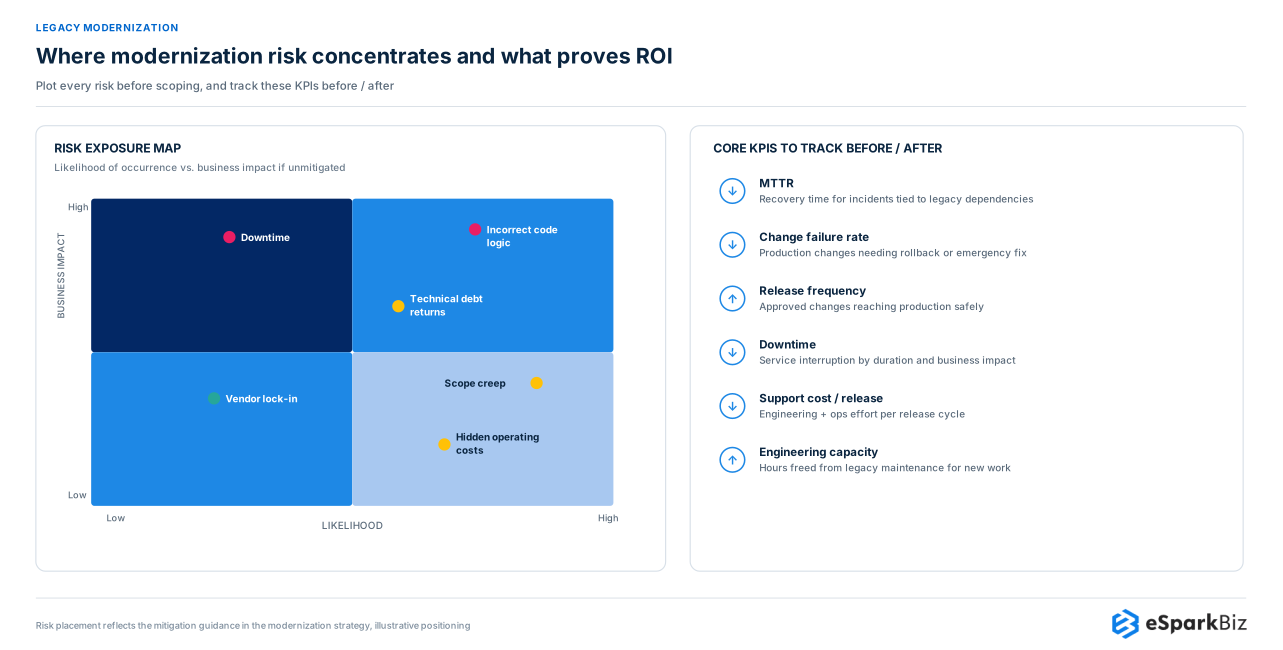
Core KPIs to Track Before and After Modernization
- MTTR: Measure recovery time for incidents that have an important impact on business activities.
- Change failure rate: Monitor production iterations that required rollback or resolution of ongoing incidents in order to understand the situation.
- Release frequency: Track the number of times approved changes reach production without increasing operational risk.
- Downtime: Measure the duration and impact of service outages rather than reporting only the availability.
- Support cost per release: Monitor engineering and operational time spent on supporting each particular release, including post-release troubleshooting.
- Engineering capacity: Measure hours spent on legacy operations, bug fixing, and technical support in comparison with the total number of available hours for product and platform activities.
Measure AI’s impact by separately analysing the time saved in code analysis, dependency mapping, documentation, testing and code transformation. This will help to determine which modernisation tasks would benefit most from AI and where it can reduce project costs.
Frequently Asked Questions
How does AI help modernize legacy systems?
AI can help with analyzing code, identifying dependencies, recovering documentation, generating tests, code refactoring and code translation. Business logic, security controls and production code changes will still require human validation.
Can AI convert legacy code such as COBOL into modern programming languages?
Yes. AI can help translate COBOL and other legacy languages to modern languages but it is essential for the team to validate business rules, functionality, security and regression outcomes before release.
How can enterprises protect sensitive data during AI-led modernization?
Enterprises must ensure that production and modernization environments are kept separate, adopt role based access control, limit code and data exposure, use synthetic data when necessary and keep audit logs for modernization efforts.
What role does testing play in AI-assisted legacy modernization?
Software testing ensures that code changes do not alter the behavior of existing features. Common testing techniques include regression testing, the generation of test cases, integration testing, and evaluation of performance. These tests are frequently performed prior to modifications or replacement of an existing business system.
What is the best approach to modernizing legacy systems with AI?
Phased implementation is generally the best strategy for updating important legacy systems using AI technology. Then perform a trial run on a small section of the system and then scale up only when it passes the needed quality and risk criteria.
How can eSparkBiz reduce risk when modernizing systems with undocumented business rules?
Through code analysis and documentation recovery eSparkBiz is able to detect embedded rules before any change is made to application functionality by engineers.
- Analyze source code
- Map dependencies
- Recover business rules
- Create test coverage
- Validate proposed changes
Can eSparkBiz help us decide between rewriting, refactoring, and replatforming?
Yes. At eSparkBiz, we look at areas where our current framework hits some technical or functional limitations. We then analyze the options available to us to solve these problems through refactoring, platform shifting, or even rewriting.
How does eSparkBiz approach modernization when legacy applications cannot be taken offline?
eSparkBiz can use techniques such as parallel validation, incremental change, controlled rollout and rollback for applications that need to be continuously available.
- Dependency assessment
- Incremental transformation
- Parallel testing
- Controlled cutover
- Rollback planning


 August 17, 2026