

From AI-Assisted Coding to Agentic AI in Software Development
For years, AI in software engineering largely meant one thing: a developer entered a prompt, comment or instruction and an AI tool suggested code.
While this made the job of the developer easier, it did not completely solve the software development problem. For the developers, the work of designing the feature, examining the code, testing the code, finding and correcting bugs and reviewing the changed code still existed.
Agentic AI redefines the unit of work. Rather than responding to each specific instruction, an agentic AI with a definite goal breaks work into tasks, uses engineering tools, analyzes the outcomes and then presents the final output to a human reviewer.
For engineering and product engineering leaders, it is less meaningful to ask whether AI can write code. A more meaningful question is to ask which engineering tasks can be safely delegated and which tasks should remain under human control.
What is Agentic AI in Software Development?
Agentic AI in Software Development uses AI agents to perform automated planning, task execution, and evaluation of complex engineering tasks with minimal user input. As opposed to regular AI tools, an agent completes a task through reasoning and use of contextual knowledge and memory to plan and operate multiple steps to achieve a goal using tools at its disposal.
As an example, a coding assistant may return a function and wait for the next task. An agent would examine a code repository, decompose a feature task into numerous subtasks, modify and update code, run tests, understand test failures and modify the code and commit changes for review.
| Capability | Traditional AI Assistance | Agentic AI |
| Breaks work into subtasks | Limited | Core capability |
| Inspects the repository | Limited to given context | Built into the workflow |
| Runs and interprets tests | User triggered | Automatic, with iteration |
| Acts without step-by-step instruction | Limited | Core characteristic |
| Human approval | At every step | At defined gates |
Agentic AI market growth
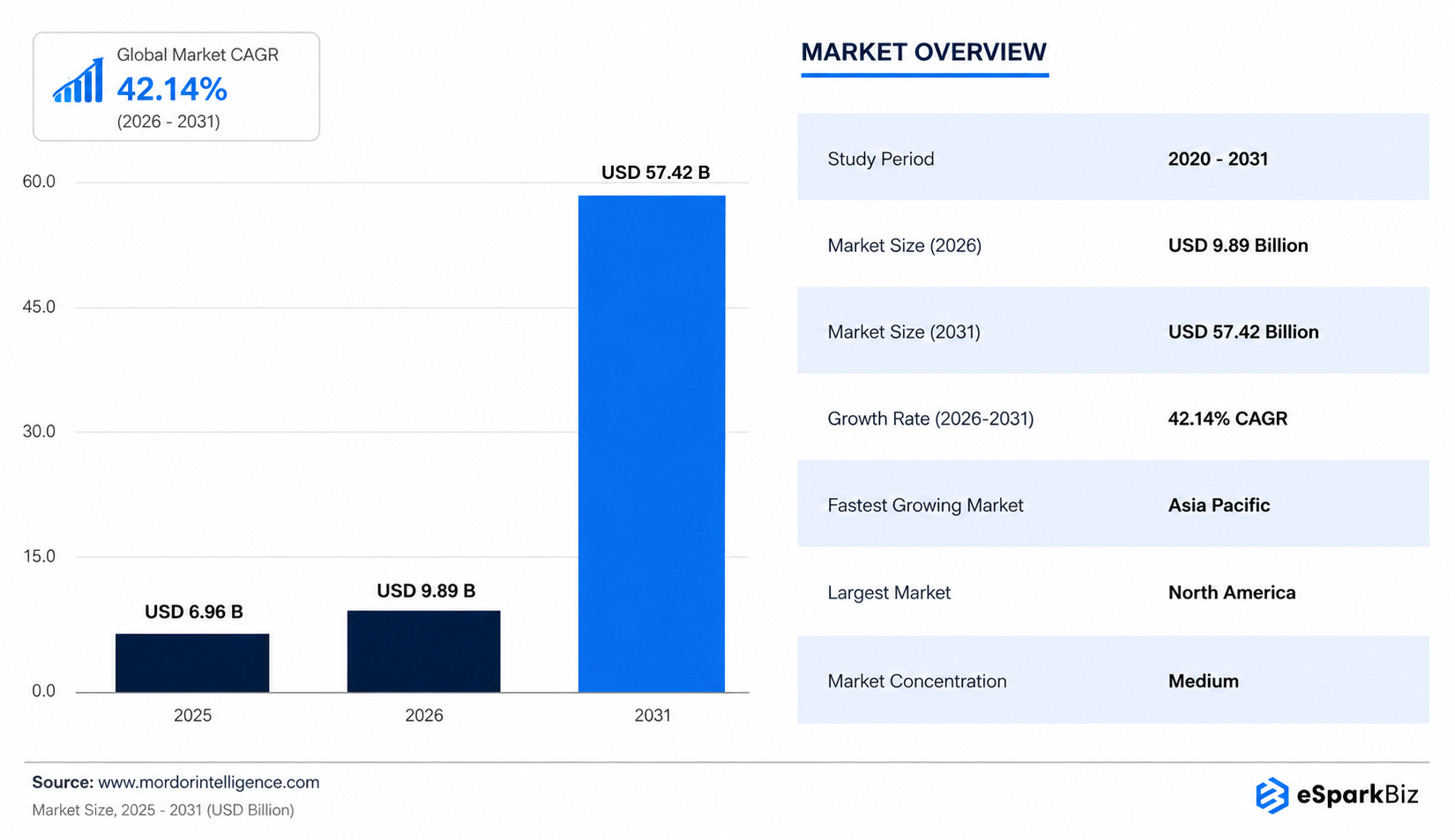
The Agentic AI market is estimated at $9.89 billion in 2026 and is projected to reach $57.42 billion by 2031, growing at a 42.14% CAGR, according to Mordor Intelligence.
Agentic AI vs Generative AI vs Coding Copilots: Where the Real Difference Lies
Generative AI creates an output based on a prompt. Agentic AI works toward a defined goal across multiple stages based on the results of previous actions to decide what to do next.
An AI coding copilot typically assists a developer within a focused interaction. A coding agent on the other hand goes further by working across a repository, terminal, test suite, version control system and pull requests in order to achieve a specified engineering goal.
The difference becomes clearer when the three approaches are compared side by side:
| Dimension | Generative AI | AI Coding Copilot | Coding Agent |
| Primary role | Generates content or code | Assists a developer with coding | Executes a defined engineering goal |
| Interaction | User provides a prompt | Developer asks for help | Developer assigns an objective |
| Scope | Usually one output or response | Usually a focused coding task | Can span multiple connected tasks |
| Context | Prompt and supplied context | IDE, file or selected codebase context | Repository, tools, tests and workflow context |
| Planning | Limited | Limited | Breaks goals into subtasks |
| Execution | Produces an output | Suggests or generates changes | Can modify files and run tools |
| Testing and debugging | User driven | Mostly developer driven | Can run, diagnose and retry |
| Human role | Reviews the output | Drives the workflow | Reviews results and handles exceptions |
| Typical outcome | Generated code, text or other content | Code suggestions or focused changes | A completed, tested change set |
The comparison matters in software development since the existing engineering workflows already offer methods for validating an agent’s progress. A test either passes or fails. Static analysis generates a pass/fail check. Pull requests can be associated with CI check runs before human validation.
In practice, it’s a simple distinction: Generative AI creates. A coding copilot assists. A coding agent acts. Agentic AI provides the broader approach that allows those agents to reason through tasks, use tools, evaluate results and continue working toward an objective.
It becomes even more relevant when the same agents go beyond coding and take on such functions as testing, documenting, managing dependencies, doing security fixes, and CI/CD operations. At that point, the value comes less from generating code and more from executing a connected engineering workflow from a defined goal to a verified result.
See Also: How much does it Cost to Hire AI Developers in 2026?
Inside the Agent Loop: How an AI Agent Plans, Acts, Tests and Iterates
An agentic workflow consists of a connected sequence of actions, rather than one single action. The agent receives a goal, identifies context, plans a course of action, uses tools as needed, assesses the outcome and determines whether the task is complete.
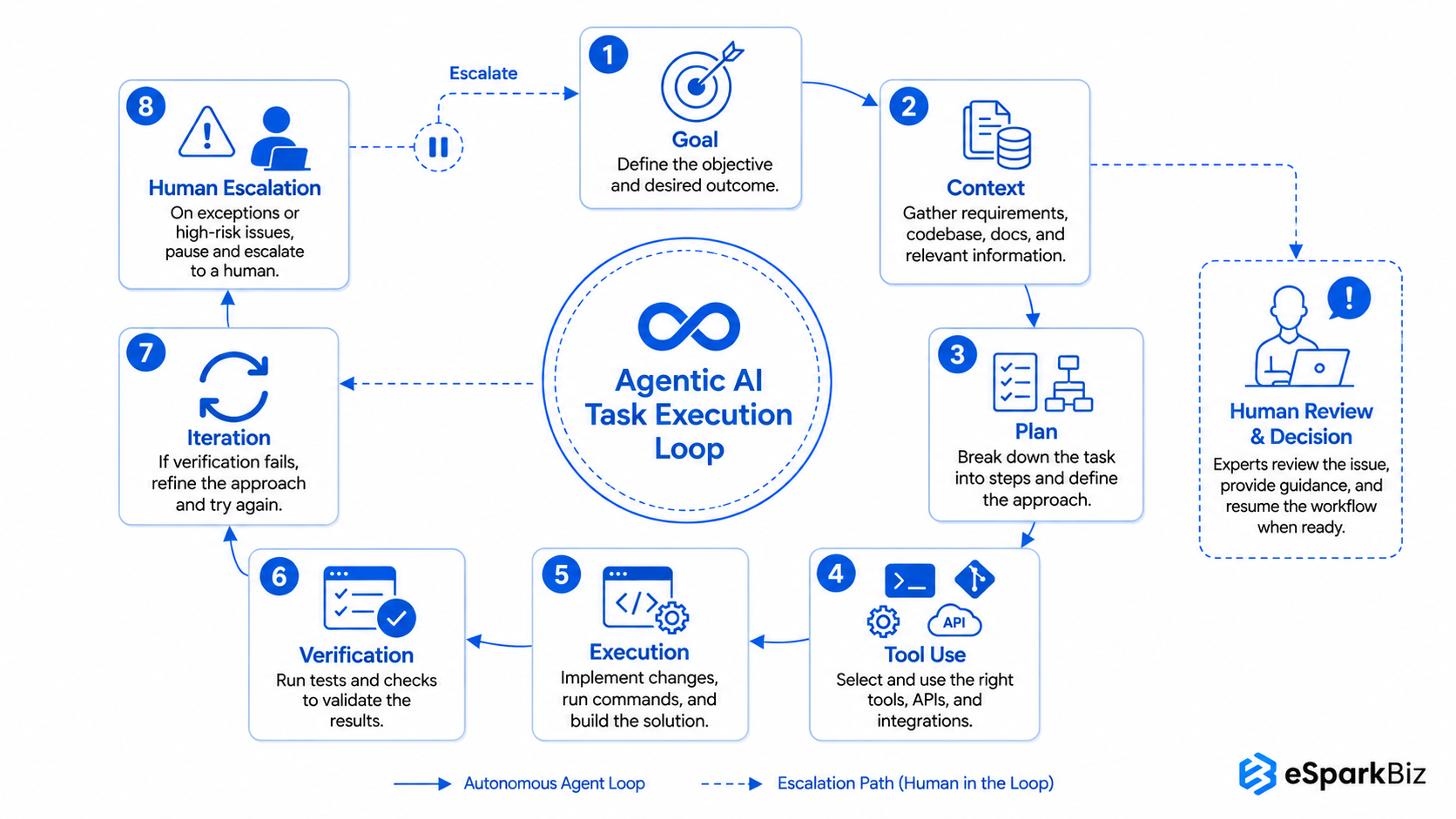
An agentic workflow moves through a sequence of connected actions rather than producing a single response. The agent takes a goal, gathers the required context, plans the work, uses available tools, checks the result and decides whether another step is needed.
For instance, while implementing a passwordless login option, an agent may start by analyzing the requirements, examining the authentication module and API integration and dividing the task into the database, API, UI, and testing steps.
Then using Git, Terminal, and test runners, the agent can perform the necessary actions. In case of test failure, the agent can examine the error, identify the probable cause of the problem, change the code, and rerun the necessary tests.
Once the workflow meets its defined verification criteria, the agent can produce the summary of the changes and prepare a pull request. An architecture conflict, security sensitive modification or other predefined exception can stop the workflow and trigger human review.
This is where agentic software development becomes more than code generation. The agent acts on the task, evaluates the result and determines the next step based on what happened.
How Tool Access Controls Agentic AI Risk
Tool connectivity gives an agent the ability to interact with the development environment but every additional permission also increases its potential impact.
| Tool Access | What It Enables | Main Risk | Recommended Control |
| Read-only repository | Understand code, dependencies and project context | Data exposure | Repository level permissions |
| Terminal | Run tests, scripts and development commands | Unintended command execution | Isolated sandbox |
| Git | Create branches, commits and pull requests | Unreviewed changes | Branch isolation and approval |
| CI/CD systems | Run pipelines and inspect failures | Pipeline or deployment changes | Restricted credentials and approval gates |
| Production systems | Perform operational tasks | High blast radius | Human approval and tightly scoped access |
Tool permissions should be part of the engineering architecture alongside authentication, access controls, testing and observability. An agent should receive only the access required for its assigned workflow, with sensitive actions routed through explicit approval gates.
What Makes an AI Agent Truly Agentic?
Agentic workflows rely on more than a capable model. This video offers a quick look at five underlying concepts that help agents understand context, use tools and handle complex work.
Where Agentic AI fits across the Software Development Lifecycle
AI agents can participate across the SDLC but they should not receive the same level of autonomy at every stage.
Suitable candidates tend to have outputs that are objective and have objectively verifiable outcomes. Requirements and architecture still rely on humans as they are business-driven and decisions have consequences that can extend well beyond a single sprint.
| SDLC Stage | Agent Role | Human Involvement |
| Requirements & Planning | Draft user stories, break down tasks | Product and engineering review |
| Architecture | Suggest patterns and service boundaries | High, human led |
| Development | Implement features and fixes | Code review |
| Testing & Debugging | Generate tests, reproduce and fix bugs | Exception review |
| Code Review | Flag issues in pull requests | High for critical changes |
| CI/CD & Maintenance | Diagnose failures, update dependencies | Approval for sensitive deployments |
Coding, testing and debugging are currently among the strongest areas for agentic adoption because their outputs can be tested and evaluated automatically.
The broader engineering environment is also becoming more connected. Multiple agent orchestration and MCP style tool connectivity can allow a coding agent to pass work to testing, documentation or other specialized agents without requiring a developer to manually coordinate every step.
Agentic AI in Coding
GitLab now serves more than 50 million registered users with roughly half of the Fortune 100 relying on its platform. Its newer agentic capabilities, including automated vulnerability resolution and custom agentic flows, show agentic AI moving from isolated code generation into security and full delivery pipeline work.
7 High-Value Agentic AI Use Cases for Software Development

Task automation involves several factors. Agent-based AI is useful, but only in cases of clearly defined boundaries. Contextual data and supportive tools need to be available to an agent. Finally, an automated assessment or human checking needs to be possible.
Agentic AI is most appropriate for tasks that involve software engineering teams that have accepted the definition of work, have set a test suite and have established a CI check to determine if the task is complete.
1. Feature Development From a Software Specification
A coding agent could be tasked with a feature request and solve this by accessing the context of the software repository, planning, coding, editing the repository and verifying that the new software code passes the tests.
The most straightforward and use case for agentic coding is in product engineering where precise requirements and acceptance criteria are expressed. The developer’s intent and the final decision remain. The agent supports the implementation.
Tools that extend beyond code suggestions for development tasks at the repository level include GitHub Copilot and OpenAI Codex.
2. Debugging with AI: Reproduction-to-Fix cycle
An efficient debugging agent can reproduce issues, analyze logs and relevant code, trace possible causes, fix the issue and validate the change through a regression test.
Agents do not just suggest fixes. They execute a complete reproduce → diagnose → modify → test cycle and then choose the next step based on the results.
This is where tools like Snyk DeepCode AI can automate the code analysis and remediation workflows as they help identify issues that Engineering teams can address in the early stages of the software development process.
3. Automating Test Generation and QA
Testing is one of the strongest candidates for agentic execution as a good portion of the workflow is based on preset outcomes.
An agent has the ability to probe the requirements, existing code and create automated test cases. Agents can also identify failing test cases and eliminate passing test cases to create new failing test cases as well as update test cases to adjust to new requirements of the application.
Tools such as Testim and mabl provide automated testing frameworks that support testing across a variety of application environments.
The more compelling opportunity is centered around continuous validation. Agents can evaluate changes to the application, understand the causes of failures, and re-execute the process until successful, at which point they can provide validated work for human evaluation.
4. Modernize Legacy Software without a Full Rewrite
Undocumented dependencies and tightly coupled components and logic are the hallmarks of legacy code.
Agents help engineers navigate unknown code repositories, identify legacy systems, and suggest strategies to support an incremental modernization effort. Agents also help draft and update system documentation.
Legacy code is modernized incrementally using these agents as opposed to a risky complete rewrite.
5. Automate Code Review and Security Fixes With AI Agents
Agents can assist with the first phase of a code review by detecting code defects, coding standard violations and use of common security vulnerabilities.
Agents can suggest changes to the human supervisor before a final review code change is made. The final review still retains responsibility for architecture, business logic, and high-impact changes to code. The agent’s purpose is to eliminate repetitive code review tasks.
6. AI Agents for DevOps, CI/CD and Pipeline Failures
Agentic pipelines can be used to debug failures during the build process, detect recurring issues in CI/CD processes, propose a solution, and maintain pipelines with predetermined permissions.
Automated delivery workflows are accessible to agents via integration with software like Harness or GitLab CI.
Production deployment remains a different matter. The closer the agent is to the infrastructure and the production systems, the more important it becomes to have isolation, approval gates, audit logs and rollbacks.
7. Keep Software Documentation in Sync With AI Agents
Documentation often gets outdated since developers keep the documentation process separate from implementation.
Agents can generate and update technical documentation from source code, pull requests and other engineering documents. This helps keep API documentation, change logs and implementation documentation remain consistent with the system as it changes.
Real-world Agentic AI Applications beyond Coding
Agentic AI is not limited to software development only. Organizations have started using agent based workflows in sectors such as finance, healthcare, customer service and other areas where multiple steps can be coordinated through predefined processes.
For software engineering teams, these examples provide a better perspective on how agentic AI can be used: coordinating workflows rather than only generating code.
- Automotive: Cox Automotive uses Amazon Bedrock Agent Core to support operational workflows.
- Human resources: IBM identifies applications such as candidate screening, onboarding and employee query handling.
- Financial services: Infosys highlights agentic workflows for transaction processing, anomaly detection and compliance activities.
- eCommerce: McKinsey examines agentic commerce use cases involving inventory and order processing activities.
- Healthcare: Research published through PubMed Central examines agentic systems for organizing patient information and supporting administrative workflows.
What Developers Think about Agentic AI
In discussions in r/AI_Agents, opinions of developers on using AI agents vary. Some developers noted that great productivity gains are achieved with AI agents while others noted that mistakes and poor architectural decisions still require human review.
The thing everyone can agree upon was that agents can handle more development work but human oversight still matters.
Benefits and Risks of Agentic AI in Software Development
Agentic AI can reduce engineering effort but the value depends on where autonomy actually improves the workflow. The strongest gains usually come from shortening feedback loops and reducing repetitive work rather than simply generating more code.
- Faster development cycles: Agents can implement bounded changes, generate tests, and resolve common failures without waiting for human intervention at every step.
- Lower maintenance effort: Dependency updates, documentation, and integration failures can move through defined workflows with less developer involvement.
- Better developer utilization: Engineers can spend more time on architecture, validation, product decisions, and complex technical problems.
- Quicker issue resolution: Agents can duplicate the bug, inspect the source code, verify solutions, and iterate through the process inside the same workflow.
- Continuous verification: Automated testing, static analysis, and CI checks provide agents measurable feedback before work reaches human review.
The same autonomy creates risks when agents receive broad permissions or operate without reliable verification.
- Improper execution or faulty assumptions
- Excessive repository or infrastructure access
- Prompt injection through untrusted inputs
- Technical debt from local corrections
- Unsafe operations in production
- Additional reviews and revisions because of agents making changes faster than human teams can verify them
The right approach is to have autonomy match the reversibility, risk, and verifiability of the task.
When do Multi-Agent Systems make sense in Software Development?
A single agent can be tasked with multiple, bounded engineering tasks. Multiple agents become useful when multiple steps of a workflow can be decomposed into subtasks that can be done in parallel or need several different skills.
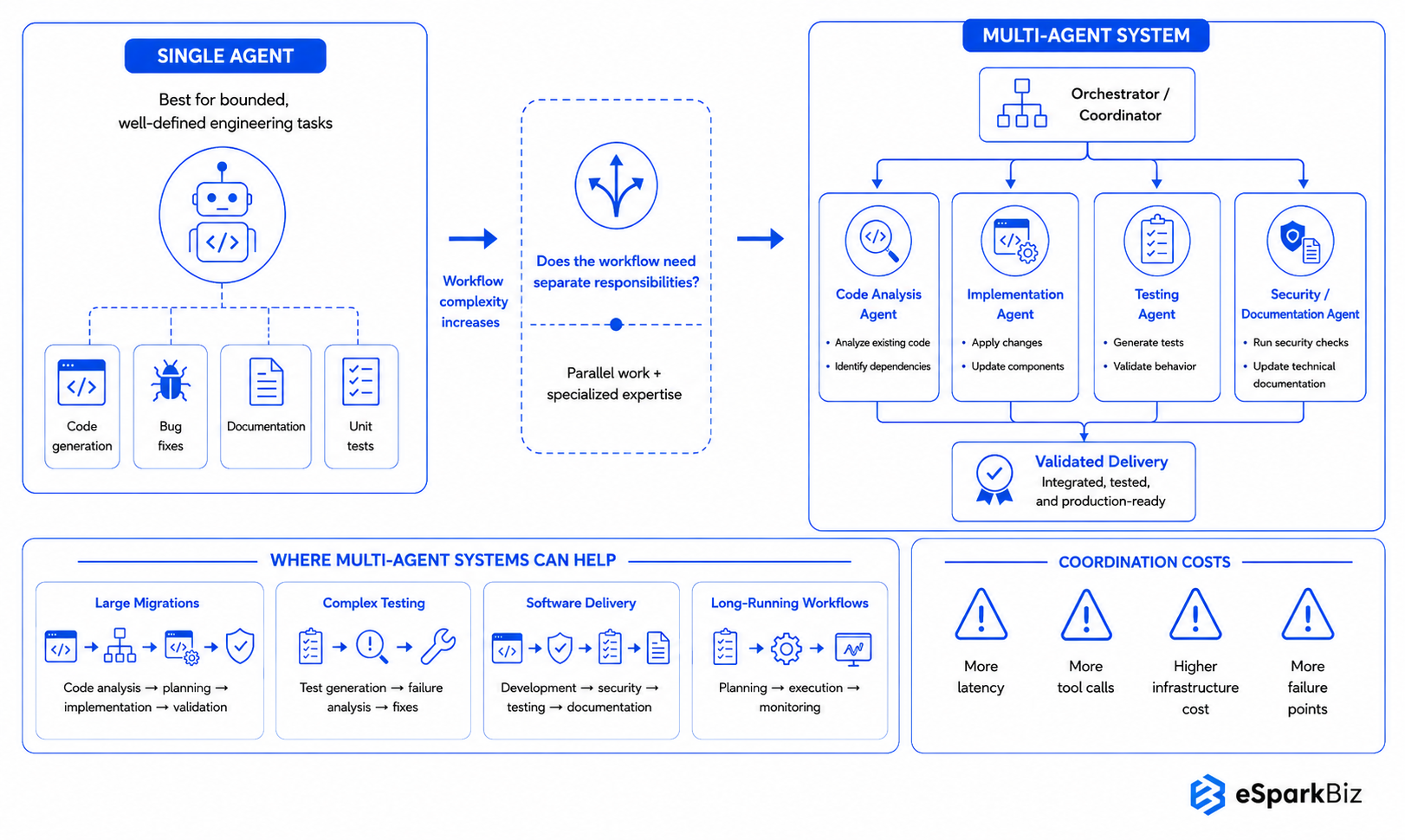
A single agent can handle many bounded engineering tasks. Multiple agents become useful when a workflow can be naturally split into distinct tasks that may be carried out in parallel or need varied skills.
Multiple agent architectures can be appropriate for:
- Large migrations: Separate agents can perform code analysis, migration planning, implementation, and validation.
- Complex testing: One agent can generate tests while another analyzes failures and prepares fixes.
- Software delivery: Specialized agents can coordinate development, security checks, testing, and documentation.
- Long running workflows: Various agents can plan, execute, and monitor the workflows without an individual agent performing all the tasks.
The additional coordination also creates costs. More agents can mean more latency, more tool calls, higher infrastructure costs, and more potential failure points.
What Technology powers Agentic AI Systems?
Agentic AI development generally makes use of several connected components instead of a single model. While a specific tech stack differs based on process, most AI production stacks require some kind of context, tool access, execution and monitoring.
- Foundation models: Provide the reasoning and generation capabilities used to plan and execute tasks.
- Vector databases: Systems such as Pinecone can support retrieval of relevant documentation, code and other contextual information.
- Data and retrieval frameworks: LlamaIndex can connect agents with external data sources and retrieval workflows.
- Cloud infrastructure: Platforms such as AWS provide computing, storage, security and deployment infrastructure for agentic workloads.
- Agent platforms: Microsoft Copilot Studio supports agent creation and workflow configuration.
- Engineering integrations: Git repositories, issue trackers, CI/CD systems, test runners and observability tools allow agents to act on real development workflows.
The architecture should follow the workflow requirements. The coding agent that runs at repository levels does not need all the capabilities or permissions of the agent that manages deployments through multiple production systems.
For enterprise teams, fit with the existing system is as important as the capabilities of the model. An agent should operate within the existing identity, source control, CI/CD, security, observability, and approvals process and not create another workflow for engineering teams to manage. Teams must also consider issues around authentication, data boundaries, audit, and recovery from failures.
Did you Know?
According to Gartner, by 2028, 60% of brands will use agentic AI for one to one customer interactions. This shows how the use of agentic systems will expand beyond just technical workflows to cover other business activities.
How to implement Agentic AI in Software Development
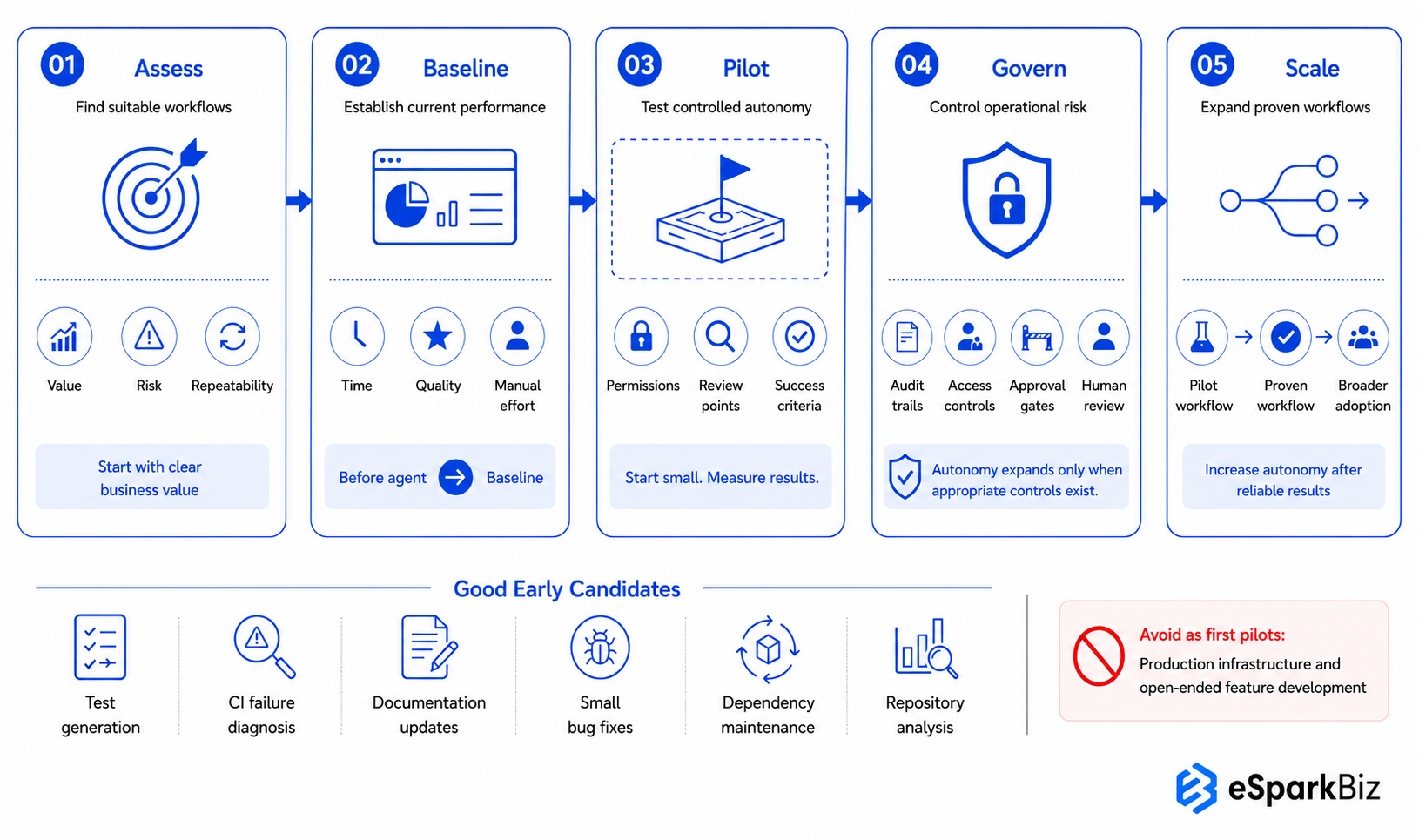
A phased approach allows the engineering team to implement agentic AI in a safe manner, measuring its effects and increasing autonomy only if the workflow has been proven reliable.
- Assess: Identify appropriate workflows by prioritizing tasks based on their value, risk, and repetitive nature.
- Baseline: Establish current performance by recording time, quality, and effort spent.
- Pilot: Test autonomous execution by giving specific permissions, review points, and success criteria.
- Govern: Manage operational risks by maintaining audit logs, access controls, and approval gates.
- Scale: Expand proven workflows by increasing usage only after they meet defined performance targets.
For enterprise teams, the initial pilot should occur within an established engineering workflow with measurable baselines, limited permissions, and a clear owner.
Good early candidates include test generation, CI failure diagnosis, documentation updates, small bug fixes, dependency maintenance and repository analysis.
Measuring the ROI of Agentic AI in Software Development
“It’s just a new way of doing computer programming. In the past, we code. In the future, we’re going to write ideas, architectures, specifications,” said Jensen Huang, Founder and CEO of NVIDIA, when talking about Agentic AI.
The ROI from using Agentic AI should be measured against the team’s baseline before the agent was deployed. A workflow becomes valuable if the increased execution speed does not increase the rework, defects, or reviewing efforts.
| ROI Metric | What to Measure |
| Task completion rate | How often the agent completes the workflow successfully |
| Cycle and lead time | Time from task creation to completion |
| Rework rate | Agent generated work requiring correction |
| Defect escape rate | Defects reaching later testing stages or production |
| Human intervention rate | How often developers need to step in |
| Review effort | Time spent validating agent generated changes |
| Cost per task | Total cost of completing the workflow |
| Production reliability | Whether faster delivery maintains or improves system stability |
For CIOs and founders, such metrics can be translated into a business opportunity by evaluating the difference between the engineering time saved, increased capacity for delivery, rework, and infrastructure costs compared to the baseline cost of the workflow.
Agentic AI Security and Governance: What Teams Need to Control
Agentic AI introduces a new security challenge because the system is capable of taking actions instead of just suggesting something. It implies that governance regarding what an agent may be able to access, what changes it may make, and when it should stop to get human approval.
Enterprise deployments also need clear rules for what source code, customer details, and credentials or internal documentation an agent has permission to access, process, or retain.
Core controls for engineering teams
- Least privilege access: Give each agent only the repository, tools and systems required for its assigned task.
- Sandboxed execution: Isolate terminal commands, scripts and untrusted inputs from sensitive environments.
- Branch and environment isolation: Keep agent generated changes away from protected branches and production systems until review.
- Approval gates: Require explicit human authorization for security changes, production deployments, sensitive data access and irreversible actions.
- Audit trails: Record prompts, tool calls, code changes, test results and approvals so teams can trace what happened.
- Rollback mechanisms: Ensure incorrect changes can be reverted without disrupting critical systems.
- Continuous monitoring: Track unusual tool usage, repeated failures, permission violations and unexpected workflow behavior.
This becomes especially important when agents interact with external documentation, repositories, tickets or other untrusted inputs. An agent’s ability to act should always be contained by the governance of that action.
Also Read: Agentic AI in Staff Augmentation: Smart Team Management
How AI Agents are Reshaping Software Engineering Roles
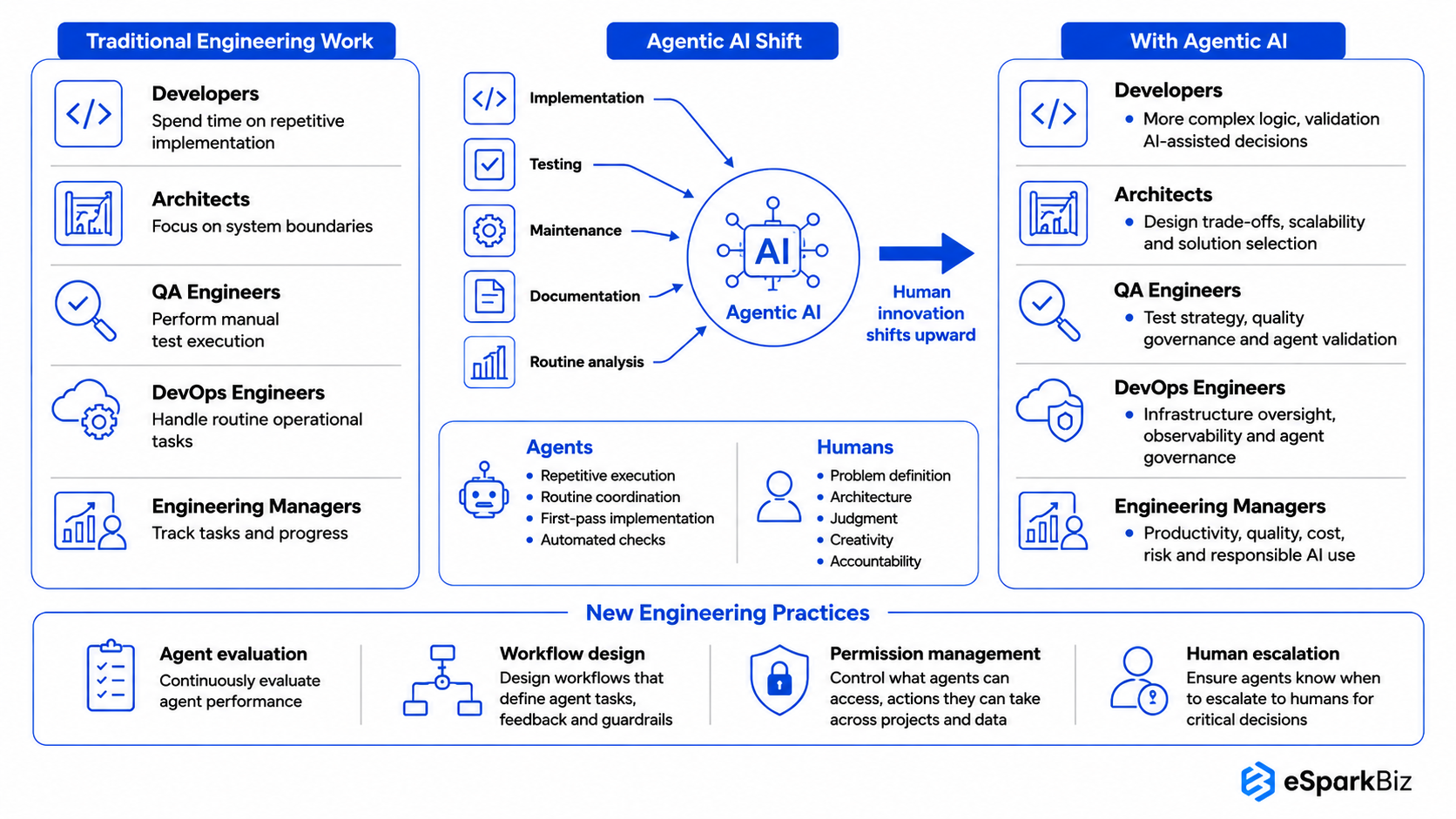
Agentic AI is shifting the tasks performed by engineering teams beyond simply eliminating the requirement of developers in the process. Agents are able to assume greater responsibility for implementing and in some cases, maintaining system functionality. Therefore, human roles shift to the formulation of problems, tasks, system architecture and more.
- Developers: Instead of spending a lot of time on mundane implementation, spend more time on validation and logical work.
- Architects: Maintain focus on system boundaries, design trade-offs and long-term systems thinking.
- QA Engineers: Move to developing a risk-aware testing strategy and ensuring quality more globally across the workflows impacted by the agents.
- DevOps Engineers: Focus more on thinking about infrastructure control, preventing unsafe deployments and managing permissions to the agents.
- Product Engineering Managers: Concerned with new productivity, quality, cost and risk metrics for teams using autonomous systems.
This new state will also provoke the development of new practices related to agent evaluation, workflow construction, permission management and human escalation.
Frequently Asked Questions
What is Agentic AI in Software Development?
Agentic AI describes a system in software development that uses AI agents to carry out software engineering tasks with minimal human involvement. Agents can perform tasks and even automate engineering tasks such as coding, testing and bug fixing. They can be directed by means of tools and feedback to determine what course of action they should take next.
How is Agentic AI different from a coding assistant?
Unlike AI coding assistants, which are meant to respond to a user’s specific requests, agents aim to achieve a goal over a number of connected tasks. Agents can plan and modify code, execute tests and respond to failures all on their own, with little to no prompting.
What Software Development tasks are actually a good fit for Agentic AI?
AI fits best when a task has a well defined start and end goal and can be verified. Some of these tasks include:
- Implementing a software feature
- Generating a test case and executing it
- Reproducing and fixing a bug
- Updating a software dependency
Where can AI Agents fit into the Software Development Lifecycle?
AI agents can support several SDLC stages, although the level of autonomy should vary by risk and complexity:
| SDLC Stage | Agent Role | Human Role |
| Planning | Break down requirements | Approve direction |
| Development | Write and modify code | Review changes |
| Testing | Run and refine tests | Validate results |
| Maintenance | Fix routine issues | Handle exceptions |
What makes Agentic AI useful for a Software Development Team?
The most prominent use cases for agentic AI include replacing routine, tedious engineering tasks with little to no review or rework, and allowing teams to perform routine maintenance, shorten the time to provide feedback and give developers the time they need for complex decisions.
How do I know if a Software Development Workflow is ready for an AI Agent?
A workflow will be ready for an AI agent after the objectives and success criteria of the workflow are clearly defined. Clarity on this will help determine if you can:
- Automate the outcome verification.
- Ensure the context needed for the agent to carry out the workflow is available to it.
- Determine if the actions of the workflow can be reversed.
- Execute the workflow within clearly defined boundaries.
We are considering about allowing some degree of autonomy to the AI Agent. How much access should it actually have?
Start with the lowest autonomy level that allows the agent to achieve the goal. One possible scale is:
| Autonomy Level | Best Fit |
| Human-led assistance | New or untested workflows |
| Execute with approval | Code changes and bounded tasks |
| Bounded autonomy | Routine, verifiable engineering work |
| Conditional autonomy | Mature workflows with strong controls |
I am worried about giving AI Agents the ability to modify our codebase. What could really go wrong?
The greatest threats include incorrect operations, excessive rights and lack of verification. One should look out for:
- Poorly reasoned code or regressions
- Prompt injection and malicious instructions
- Excessive repository or system access
- Technical debt caused by unverified modifications
- Production actions that were not authorized
We have begun using Agents in our work but how do we know that they are actually making any difference?
Do not measure success based on the amount of code generated by the agent. Instead, compare the workflow against its pre-agent baseline, measuring things such as:
| Metric | What to Compare |
| Cycle time | Time to complete work |
| Rework | Corrections after agent output |
| Human effort | Review and intervention time |
| Cost per task | Total workflow cost |
Which are the Best Agentic AI Companies for Software Development?
Among the Most Prominent Choices for Agentic AI within software development are such solutions as eSparkBiz, Softermii, Plavno, Biz4Group LLC and Spiral Scout.


 August 17, 2026