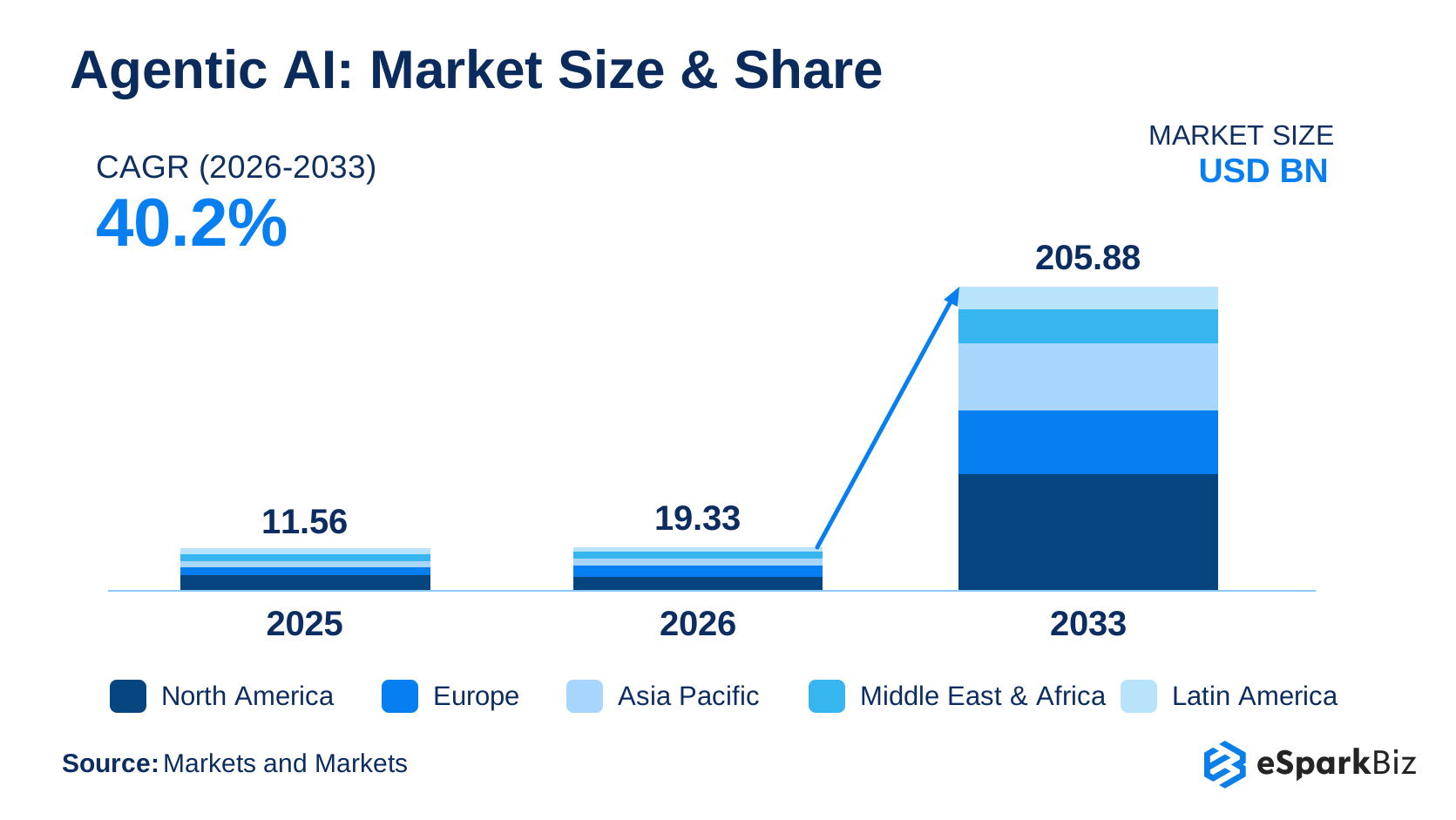
Agentic AI is moving beyond the simple assistance with systems designed to plan tasks, use tools, and act across the business processes. This shift is reflected in a market worth USD 19.33 billion in 2026 expected to reach USD 205.88 billion by 2033 growing at a CAGR of 40.2%.
That rapid growth is increasing the need for people, who can build & manage these systems in real business environments. Agentic AI in Staff Augmentation can help businesses to add specialized capabilities while your business retains control over the agent, its access and its outcomes.
What Does Agentic AI in Staff Augmentation Mean?
Agentic AI systems can plan, use tools and take actions toward goals while staff augmentation adds external specialists to an existing team. Together they bring specialized agent expertise without transferring overall project ownership externally.
This differs from using regular AI tools to manage contract developers. Traditional AI tools assist with activities such as code suggestions, progress summaries, documentation and task tracking. Agentic AI systems can go further by executing multi-step workflows, interacting with connected tools and taking approved actions with defined levels of autonomy.
What You Add
- Agent expertise: People who understand architecture of agent, tool use, integrations and evaluation.
- Production skills: Experience over testing, monitoring, security, deployment and production support.
- Additional capacity: Extra engineering support when internal teams are lacking in any specific capabilities.
Staff augmentation can help teams to increase engineering output without adding permanent headcount. Instead of creating a new full time position for a capability needed only for a specific project, businesses can bring in specialists for the required period and skills.
It can also reduce the time needed to access specialized agentic AI talent compared with starting a full time recruitment process from scratch. The actual time saved depends on role complexity, candidate availability, screening requirements and the provider’s hiring process.
For US businesses seeking Agentic AI engineering support, eSparkBiz brings specialized development expertise into existing teams without shifting project ownership.
Why Agent Projects Fail And What It Means for Staffing
Agent projects can fail even when the technology works in testing. Problems often appear around unclear goals, weak evaluation, excessive autonomy, poor integration or limited human review.
| Failure point | What it means for staffing |
| Unclear goals | Domain and product ownership are needed first |
| Weak evaluation | Teams need agent testing and evaluation skills |
| Too much autonomy | Engineers must understand permissions and human approval |
| Poor integration | Strong integration and production skills become essential |
| Unclear accountability | Someone must monitor the agent after launch |
The staffing lesson: adding developers does not automatically reduce agent risk. Augmentation makes sense when a specific capability is missing; it is a poor fit when ownership, goals, or accountability are unclear.
Expert View
Success in creating AI would be the biggest event in human history. Unfortunately, it might also be the last, unless we learn how to avoid the risks.
Augment, Hire or Managed Service for Agent Work
The wrong staffing model can create gaps in delivery, ownership and accountability. The right approach depends on your existing capabilities, missing skills and how much responsibility you want an external partner to take on.
| Choose | When it fits |
| Augment | You have an internal team but need agent-specific skills |
| Hire | Agent work will become a permanent internal capability |
| Managed service | You want an outside team to own delivery and operations |
If you need two engineers to build AI agents for Jira and Slack, staff augmentation is a good fit when your internal team can manage the project. eSparkBiz can provide specialists for agent development and workflow integration, with team ramp-up possible within 48-72 hours, depending on skill requirements and availability.
Choose staff augmentation when your internal team can own the product but needs specialized Agentic AI skills. Choose a managed team when you want an external partner to take greater responsibility for delivery and ongoing operations.
AI agents are suitable for repetitive tasks such as test generation, documentation, and issue triage. Augmented engineers are better for complex debugging, architecture, and feature development. Use both when your backlog includes routine tasks and work requiring human judgment.
Do Not Augment When
- No internal owner is accountable for the outcome
- The use case or success metric is unclear
- Your team cannot direct or review the work
- The project needs full external ownership
Rule of thumb: Augment for a capability gap, hire for a lasting capability, and use a managed service for an ownership gap.
AI INDUSTRY INSIGHT
Agentic AI, Automation and Scaling 2026
A discussion on where agentic AI fits, who builds AI workflows and what changes when organizations scale these systems across teams.
What Your Agent Team Needs Beyond Developers
A production agent needs clear ownership across five areas. One person can cover multiple areas but none should be left undefined.
1. Agent Engineer
Owns: Agent logic, tools, workflows and integrations.
Test: Task completion, tool use, failure handling.
2. Software Engineer
Owns: APIs, backend systems, data flows and deployment.
Test: Reliability, integration failures and performance.
3. Evaluation Specialist
Owns: Agent testing, quality measurement and edge cases.
Test: Accuracy, consistency and unexpected behavior.
4. Security Engineer
Owns: Permissions, data access and security controls.
Test: Access boundaries, sensitive data exposure and unauthorized actions.
5. Product or Domain Owner
Owns: Business goals, workflow and success criteria.
Test: Business outcomes, escalation points and when human review is required.
One person can cover multiple roles especially during a pilot. What cannot be combined away is responsibility.
DID YOU KNOW?
Enterprise agentic AI is projected to grow rapidly
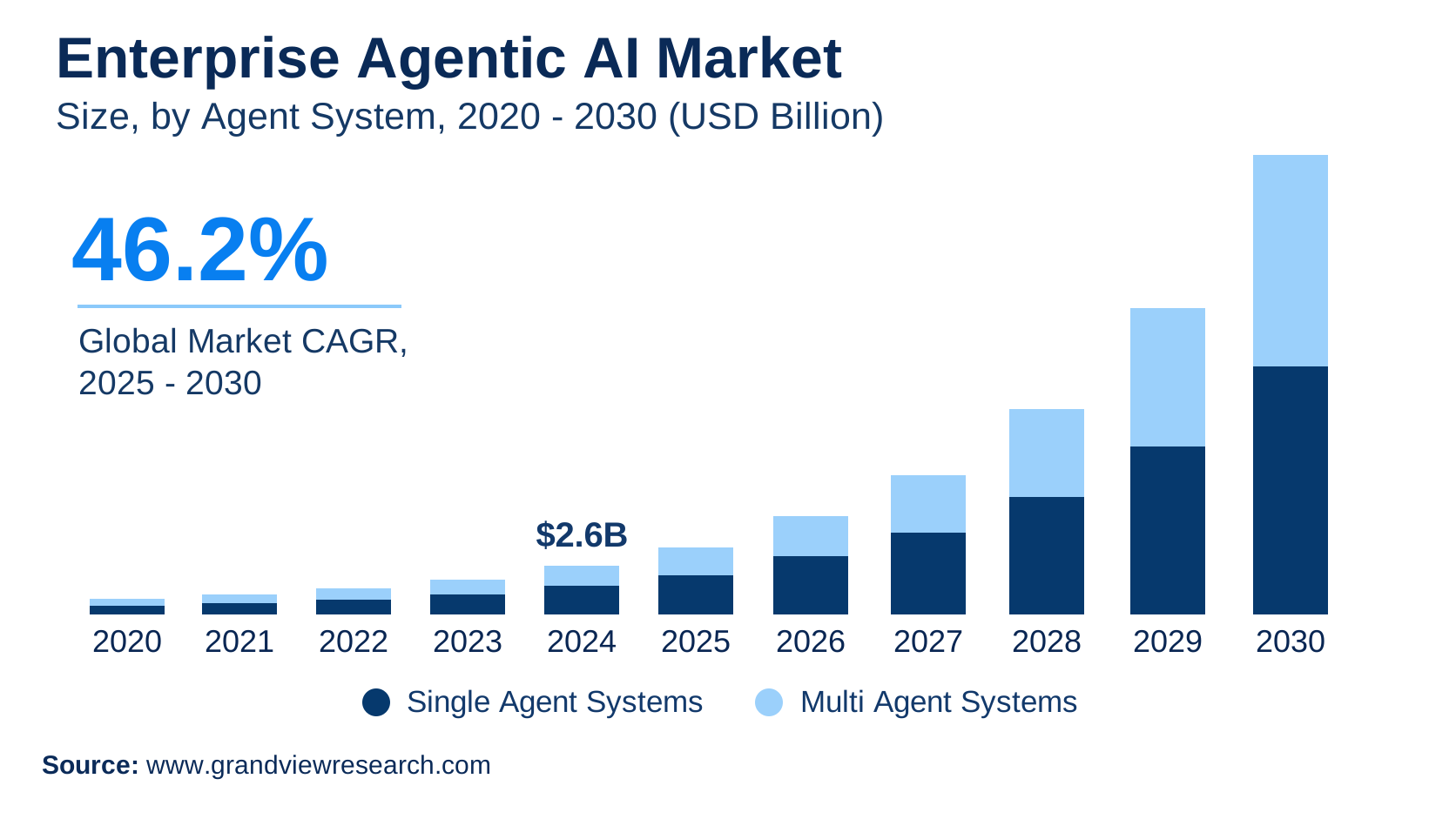
The global enterprise agentic AI market is projected to increase from USD 5.3 billion in 2026 to USD 24.5 billion by 2030. That represents a 46.2% CAGR during the forecast period.
Access, Accountability and Audit Before Production
When external engineers build agents, access and responsibility need clear boundaries. Before production, define who can access what, who approves actions, how activity is tracked, how systems can be stopped and who owns the IP.
- Access: External engineers only have access to the systems, data and environments required for their role.
- Approval: High impact agent actions have defined human approval points.
- Kill switch: Someone with clear authority can stop the agent quickly if it behaves unexpectedly.
- Audit: Important actions, tool calls, approvals and changes are logged and traceable.
- IP: Contracts clearly define ownership of code, workflows, prompts, configurations, data and other project outputs.
- Workload limits: Connect agents to up-to-date capacity and on-call schedules. Set assignment limits and require manager approval before reallocating tasks or changing sprint commitments.
Ownership by engagement model: Under staff augmentation, clients generally own project-specific prompts, data pipelines, custom models and code when covered by IP assignment clauses. Under managed services, ownership and usage rights depend on the contract. Pre-existing vendor IP, third party models and licensed tools remain subject to their respective terms.
When contractors use AI coding agents, apply the same least privilege approach to the tools they use. Restrict repository and production access, protect secrets, require code review and log AI generated changes before deployment.
The goal is very simple such as give external engineers enough access to do the work, while keeping critical decisions, visibility and responsibility clearly assigned.
REAL WORLD CASE STUDY: ThinkDeep AI and France’s Public Sector
ThinkDeep AI developed DeepBrain with NVIDIA to help French government organizations to process large volumes of documents through multi-agent AI while keeping sensitive data within controlled infrastructure.
Reported results:
- 2 days → 2 minutes: Document retrieval time
- 1,000 hours/month: Time saved in a typical 100 user deployment
- €2 million saved: Reported savings across 10,000 Ministry of Finance employees
- On premises infrastructure: Sensitive data remains within the ministry’s controlled environment
Defining Responsibilities Across Human Agent Teams
A hybrid team does not mean replacing people with agents. It means giving each side work that matches its strengths while keeping the important decisions with people.
Let the agent handle
- Repetitive, rule based tasks
- Multi step workflow execution
- Data gathering and processing
- Tool calls and routine system actions
- Drafting and first pass analysis
Keep with humans
- Business priorities and decisions
- Approval of high impact actions
- Handling exceptions and vague cases
- Security and access decisions
- Accountability for outcomes
The staffing implication is important: external engineers may help build and operate the agent but the business should decide what the agent does, where it can act and when a person must take over.
COMMUNITY PERSPECTIVE
As Zane Griffin, a Quora contributor explains in simple terms while conventional AI reacts to commands, agentic AI is capable of planning multiple steps in order to achieve a certain goal.
What Should You Budget for Agentic AI Staff Augmentation?
Agentic AI projects have cost drivers that traditional development estimates may not capture. The final budget depends on the people involved, technical complexity, risk controls and work required after launch.
Start with the team: Specialized agent engineers, software engineers, evaluators and security expertise can affect the baseline cost.
Add the project complexity: More integrations, tools, workflows, data sources and autonomy usually mean more engineering and testing.
Account for controls: Security reviews, permissions, audit logs, human approvals and evaluation add work but should not be treated as an optional extras.
Plan for production: Monitoring, maintenance, model changes and incident handling can continue after the initial build.
As a rough 2026 benchmark US based agentic AI engineers may cost around $25 to $200 per hour through the staff augmentation depending upon experience, specialization and project requirements.
The cost of hiring Agentic AI engineers varies by experience, location, technical skills, project complexity and engagement length. Businesses should compare the work included in the quoted price rather than looking at hourly rates alone.
For example a 30 person engineering team planning to use AI agents for task allocation and workload forecasting may have the following implementation costs:
| Implementation stage | Timeline | Estimated cost |
| Pilot implementation | 4-8 weeks | $25,000 – $60,000 |
| Production rollout | 3-5 months | $60,000 – $180,000 |
Indicative planning estimates. Actual costs depend on integrations, data quality, security requirements and automation complexity.
Staff augmentation can reduce the cost of maintaining a permanent specialist when agentic AI expertise is needed only for a specific project or period. The actual saving depends upon engagement length, hiring costs and whether the role would otherwise require a full time hire.
Planning formula: Team + Complexity + Controls + Ongoing Operations = Total expected cost
The most useful comparison is therefore the total scope of work, not the lowest quoted rate.
INDUSTRY EXAMPLE
Meta is building AI agents that can act not just respond
Meta has been developing agentic AI capabilities that can perform multi step tasks, use tools and assist users beyond simple question and answer interactions. This shift shows why agent projects need specialized engineering, testing, access controls and human oversight not just general AI development skills.
MARKET GROWTH
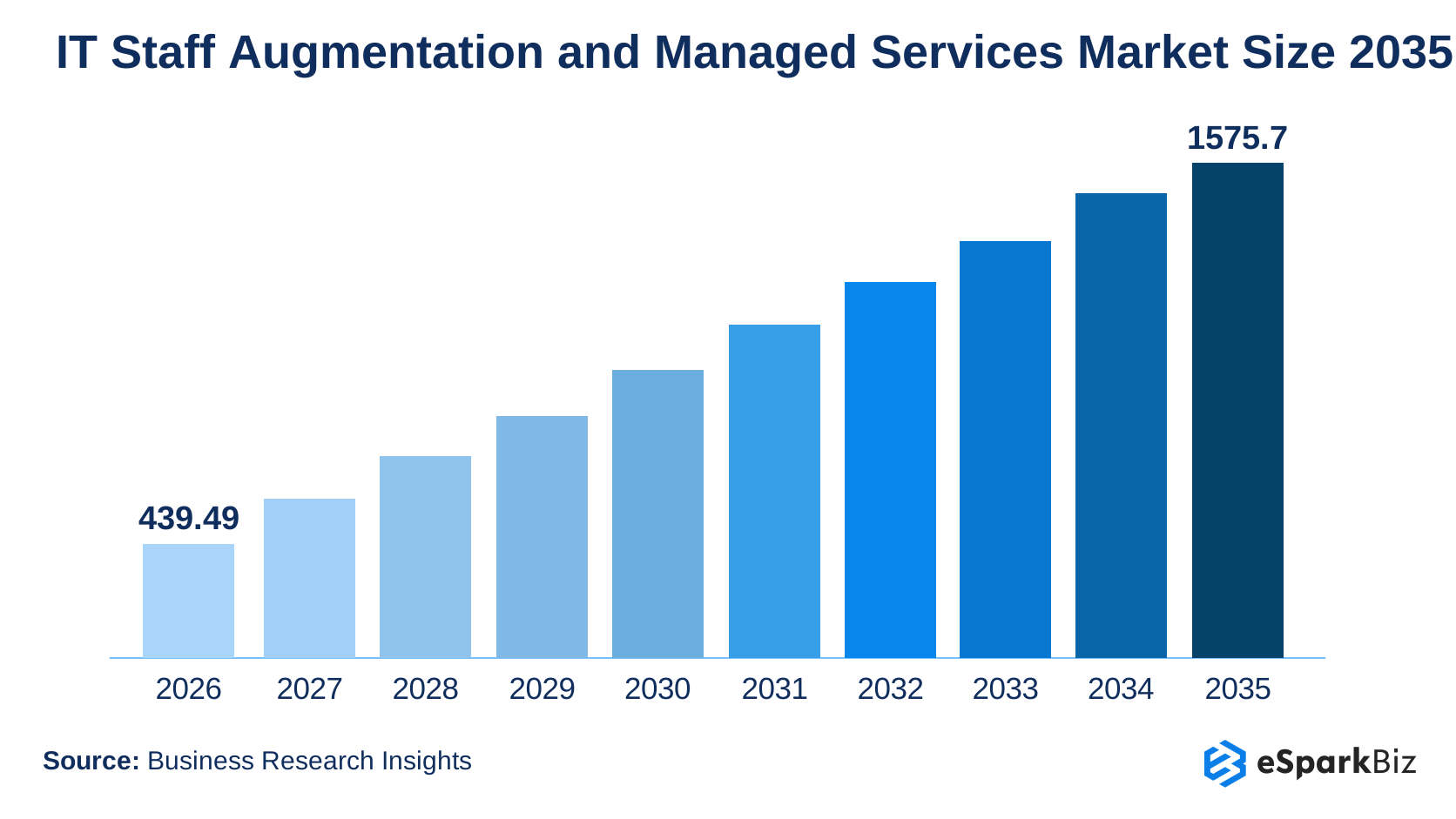
IT staffing and managed services are becoming a major business market
The global IT staff augmentation and managed services market is projected to grow from USD 439.49 billion in 2026 to USD 1.58 trillion by 2035 representing a 13.7% CAGR over the period.
How to Validate Agentic AI Before Scaling
A pilot gives businesses a simple way to test an agent before committing more people, budget or system access. Keep the first use case narrow & define the expected outcome before the development starts.
Start with:
- One clearly defined process
- One measurable goal
- Limited system access
- Assigned team member
Then set the exit test:
- Continue if the agent meets performance, control and business targets.
- Adjust if the core approach works but specific gaps remain the same.
- Stop if the expected value or risk threshold is not acceptable.
This makes the staffing decision evidence based rather than just driven by any false assumptions.
Working with eSparkBiz for Agentic AI Staff Augmentation
eSparkBiz helps US businesses add skilled AI and software developers to their existing teams. Its staff augmentation model lets businesses choose engineers, set project priorities and maintain control over product decisions and delivery.
How the engagement works:
- Technical team selection: Identify the required Agentic AI skills, review shortlisted profiles and interview engineers before onboarding.
- US time zone collaboration: eSparkBiz provides overlapping working hours for US teams with schedules agreed according to the project requirements and collaboration needs.
- Contract and IP protection: eSparkBiz uses MSAs and NDAs to define payment terms, IP ownership and project responsibilities.
- Integration with existing teams: Augmented engineers work within your existing repositories, project management tools, communication channels and sprint workflows.
- Security and governance: eSparkBiz follows documented security practices including ISO 27001:2022 certification, access controls and NDA protected engagements.
For businesses planning Agentic AI projects eSparkBiz can provide engineering support across agent development, integrations, testing and production deployment while internal teams retain the control over business priorities & critical decisions.
Before starting any project define the required expertise, working hour overlap, deliverables, IP assignment, access permissions and replacement terms in the engagement agreement.
Frequently Asked Questions
What is Agentic AI in Staff Augmentation?
It means adding external specialists with agent development skills to an existing team. The internal business continues to guide the product, workflow, access and important decisions.
When is Agentic AI staff augmentation a good fit?
It is a good fit when your team has:
- A clear business process
- An internal person to manage the project
- Skills that your current team lacks
- The ability to guide and review external engineers
When should you not use staff augmentation for Agentic AI?
Avoid it when your team lacks clear ownership, not just enough people. If nobody internally manages the project, the task is unclear or your team cannot guide external engineers, adding more people may not fix the problem.
What roles are needed for a production AI agent?
Team requirements depend on the project but a typical team needs:
Build: Agent and software engineering
Test: Evaluation and quality testing
Protect: Security and access control
Decide: Product or domain ownership
These responsibilities can be shared across the few people in a smaller project.
How should businesses control external access to AI agents?
Think in terms of least necessary access:
| Control | Purpose |
| Role based permissions | Limit system access |
| Approval points | Review high impact actions |
| Audit logs | Track important activity |
| Kill switch | Stop unexpected behavior |
| IP clauses | Define ownership of project assets |
What factors affect the cost of Agentic AI staff augmentation?
The cost mainly depends upon engineer experience, project complexity, system integrations, testing, security requirements and ongoing support. Comparing hourly rates only may not show the full cost of the project.
How should a business test Agentic AI staff augmentation before scaling?
Then decide what to do based on the results:
- Meets targets: Expand the project.
- Some issues remain: Make changes and test again.
- Does not meet business needs: Stop the project.
What if my team has the right product knowledge but lacks Agentic AI expertise?
You do not need to replace your existing team. eSparkBiz can add Agentic AI experts to help with agent development, system integrations, testing and preparing agents for real use while your internal team continues to manage the product.
Should I use staff augmentation or hire full time Agentic AI engineers?
Choose staff augmentation when you need extra skills or engineers for a specific period. Hire full time engineers when you need an in house Agentic AI team for long term work. Consider your project timeline, skill gaps and future plans before deciding.
Who are the top AI agent development companies?
Compare companies based on production experience, tool integrations, security practices and engagement models such as staff augmentation or full project delivery. Notable companies include eSparkBiz, Softermii, Plavno, Biz4Group LLC and Spiral Scout.
What is the difference between AI staff augmentation and project outsourcing?
The main difference is control and delivery ownership:
- AI staff augmentation: External AI engineers join your existing team while you manage tasks, priorities and project decisions.
- Project outsourcing: An external provider manages the project including development, delivery and agreed responsibilities.
Choose staff augmentation when you need specialized skills and internal control. Choose project outsourcing when you want an external team to manage delivery.
How do you coordinate AI coding agents and contract developers working on the same repository?
Decide who is responsible for each file, module and database change before work starts. Use separate branches, assign people to manage database changes, review pull requests and run automated CI checks to avoid conflicts. Make sure AI agents and developers coordinate before changing shared components or merging code.
How should businesses measure AI assisted engineering output without gaming productivity metrics?
Measure completed work based on its quality and business results, not just the number of tickets closed. Track completion time, how often your code is released, errors, repeated work, code review results and sprint goals. Keep human approval for code merges and major changes. Compare results with earlier performance and avoid rewarding teams or agents just for closing more tickets.
What is the hourly rate for an Agentic AI engineer through the staff augmentation and what affects the cost?
Agentic AI engineers may cost around $20 - $200 per hour through the staff augmentation and it is depending on location, experience, technical skills and project requirements. Rates also vary with integration complexity, security requirements, engagement duration and production support needs.
AI staff augmentation vs. project outsourcing for building AI agents: Which offers more control and lower risk?
The choice depends on your team's capabilities and level of control you need:
- Staff augmentation: More control over developers, priorities, workflows and product decisions. Best when you have an internal project owner.
- Project outsourcing: The external provider manages delivery and reduces your team's management effort but requires clear contracts, security controls and IP terms.
Choose staff augmentation for greater internal control and project outsourcing when you need ownership for external delivery.

 August 17, 2026