
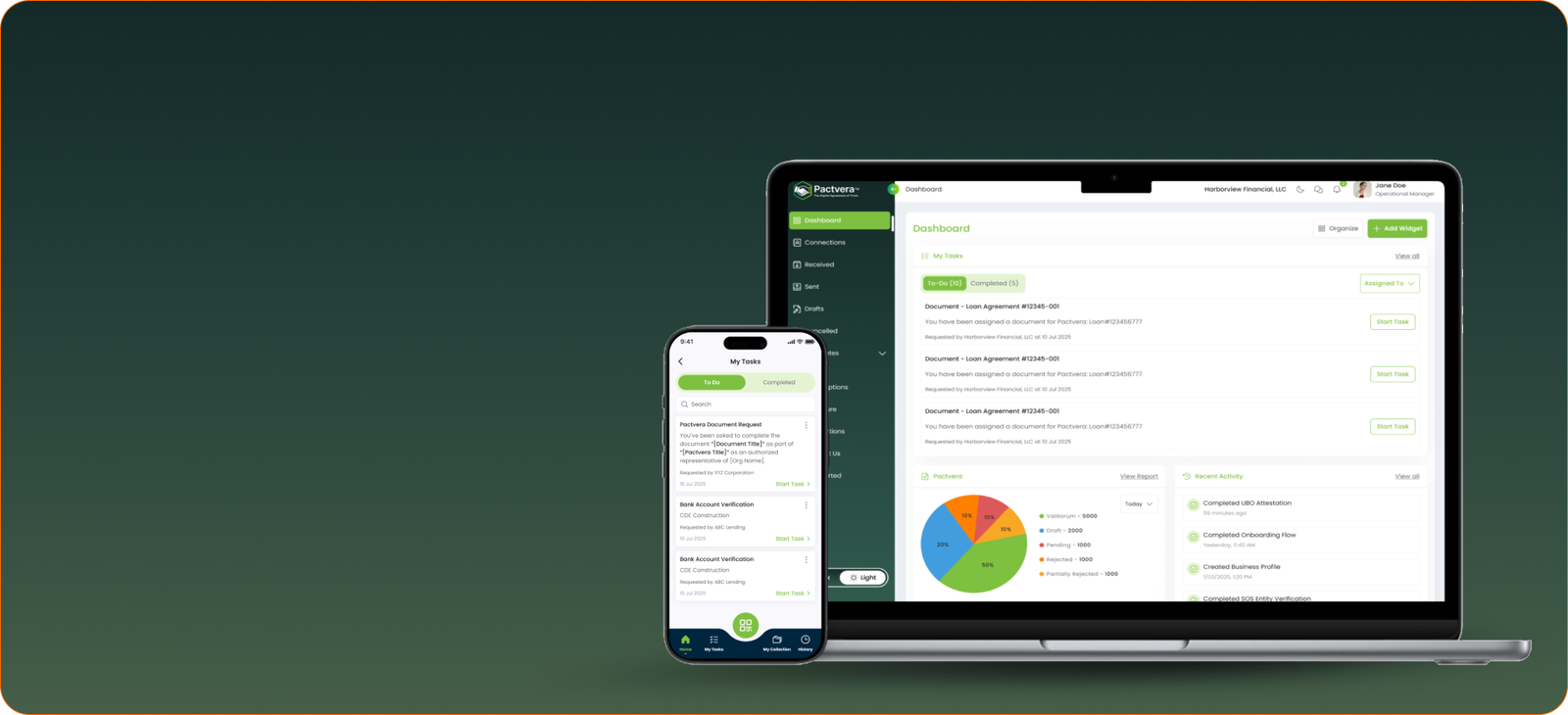
Summary

eSparkBiz partnered with a blockchain solutions provider to develop an advanced digital agreement and contract execution platform designed to unify identity verification, legal enforceability, smart contract automation, and blockchain-backed auditability within a single ecosystem. Unlike traditional e-signature solutions that primarily verify email access and document interaction, the platform ensures comprehensive validation of signer identity, organizational authority, contract conditions, and execution requirements before any agreement is finalized.

Project Overview

Ask what a digital signature actually proves. Someone opened a document. Someone clicked a button. An email address was on file. That’s the full extent of it. Who that person really was, whether they were authorized to sign on a company’s behalf, or whether the legal conditions within the contract were truly satisfied before execution none of that is answered by a standard e-signature. It simply creates the appearance of validity.

This gap led to the development of a new kind of digital agreement platform—one where every participant undergoes biometric identity verification before taking any action, where the contract itself enforces validation checks through embedded logic, and where the final output is not just a static document but a blockchain-sealed artifact carrying cryptographic proof of who agreed, under what conditions, and with what authority.

The solution was built end-to-end, covering the web platform, agreement creation and templating workflows, and a Business Rules Engine that enables conditional contract execution. It includes a tokenized event pipeline that records each interaction on-chain, a framework for embedding and releasing tokenized value within agreements, a granular audit trail capturing every user interaction, and a finalization system that produces a verifiable, tamper-proof digital artifact.

The platform also integrates biometric identity verification and organizational authority validation systems to ensure that every signature is not only authenticated, but legitimately authorized within its business context.

Full-Stack Web Application Development
Smart Contracts & BRE
Biometric Identity
Blockchain & Valitorum Minting
VDT Architecture & Token Grading
TCA Framework
Touch Audit™ Trail
ARP Integration
UI/UX Design & Testing
QA & Compliance Validation
98%
Core Components Integrated
100%
On-Chain Immutability
95%
Compliance With URPERA, UETA & ESIGN Standards
0%
Disputes Possible Without Forensic Evidence

The Problem

E-signature tools solved a real problem getting wet signatures out of the workflow. But in doing that, they quietly introduced a different one: agreements that look verified but aren't, really. For routine low-stakes transactions, that's fine. For anything with legal, financial, or regulatory weight, the cracks start to show.

Unverified Signer Identity

Standard e-signature platforms log a device, an IP address, and an email. That's their proof. It tells you something accessed a document nothing about who that person actually was. Shared inboxes, delegated accounts, and outright impersonation all slip through without any friction. The signature looks valid right up until someone challenges it.

Unverified Signing Authority

Companies sign agreements through people officers, executives, authorized representatives. But most digital agreement tools have no way to confirm that the person signing actually had the legal authority to do so on behalf of their organization. That assumption works until a deal falls through and the counterparty argues the signatory had no authority. Then it gets expensive.

No Automated Contract Execution

What happens after a contract is signed fund disbursements, license activations, service triggers has always lived outside the agreement itself. It required manual follow-through, separate systems, and trusting both parties to honor the terms. There was no mechanism inside the contract to actually make any of it happen automatically.

No Enforceable Contract Logic

Contracts are full of conditions age restrictions, jurisdiction clauses, approval requirements, time-sensitive terms. In a typical digital agreement, those conditions are described in text. They're not enforced anywhere. The platform lets anyone sign regardless of whether they actually meet the contract's own requirements. Nobody checks.

Weak Audit Trail

Completion certificates showing timestamps and IP addresses have become increasingly easy to challenge in legal settings. Courts want to know whether a real person with real identity was present at the point of signing and an IP address doesn't answer that. Most e-signature audit trails are thin enough that a determined challenge can put the whole agreement in question.

Fragmented Compliance Evidence

Even organizations with decent compliance practices ended up with their evidence spread across five systems an e-signature certificate here, an identity check there, a compliance screening result somewhere else. Reconstructing a complete picture for an audit or a legal dispute took significant effort, and the pieces didn't always fit cleanly together.

Our Methodology

Intersection of identity, smart contract logic, and legal compliance. You can't design one of those layers properly without understanding how it affects the others. That informed how we structured the whole development process.

Discover

We started with the legal question, not the product question. What does a court actually need to see to accept a digital agreement as evidence? What do URPERA, UETA, and the ESIGN Act require? Where do existing e-signature platforms fall short against those standards? The answers shaped the product brief more than any market research would have.

Define

Six components made for biometric identity, the BRE for embedded contract logic, VDT for on-chain event recording, TCA for tokenized value, ARP for authority validation, and Touch Audit for the interaction trail. Defining how those six pieces fit together and particularly how they hand off to each other in sequence was where most of the architectural thinking happened.

Design

The UX problem on this project was genuinely tricky. The platform handles concepts that most users have no mental model for smart contract conditions, token minting, biometric attestation and it had to present those through an interface that felt like a professional agreement tool, not a blockchain demo. We went through several rounds of redesign before the complexity felt properly invisible.

Develop

The build covered everything: agreement creation and templating, BRE logic configuration, VDT minting, TCA embedding and release, authentication, ARP authority checking, Touch Audit logging, and Valitorum finalization. These systems intersect at multiple points in the agreement lifecycle, so execution order had to be deterministic and every state transition had to be logged correctly for the audit trail to hold up.

Validate

On a platform designed to be court-admissible evidence, the failure paths matter more than the happy path. We specifically tested the scenarios that would create legal exposure if they went wrong BRE rules that should block execution but don't, ARP rejecting an unauthorized signer, TCA triggering before conditions are fully met. Each one was resolved before we handed anything over.

The Solution

Replaces passive document signing with an active, identity-verified, logic-governed process. Here is what actually changed for the organizations using it:

Biometric Identity At The Moment Of Agreement

A verified face scan, liveness detection, and government ID to the individual before they can take any action. The result is that every signed agreement is backed by proof of a real, physically present person not just a device that happened to be logged in. That distinction is what makes the difference when an agreement gets challenged.

A Rules Engine That Can Actually Say No

The BRE sits inside every runs before execution is allowed. Age checks, jurisdiction validation, role restrictions, multi-party approval requirements these aren't text in a document anymore, they're conditions the system evaluates. If something fails, doesn't go through. The contract enforces its own terms, which is something no static PDF has ever been able to do.

Organizational Authority That's Documented, Not Assumed

Before a representative can finalize on behalf of their organization, their authority is resolved against the organization's verified role registry through ARP. That resolution becomes part of the agreement record. There's no "I assumed they were authorized" argument available later the authority was checked and logged at the time of signing.

Value Embedded Directly In The Agreement

TCAs let organizations embed funds, licenses, rights, or digital deliverables directly inside. When the contract conditions are satisfied, the TCA executes escrow releases, a license activates, an asset transfers. The agreement stops being a record of what should happen and becomes the mechanism that makes it happen. For anything that can be digitally automated, the manual follow-up layer largely disappears.

A Forensic Record, Not Just A Log File

VDTs capture every meaningful event in the agreement lifecycle who acted, what they did, when, where, on which device, and with what identity verification strength. Each token is graded based on biometric quality, device trust, and data integrity. Touch Audit weaves these into a complete interaction trail. The output isn't a flat log someone can question. It's scored, timestamped, biometrically anchored evidence.

Everything Sealed Into One Artifact

The Valitorum is what you get at the end of a completed a court-admissible, blockchain-stored, jurisdiction-tagged document that contains the identity records, authority proofs, contract terms, BRE outcomes, TCA state, and full audit trail in one place. URPERA and UETA compliant by design. When someone needs to prove what was agreed and by whom, there's one object to point to.

Interface Highlights

A modern, intuitive interface designed to simplify secure digital agreement creation, validation, and execution. Seamlessly integrates identity verification, contract logic, and blockchain-backed finalization into a unified user experience.

Behind The Scenes

ost of the hard work in this build was in the parts users never directly interact with execution sequencing, token grading logic, smart contract conditions, and a biometric-to-blockchain pipeline that had to be reliable enough to constitute legal evidence.

Phase 1

Legal & Compliance Research

We mapped what courts and regulators need from a digital agreement before we designed anything. URPERA compliance, UETA requirements, ESIGN Act provisions, non-repudiation standards all of it informed the data model and the Valitorum specification from the start. Retrofitting legal requirements into an existing architecture tends to produce gaps. We wanted to avoid that.
Phase 2

Architecture & Component Sequencing

Six core components, each with distinct technical and legal weight, all needing to work together in a specific sequence. The architecture work focused heavily on how each component hands off to the next, what triggers VDT minting at the right moments, and how execution state gets tracked across a multi-party agreement flow. Getting that sequencing wrong would produce audit gaps, so it got significant attention.
Phase 3

Business Rules Engine

The BRE had to handle real contract conditions expressively while staying deterministic and legible to a non-technical legal reviewer. Jurisdiction checks, age gates, role restrictions, time-based clauses, multi-party consent all of it running inside the agreement itself. The challenge was making the rule configuration flexible enough for real-world complexity without producing logic that nobody could later explain to a judge.
Phase 4

VDT Pipeline & Token Grading

VDTs needed to fire at the right points in the lifecycle and carry consistent, defensible metadata. The grading system was built around objective criteria biometric verification strength, device trust level, data immutability score rather than an arbitrary tier system. Each grade had to mean something specific that a legal or compliance reviewer could interpret without needing a technical explanation.
Phase 5

TCA & Smart Contract Layer

Embedding value inside an agreement and having it release correctly when conditions are met and only then required a smart contract layer with thorough condition validation and well-defined failure handling. The TCA framework covers funds in escrow, license transfers, digital assets, and service entitlements. Each type has its own release logic and its own set of failure states that had to be handled without leaving assets in a broken intermediate state.
Phase 6

Valitorum Finalization & End-to-End Testing

Pulling all six components together into a single finalized artifact was the last integration point and the one where any gap in the preceding phases would show up. Testing ran through every legal failure mode we could construct: BRE rules that should have blocked but didn't, ARP edge cases, TCA releasing on partial completion, audit trail gaps from interrupted flows. The platform didn't go live until all of those were resolved.

What Sets Us Apart

What makes different from an e-signature tool isn't any single feature it's the combination of things it does that standard platforms simply don't attempt.

Verified People, Not Verified Devices

Biometrics at the point of action means every signer is confirmed as a real, physically present individual. Email access does not equal identity here. That changes the legal standing of every agreement the platform produces.

Contracts With Logic Baked In

The BRE makes contracts active rather than passive. Invalid signers get blocked before execution. Jurisdictional requirements are checked programmatically. Deadlines enforce themselves. The amount of compliance work that used to require human review or just got skipped gets handled by the agreement itse

Authority That's On the Record

ARP checks whether the person signing has documented organizational authority to do so, and that verification is embedded in the agreement. If a dispute comes up months later about whether the signatory had authority, the answer is already in the record.

Agreements That Execute Their Own Terms

TCAs mean the gap between signing and fulfillment shrinks dramatically for anything that can be automated. Money releases. Licenses activate. The contract isn't just describing what should happen it's making it happen when the conditions say it's time.

Evidence-Grade Audit Trail

Touch Audit combined with VDT grading produces something considerably more robust than a standard completion certificate. Biometrically anchored, privacy-preserving, graded by identity strength it was designed from the start to survive a legal challenge rather than just check a compliance box.

One Object, All the Proof

The Valitorum brings everything together. Identity, authority, contract terms, BRE results, TCA state, full audit trail all in one blockchain-sealed, court-admissible artifact. No pulling records from five different systems when something needs to be proven. It's already there.

The Power Of BlockChain In Our Product

Contracts with Biometric Execution

Contracts are executed with biometric verification, tying signatures to real, verified identities. This ensures authenticity of who agreed, what was agreed, and when.

Valitorum Artifacts Anchored On-Chain

Each contract generates a cryptographically sealed, blockchain-anchored document. These artifacts serve as independently verifiable, court-admissible proof.

VDT Audit Tokens for Transaction Integrity

VDTs create a step-by-step, immutable audit trail across the contract lifecycle. Every action is recorded in sequence and cannot be altered.

TCA Tokenized Value Settlement

Contract value is tokenized and settled on-chain using TCA. This reduces manual reconciliation and lowers settlement risks.

Touch Audit Trail for Every Contract Interaction

Every interaction with a contract is logged on-chain. This creates a complete, unbroken record of all activity from creation to completion.

The Tech Behind It

A robust, future-ready technology stack designed to ensure scalability, security, and seamless system interoperability across all platform layers. Combining modern web technologies with blockchain, biometric identity, and zero-knowledge auditing to deliver trust, automation, and verifiable digital transactions.
AWS
AWS
Biometric Identity Integration
CSS3
CSS3
HTML 5
HTML 5
JavaScript
JavaScript
Node.js
Node.js
PostgreSQL
PostgreSQL
React.js
React.js
Smart Contracts & Business Rules Engine (BRE)
Tokenized Consideration Asset
Valitorum & VDT Storage
Zero-Knowledge Audit Trail

Impact & Outcomes

Twenty years of digital agreements and the core problem was never really solved. Signing got faster, yes. But the question of whether that signature actually meant something whether it proved human intent, verified authority, or satisfied the contract's own conditions stayed unanswered. It is the first system we've worked on that takes a proper run at answering it.
Organizations on the platform aren't just running a more efficient signing process. They're producing agreements with a fundamentally different evidentiary weight behind them. A Valitorum contains the full picture: who was verified, that they had authority, that the contract's conditions were met, and a complete record of how it all unfolded. A PDF with a typed name in a signature box doesn't come close.
For industries where this actually matters real estate closings, financial agreements, regulated supply chains, healthcare consent the practical impact is meaningful. Disputes that used to end up in arbitration because the evidence was ambiguous now have a clear resolution. The proof isn't reconstructed from scattered records. It's in the Valitorum.
We built from the ground up the architecture, smart contract infrastructure, biometric integration, blockchain layer, and the compliance logic running through all of it. It's genuinely one of the more complex builds we've taken on, and the problem it solves was worth the effort.

Full-Stack Web Application Development
Smart Contracts & BRE
Biometric Identity
Blockchain & Valitorum Minting
VDT Architecture & Token Grading
TCA Framework
Touch Audit™ Trail
ARP Integration
UI/UX Design & Testing
QA & Compliance Validation
98%
Core Components Integrated
100%
On-Chain Immutability
100%
Compliance With URPERA, UETA & ESIGN Standards
0%
Disputes Possible Without Forensic Evidence
Craft your next digital masterpiece with our IT experts
Business professionals discussing project details at eS corporate office.

Related Portfolio

Miova – Effortlessly Perfecting Corporate Communication

Miova is an internal email platform that lets you communicate with your team members without using external services. Here we can create, send, and track emails easily, and get feedback…

Revolutionizing Healthcare Staffing – Empowering Clinicians and Facilities, One Shift at a Time

The web platform for  Staff management system in the healthcare domain named Sadiant is a comprehensive solution designed to streamline and simplify the process of managing healthcare professionals and their…

Revolutionizing Fitness with an Innovative Platform for Health and Wellness

The app is designed to help users maintain a healthy lifestyle by providing easy access to fitness information and tools on-the-go. A fitness app aims to empower users to take…

DSD: Intelligent AI Platform for Dental and Facial Imaging

DSD is an AI-native dental and aesthetic imaging platform designed to redefine how clinicians analyze facial and dental structures for smile design and aesthetic treatment planning.

Cyti Psychological

Cyti Psychological is a comprehensive telehealth and patient care management platform developed by eSparkBiz that streamlines appointment scheduling, virtual consultations, patient communication, billing, and EHR integration within a secure, HIPAA-compliant…

banner-decorate-right