 Last update date:


Quick Summary :-
The IoT sector has expanded quickly in recent years, reaching almost every industry. This blog presents important IoT use cases that show how connected devices exchange data, assist with routine processes and maintain real time coordination across homes, office settings and large operational systems.IoT or the Internet of Things, simply means everyday devices connected to the internet so they can send and receive data. This connection helps homes, businesses and industries work more smoothly through smart automation and real time interactions.
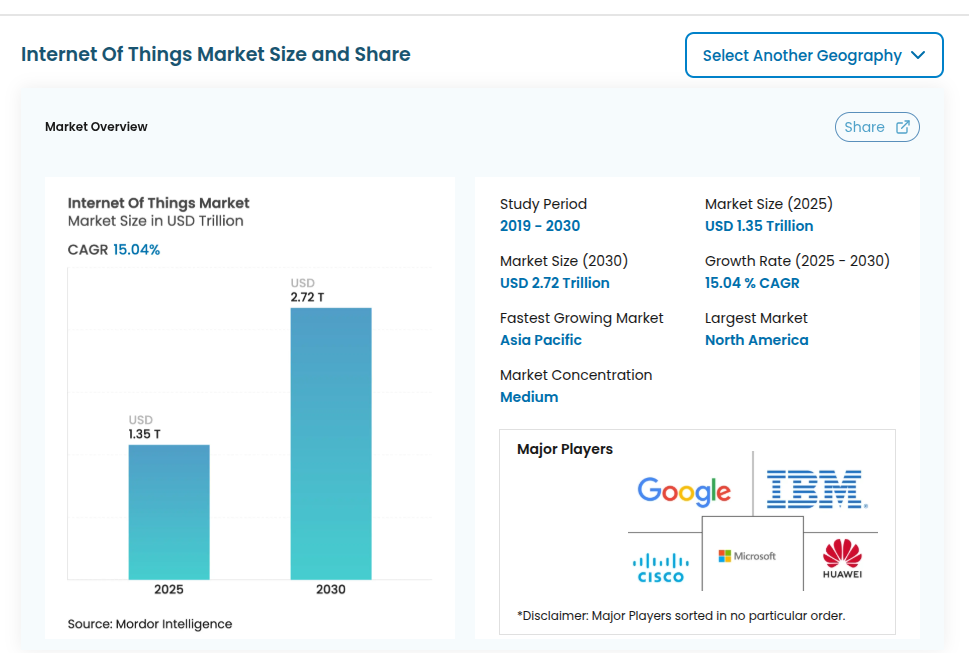
The Internet of Things market stands at USD 1,350 billion in 2025 and is projected to reach USD 2,720 billion by 2030, growing at a 15.04% CAGR, reflecting the rising demand for connected and intelligent solutions worldwide.
With its expanding impact, IoT is becoming a core element of modern operations, improving accuracy, reducing manual efforts and supporting real time insights. Understanding its practical uses helps businesses and individuals gain value from connected technologies.
Noteworthy Internet of Things Use Cases
These IoT use cases help explain how real time connections between devices shape routine processes in homes, offices and industrial spaces.
Autonomous and Connected Vehicles
Cars running without drivers? Some people may faint after hearing this. But, this is going to be the reality, thanks to IoT. Experts are already working on up to level 4 autonomy, and the onset of 5G and IoT, through level 5 autonomy would transform the experience of car riding without human intervention.
The LIDAR, satellites, GPS, and onboard cameras will be used to capture and store the information about the road condition, traffic, and nearby cars, thus helping to prevent accidents.
Moreover, the IoT-equipped devices would help in enriching the GPS and infotainment arrangements. IoT Applications and Examples are proof of that.
Example:
Waymo’s self driving cars already operate in select U.S. cities, using real time IoT sensors and AI to navigate traffic, detect hazards and ensure safer autonomous rides.
Smart Security
Smart security systems have replaced traditional peepholes, offering IoT-powered devices like connected cameras, smart locks, and thermostats. These solutions enhance safety for homes and businesses by providing real time visibility of people entering or leaving a property.
Advanced IoT security devices can even identify individuals and allow remote monitoring from any location with a stable WiFi connection. To fully benefit from such systems, it is essential to address IoT security challenges effectively.
Example:
Ring’s smart doorbell cameras let users view visitors, receive instant alerts and monitor entry points remotely through IoT connectivity, improving home security convenience.
Smart Home
Let us understand IoT by a simple example. Suppose, you have forgotten to switch off the lights in your room at the time of leaving your house for the office. Now, suddenly you remember the ‘crime’ you have done.
In earlier days, there was no way to save electricity, thanks to the work you have done. In the days of IoT, all you have to do is to instruct your smart home device to switch off the lights. Hurray, electricity is saved.
By enabling your household with the help of a voice assistant device, you can perform tons of activities by just sitting in a corner, starting from instructing your TV to play your favorite show to dim the lights.
Example:
Amazon Echo and Google Nest are some of the Most Popular IoT Devices that can make your home smart.
Smart Watches, Fitness Trackers & Other Wearables
Now, the time has come in the days of IoT Use Cases when you can just get a wearable device and forget about your smartphones.
People are preferring to use a smartwatch, connected with their smartphone to perform tons of functions from receiving a call, keeping their health data, measuring heartbeats while running, finding a location, and so on.
But, due to some issues regarding screen size, ease of use, and privacy, the number of wearable users started to decline and that plunge has motivated the developers to build an alternative, and that is ‘Hearables’ which are voice-connected with wireless earphones.
Machine-to-Machine (M2M) Connected Devices
The era of the IoT revolution is not only perceived by the end-user of the product, but also by the manufacturing industry.
IoT Manufacturing Use Cases has become so rapid in the industries that it may help the workers to monitor the workload of the devices, thus avoiding damage and accidents.
Not only this, but IoT devices also help M2M connected devices to keep track of the depreciation that a machine undergoes in the process of production and thus advising a timely replacement.
This highly advanced technology is going to transform the manual industries as automated industries and thus to enhance the efficacy of the machines.
Supply Chains
IoT now plays a key role in supply chains, helping companies improve visibility, coordination and handling. Using GPS and connected sensors, businesses track goods, monitor movement and maintain quality across procurement, shipping and final delivery stages.
IoT devices provide real time location updates so teams know where goods are at any moment. These sensors also track warehouse capacity, product condition and temperature, enabling better storage practices and smoother inventory planning.
Example:
Maersk uses IoT enabled trackers to monitor containers in transit, giving real time data on location, temperature and condition to maintain quality during long journeys.
Drones
The ubiquitous presence of drones has made it one of the most popular IoT devices in various fields. For instance, in agriculture, industry, mining, rescue operation, wildfire control, law and order administration, construction sites, photography, and filming, and whatnot!
Drones are now even used by e-commerce companies to serve their customers at their doorstep.
Police are using it to control riots and unforeseen terrorist activities, agriculturalists are using it for pest control, and directors nowadays can’t think of making a movie without using drones.
Smart Cities
Smart cities are those cities that, with the help of IoT-enabled devices gather information and data about the things and people of that city.
By processing those data the city administration helps to improve the condition of public life, public utilities, and various public facilities.
Starting from automated traffic signals in terms of traffic, public communication, advanced transportation, environmental safeguards, easy parking to safety, and security, all these are the fundamental tenets of a smart city.
Smart City Growth
By the end of 2025, nearly 26 smart cities are expected globally, including 16 in North America and Europe and others developing across the Asia Pacific region.
Farm to Tech to Table
In countries where Agriculture serves a great portion to bolster the GDP of a country, using IoT-connected devices to improve the way of agriculture is a necessity.
These days, farmers, having large livestock, use sensors to locate and identify each of the animals, and imminent dangers on a real-time basis.
In the field, they can get an idea of the temperature, the soil moisture, based on which they can use the fertilizer and irrigation system.
They can also identify any disease in the livestock population which helps them to identify and isolate that particular animal to avoid contamination.
Inventory Management
Inventory management has been a great challenge in the retail business, but IoT Retail Use Cases has reduced the problem in several aspects.
As mentioned above, apart from tracking the location of goods and items, IoT-enabled devices are capable of using technology to keep a better record of all the goods and products coming in and out of a store.
Inventory management entails both shelf management and warehouse management. Through IoT devices and sensors, retailers can have a look at the condition of the products (broken or rotten).
IoT enables better and efficient Inventory management through accurate and cost-effective technology.
Predictive Maintenance
Any company or industry that relies on heavy and dedicated hardware machines, like vehicles, automated Kiosks (in banks and corporates), and manufacturing machines have seen the machines undergoing wear and tear in the due course of time.
A timely and early notification regarding the repair of the machines could lead to preventive maintenance and thus helps to save a huge amount.
IoT-enabled devices are nothing but internet-connected microcontrollers that always keep a close look at the condition of the machines, and provide early warning signs whenever necessary.
This has improved the working efficiency of the machines to a great extent.
Also Read: Internet of Things (IoT) Applications and Real World Examples
Optimized Production
IoT Use Cases in optimized manufacturing of products have been proved very effective to bring in new approaches, technology, and infrastructure. To optimize production, a detailed analysis of big data is necessary for the production units.
IoT enabled devices to help to analyze and process this big data to use manufacturing intelligence to optimize and channelize the production to be adapted in a new business model.
IoT helps to glean a lot of information from various sources. With the help of artificial intelligence and internet-connected devices, it tries to improve the capital investment in the right direction, and area of production and manufacturing to satiate the thirst of targeted consumers.
Patient Monitoring
In the time of Coronavirus, the invention of various IoT-enabled devices for patient monitoring has come to the forefront. It has been proven the importance of IoT in the healthcare industry.
IoT technologies not only keep the records of the patients, but it also does make sure that the patient is taking the right medication at the right time without any human intervention.
Starting from telemedicine to use the voice and clinical symptoms of patients to detect any disease, it has been clearly understood by most of the people that without IoT, the next-generation medical system is bound to collapse.
So, Patient Monitoring is one of the best IoT Use Cases for the healthcare industry.
Fleet Management
Suppose, you run a retail e-commerce business, and the vehicles you use for transportation purposes, have faced some accidents or any other issues on the road.
You would get the location and problem of the vehicle on a real-time basis. It would help you to track the fleet and take decisions as early as possible. You can also develop Web Applications Based On IoT for this purpose.
If the truck is running out of fuel, IoT enabled devices would provide the information to the truck driver to take the shortest route to reach a petrol pump.
So, this automated system generated data by the IoT devices would help you maintain better routing and efficient fleet management. So, it is one of the finest IoT Use Cases.
Smart Metering
A smart meter, unlike traditional meters, is not only capable of showing the consumption unit, but also can show which electrical devices have consumed how much electricity and thus helps for better management of your electric consumption.
Smart meters break the total consumption units in small segments and thus provides the consumers with better satisfaction as it enables them to have awareness, and better control over energy consumption.
- Reduce power outage
- Lower Cost
- Accurate forecasting

US IoT Spending
Over 4.2 million US companies are expected to invest about $25 billion in IoT, contributing nearly one third of the total IoT market size.
Asset Tracking
According to experts, nearly 3/4th of companies are aware of the enormous advantage of IoT-enabled asset tracking devices, but even today only 1/4th of companies have utilized it.
There are umpteen instances where the Internet of Things Use Cases has been proved effective. For instance, cargo containers on the seas, monitoring of cold-chain and temperature-sensitive goods and products, insurance companies to detect health information, and in construction sites.
Asset tracking with the help of real-time databases and information helps the farms in better management.
Connected Vehicles
IoT-enables devices that are connected with vehicles will surely shape the road traffic in the future. IoT connected vehicles can detect anything imminent and thus can react faster than humans to prevent any accidents and mishaps.
IoT connected vehicles, by the use of GPS, sensors, cameras, and radars can visualize anything in rain, snow, and dark. It is one of the classic IoT Use Cases.
Apart from that, the sensors and wifi collect huge data from the working of IoT vehicles. And, sends it back to manufacturing companies. Thus assisting them to develop a more advanced design based on safety and security.
Pest Control
For agriculture industries, the IoT Use Cases considered a boon. As the biggest threat of farmers, i.e., pests easily controlled by the help of IoT devices. It’s by collecting real-time data and preventing pest activities by taking immediate action.
Pest Control with the help of Semios, an IoT-device, has been a major contributor to achieve food safety.
Power Grid Optimization
One of the most successful Internet of Things Uses achieved in transforming the power grids into Smart Grids(SG).
In Power grid optimization, IoT devices act as an integrated data communication network. It collects data from various sources, for instance, transmission lines, production houses, distribution centers, and ultimate consumers.
In many instances of a power cut or power failure, the connected devices can provide early warnings. These IoT devices can act smartly to provide information according to power demand and supply. It can save a huge amount of electricity.
Thwarting Illegal Fishing
The problem of illegal fishing is on the rise. The United Nations (UN) has framed many policies to thwart illegal fishing on the high seas.
Nevertheless, illegal fishing is one of the greatest challenges the countries face still today.
IoT Use Cases is a savior in case of preventing illegal fishing. As these devices can track the unknown boats that are coming within the marine area of a country. It can also collect information about the underwater marine life to improve the quality of legal fishing.
Also Read: Analyzing The Internet of Things Benefits In Detail
Frequently Asked Questions
What Are The Various Use Cases Of IoT?
The IoT Use Cases are listed as follows:
- Autonomous & Connected Vehicles
- Smart Security
- Smart Home
- Smartwatches, Fitness Tracker & Other Wearables
- Machine-to-Machine (M2M) Connected Devices
- Supply Chains
Which Software Is Used In IoT?
RIOT OS is an operating system that is used for the Internet of Things devices. It is entirely based on a microkernel.
Which Famous Companies Are Using IoT?
Vates, ScienceSoft, HQ Software, Cisco, PTC, ARM, etc.
Is IoT A Hardware or Software?
IoT has opportunities in both software as well as hardware.
What Are The Features Of IoT Devices?
Connectivity, Things, Data, Communication, Action, Ecosystem, etc.