Creating a budget for MVP becomes tough when estimates for the same concept vary ten times over. According to WiseGuyReports, the MVP development services market is expected to hit $10 billion by 2035 with a CAGR of 7.8%.
The cost of validating a product goes beyond development hours. Scope, integration, compliance, technology and team structure affect the initial budget; testing, launch and maintenance will add to the cost.
This guide outlines the key cost factors, reviews the build strategies and provides feasible means to manage costs without compromising product validation.
How Much Does It Cost to Build an MVP in 2026?
MVP development cost will depend on the number of workflows, integration level, technical risks and assurance prior to release.
Treat these as planning ranges, not fixed prices.
| MVP Tier | Typical Cost | Timeline | Typical Scope |
| Simple MVP | $10,000 – $30,000 | 4 to 10 weeks | One workflow, simple UI, fewer integrations |
| Standard MVP | $25,000 – $100,000 | 8 to 16 weeks | Multiple workflows, users, payments, integrations |
| Complex MVP | $80,000–$150,000+ | 16 to 24+ weeks | AI, advanced integrations, multiple platforms, compliance |
Ranges overlap because team size, approvals and technical risk differ. These ranges cover a first release built to test your idea, not a fully scaled product.
What Is the MVP Development Cost Breakdown by Phase?
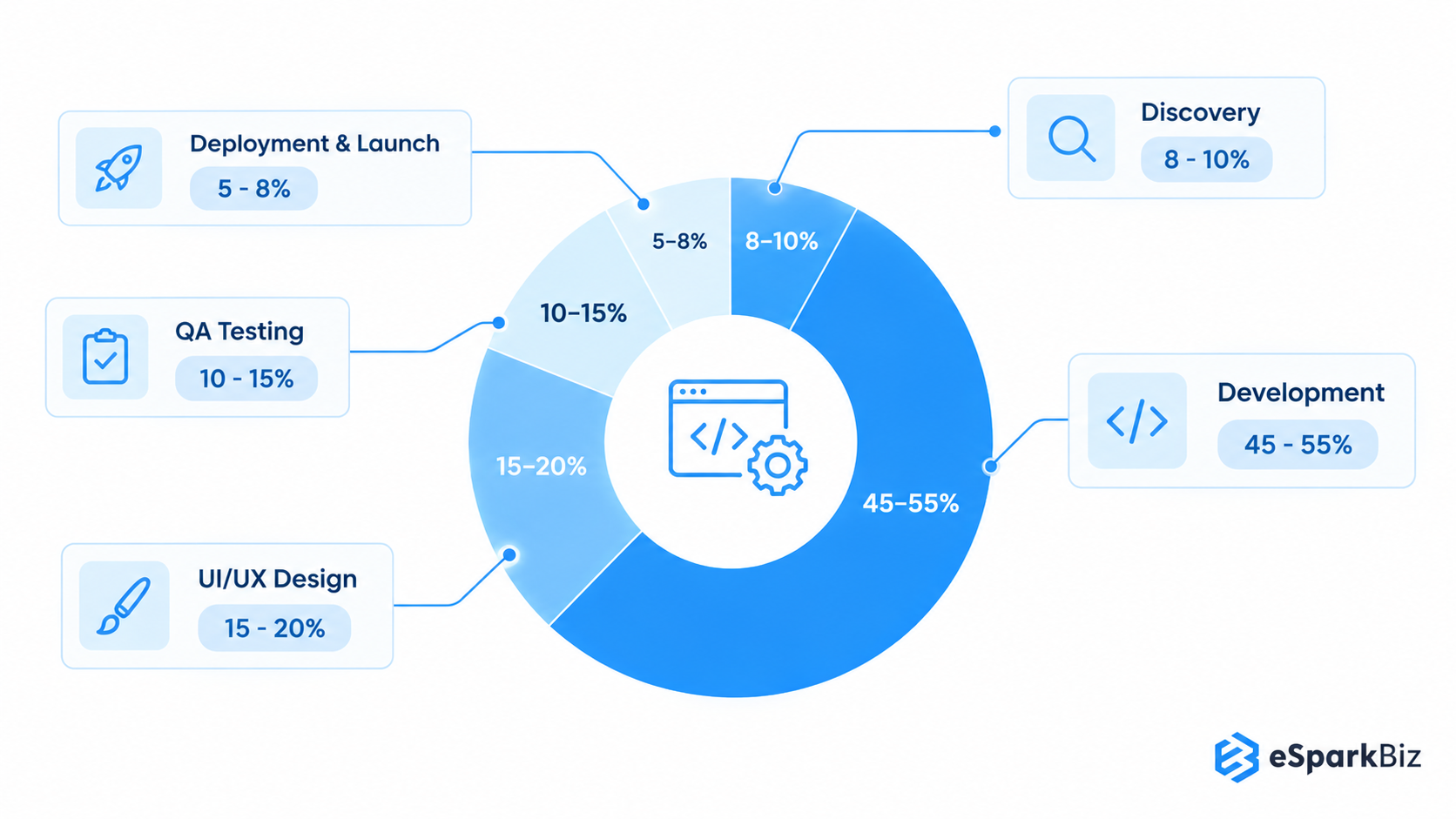
Development is not the only factor involved in the budget. The discovery phase is responsible for establishing needs, design establishes user flows, while development and testing create the product.
| Development Phase | Typical Budget Share |
| Discovery | 8 – 10% |
| UI/UX Design | 15 – 20% |
| Development | 45 – 55% |
| QA Testing | 10 – 15% |
| Deployment & Launch | 5 – 8% |
Project management is often priced separately, so ask if it sits inside the quote. Development may take around half of your budget for MVP. Skipping discovery usually leads to vague requirements, scope changes and costly rework.
What Factors Determine MVP Development Cost?
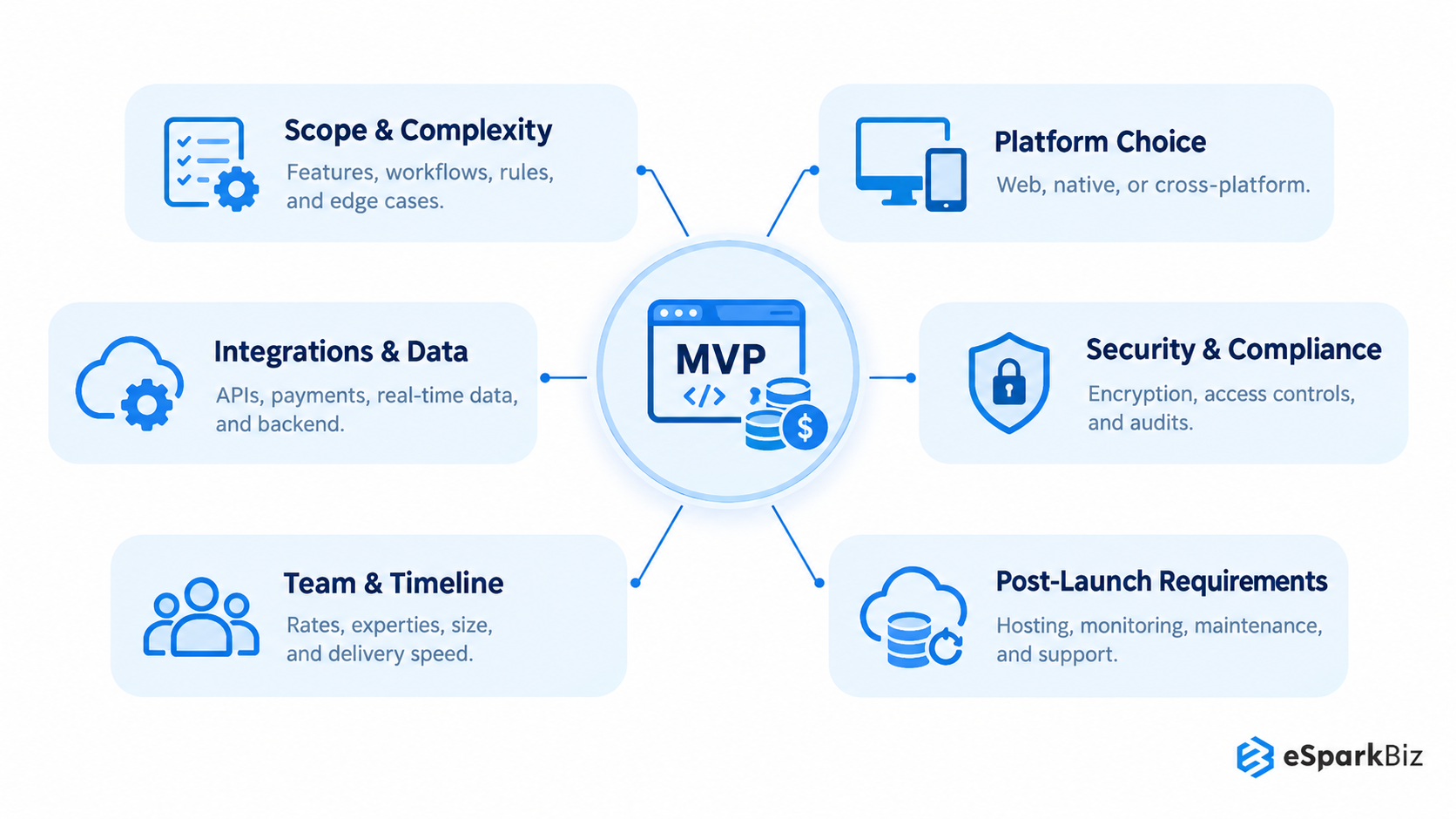
MVP development cost depends on what you build, where it runs, how it connects with other applications and what it takes to secure, deploy and maintain it.
1. Scope and complexity
Features, constraints, roles and corner cases determine what should be built. Payments, dashboards, searching, messaging and automation increase costs. Consider the least number of functionalities that will put your concept to the test without being inconclusive.
2. Platform choice
Engineering and testing requirements differ for web, native mobile and cross-platform development.
| Platform | Typical MVP Cost | Main Consideration |
| Web | $8,000–$50,000 | Browser Compatibility and Back-end Requirements |
| Native mobile | $10,000–$70,000 | Implementation and testing separately for iOS and Android |
| Cross-platform | $15,000–$80,000 | Shared code with platform-specific validation |
Cross-platform can save time when both apps share most of their logic.
3. Integrations and data
Payment gateways, third-party APIs, CRM tools, analytics and real-time features all add build and testing effort. Authentication, synchronization, error handling and migration influence software testing. Test high risk integration first, particularly when documentation or access is unknown.
4. Security and compliance
Applications that deal with personal, financial, or regulated information may require access controls, encryption, auditing, security assessments, privacy protection and regulatory review. Ensure that these requirements are discovered to prevent costly redesign and release delay.
5. Team and timeline
Engineering rates, seniority, team composition and delivery speed influence budgets. Compressed schedules may require parallel work and coordination. Lower hourly rates do not guarantee lower costs if projects require more hours or revisions.
6. Post-launch requirements
These include cloud infrastructure, monitoring, dependency upgrades, bug fixes, customer support and security services. All these should be considered when developing an investment case since they occur post-launch.
Should You Build With AI Tools, No-Code or Custom Code?
Your build method affects cost, speed, security and flexibility. Choose based on product complexity and future plans.
| Build approach | Typical Cost | Best Fit | Principal Cost Risk |
| No-code | $10,000+ | Simplified workflows and verification | Platform constraints and reengineering |
| AI-assisted | $10,000–$50,000+ | Efficient implementation with engineering supervision | Testing, security and engineering debt |
| Custom code | $15,000–$100,000+ | Unique workflows and architectural control | Higher upfront engineering effort |
When No-Code Makes Financial Sense
The no-code route is suitable for simple workflows and basic testing, where costs start at around $10,000. However, for more complicated integrations, additional users, or advanced product requirements, expensive alternatives may be necessary.
How AI-Assisted Development Affects MVP Costs
AI coding tools accelerate implementation, but architecture, review, testing and security remain necessary. Although AI coding solutions may increase your productivity, there is always a need for a proper architectural design, code reviewing, testing and security. In fact, Microsoft Research found 55.8% faster task completion when using GitHub Copilot.
Why AI-Generated Code Needs Security Review
A faster development process does not mean that it is always safe code. According to a study conducted by Veracode, 44% of AI-generated code was found to have vulnerabilities, which makes security tests vital.
Quote
“The minimum viable product is that version of a new product which allows a team to collect the maximum amount of validated learning about customers with the least effort.”
– Eric Ries, American entrepreneur and author
How Much Do Team Models and Regions Cost?
MVP development cost depends on team structure, location, internal resources and delivery requirements.
| Team Model | Typical Rate | Best Fit | Main Trade-Off |
| In-house | $80 – $200+/hr | Long-term ownership | Hiring and overhead |
| Freelancer | $20 – $150/hr | Small and specific projects | Delivery capacity constraints |
| Agency | $30 – $150+/hr | Full product development | Higher project cost |
| Outsourced team | $18 – $100+/hr | Dedicated engineering capacity | Coordination requirements |
How Do MVP Development Rates Vary by Region?
Hourly rates vary by location, provider and project scope.
| Region | Typical Hourly Rate |
| North America | $100 – $230/hr |
| Western Europe | $70 – $150/hr |
| Eastern Europe | $40 – $100/hr |
| Latin America | $30 – $90/hr |
| India and Southeast Asia | $20 – $50/hr |
Low hourly costs do not necessarily translate into a low total price. Faster turnarounds and fewer changes will lower the total price.
Decision rule: Use in-house staff for long-term ownership, freelance workers for certain jobs and agencies/outsourced staff for wider knowledge without forming an in-house staff.
Did You Know?
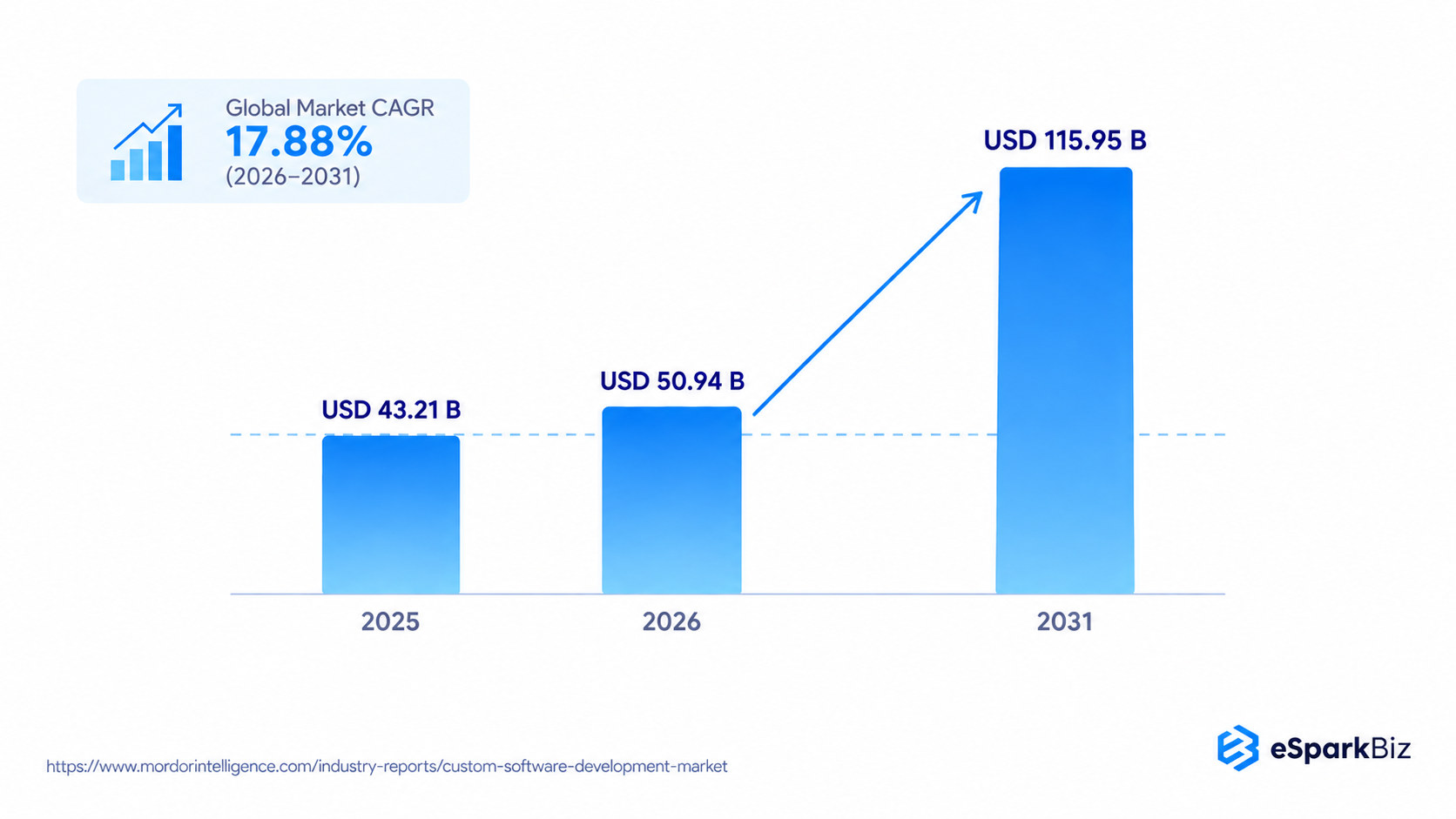
According to Mordor Intelligence, the customized software market is projected to reach $115.95 billion by 2031, at a CAGR of 17.88%.
What Hidden Costs Sit Behind the MVP Quote?
Costs associated with MVP development are not limited to the first estimate. There are additional costs that may arise when developing an MVP or even after its launch.
| Cost Category | Initial Build | After Launch |
| Engineering and QA | Development and testing | Fixes and enhancements |
| Infrastructure | Environment setup | Hosting & usage |
| Third party services | Integration | Licenses & API usage |
| Security | Initial controls | Reviews and remediation |
| Maintenance | Handover | Monitoring and updates |
How Much Should You Budget for Maintenance?
Annual maintenance can be estimated to be 15% – 25% of the initial cost of development, but the amount may vary. For an MVP that costs $50,000, 20% would be $10,000 per year.
Also account for:
- Scope changes: Addition of functions increases cost for development and testing.
- API changes: The provider may change the price, limitations and requirements.
- Cloud usage: More traffic means increased costs of cloud infrastructure.
- Technical debt: Hasty architecture can make future updates more expensive.
Planning tip: Request vendors to segregate one-time development charges from ongoing infrastructure, maintenance, security and support charges.
Build Only What Users Need
AI tools such as Claude Code and Codex make development faster, although more features do not necessarily lead to success. Validate the needs of your users and include only those features that are necessary.
How Do You Calculate Your MVP Budget?
MVP development cost depends on estimated hours, team rates and launch requirements. Use this equation to calculate expenses and see what each budget can afford.
Formula: (Total development hours × Blended hourly rate) + third-party setup costs + contingency.
Example: If development takes 300 hours at $50 per hour, labor will cost $15,000. With an additional cost of $2,000 for third-party configuration and 10% contingency amounting to $1,700, the budget is $18,700.
| Budget | Typical MVP Scope |
| $10,000 | Prototype or one basic workflow |
| $25,000 | Core workflow, minimal UI, one platform |
| $50,000 | User accounts, payments, integrations & QA |
Use a 10% contingency for known scope and 20% for uncertain integrations and compliance needs. The above are planning figures, not quotes from the vendor.
How to Reduce MVP Development Cost Without Weakening the Test
Reducing MVP development cost doesn’t mean missing anything that requires time. It means investing only in those things which help answer the product question.
Use three rules:
- Define one core outcome: Design your MVP around the sole assumption that needs to be validated.
- Start with one platform: Pick web, iOS, Android or cross-platform based on where your first users are.
- Prioritize with MoSCoW: Prioritize features as Must Have, Should Have, Could Have and Won’t Have.
Should You Build a Prototype, Proof of Concept, or MVP First?
Choose the stage that will address your major problem. Prototype tests product, proof of concept tests its technical feasibility and MVP tests it on real users.
| Build Stage | Purpose | Rough Cost | When to Choose |
| Prototype | Test flow and user experience | $5,000 – $10,000 | When usability is the main uncertainty |
| Proof of Concept | Test technical feasibility | $5,000 – $20,000 | When technology or integration is uncertain |
| MVP | Test market demand | $10,000 – $150,000+ | When the core product is ready for users |
Use a prototype or proof of concept if it can address your primary question at reduced costs. Switch to MVP if real-world testing is the next step in the validation process.
Also Read: What Comes After Proof of Concept?
How Do You Choose an MVP Partner and Check Their Quote?
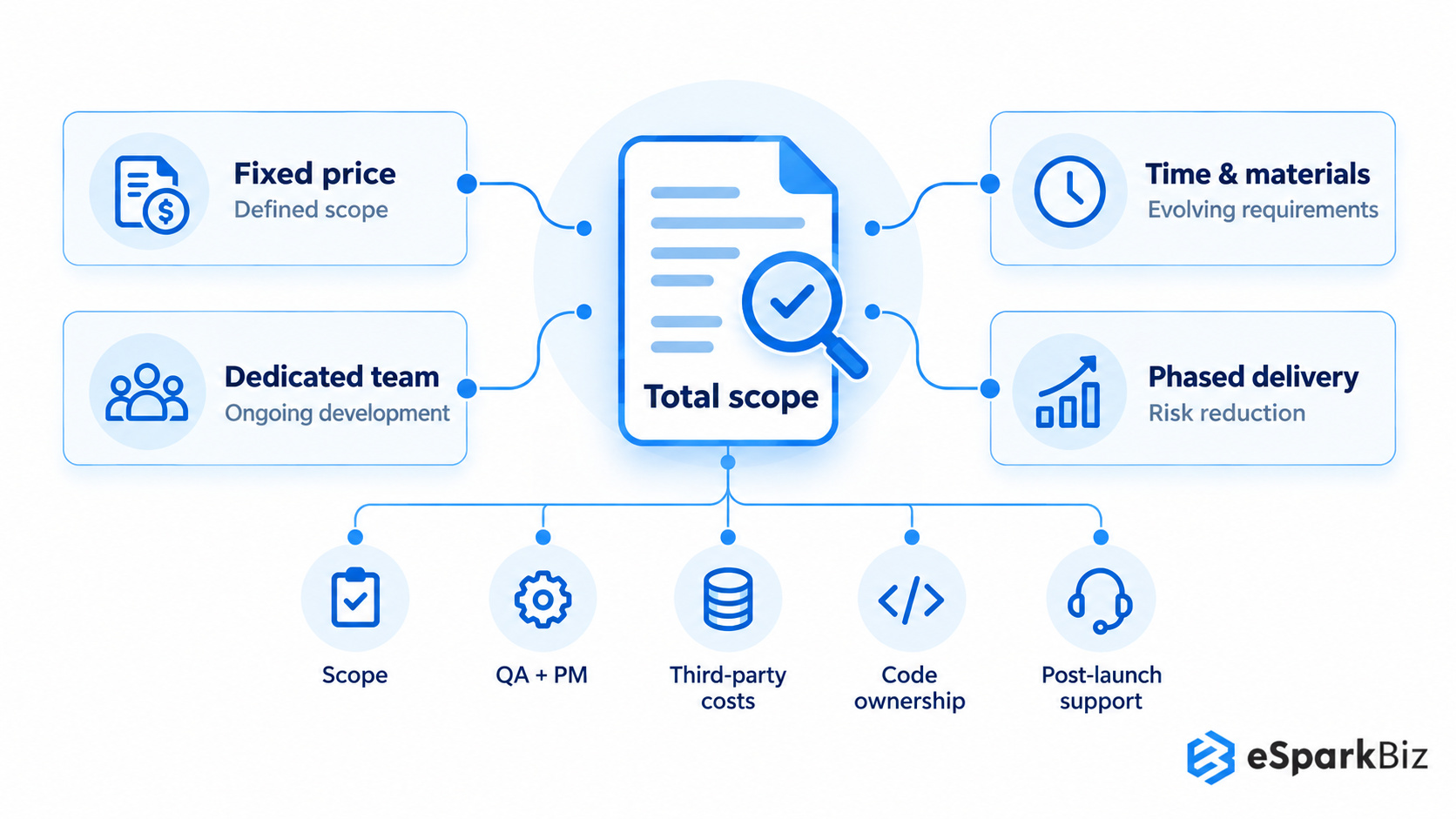
MVP development partner selection is not all about comparing hourly prices. Consider the scope, assumptions, delivery model and extra expenses which may be incurred beyond the quoted price.
| Contract Model | Best Fit | Main Consideration |
| Fixed price | Defined scope | Changes can increase costs |
| Time and materials | Evolving requirements | Needs active budget control |
| Dedicated team | Ongoing development | Requires clear team management |
| Phased delivery | Risk reduction | Requires milestone planning |
What Should You Check Before Signing?
- Scope: Make sure each quote includes the same scope of features and workflows.
- QA and project management: Check whether testing, coordination & reporting are included.
- Third-party costs: Look for API, cloud, licensing and infrastructure fees separately.
- Code ownership: Verify ownership of code, documentation and intellectual property.
- Post-launch support: Ensure that maintenance and support terms are defined.
Evaluate the total delivery scope, not just the development fee.
If a working SaaS product is due in about four months, judge the partner on how they plan delivery, not on how they pitch it.
- Timeline plan: Ask for a week-by-week plan with a demo every two weeks. A 16-week build only works when design, development and QA overlap.
- Fixed price terms: A fixed quote holds only when the feature list, change request process and acceptance checklist are in writing.
- US working hours: Confirm a daily overlap for standups, demos and sign-offs, so approvals never wait a full day.
- Similar delivery: Ask for a SaaS MVP of the same size and speed. The 16-week build below is one such example.
With eSparkBiz, you get access to 400+ engineers, 1,000+ delivered projects and 15+ years of product engineering and software development experience.
Its MVP development services offer agile delivery and flexible engagement models, with each MVP priced after scoping under fixed price, time and materials or dedicated team contracts. Teams agree on a daily working hour overlap with US clients, and code and documentation are handed over at launch.
How Did eSparkBiz Prepare a SaaS MVP for 3 Business Workflows?
A mid sized B2B company relied on spreadsheets and disconnected tools for onboarding, approvals and reporting. It needed a unified platform to validate workflows before a full rollout.
Solution
eSparkBiz prioritized core workflows, integrated the CRM & built a secure web MVP with role based access and an operational dashboard.
The project targeted a 16 week delivery timeline, a $55,000 development budget, three core workflows and an initial pilot group of 30 users. Sixteen weeks is about four months from kickoff to a live pilot, so this build shows what a fixed launch window looks like in practice.
Expected Outcomes
- Reduce duplicate data entry across workflows.
- Validate usability with pilot users.
- Guide future releases using adoption data and feedback.
Frequently Asked Questions
Can you build an MVP for under $10,000?
Yes, for validation. No-code builds can start near $10,000, so going lower means a prototype or a very narrow test. Agency MVPs also start around $10,000, and growth may need a rebuild.
What can a $50,000 MVP budget cover?
A budget of $50,000 can generally cover accounts, transactions, integrations, and quality assurance on one platform. eSparkBiz typically builds MVPs starting at $10,000, depending on project complexity and scope.
How long does it take to build an MVP?
MVP development typically takes 8-16 weeks. Development with no-code platforms can be completed within 2-8 weeks, while complex products take four to eight months.
Does building an MVP faster cost more?
Yes, normally. A shortened timeline requires more manpower, and working under pressure builds up technical debt. AI-aided workflow can be used to address the problem.
Should you choose fixed price or time and materials?
Select fixed pricing for known scope and time & materials for unknown requirements. Fixed price is usually more expensive by 10-15%.
Do AI features raise MVP development cost?
Yes, the implementation of AI capabilities will increase the cost of building an MVP by 15 to 30%. Expect additional charges for the use of AI on a per-user basis.
Why do fintech and healthtech MVPs cost more?
Costs associated with compliance such as PCI-DSS and HIPAA are estimated at an additional $20,000 to $80,000 on top of the standard development costs.
Do you need a prototype or proof of concept before an MVP?
Not always. A prototype ($5,000 to $10,000) tests design risk, and a proof of concept ($5,000 to $20,000) tests technical risk. Skip them if the core product is ready.


 August 27, 2026