There is a point in product growth when the question shifts from “Who should we hire?” to “What should our engineering organization own?” That’s when scaling becomes a decision about how the engineering team should work.
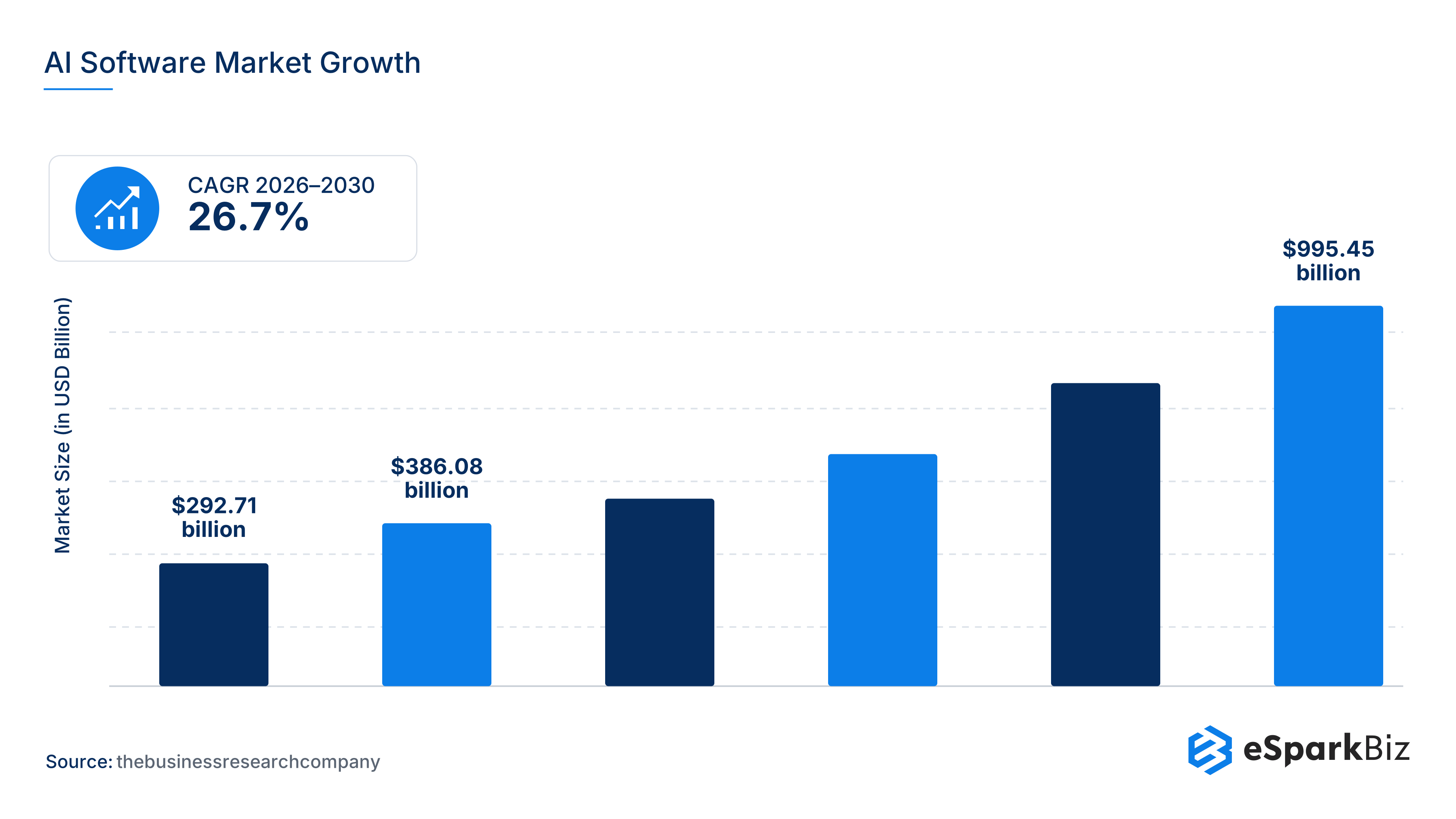
The question matters more as the market expands. The AI software market is projected to reach $995.45 billion by 2030, growing at a 26.7% CAGR, according to The Business Research Company. That growth increases pressure on the engineering capacity.
For AI product companies, capacity extends well beyond application development. ML engineering, MLOps, DevOps automation, data infrastructure, security and product engineering can all compete for a finite core team.
Scaling an AI software product without growing the in-house team means deciding which capabilities stay internal, which can sit with an external engineering partner and where AI native practices can help the team get more done.
Why Headcount Only Scaling Breaks for AI Software Products
Adding engineers increases capacity. It doesn’t automatically remove a constraint holding the product back.
Sometimes the bottleneck is not people at all. It is architecture, platform tooling, MLOps, testing, or deployment pipeline that has become a constraint on delivery.
AI development makes this gap harder to ignore. DORA research describes AI as an amplifier: Strong engineering systems can turn faster development into greater gains, while the weaker systems can limit those gains.
The best, most innovative organizations develop and deliver their software faster, more reliably, more securely, and with higher quality.
Headcount only scaling often hits same limits:
- Specialization gaps: one missing MLOps, data, security, or platform capability can constrain many product teams at once.
- Ramp up time: new engineers need a product context, architectural history and the system access before they contribute effectively.
- Downstream bottlenecks: faster code helps only if testing, review, and deployment can keep up. Speeding up one part of the process does not always make the whole delivery process faster.
- Coordination load: each additional engineer adds dependencies across a product, infrastructure, reviews & technical decisions.
None of this means hiring is wrong. It means the executive question isn’t simply “How many engineers do we need?” It is “What constraint are we actually trying to remove?” That answer should determine the right capacity model.
Four Ways to Scale Without Growing Headcount
There’s no single replacement for hiring. The right model depends on a capability required, how quickly it is needed and how much ownership must stay internal.
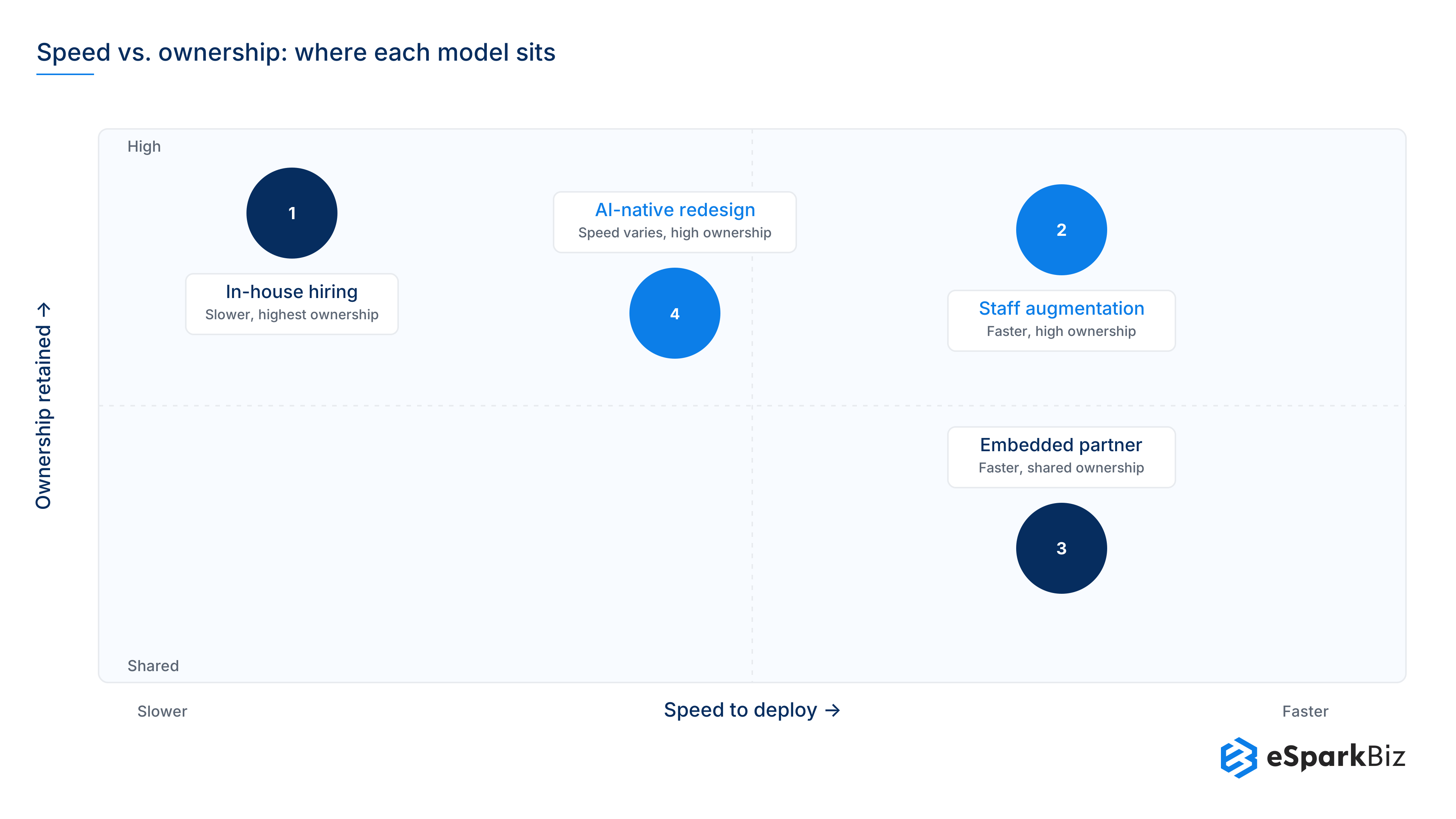
These four models address the main capacity choices leaders evaluate. Each solving different constraint:
1. In-House Hiring
Best when the capability is strategically important, continuously needed and closely tied to product knowledge, or long term architecture. Internal engineers retain context and decision making authority, but hiring adds fixed costs, and takes time to recruit and ramp up.
2. Staff Augmentation
Staff augmentation adds external engineers to an existing team while the company retains product ownership and technical direction. It works well when the constraint is short term capacity or a specific skill gap, while internal leaders remain responsible for delivery.
3. Embedded Product Partner
An embedded product partner takes a broader role than staff augmentation. The partner works alongside the product organization and contributes to engineering, architecture & delivery without creating another permanent internal team.
- Staff augmentation adds capacity to an existing team while the client retains day-to-day direction.
- An embedded partner contributes more deeply to delivery, and engineering alongside the internal organization.
4. AI Native Engineering Redesign
AI native engineering changes how existing teams build, test, review and deploy software. Coding agents, automated testing, CI/CD, and better developer workflows can increase capacity, but tools cannot compensate for the unclear ownership, or weak engineering foundations.
Practitioner Perspective
Discussion in r/ProductManagement highlights that scaling AI products involves more than the model performance. Teams must consider cost, API concurrency, rate limits, privacy, and an infrastructure before choosing how to scale.
Here’s how the four models compare across the dimensions that shape the decision:
| Model | Best Fit | Cost Profile | Speed | Ownership / Control | Primary Trade Off |
| In-house hiring | Permanent strategic capability | Higher fixed cost | Slower | Highest | Hiring and ramp up time |
| Staff augmentation | Capacity or skill gaps | Variable | Faster | High | Internal team retains delivery responsibility |
| Embedded product partner | Sustained product capacity | Variable | Faster | Shared | Requires clear ownership & governance |
| AI native redesign | Workflow and engineering bottlenecks | Tooling + change cost | Varies | High | Depends on engineering maturity |
The practical choice is rarely one model for the whole organization. Leaders can keep architecture, product decisions, and core IP internal, while using external teams for specific needs, and AI to help teams work faster. These models can work together; The key is deciding where each adds the most value.
Did You Know?
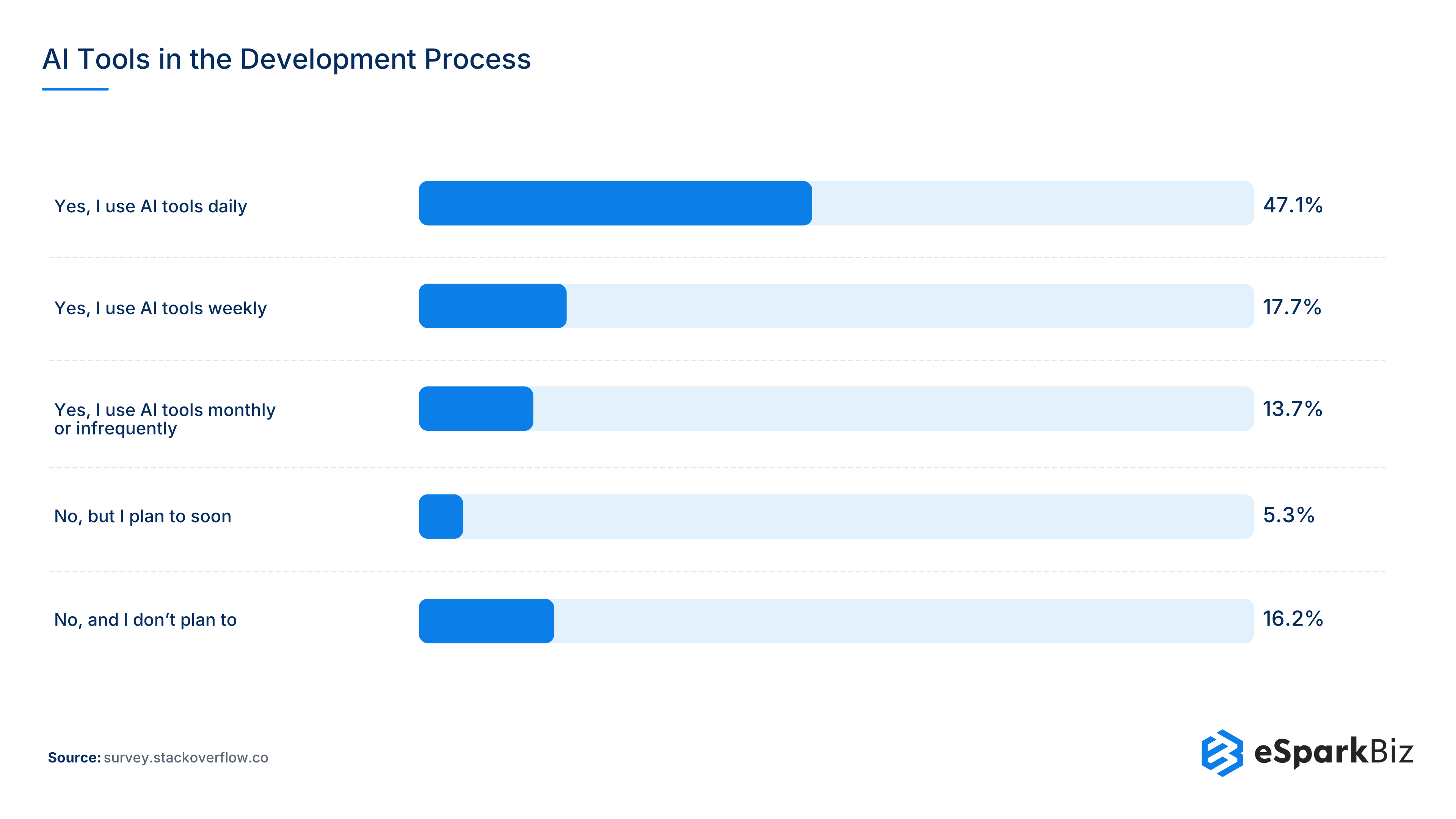
84% of developers use or plan to use AI tools in their development process, yet only 29% trust AI generated output to be accurate. The gap reinforces why AI tooling still needs strong engineering review, governance & human judgment.
Governance & Risk When Scaling With External Capacity
External engineering doesn’t create risk by itself. Unclear ownership does. When outside teams work on an AI product, leaders need clear boundaries around code, data, infrastructure, models and decision rights.
The governance model should answer these questions before work begins:
- Who owns the IP? Define ownership for source code, model artifacts, prompts, documentation, datasets and a derivative work in the engagement terms.
- What can the partner access? Give access only to what is needed for the work. Review that access regularly, and revoke it when it is no longer needed.
- What security evidence is required? Review independent assurance such as SOC 2 alongside internal security requirements.
- Who governs AI specific risk? Assign ownership for the model evaluation, data lineage, monitoring and incident response. The NIST AI Risk Management Framework offers a useful structure: Govern, Map, Measure, Manage
- What happens when the engagement changes? Document architecture, deployment processes and operational knowledge, so the organization can maintain continuity.
The answer isn’t maximum restriction. It is controlled access with a clear accountability. Internal teams retain authority over the product direction, architecture and core IP. While external teams get enough context to deliver effectively.
This matters especially for the AI products, where teams may handle proprietary models, customer data, evaluation datasets and production systems together. Governance has to cover the working environment, not the contract.
The goal isn’t eliminating external risk. It’s making a responsibility, access, evidence and accountability clear before external capacity becomes critical to the product.
Cost & ROI: What Scaling Without Headcount Actually Saves
A salary is easy to budget. What’s harder to budget is the cost of waiting when a critical role remains open, and a roadmap item cannot move.
That gap has the real price. The U.S. Bureau of Labor Statistics, reports a $133,080 median annual wage for software developers, before accounting for broader costs of employment.
Fixed cost versus flexible cost is the first comparison to make. In-house hiring creates an ongoing compensation commitment. Staff augmentation and an embedded partner can align spending more closely, with how long the capability is needed, while AI native tooling adds a different type of investment.
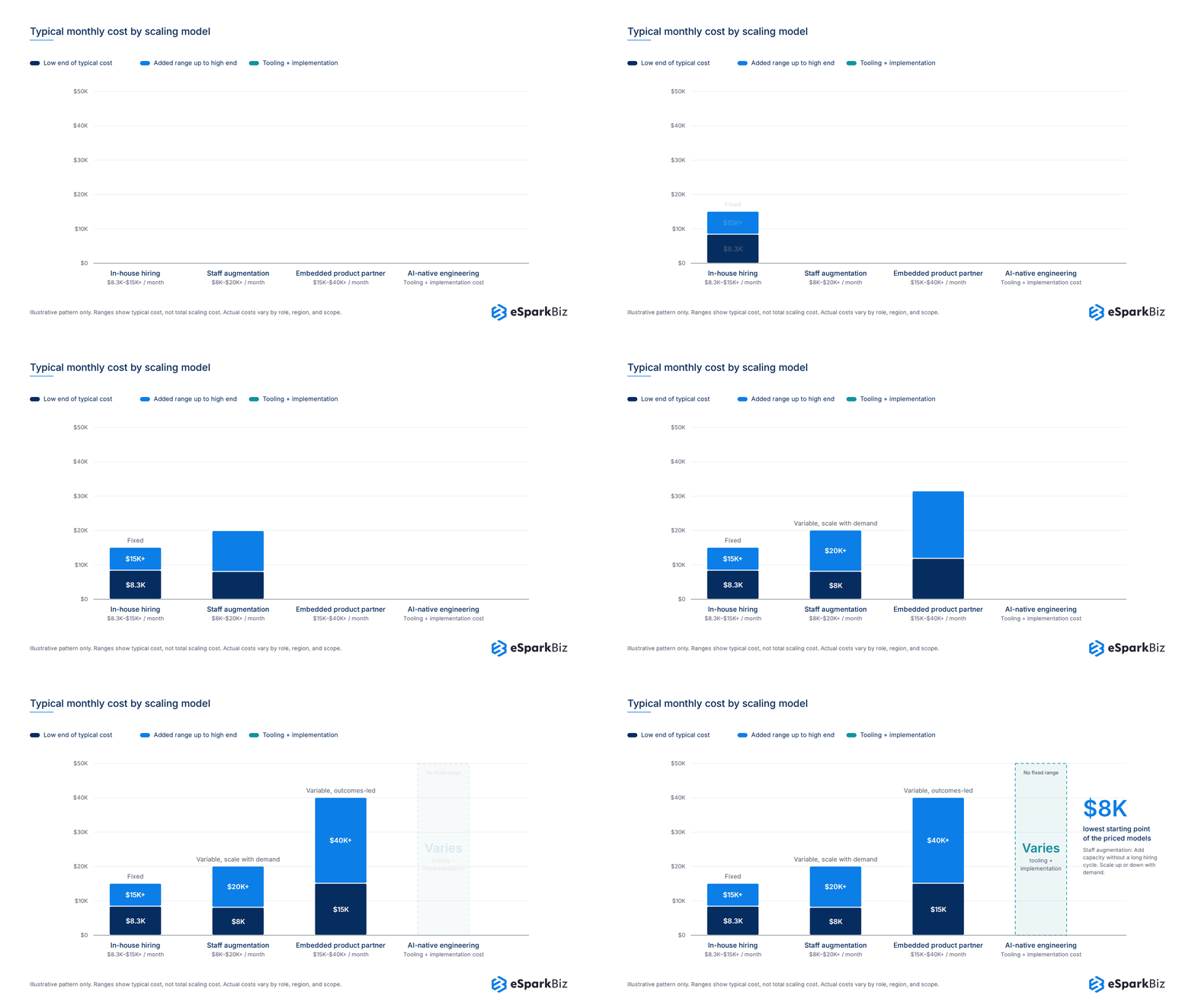
Here’s how the trade off looks:
| Cost consideration | What leaders should evaluate |
| Fixed vs. variable cost | Does demand justify a permanent cost commitment? |
| Time to productive capacity | How long before the capability contributes to delivery? |
| Utilization | Will the capability remain consistently needed? |
| Opportunity cost | What does delayed delivery, or internal reallocation cost? |
| Total scaling cost | What are the recruiting, management, tooling, partner, and delay costs? |
The cheapest option on paper can still become expensive if it delays a launch, leaves a specialist underutilized or pulls senior leaders into work below their highest value responsibilities.
For example: If a company needs three engineers for six months, external capacity at $10,000–$15,000 per engineer per month would represent roughly $180,000–$270,000 in capacity cost. That should be compared with full cost and time required to recruit, onboard, manage and retain three internal hires.
A useful ROI model is:
ROI = (Business value created − Total scaling cost) ÷ Total scaling cost
Total scaling cost should include benefits, recruiting, onboarding, partner fees, tooling, management overhead and cost of delayed delivery. For an embedded product partner evaluate the same period based on outcomes delivered, not the number of engineers supplied.
Track ROI alongside engineering velocity, cycle time, release frequency and a defect escape rate. These measures show whether additional capacity is improving the delivery system, not simply increasing the number of people or tools involved.
The goal is not to prove that one model always costs less. It’s to determine which model provides the required capacity at a cost, speed, risk and the level of control that the business can justify.
Watch: Scaling AI Products Beyond Product-Market Fit
Tuhin Srivastava, CEO and Co-founder of Baseten, discusses what changes when AI products move beyond initial product market fit, from inference costs and infrastructure constraints, to deciding what capabilities to build internally versus outsource.
Watch the conversation…
Decision Framework: When to Hire, Augment, Partner, or Redesign
Company size is a poor guide for choosing the right scaling model. A twenty person product team may need a permanent ML capability, while a much larger organization may only need temporary MLOps capacity for a migration.
| Decision Factor | Hire In-House | Staff Augmentation | Embedded Partner | AI-Native Redesign |
| Need duration | Long-term | Short to medium-term | Medium to long-term | Ongoing |
| Primary need | Core capability | Additional capacity or skill | Sustained engineering capacity | Greater engineering leverage |
| Internal ownership | Highest | High | Shared | High |
| Best signal | Demand stays steady | Team has a temporary gap | Roadmap needs execution capacity | Workflow is the bottleneck |
Is this core differentiation? Hire in-house. Central capabilities with predictable demand often justify permanent ownership and knowledge built over the time.
Is the gap temporary? Use staff augmentation. The internal team owns what needs to be built but needs additional capacity or a specific skill for a defined period.
Is the need sustained but not permanent? Choose an embedded partner. This fits ongoing execution needs where the organization also benefits from deeper engineering involvement without adding another permanent internal layer.
Is the bottleneck the workflow itself? Redesign around AI native engineering. Coding agents, CI/CD, automated testing and DevOps automation can increase engineering capacity when the underlying engineering foundations are strong enough to support them.
These options can work together. Hire for the skills you need in-house, use outside help to fill specific gaps, bring in partners for ongoing work and automate repetitive tasks where it makes sense.
The decision should follow the constraint, and the duration of the need, not the model an organization has used before.
Case Study: Scaling an AI Product Through a Partnership Model, Not a Hiring Spree
Imagine AI is an AI powered recruitment intelligence platform that centralizes candidate management, communication, scheduling and hiring in one system.
Detail Data Industry Human Resources Engagement model Product Engineering Partnership Engineering team 8 engineers Time to live 7 months Services AI/ML integration, end-to-end product engineering Market stage Live and scaling Rather than building a larger permanent engineering organization, Imagine AI added AI/ML, architecture, and product engineering capacity through a partnership model, while retaining product direction internally. The engagement reduced hiring cycles by 55%, accelerated recruitment workflows by 45% and maintained 99% platform reliability, and workflow continuity.
Measuring Success: KPIs That Show the Model Works
Scaling works when added capacity improves delivery, not a team size or activity. Measure the model against outcomes that matter to the organization.
Measure these four outcomes:
- Engineering velocity: Meaningful product output over time, not the lines of code or tickets closed. The goal is more delivery capacity, without sacrificing the quality.
- Cycle time: How long work takes from development start to production. A good scaling model reduces waiting, handoffs and the bottlenecks.
- Defect escape rate: Defects reaching to the production. Higher output means little if quality drops, and rework consumes a capacity gained.
- Roadmap predictability: Compare planned work with what was actually delivered in each release. A stronger model makes the delivery more reliable, not more active.
Review performance against the same baseline before and after changing models, and the segment results by workstream where possible. One model may fix one bottleneck, while leaving another unchanged.
A model that adds engineers but leaves cycle time, quality or a predictability unchanged hasn’t solved the capacity problem.
Frequently Asked Questions
How can I scale an AI software product without hiring more engineers?
Use staff augmentation, an embedded product partner or AI native engineering where appropriate, while keeping strategic product, architecture, and IP ownership internal.
Is staff augmentation better than hiring for an AI software product?
It depends on the constraint. Staff augmentation fits temporary capacity or the skill gaps, while hiring suits capabilities that remain strategically important and consistently needed.
What's the difference between staff augmentation and an embedded product partner?
The distinction comes down to how deeply the external team participates in delivery, and where day to day responsibility sits.
| Factor | Staff Augmentation | Embedded Product Partner |
| Role | Adds capacity or skills | Extends engineering execution |
| Direction | Internal team directs work | Shared delivery responsibility |
| Best fit | Defined capacity gaps | Sustained engineering needs |
When should an AI software company use an embedded product partner?
An embedded product partner fits sustained engineering needs where the company needs deeper delivery capacity, architectural contribution, and shared execution, without adding permanent headcount.
How do you scale an AI product while protecting IP and security?
External capacity can work within the strong governance model when ownership, access, security, and accountability are defined before the engagement begins.
- IP ownership: Define ownership of code, models, prompts, datasets and documentation.
- Access control: Apply least privilege access to repositories, infrastructure & production systems.
- Security assurance: Review relevant evidence such as SOC 2.
- Governance: Assign responsibility for model evaluation, monitoring and incidents.
How much does it cost to scale an AI software product without adding employees?
Compare the total cost of capacity rather than hourly rates. For example adding external capacity can cost $8,000–$20,000+ per engineer per month, depending on skills and the engagement model. Include the partner fees, management overhead, tooling, onboarding, recruiting and cost of delayed delivery.
When should a CTO hire in-house versus use an embedded product partner?
Hire in-house for strategic capabilities, with sustained demand and long term ownership. Use an embedded partner when the product needs sustained execution capacity, without permanent headcount.
Can AI native engineering alone replace the need for additional engineers?
No. AI native engineering can increase existing capacity, but architecture, product judgment, IP ownership, governance and an engineering accountability still require people.


 August 17, 2026