Selection of frontend framework is not an arbitrary choice, but a business decision for the organization. Poor selection of the framework might increase technical debt, slow down release processes, make scaling difficult and require costly migrations as projects evolve.
According to BuiltWith’s current statistics, approximately 4.5 million websites employ Vue, while about 904,000 utilize Angular. React is another widely used framework, however usage shows popularity, not suitability for your application.
This guide examines Vue vs Angular architecture, scalability, performance, developer experience, ecosystem maturity and long term maintenance to help teams assess which framework aligns with their product complexity, engineering resources and future growth.
What Are Vue and Angular in 2026?
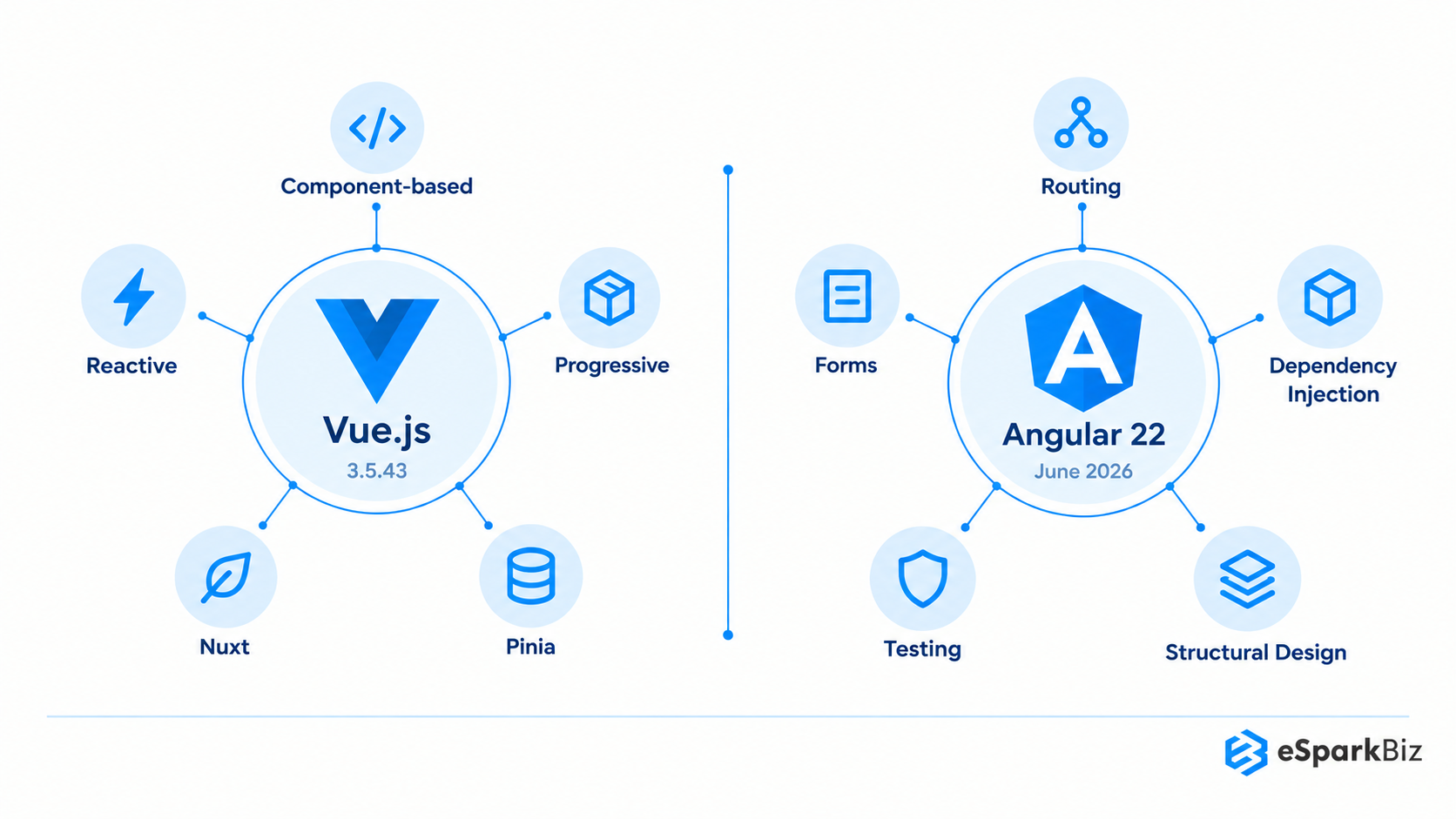
Vue.js and Angular are modern JavaScript frameworks for web application development, but they differ in architecture, development approach and the level of structure they provide for complex products.
Vue.js 3.5 and Current State of Its Ecosystem
Vue.js is a progressive JavaScript framework that is created using regular HTML, CSS and JavaScript with the component based and reactive development approach.
Currently, the last stable version of Vue.js is 3.5.44, whereas Vue 3.6.0-rc.9 is under release candidate testing.
Vue is maintained by an open source core team and has an ecosystem that consists of Nuxt and Pinia.
Angular 22 and Its Structure
Angular 22 is a full-fledged framework released by Google in June 2026 and remains relevant for enterprise teams. The main features of this framework include routing, forms, dependency injection, testing and structural design.
- Signals: A mechanism used to observe changes in the state so that Angular can understand which elements need updating.
- Zoneless: Beginning with Angular 21, it utilizes an approach to change detection that does not involve ZoneJS and reduces unnecessary complexity.
- Dependency Injection: A system responsible for providing services and reusable functions for components.
Vue.js vs Angular: Key Differences At A Glance
Selecting a framework is not an easy task since architecture, development speed, tools and scalability influence the process of building and maintaining applications.
| Comparison | Vue.js | Angular |
| Architecture | Progressive and flexible | Full-featured, structured |
| Language | JavaScript/TypeScript | TypeScript-first |
| Development | Composition API, SFCs | Components, Dependency Injection, Services |
| Reactivity | ref(), reactive(), computed() | Signals, RxJS |
| Tooling | Vite, Vue tooling | Angular CLI |
| State Management | Pinia, reactive state | Signals, services, RxJS |
| Routing | Vue Router | Angular Router |
| Learning curve | Generally easier | Generally steeper |
| Scalability | Flexible conventions | Built-in structure |
| Best fit | Flexible, incremental projects | Complex, structured applications |
How Vue and Angular Differ in Architecture and Development Workflow
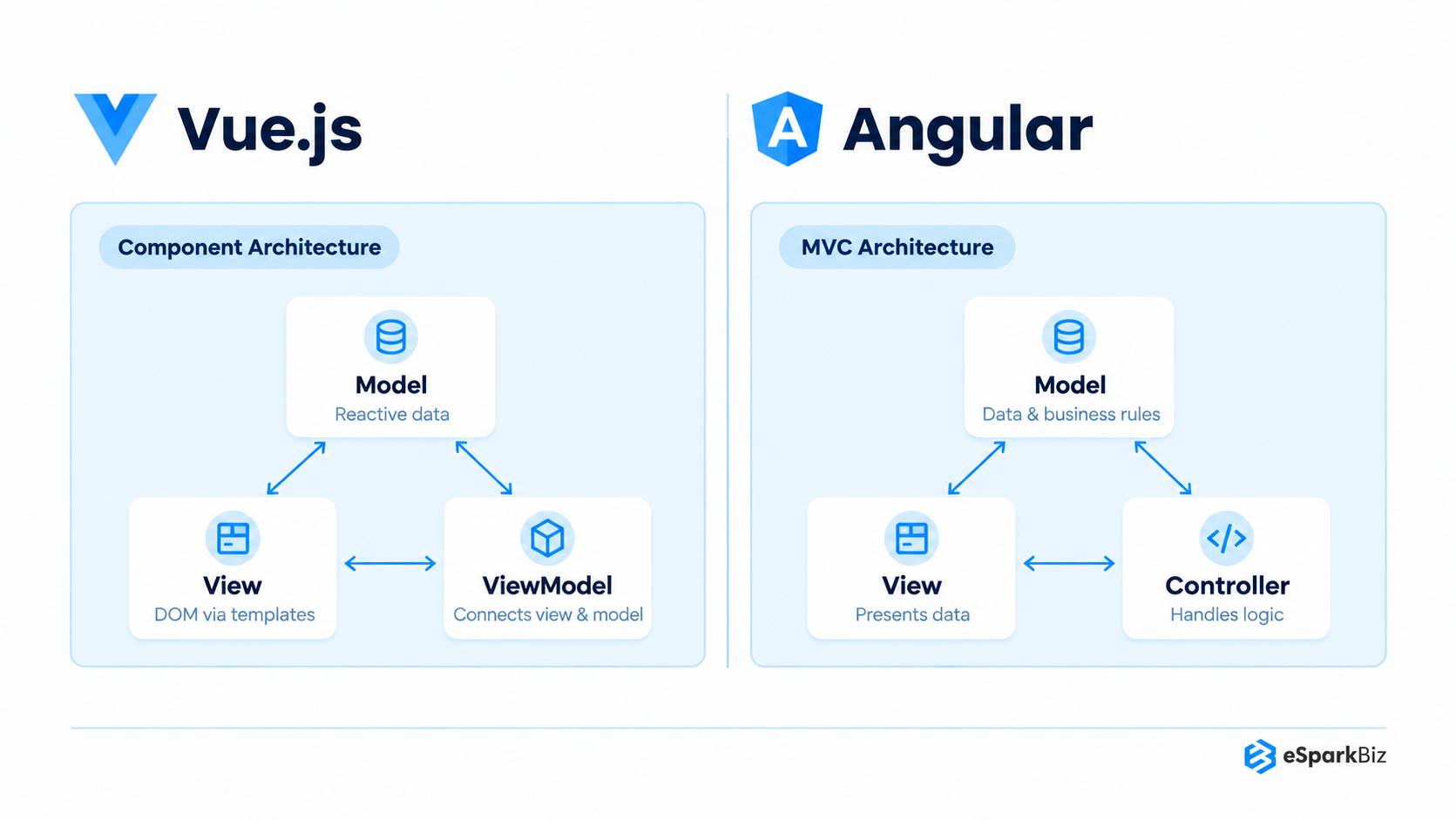
Vue is based on flexibility and MVVM concepts, whereas Angular provides additional structure needed when developing complex applications.
Vue Architecture
The architecture used in Vue is the Component Architecture which utilizes the Composition API and MVVM pattern:
- Model: stores the application data using reactive states.
- View: manipulates the DOM by means of Vue templates.
- ViewModel: connects the View and the Model.
- Workflow: State is managed by Pinia and Navigation is controlled by Vue Router.
Angular Architecture
Angular follows a structured approach to programming that is based on MVC architecture. Here, the Model manages the data and business rules, the View presents data to users and the Controller connects both.
Dependency Injection, Services, Routing, Forms and RxJS are used in Angular to maintain consistency.
Which Is Easier to Learn, Vue or Angular?
Learning efforts, team capabilities, application complexity and other factors are usually taken into account in the comparison between the flexibility of Vue and the structure of Angular.
What Makes Vue Different from Angular in Learning?
- Vue: Starts learning with HTML, CSS and JavaScript. Vue 3 advocates for Composition API along with Single File Components.
- Angular: Needs TypeScript knowledge and involves ideas like dependency injection, components and reactive programming using RxJS.
For example, Vue’s Composition API can keep component logic relatively compact:
<script setup>
import { ref } from ‘vue’
const count = ref(0)
</script>
<template>
<button @click=”count++”>
{{ count }}
</button>
</template>
Angular uses a more structured component model:
import { Component, signal } from ‘@angular/core’;
@Component({
selector: ‘app-counter’,
template: `
<button (click)=”increment()”>
{{ count() }}
</button>
`
})
export class CounterComponent {
count = signal(0);
increment() {
this.count.update(value => value + 1);
}}
Vue vs Angular: Which Handles Performance and Scale Better?
Performance problems affect user experience while scaling problems increase development effort. The approaches of Vue and Angular to addressing these problems are quite different.
| Factor | Vue | Angular |
| Performance | The fine-grained nature of reactivity eliminates unnecessary updates of components. | Signals, along with change detection, reduce unnecessary work. |
| Bundle size | Flexible architecture allows developers to pick and choose what to include. | The built-in abilities require proper code splitting and lazy loading. |
| Scalability | Scales easily where the teams clearly define component and state management. | Strong conventions support consistency across large applications and multiple teams. |
| Rendering | Supports server-side rendering (SSR) and hybrid rendering via Nuxt. | Supports SSR and hybrid rendering via Angular tooling. |
| Large applications | Works for enterprise apps when teams set clear architecture early. | Provides more predefined patterns for complex codebases. |
| Business impact | Useful when flexibility and delivery speed matter. | Useful where standardization and team development is desired. |
None of the frameworks can be guaranteed to be faster all the time. Test your workload, bundle size, Core Web Vitals, rendering and infrastructure cost before selecting a framework.
What Developers Say About Vue vs Angular
In a Reddit discussion members noted that when deciding whether to use Vue or Angular, popularity shouldn’t be the only factor. Angular is considered to have a proper structured approach to working on larger apps, whereas Vue is more flexible and user-friendly.
Security, Compliance and Governance: Where Framework Choice Matters
Vue or Angular security is more of an engineering practice issue than a framework issue, where factors such as dependency & access management, secure coding practices and testing determine security risk.
Is Angular More Secure Than Vue?
There is no definitive answer to which one is safer. Both of these frameworks include built-in security features that need to be applied correctly by the development team.
Frontend Security Governance Checklist:
- Dependencies: Watch out for packages, scan for vulnerabilities and patch them.
- Authentication: Use secure authentication and session management.
- Authorization: Implement permissions at the server side, not only at the frontend.
- XSS Protection: Do not render untrusted HTML or templates.
- CSP: Use Content Security Policy where appropriate.
- Testing: Perform security testing in CI/CD pipelines.
- Auditability: Record controls, approvals and remediations.
- Compliance: Ensure that front-end processes comply with standards such as HIPAA, SOC 2, PCI DSS, and ADA/WCAG.
OWASP recommends dealing with client-side security risks through coding, dependencies and application architecture.
Vue vs Angular: Evaluating Ecosystem Strength Before You Commit
When assessing Vue and Angular, community size, usage, GitHub presence, company support and the stability of their ecosystems may be regarded as significant factors.
| Factor | Vue | Angular |
| GitHub stars | 54.9k+ for Vue core | 101k+ for Angular |
| Community | Larger open source contributor community | Global community of developers supported by Google |
| Ecosystem | Vue Router, Pinia, Nuxt, Vite | Angular CLI, Angular Material, RxJS, Router |
| Support | Open-source core team and community ecosystem | Google-backed Angular team with defined release lifecycle |
| Hiring availability | Smaller pool of candidates than Angular | Larger enterprise talent pool and steady demand |
| Enterprise consideration | Larger teams may require better conventions internally | Convention standards help with governance among big teams |
Popularity alone should not drive framework selection. Evaluate community activity, documentation quality, hiring availability, ecosystem maturity, release cadence and the support model your organization requires.
Did You Know?
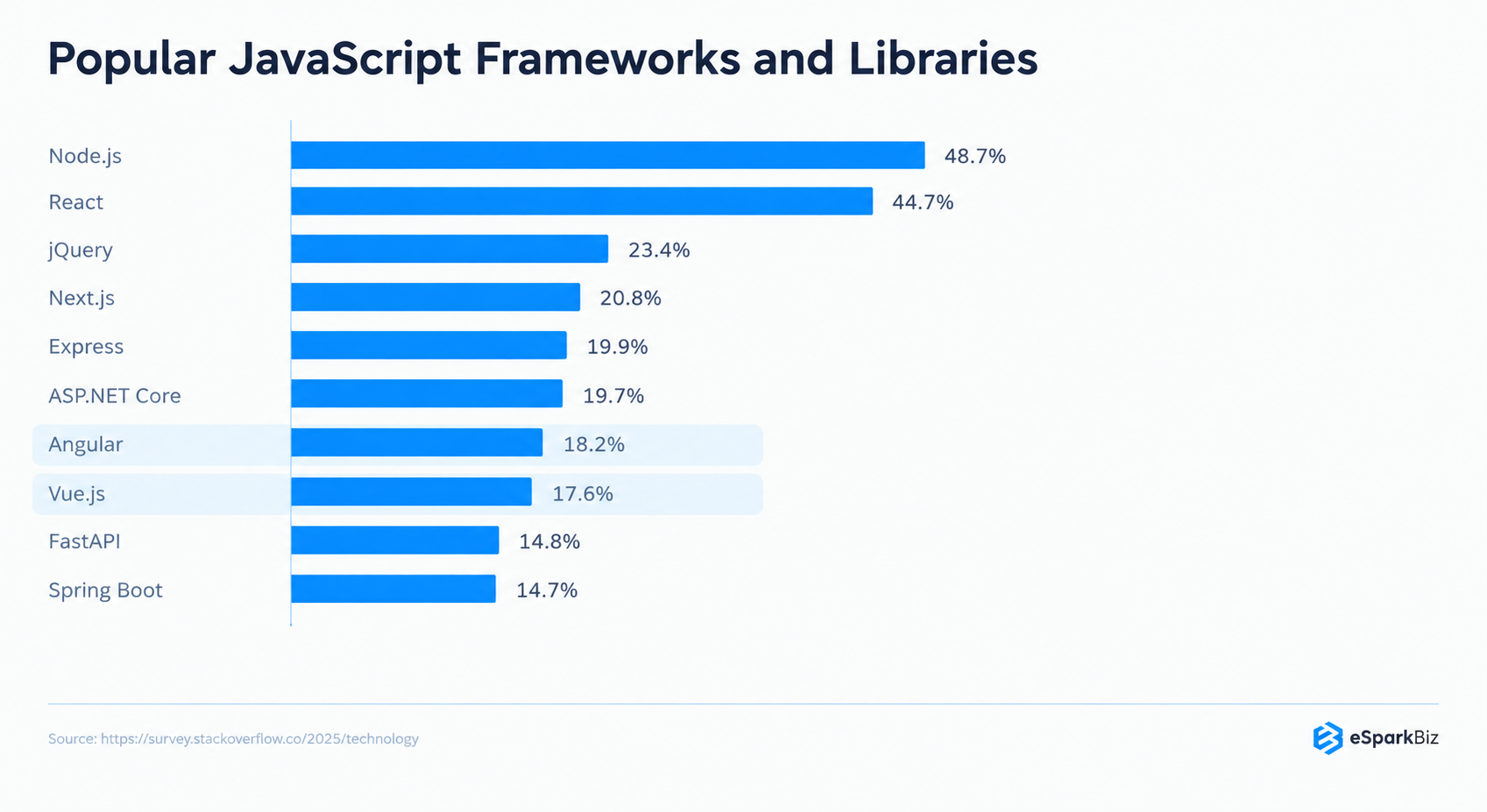
According to the Stack Overflow Developer Survey, Angular has been used broadly by 18.2% of developers, while Vue.js by 17.6%.
How AI-Assisted Development Changes the Vue vs Angular Decision
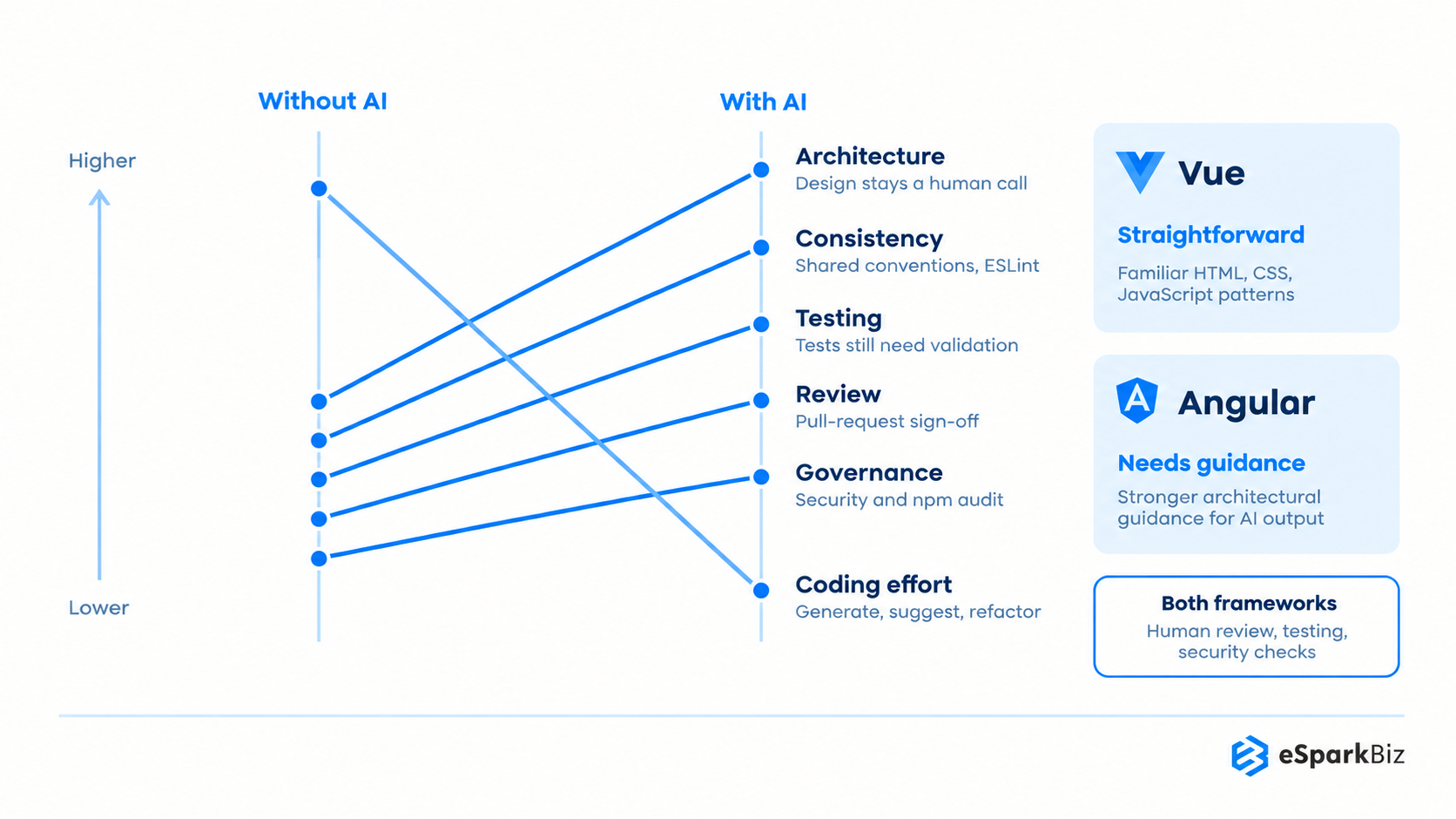
AI-driven development influences the comparison process of Vue and Angular. It reduces the number of lines of code and makes architecture, testing, code reviews, consistency and governance crucial.
Is AI Making Vue or Angular Development Simpler?
AI coding assistants are able to write components, suggest code, test, document and refactor in either framework.
- Vue: AI makes component development easy with the use of well-known HTML, CSS and JavaScript constructs.
- Angular: AI can help in speeding up TypeScript coding, services, components, testing and reiterative frameworks, but architectural help is needed.
Code generated by AI requires testing, dependency checking and validation for security purposes.
What Should Teams Evaluate?
- Architecture: AI cannot replace architecture-level decisions.
- Consistency: Common conventions improve the quality of AI-written code.
- Testing: Tests written by AI still require verification by humans.
- Migration: AI can help with refactoring, but complex migration requires a controlled review process.
- Cost: Fast coding does not reduce the need for reviews, tests, infrastructures and maintenance.
Vue vs Angular: Companies Using Each Framework at Scale
Real-life examples illustrate how these frameworks can be used within a more sophisticated technical architecture. This will help assess the maturity & usability of the particular framework in production.
Companies Using Vue
- GitLab: Uses Vue for its web interface along with other technologies like Ruby on Rails, GraphQL and PostgreSQL.
- Alibaba: Uses Vue for creating large-scale e-commerce experiences along with other JavaScript and backend technologies
- Xiaomi: Uses Vue for web interfaces and digital product experiences, along with other JavaScript-based technologies.
Companies Using Angular
- Google: Uses Angular in their web applications with TypeScript and other Google web technologies.
- Microsoft: Uses Angular in some web experiences with TypeScript and cloud technology.
- Forbes: Has used Angular for some web experiences along with backend services and other modern web technologies.
How to Decide Between Vue and Angular for Your Project
Complexity, skills, delivery, legacy constraints and governance all shape the choice, so check each before committing.
Which Framework Fits Your Project?
| Project condition | Consider | Reason |
| Startup, small team, fast launch or gradual adoption | Vue | Familiar syntax and supports gradual integration |
| Complex, multi-team application | Angular | Structured architecture and TypeScript-first development |
| TypeScript-first team | Angular | TypeScript is central to development |
| Existing AngularJS codebase | Angular | Practical, staged migration process, often led by dedicated Angular developers |
| Existing Vue 2 codebase | Vue 3 | Support for Vue 2 was dropped in December 2023 |
What Should Teams Check Before Choosing?
- Team Skills: Skill in JavaScript, TypeScript, testing and architecture.
- App Complexity: Take into account integrations, routing, state management, permissions and workflow.
- Delivery: Onboarding, development speed, migration costs and in-house versus outsourced delivery.
- Operating Costs: Staffing, maintenance and tech debt. Angular and Vue developers usually cost under $25 to $100 an hour. Nearshore and offshore teams cost less than onshore hires. Multiply the hourly rate by team size and project length, such as a six-month build, before comparing quotes.
- Governance: Quality of testing, documentation, ownership and coding practices.
- Partnership: Check with the providers about experience with comparable projects, migration, testing, teamwork, and support after launch.
- Partner Criteria: Look for a proven migration record, testing built into CI/CD and the ability to grow from one squad to several teams. A dedicated Angular development company or Vue.js development team should show this through past delivery, not claims.
- Team Model: Confirm whether you get dedicated developers, how much of their working day overlaps with your US hours, which contract model applies (fixed scope, time and materials, or a dedicated team) and whether a US entity signs the agreement.
- Migration Support: For AngularJS or Vue 2 codebases, ask how the partner stages the move module by module and what testing sits at each stage.
Choose the framework your team can build, manage, test and sustain.
How eSparkBiz Helped a Digital Product Scale 30% Faster
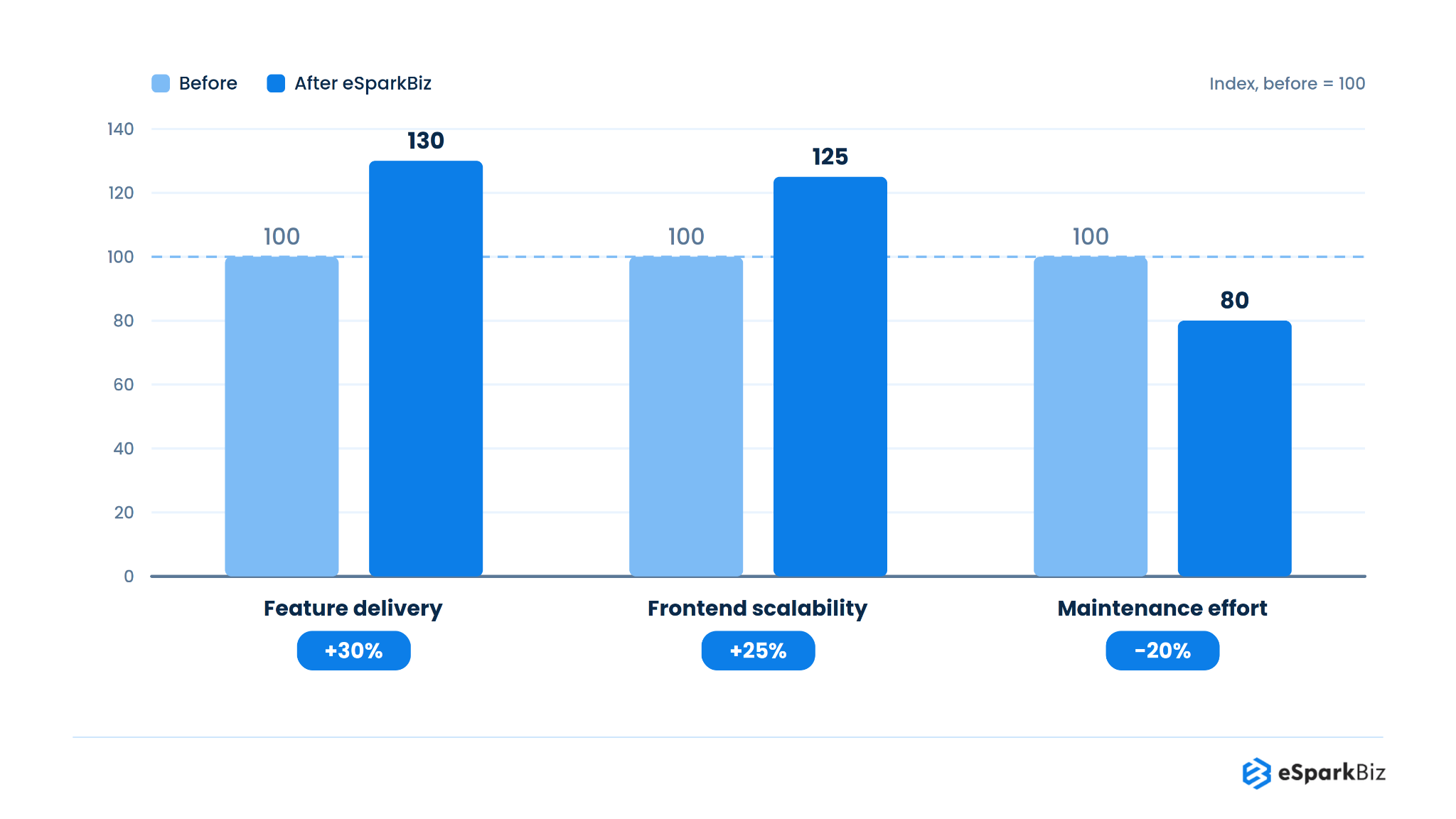
A digital product company was confused about whether it should adopt Vue or Angular to support its expanding platform.
The company had to deal with the growing complexity of its frontend, delayed feature delivery and scalability concerns across multiple teams.
The eSparkBiz Approach
eSparkBiz analyzed the workload, system architecture, testing requirements and technological approach before selecting Angular to meet the product’s functional requirements. Its Angular developers focused on aligning the framework with the product’s architecture, performance needs and long-term maintainability.
The Outcome
- Features implemented 30% faster
- Frontend could manage 25% more load
- 20% reduction in maintenance costs
The key difference was simply picking the right framework according to product requirements rather than personal preference.
For more stories like this visit the eSparkBiz portfolio.
Frequently Asked Questions
Which is better for large, multi-team applications, Angular or Vue?
Both Angular and Vue will be good for large, multiteam projects because of the internal framework which ensures uniformity in coding practices.
Is it risky to stay on AngularJS or Vue 2?
Yes. Both are end of life,means that there won’t be any official support for fixing security issues. It would be a good idea to prepare a gradual migration to either Angular or Vue 3.
Is Vue or Angular better for a startup or small team?
Vue is generally better for small businesses and startups which need quick releases of code, while Angular is for those who anticipate quick scaling of their operations.
Is Angular still a good choice in 2026?
Yes. Angular 22 was released in June 2026 and it continues to be a good choice for building large-scale applications due to its organization and the support by Google along with an evident roadmap.
Is Vue or Angular cheaper to build and maintain over five years?
Neither solution is cost-effective by default. Rates of developers remain about the same, thus the expenses on five years will depend on developers' qualifications, their training, updates, tests, and coding.
Should we hire in-house or outsource Vue or Angular development?
In-house development is preferable for long-term projects and a constant workload. Outsourcing development is better for quick releases, migrations and skills shortage.
Do Vue and Angular meet HIPAA, SOC 2 or accessibility requirements?
Both can. Compliance depends on how you build, test and monitor the application, not the framework, so plan for HIPAA, SOC 2 or accessibility early.
Can eSparkBiz build or migrate a large-scale application in Vue or Angular?
Yes. eSparkBiz covers build and migration from assessment to deployment, with dedicated developers, time-zone overlap for US teams and flexible contract models. Confirm the same with any vendor.
How should we budget for Angular or Vue developers on a six-month build?
Angular developers typically bill under $25 to $100 an hour, and Vue sits in a similar range. Multiply by team size and months, then add QA and management.


 October 27, 2026