


Node.js microservices to let development teams update specific business capability without releasing the entire application. An e-commerce platform, for example, if they can separate its users, catalog, orders, payments and notifications into the independently deployable services.
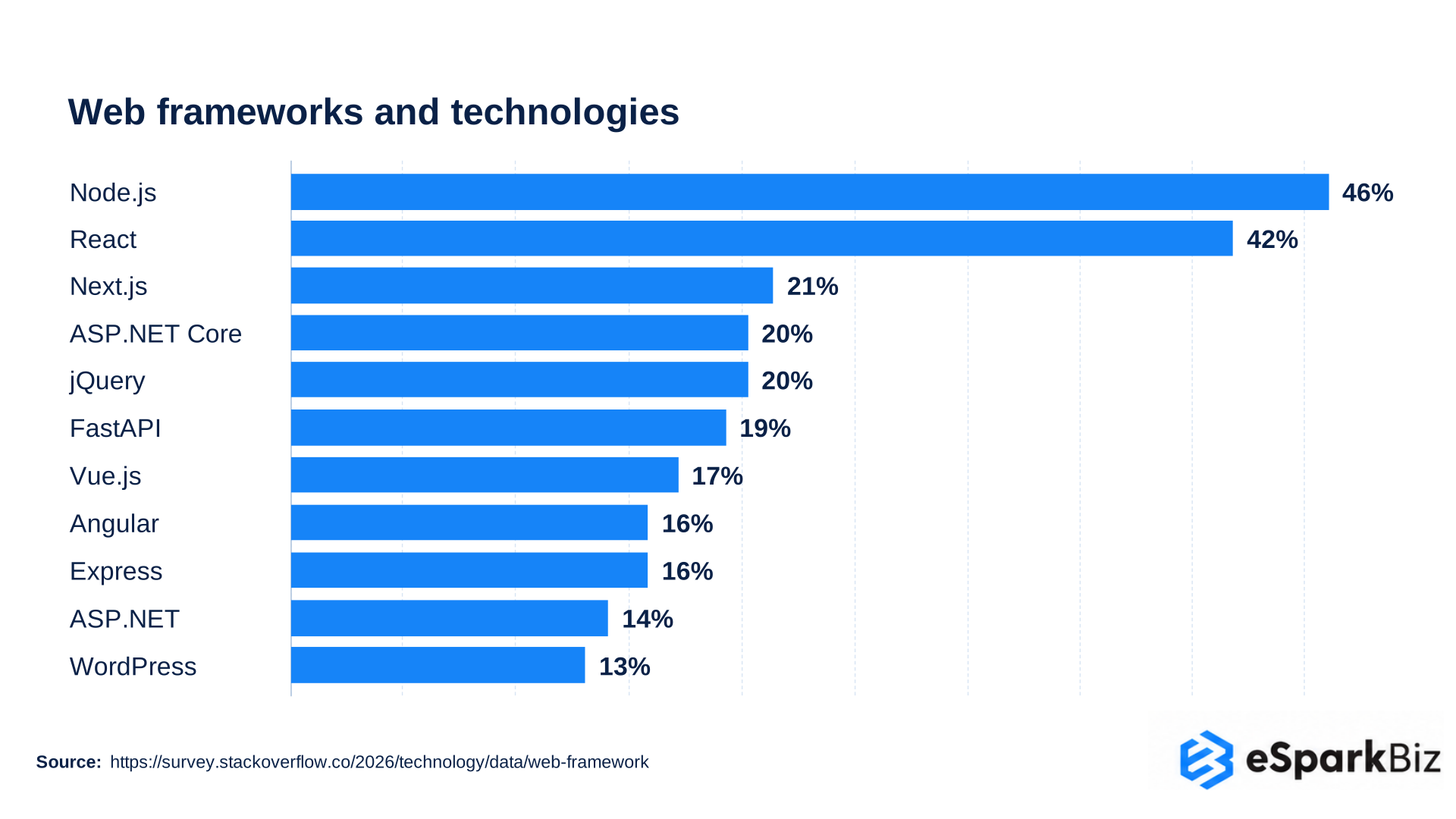
Node.js suits many microservices workload because its non blocking I/O model to handles concurrent network and the database operation efficiently. The 2026 Stack Overflow Developer Survey found that 46.4% of 10,281 respondents reported extensive development work with Node.js over the past year, making it the most used technology in the survey’s web frameworks & the technologies category.
However, independent services introduce network failures, distributed data, security requirements and the additional operating costs. The right architecture depend on business needs, team structure & operational capacity.
Choosing Between a Modular Monolith and Microservices
A modular monolith organize an application into clearly define modules but deploying them together. Microservices separate business capabilities into the independently deployed services.
| Factor | Modular monolith | Microservices |
| Deployment | One application release | Independent service releases |
| Scaling | Scale the application | Scale individual services |
| Communication | Inprocess calls | APIs and messaging |
| Operations | Lower overhead | More monitoring & deployment work |
| Best fit | Small teams and evolving products | Clear service boundaries and independent team ownership |
A modular monolith is often the better starting point when requirement are changing, the team is small or features frequently change together. It preserves clear code boundaries without the requiring distributed tracing, service discovery & multiple deployment pipelines.
Microservices become more useful when the stable business capabilities need independent releases, different scaling patterns or also stronger fault isolation.
Avoid creating a distributed monolith: multiple services that can still depend on the one another for every operation and must be deployed together. Define service ownership, minimize synchronous call chain and keep data access within each service responsibility.
Community Insights
Practitioners in Gartner Peer Community describe reverting to the monolith after concurrency problem under heavy traffic. Some peers say scaling a monolith vertically & horizontal can sometime beat microservice overhead.
Comparing Microservices Technologies: Node.js, Java, Go and .NET
Node.js is a strong choice for I/O heavy applications, but Java, Go and .NET can also support the production microservices. The right technology depend on workload characteristics, team expertise, ecosystem requirement & operational constraints.
| Technology | Best suited for | Key consideration | Team and talent considerations | Cost and operational trade offs |
| Node.js | Real time apps, APIs and I/O heavy workloads | CPU heavy task can block the event loop | Fits JavaScript & TypeScript teams | Shared skills reduce training, monitoring still costs money. |
| Java | Large backends & JVM based systems | Runtime configuration and resource needs | Fits teams with Java & JVM expertise | Mature tools, resource needs vary by workload. |
| Go | Network services and concurrent workloads | Different language & ecosystem | Fits teams familiar with Go and concurrency | Lightweight deployments, costs depend on usage. |
| .NET | Business apps, APIs & Microsoft environments | C# skills and platform dependencies | Fits teams experienced with C# & Microsoft tools | Mature tools, hosting and licensing costs vary. |
Choose Nodejs for I/O heavy workload and JavaScript/TypeScript teams. Java suit organizations with the JVM expertise, while Go fits lightweight, concurrent service. .Net work well for teams using C# & Microsoft technology. Evaluate workload demand, skills & operating cost before it deciding.
Node.js Microservices Architecture and Service Boundaries
A Node.js microservice architecture breaks an application into discrete business services, each responsible for its own APIs and data. Not just separating Express APIs, real microservices own their data and are independently developed, deployed and scaled apart from each other. For example, an e-commerce site may have the services of a catalog, orders, payment & notifications.
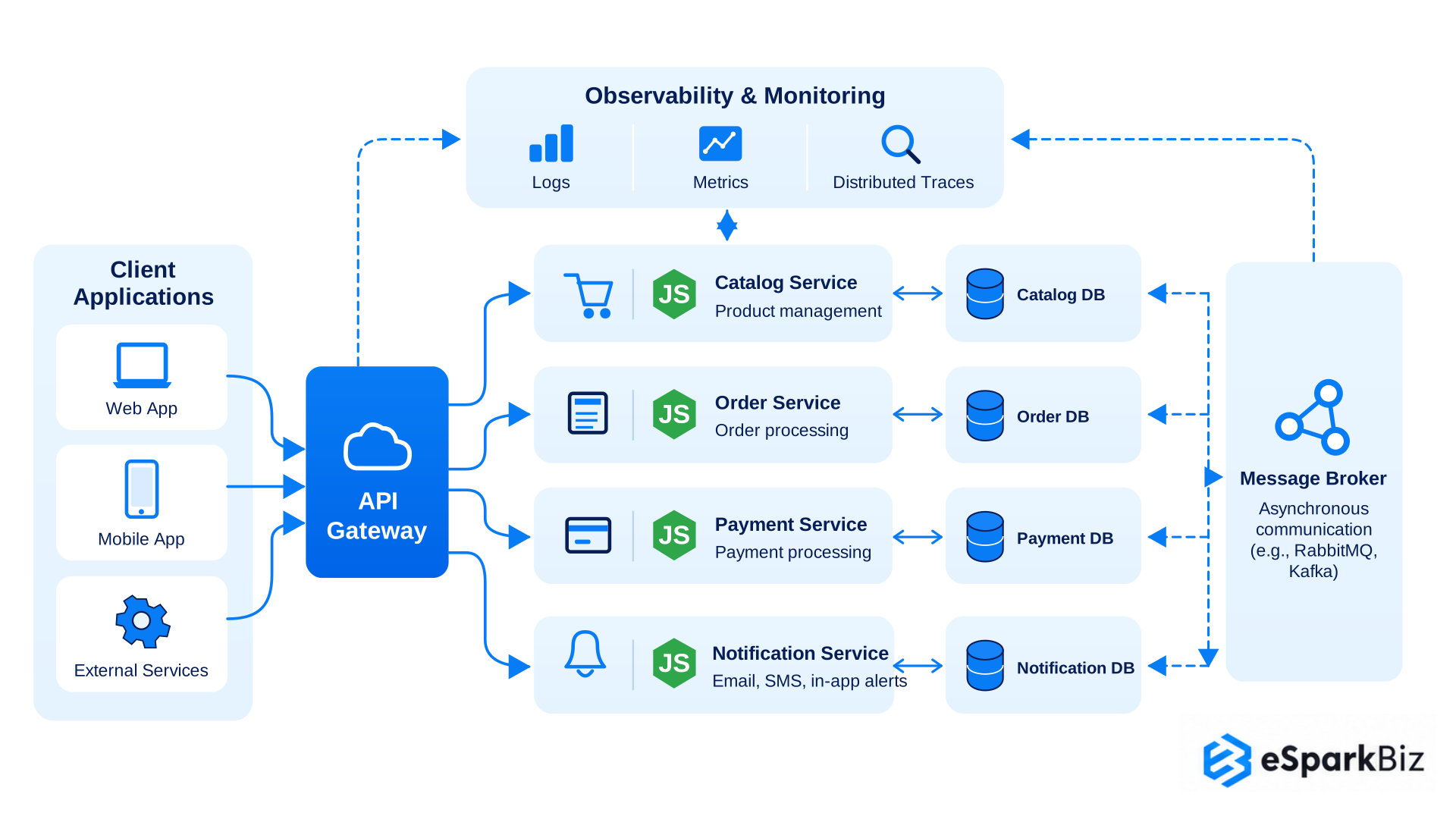
A typical architecture includes these components:
- API gateway: Route incoming request to the appropriate service.
- Independent services: It handle specific business function.
- Service owned databases: Keep the data management under each service’s control.
- Message broker: Enable asynchronous communication between the services.
- Observability tools: Track logs, metrics & distributed traces.
How to Avoid a Distributed Monolith
Poorly designed services can become a distributed monolith when they depend on frequent synchronous calls, share database tables or require coordinated deployments. Prevent this by following a few principles:
- Define boundaries around business capabilities.
- Minimize cross service dependencies.
- Enable independent testing and deployment.
- Use asynchronous messaging when immediate responses are unnecessary.
The goal is independent change and not simply more service. Split service further only when business or operational need justify the add complexity.
Best Node.js Frameworks for Microservices by Use Case
The right Node.js framework depend on service complexity, performance requirements and the team experience. Some Node.js frameworks offer only basic HTTP routing capabilities, whereas others provide more advanced tools for building services & managing their communication.
| Framework | Best use case | Key advantage | Team and maintenance fit | Development trade off |
| NestJS | Large applications with multiple services | Structured architecture and TypeScript support | Suits teams needing consistent conventions | More initial setup & framework concepts |
| Express.js | Lightweight REST APIs | Simple setup and flexible middleware | Fits teams familiar with JavaScript | Requires additional choices for architecture & service communication |
| Fastify | Performance focused API | Low overhead and schema based validation | Suits teams prioritizing efficient request handling | Requires careful plugin and integration selection |
| Moleculer | Distributed applications with service oriented patterns | Built in service discovery and messaging features | Fits teams wanting an established microservices toolkit | Adds framework specific conventions & dependencies |
Choose NestJS for structured teams, Express.js for flexible APIs, Fastify for performance and Moleculer for built in microservices features. Evaluate maintenance, integrations, security and team expertise before the selecting.
Expert’s quote
“Microservice decomposition can cause issues with troubleshooting, tracing flows, latency, referential integrity, cascading failures and a host of other things. Most of those problems are things you’ll notice only after you hit production.”
– Sam Newman, Monolith to Microservices: Evolutionary Patterns to Transform Your Monolith
Building a Node.js Microservice: A Practical Example
Usually, a Node.js microservice provides the basic APIs for a single business capability. For instance, a product service provides information on products without being dependent on order or payment service. In the following example, an Express.js interface is implemented to demonstrate a simple HTTP API.
const express = require(“express”);
const app = express();
app.use(express.json());
app.get(“/products/:id”, (req, res) => {
res.json({
id: req.params.id,
name: “Laptop”,
price: 75000
});
});
app.listen(3001, () => {
console.log(“Product service running on port 3001”);
});
This example returns the product details as JSON. In production, connect the service to a database and add input validation, authentication, error handling & automatic tests.
Communication Patterns and Data Consistency in Node.js Microservices
Communication among Node.js microservices is carried out using synchronous requests or asynchronous messages. REST and gRPC are examples of direct service communication solutions, while messaging is provided by RabbitMQ and Kafka.
| Technology | Best use case | Key consideration |
| REST APIs | Request response operations | Network latency and service availability |
| gRPC | Efficient, strongly typed communication | Additional tooling & configuration |
| RabbitMQ | Task queues and background jobs | Message delivery and broker management |
| Kafka | High volume event streams & event replay | Partitioning & consumer management |
Service to Service Communication Example
An order service can use Node.js’s built in fetch() to retrieve product information from a separate product service.
async function getProduct(productId) {
const response = await fetch(
`http://product-service:3001/products/${productId}`,
{ signal: AbortSignal.timeout(3000) }
);
if (!response.ok) {
throw new Error(“Product service request failed”);
}
return response.json();
}
The timeout prevents the request from waiting indefinitely. Production services should also implement appropriate authentication, error handling and controlled retries.
Managing Data Consistency with Sagas
Each service should own its data. The Saga pattern coordinates transactions across services through local transactions and compensating actions. For example, if payment fails after inventory reservation, the system can release the reservation.
Improve reliability by:
- Making message handlers idempotent.
- Using the transactional outbox pattern to publish events reliably.
- Applying timeouts & controlled retries.
These practices help manage distributed transactions without requiring a single database transaction across services.
Deploying and Managing Node.js Microservices in Production
Microservices based on Node.js need a reliable way to deploy them, secure ways to communicate with each other and centralized ways to monitor them to be effective in a production environment.
- Deployment: Use Docker to package services as consistently. Kubernetes suits environments require detailed orchestration, while serverless platforms can fit event driven or variable workloads.
- Security: Protect service endpoints with authentication, authorization, encrypted communication and managed secrets. Apply input validation and least privilege access.
- Monitoring: Collect structured logs, metrics & distributed traces to identify failed requests, latency and service dependencies.
For example, a health endpoint helps deployment platforms determine whether a service can respond to requests.
app.get(“/health”, (req, res) => {
res.status(200).json({ status: “healthy” });
});
A basic health endpoint confirms that the application responds; production readiness checks should also account for critical dependencies when appropriate.
How to Migrate from a Monolith to Node.js Microservices
Migrating a Node.js monolith to microservices doesn’t require pausing feature development. Teams can gradually extract business capabilities while the existing application continues handling production traffic & getting new versions released. The following five steps will allow you to define service boundaries, maintain data consistency & minimize downtime during migration.
Step 1: Identify Service Boundaries
Identify business capabilities, including payments, inventory or notifications, that are able to function on their own. Choose the modules with the simplest accountability and fewer dependencies, in order for the transition to take place simultaneously with the development of features.
Step 2: Extract the First Service
Build the selected module as a separate Node.js service with a defined API. Use a low risk capability, instead of making changes in the primary product. Feature flags or API routing can be utilized for a smooth transition process.
Step 3: Establish Data Ownership
Give the new service control over its data. Replace direct database dependencies with API calls or events, gradually transferring data ownership while maintaining compatibility & data consistency.
Step 4: Test and Redirect Traffic
Test functionality, security & performance. Use automated tests and gradual traffic shifting to validate the new service while keeping a rollback option.
Step 5: Monitor and Expand
Monitor errors, latency, resource usage and service reliability. Run migration and feature development in parallel, extracting additional services only after validating previous ones.
The Strangler Fig pattern enables slow migration by transferring functions to new microservices while the monolithic structure takes care of the rest of the operations. Teams can manage feature launches, build services one by one & transfer traffic step by step.
Node.js Microservices Pricing: Key Cost Drivers and Trade Offs
The cost of building Node.js microservices depend on the development effort, infrastructure, integrations, security & ongoing support. Cloud infrastructure and operational complexity can significantly affect the overall cost of ownership.
What Shapes Your Development Budget?
- Development and architecture: Service boundary, API design, business logic & database integration.
- Infrastructure: Cloud hosting, containers, networking, databases and message broker.
- Testing and security: Automated tests, vulnerability assessment, access controls and compliance requirements.
- Monitoring and maintenance: Logging, distributed tracing, incident response & software upgrade.
- Team expertise: Developer experience, DevOps capability & project management requirements.
Where Microservices Costs Add Up
Microservices can introduce additional expenses as the number of service & their operational requirement increase.
- Inter service communication: Network traffic, API calls and data transfer between services.
- Deployment complexity: Multiple pipelines, environments and release management.
- Debugging and monitoring: Tools to trace requests & diagnose failures across services.
- Operational support: On call engineers, incident handling and infrastructure maintenance.
- Scaling overhead: Additional compute resources, database capacity & messaging infrastructure.
Budgeting tip: Know the total number of services, integrations, incoming traffic, deployment model and support requirement prior to requesting for vendor quote. Calculate the development costs and recurring operational expenses in order to compute the costs of ownership.
Did You Know?
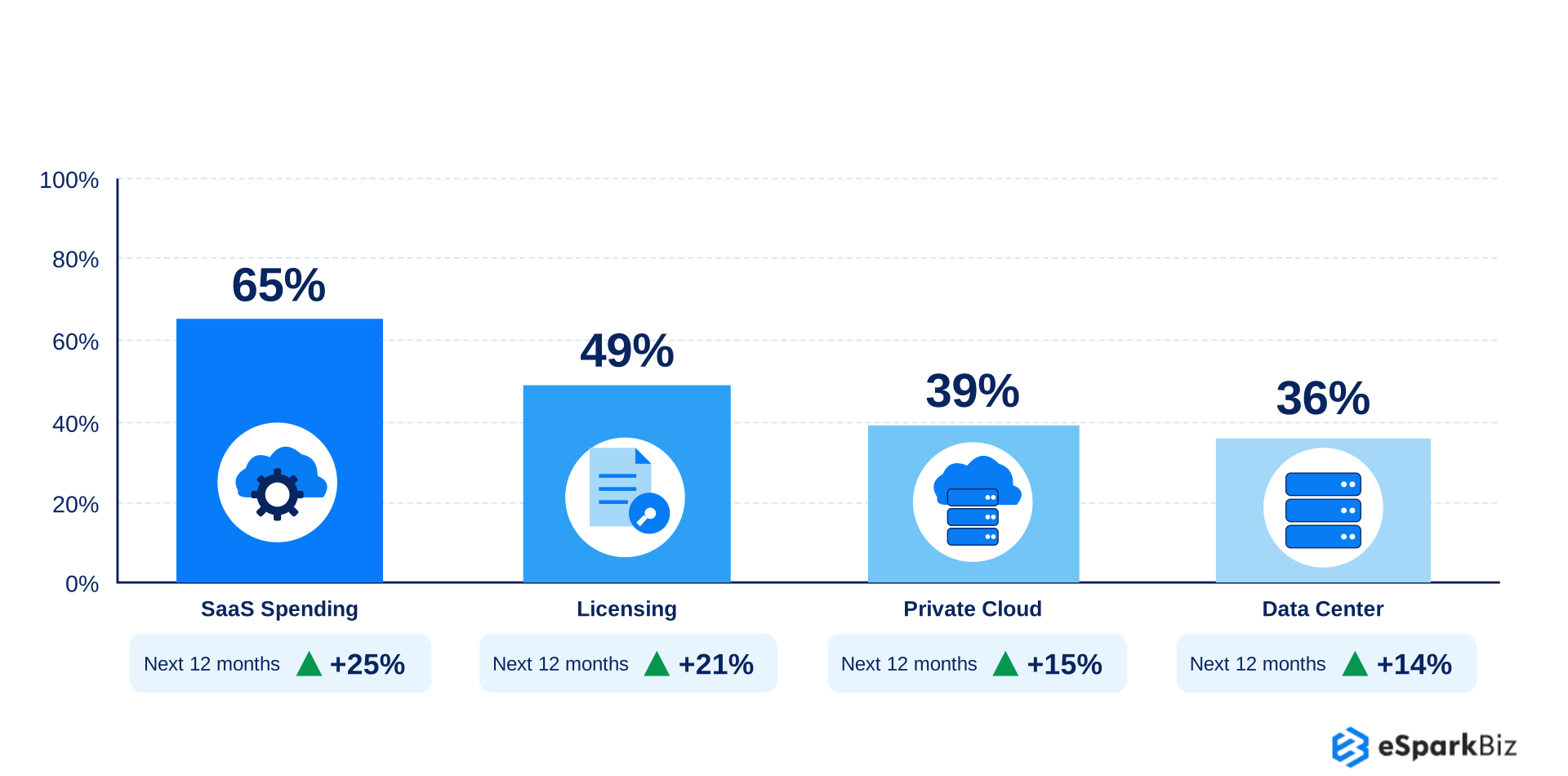
The FinOps Foundation reports that 65% of respondents manage SaaS spending, 49% licensing, 39% private cloud and 36% of data centers. These findings highlight the importance of tracking infrastructure, software tools, hosting & operational expense when estimating Node.js microservices about the total ownership costs.
Security Controls for Regulated Node.js Applications
Security requirements are depend on the data a Node.js microservices application handle and the regulations applicable to the operations.
| Regulation | Key requirement | Relevant security controls |
| PCI DSS | Protect payment card data | Access restrictions, secure configurations & security monitoring |
| HIPAA | Safeguard protected health information where applicable | Access controls, audit controls & appropriate data Safety |
| UK GDPR | Protect the personal data and hold applicable data subject right | Data minimization, access controls, retention policies and appropriate security measures |
Essential Security Measures
To support these requirements, implement the following controls across services:
- Encryption: Protect the sensitive data in transit and at rest.
- Authentication and authorization: Verify service identity and enforce least privilege access.
- Audit logging: Record the relevant access and security events.
- Secrets management: Keep credential and API key outside a source code.
- Data lifecycle management: Define data retention, access & deletion procedures.
Important: Using microservices does not automatically establish regulatory compliance. Organizations must assess applicable requirements, implement suitable controls and maintain the evidence that those controls operate effective.
Questions to Ask Before Hiring a Node.js Microservices Development Company
The right partner shape your delivery speed, cloud spend and long term maintenance. As the publisher of this guide, eSparkBiz also provides Node.js development services, so we encourage you to ask us these same questions. Use them to evaluate any vendor before the shortlisting:
- Architecture: How will you define service boundaries and avoid unnecessary complexity?
- Data Management: How will you handle failed transactions & duplicate messages?
- Security: What authentication and data protection measures will you implement?
- Deployment: How will you manage releases, CI/CD pipelines, Kubernetes deployments, monitoring and incidents?
- Pricing: Does the estimate include infrastructure, testing & maintenance?
- Milestones: Will the migration plan define fixed milestones, such as one extracted service per phase, with rollback criteria for each?
- Ownership: Will you receive source code, documentation and deployment configurations?
- Delivery model: Can the team own architecture, CI/CD and Kubernetes operations & work with overlapping hours with your US team?
When making the comparison, consider technical expertise and experience of the provider, transparency in their pricing, and the support provided after the launch. Having clear ownership and maintenance agreements reduces operational risk. Your team can manage the application effectively.
Frequently Asked Questions
How much does it cost to build a Node.js microservices application?
A Node.js microservices application may cost $10,000 - $20,000 for a basic MVP, $20,000 - $55,000 for a mid-sized system and $55,000 - $150,000+ for a complex platform. A microservices engagement cost depends on the service count, integrations, security and testing. Hosting, maintenance and migration expenses, including data transfer, parallel operations and AWS infrastructure, may add to the overall budget.
How long does it take to develop a production ready Node.js microservices application?
Migrating a mid-size Node.js monolith to microservices on AWS can take several months, depending on the number of services, data complexity, integrations and team size. Costs depend on service extraction, AWS infrastructure (EKS, RDS or MSK), testing and parallel operations during migration. A phased approach, extracting one service at a time, helps control costs and minimize production disruption.
Should I choose Node.js microservices or a modular monolith for my project?
A modular monolith suits smaller applications because it offer simpler development and deployment. Node.js microservices are better when the applications require independent releases, service level scaling & separate team ownership, despite having the higher operational complexity.
How do you prevent cascading failures in Node.js microservices?
Prevent cascading failures with timeouts, circuit break, controlled retries and resource isolation. Health checks & monitoring help to identify problems early, while idempotency reduces duplicate processing when requests are retried.
Should I build a Node.js microservices team in-house or outsource development?
An in-house team offer direct control & retain technical knowledge but requires ongoing recruitment and staffing costs. Outsourcing provides access to the external expertise and development capacity. Compare technical skills, pricing, communication, code ownership and post launch support before going to be deciding.
What are common mistakes in Node.js microservices?
Common mistakes include excessive API calls, shared databases, poor service boundaries and weak error handling. Define clear service ownership, use asynchronous messaging where suitable and implement timeouts, retries & monitoring to improve reliability.
What should I look for when hiring a Node.js microservices development company?
Evaluate the providers based on the following factors are as follows:
- Technical expertise: Experience with the Node.js, databases and messaging systems.
- Architecture: Ability to define service boundaries and design reliable APIs.
- Security: Strong authentication, access controls & data protection practices.
- Testing and monitoring: Automatic testing & production monitoring.
- Pricing: Transparent development and maintenance estimates.
- Ownership and support: Source code, documentation, knowledge transfer and post launch support.


 August 19, 2026