Your group releases an important feature, but users continue to express dissatisfaction with the product’s slowness. This is where the importance of UI quality takes on commercial significance, beyond being a design issue.
A good looking UI is not limited to great looks. It will make your product faster, easier to understand, accessible and consistent on various devices. All these will help you grow your conversion rate, boost customer loyalty, decrease customer support and facilitate faster releases.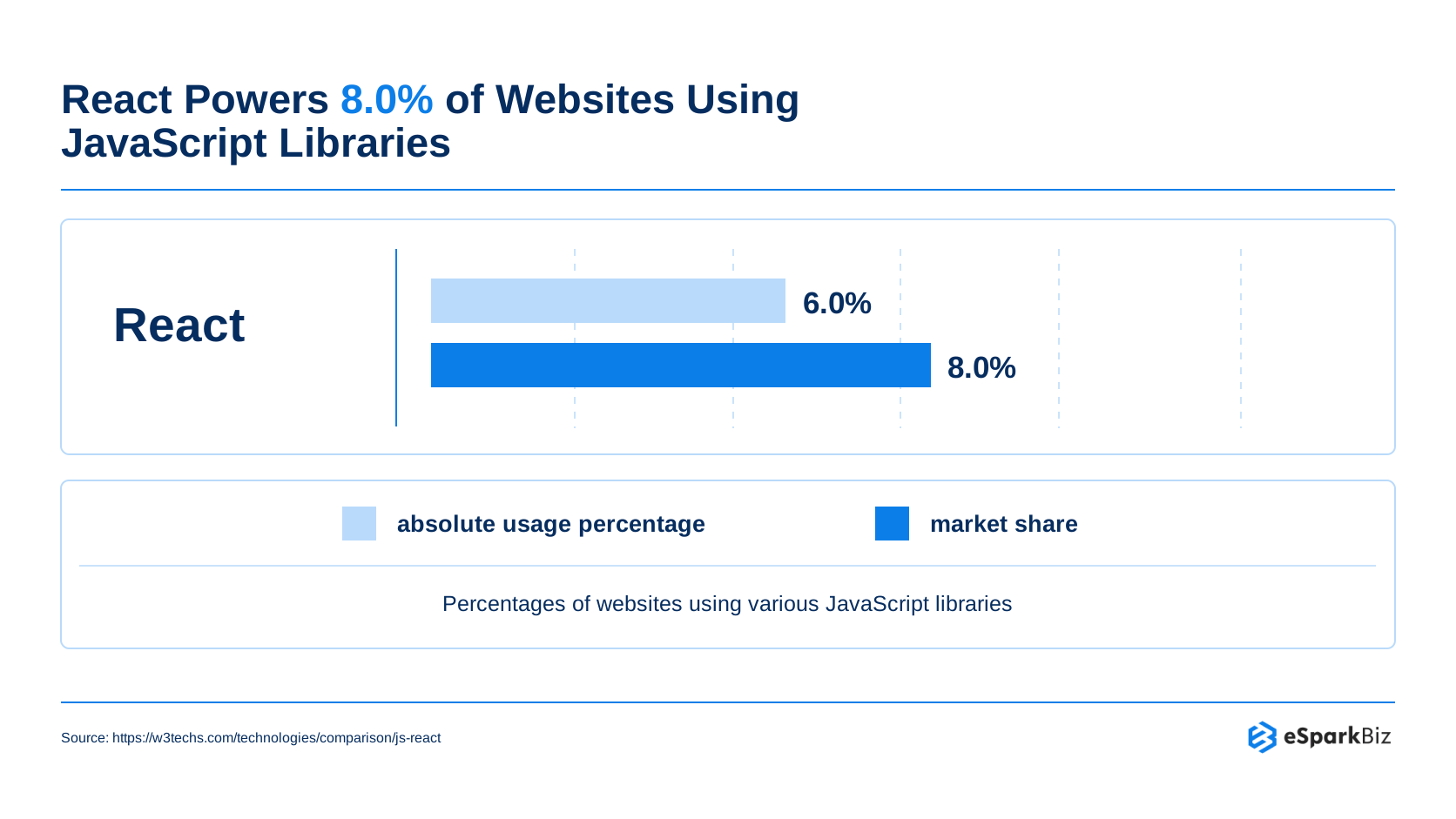 React is used by 8.0% of all the websites whose JavaScript library we know. To calculate the ROI of a UI redesign, monitor the rate of conversion, customer retention, support tickets and releases prior to the launch and afterward. A common assertion about the return from UX is based on secondary sources; therefore, measurable results provide a more solid foundation.
What Comprehensive ReactJS Development Services Include
The complete ReactJS development services include interface design, custom app development, performance optimization, modernization and support to enhance the user experience without losing sight of your objectives.
The Service Menu, Mapped to UI Outcomes
When each development service is linked to an outcome that can be measured, selecting ReactJS development services gets much easier. Having a defined scope means no wasting money on unnecessary features.
| Service | UI outcome | Metric to track |
| UI/UX design and prototyping | Clear flows users grasp quickly | Task completion rate |
| Custom React web app development | Interfaces built around your workflows | Time to ship new features |
| Component library and design system | Consistent look across products | Share of screens using shared components |
| Performance optimization | Faster loads and responses | Core Web Vitals, including Interaction to Next Paint (INP) |
| Migration and modernization | Old screens move to React step by step | Defects and support tickets after release |
| Next.js and server rendering setup | Faster first view, better search visibility | Largest Contentful Paint, indexed pages |
| React Native mobile apps | One skill base across web and mobile | Release cadence across platforms |
| QA and accessibility testing | Fewer regressions, fewer barriers | Accessibility audit issues, escaped bugs |
The services can function on their own or as a component of a larger product campaign. It all depends on your existing application and customer demands.
How an Engagement Runs, Step by Step
A structured approach ensures that the ReactJS development process is geared toward organizational objectives without having every design modification become a big project. The step by step process is:
- Evaluation: We examine your existing UI, metrics, technical restrictions and customer input. Why it’s important: Decisions will be based on facts, not opinions.
- Design: We build prototypes and reusable components and test them with actual users. Why it’s important: Feedback early saves expensive rework later.
- Design and implement: We release incremental versions with testing and accessibility evaluation. Why this is important: Incremental changes make it simpler to detect bugs.
- Deployment and maintenance: We track performance, create patches and schedule upgrades. Why this is important: Your user interface will remain easy to maintain.
Throughout this entire engagement, clear boundaries ensure the project stays on track. You keep all product decisions, strategy, and business priorities in-house. Meanwhile, your React development services provider owns technical delivery, code quality, QA testing, and release cycles within the agreed scope.
What “Appealing” Means in 2026: Fast, Clear, Accessible, Consistent
A great ReactJS UI is fast, clear, accessible and consistent to make the user experience smoother for everyone.
Design must make things easier; beauty is just a by-product. Users expect a system that reacts fast, speaks clearly and behaves predictably. React offers a solution for this problem, but every enhancement requires tangible results.
Fast: Speed Users Can Feel
Speed involves having your application load rapidly and perform without any annoying lag times. An excellent design is rendered useless by an application that freezes when you try to click buttons.
React offers two practical approaches:
- React Compiler: Helps eliminate unnecessary component re-rendering and increases responsiveness.
- Server rendering: Enables faster loading of initial page content, depending on the application architecture.
Test Track Interaction to Next Paint (INP), which is a Core Web Vitals measurement tool for measuring responsiveness. The performance of React Compiler depends on the application.
Clear: Interfaces People Understand at a Glance
“Clarity” is defined as customers who know right away where to go and what to do. Being clear about layout, content and user interaction can help accomplish that goal.
React components could standardize necessary user interface elements like:
- Navigation bars and page structures
- Labels and messages for forms
- Buttons and alert messages
Efficient interfaces can also avoid unnecessary customer support calls. Measure how well users are completing their tasks and make sure there are no mistakes made by users.
Accessible: Built In, Not Bolted On
Accessibility refers to a situation where individuals with varying levels of ability can use your application efficiently.
WCAG 2.1 AA is one of the most commonly used guidelines. W3C suggests that newer efforts in accessibility should use WCAG 2.2.
React does not make applications automatically accessible. Teams need to tackle keyboard accessibility, accessibility for screen readers, color contrast and accessible forms.
Monitor findings from the accessibility audit as well as any issues left unaddressed. Consult your legal and security representatives about your legal obligations.
Consistent: One Look Across Every Screen
This implies that users are subjected to similar controls, colors and interaction methods across your software. The concept is particularly vital when there are different groups handling several products.
React facilitates consistency within its interfaces by way of:
- Reusable components: Buttons, forms and navigation.
- Tokens: Colors, typography and spacing.
- Design guidelines: Harmonized experiences for both web and mobile applications.
Standard interfaces would minimize repeated effort in designing and make updates easier. Measure the proportion of screens that use approved elements. It will show where your design guidelines have succeeded and where they failed.
What Modern React Adds: Compiler, Server Components and Activity
Modern React comes with features that will improve its performance, server-side operations and screen state management, hence making the interface fast and easy to use without having to do any rebuilding.
Each of these components addresses distinct user interface needs. But each component presents its own set of technological implications to be considered before implementation.
| Feature | Effect on your UI | Caveat |
| React Compiler 1.0 | Automatically optimizes component rendering, reducing manual performance work. | Benefits depend on application structure. Benchmark actual results before adoption. |
| React Server Components (RSC) | Can reduce browser JavaScript and improve initial page delivery through supporting frameworks. | Requires compatible architecture, secure dependencies and a defined patching process. |
| Activity (React 19.2) | Can preserve hidden screen state, making returning to previous views feel faster. | Adds lifecycle and resource management considerations. Test behavior before production use. |
React’s official documentation confirms these capabilities, but the benefits are not universal.
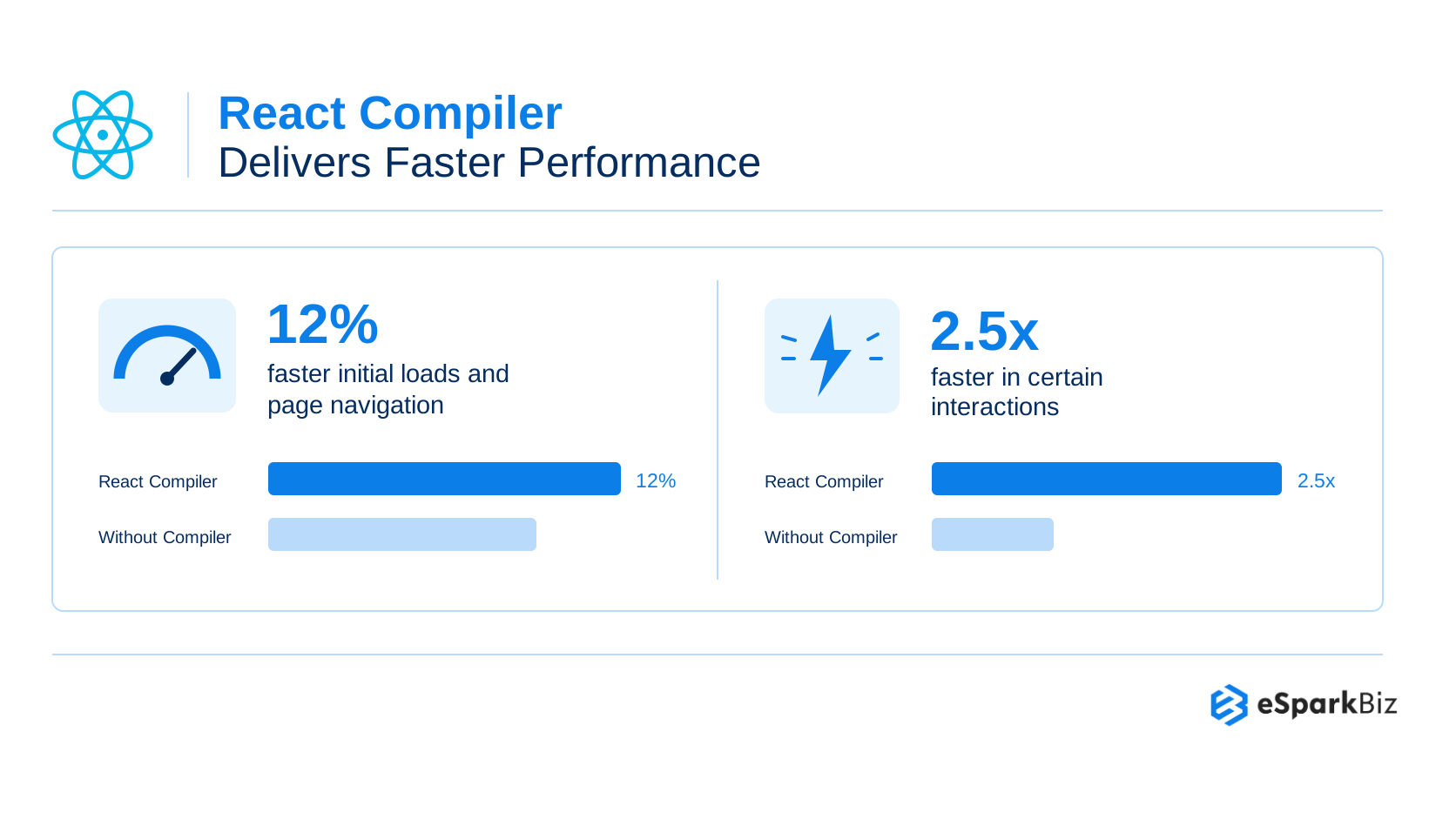 As per the company announcement, Meta found up to a 12% improvement in initial loading time and page navigation, along with some interactions being more than 2.5 times faster for React Compiler.
Security needs to be considered too. A remote code execution bug has been fixed in React Server Components 19.0.1 and later. Other security issues have required additional patches.
In terms of investments, one should:
- Compiler: Evaluate rendering and interaction performance.
- Server Components: Review architecture, dependencies, and patches.
- Activity: Test state preservation and hidden screen support.
Validate architectural and security decisions with your engineering and security teams.
Did You Know?
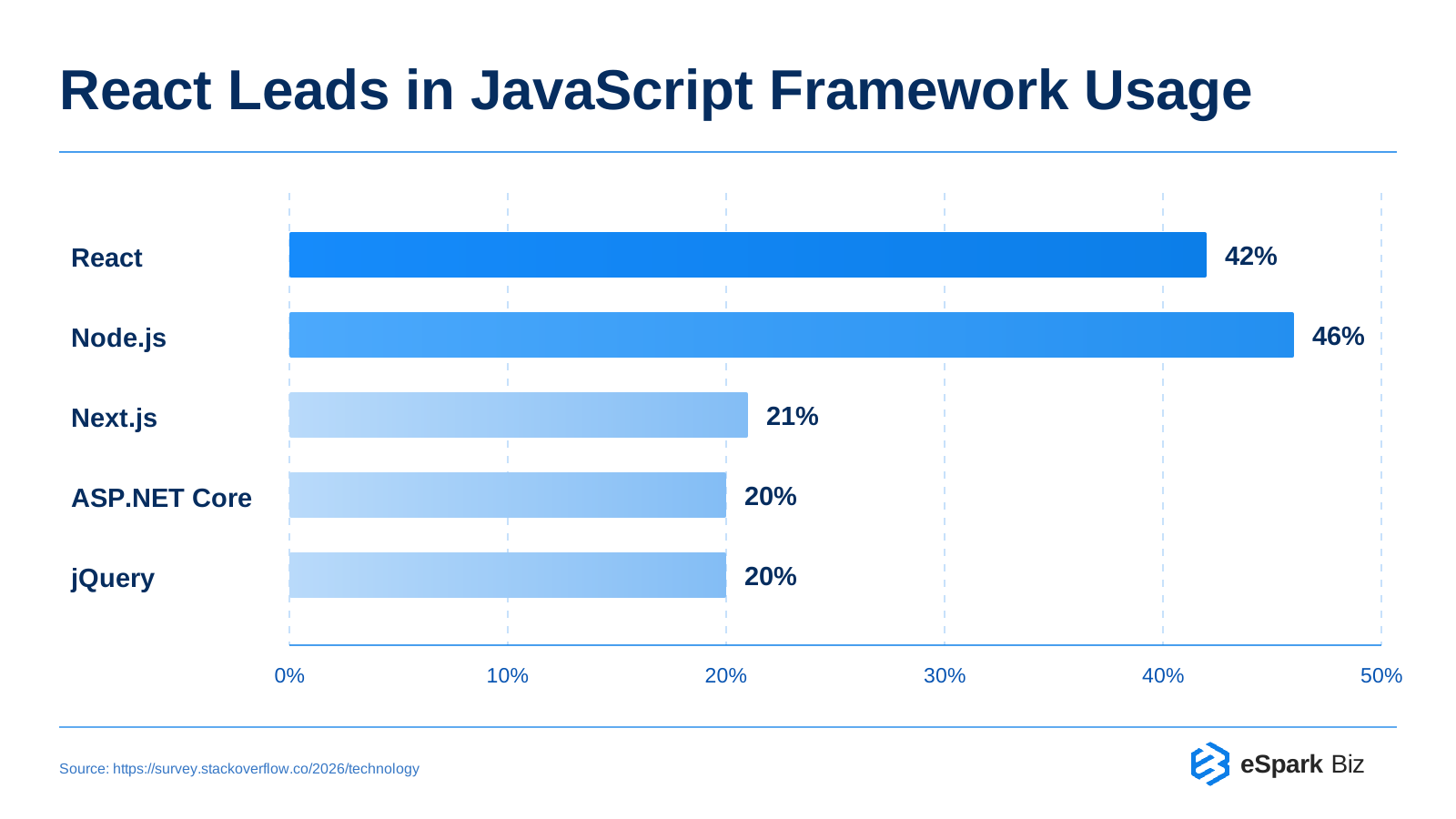
42% of developers surveyed use React, making it one of the most widely adopted web technologies worldwide.
ReactJS for Your UI: Benefits and Trade-Offs
ReactJS supports consistent, maintainable interfaces, but its flexibility also requires careful architecture, security and maintenance decisions.
Benefits: Where React Adds Business Value
React offers practical advantages for teams balancing customer experience, development speed and long term product maintenance.
- Reusable components: Commonly used buttons, forms, and layouts ensure consistency and avoid repetitive coding efforts.
- Huge developer pool: Being extensively used by many companies ensures that the company can hire experienced developers.
- Mature framework: Mature libraries help with testing, interface design, state management, and other needs.
- React Compiler: The React Compiler is capable of automatically optimizing the rendering process, reducing the need for manual performance tuning. Expectations will differ based on your application.
- Web and Mobile Development: React Native provides an opportunity to leverage React skills in a multi-platform environment, even if the user interface code isn’t entirely transferable.
Trade-Offs: What Your Team Must Manage
React provides the building blocks, but you retain full control over architecture decisions within your organization.
- The architecture decisions: React is simply a library, which means that teams will need to choose routing, state management, and any other libraries necessary for their projects.
- Dependency Management and Patching: The new Server Components feature requires diligent updating of dependencies and patches.
- Planning: As React iterates and evolves, you will need to budget for compatibility tests.
- Accessibility: React doesn’t automatically comply with accessibility guidelines; testing and review processes still apply.
- Team dynamics: Some companies benefit from using a more opinionated library rather than creating one themselves.
As evidence of our hiring reach, according to the Stack Overflow Developer Survey, React is used by 41.5% of the 10,281 respondents who answered questions regarding web technologies.
Moreover, the React team deprecated Create React App and suggested developers utilize alternative frameworks like Next.js, React Router and Expo.
Design Systems: Keeping a UI Consistent as It Grows
Consistency within ReactJS applications comes via design systems, which rely on the use of component reuse, guidelines, and ownership to achieve their desired effect.
Without design systems, UI entropy results from various teams implementing distinct interfaces to accomplish the same task.
As pointed out by the 2026 Design Systems Report, emphasis should be placed on adoption and governance, not simply documentation.
To maintain consistency, establish clear ownership:
- Approvals: Who signs off on the use of new components?
- Sunsetting: Who retires old components?
- Adoption: Who tracks how widely components are used in different products?
Ownership can eliminate redundancy and ensure interface consistency during product expansion.
🎥 Watch: React vs HTMX | Which Frontend Technology Should You Choose?
What a ReactJS UI Project Costs: The Drivers
ReactJS Development Costs Will Be Determined by Several Key Factors.
The extent of a ReactJS development effort will be influenced by such things as the breadth of your project scope, the expertise of your team, geographical considerations, legacy systems, and test requirements.
| Driver | Why it moves price | Question to ask a vendor |
| Scope and number of screens | More design and testing effort | What does this estimate include? |
| Seniority mix | Senior expertise costs more but may reduce rework | Who will perform the work? |
| Region and engagement model | Rates and contracts vary | Fixed price or time-based billing? |
| Existing code and integrations | Legacy dependencies increase effort | How will existing systems connect? |
| Accessibility and testing depth | More testing increases upfront costs | Which WCAG level is tested? |
Expert Quote:
“I believe the culture and energy of the React community is the reason for React’s massive success.”
~ Jordan Walke – Creator of React
How to Choose a ReactJS Development Partner
Finding the right developer for ReactJS projects involves a lot more than just comparing costs; you need to assess capability, security procedures, accessibility testing, and ownership.
Six Questions to Ask Any React Vendor
Portfolios can definitely help but promises made must be kept. This is what we recommend to get your questions answered about upgrade services, application security, and performance monitoring.
| Question | What a good answer sounds like |
| Which React version do you start new projects on? | Current stable release with a written upgrade policy. |
| How quickly do you apply security patches? | Defined patching timelines, ownership and client communication. |
| How do you test accessibility? | Automated and manual testing against a specified WCAG level. |
| Do you build a design system and who owns it afterward? | Documented components, clear ownership and a handover plan. |
| Which metrics will you report? | Performance, error rates and task completion tied to business goals. |
| What happens at handover? | Client code ownership, documentation and structured knowledge transfer. |
Always request a written document. It is the responsibility of the vendor to justify why they use these practices in your case.
Three Red Flags
Look out for these red flags when negotiating a ReactJS development agreement:
- Unsubstantiated assurances: Asserting that React is inherently accessible or secure.
- Uncertain cost information: Giving only an hourly rate without outlining scope and deliverables or testing details.
- Lack of transition information: Failing to offer any kind of documentation or knowledge transition process.
To avoid these outsourcing mistakes and verify a vendor’s code quality before signing a contract, follow these steps:
- Do not choose based on hourly rates alone: Compare the cost per delivered feature instead.
- Review code before signing: Request a sample repository or review a module the vendor has already built.
- Interview the actual team: Speak with the engineers and tech leads responsible for your project, not just sales staff.
- Run a paid pilot: Complete one sprint with a clear goal before committing to a long-term contract.
- Define ownership terms clearly: Ensure the contract assigns IP, repositories and cloud accounts to you, with clear exit and handover clauses.
- Set quality standards upfront: Agree on test coverage, code review rules and Core Web Vitals targets before development begins.
Community Insights:
According to a Quora thread, hiring React development services offers businesses access to advanced technologies, faster project delivery, reduced risks and greater flexibility. Outsourcing also lowers operational costs, provides experienced developers and frees internal resources, enabling businesses to focus on growth and innovation.
How eSparkBiz Supports Enterprise ReactJS Development
eSparkBiz brings 15+ years of experience and 400+ developers to enterprise ReactJS projects. Operating through our Delaware entity, we offer daily US time-zone overlap and can onboard ReactJS specialists within 48 – 72 hours.
Our approach focuses on long-term maintainability and clear delivery, featuring:
- Performance & Upgrades: Tracking Core Web Vitals and managing safe React version updates.
- Security & Accessibility: Strict patching protocols and WCAG-compliant testing.
- IP Ownership & Handover: NDA-first contracts, 100% source code ownership, and structured knowledge transfer.
Backed by a 4.9/5 Clutch rating and verifiable client references, we keep projects on track with a dedicated project manager and weekly demos.
Frequently Asked Questions
How much does it cost to hire a ReactJS development company in the USA?
ReactJS developers in the USA typically charge an average of <$25/hr to $200/hr, depending on experience, project scope and testing requirements. Request detailed written quotes to compare total costs and deliverables.
What should a ReactJS development services package include?
A complete package should include UI/UX design, custom development, component libraries, performance optimization, migration, server rendering, React Native development, quality assurance and accessibility testing, with support matched to your project.
Should I hire a React development company or build an in-house team?
Agencies provide fast access to specialized skills, while in-house teams ensure long-term ownership. Choose your model based on control: use staff augmentation or freelancers to manage day-to-day processes yourself, or hire a dedicated team to deliver complete outcomes.
How long does a React UI redesign take?
Timelines depend on screen count, design complexity, integrations and testing requirements. A focused redesign may require less effort than full modernization. Request a milestone-based schedule after technical assessment.
What is WCAG 2.1 AA and why does it matter to my business?
Web Content Accessibility Guidelines (WCAG) 2.1 Level AA provides a widely used accessibility benchmark. It supports more inclusive interfaces. Confirm applicable legal obligations with qualified counsel.
Is React still a safe long-term choice?
React has broad developer adoption, Meta-backed development and React Foundation governance. However, upgrades, dependency security and architectural decisions still require attention. No technology guarantees long-term suitability.
Can I modernize my old interface to React without a full rewrite?
Yes. Depending on your existing architecture, teams can migrate individual screens or features incrementally. This approach can reduce disruption while allowing testing and validation throughout modernization.

 August 20, 2026