

What We'll be covering here
- When augmentation makes sense
- What the costs will be and how it'll impact your runway
- Which roles to bring in
- Integrating augmented staff into your team and the potential risks
- Choosing the right provider
The traditional path from startup growth to a larger engineering team is changing. Building a core team then adding expertise as you need it, is becoming a more practical approach as technical requirements evolve. Companies are increasingly combining permanent employees with external technical talent without making every capability part of their long term organization.
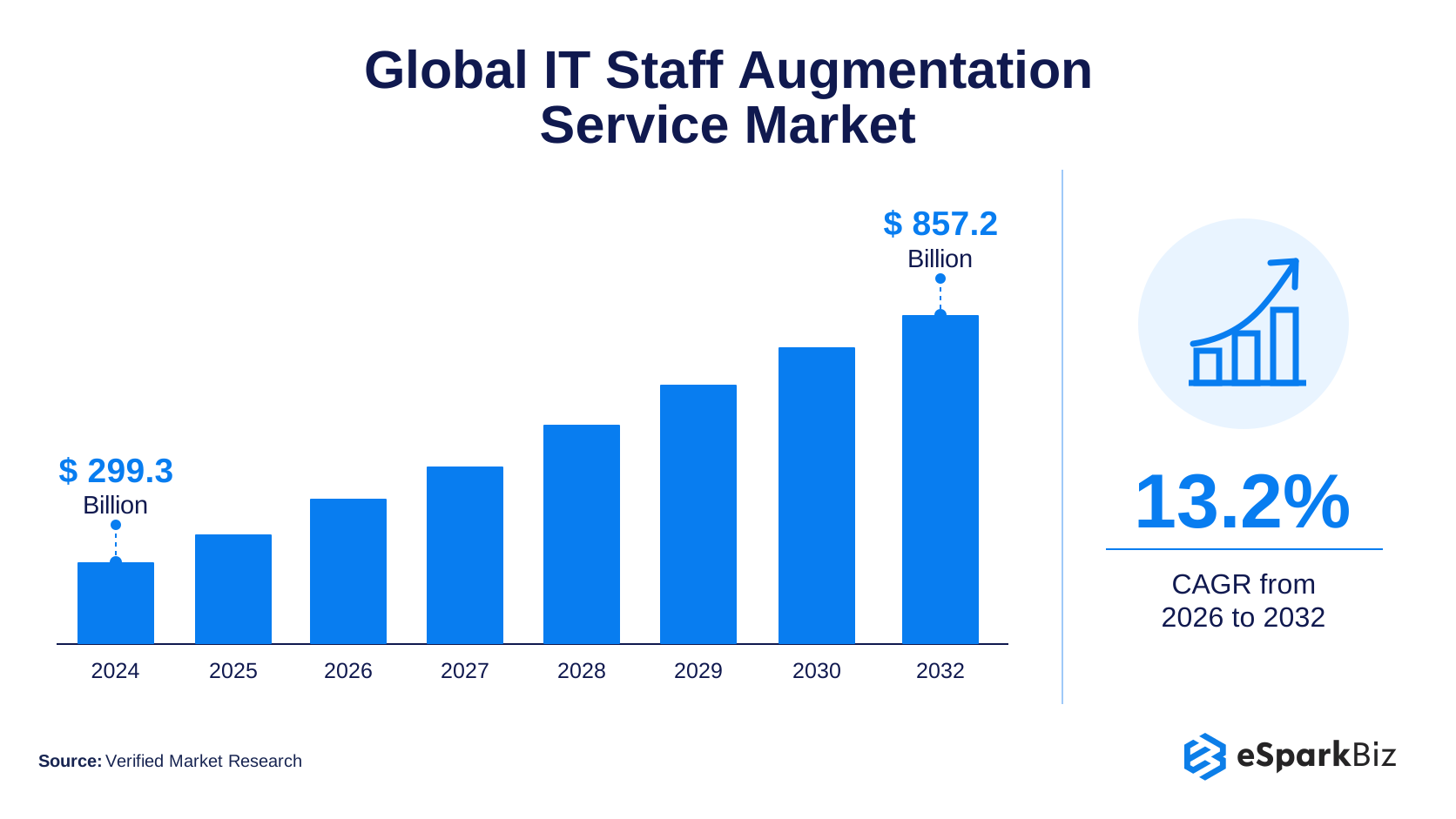
The market is moving in this direction. Verified Market Research estimates the Global IT Staff Augmentation Service Market will reach $857.2 billion by 2032, growing at a 13.2% CAGR.
For early stage funded startups, this shift offers another way to structure engineering teams as business needs change. Rather than choosing between permanent hiring and fully outsourced product development, startups can combine an internal core team with external technical expertise.
What is IT Staff Augmentation?
IT staff augmentation means adding external engineers to your existing team for a specific period or technical need. They work with your team, tools, workflows and processes while you control their daily priorities and technical decisions.
How It Works:
- Your startup: Defines the work and manages the engineers
- Staffing provider: Sources the talent and typically handles contracts, payroll and compliance
- Augmented engineers: Join your team and work on your product alongside your employees
- Real world scenario: A Series A startup needs two AI engineers for a four month product launch. Instead of hiring two permanent employees, it adds two augmented engineers who work with the existing team until the project is complete.
- Staff augmentation vs outsourcing: Staff augmentation adds engineers to your team under your direction. Outsourcing gives an external provider responsibility for delivering defined work or outcomes.
Did you know?
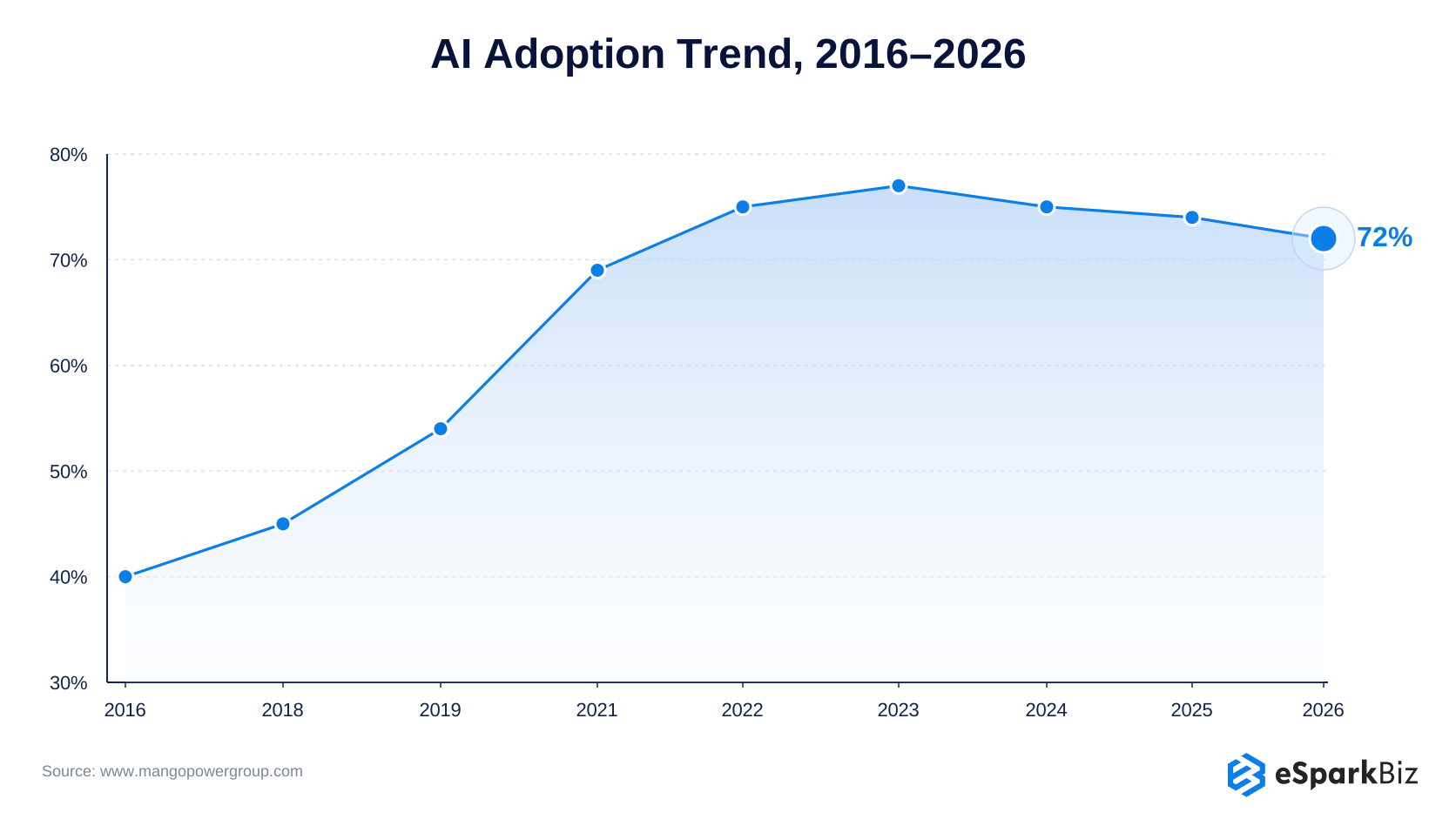
72% of employers worldwide reported difficulty filling roles in 2026 with AI skills among the hardest to find, according to ManpowerGroup’s global talent shortage survey.
Why Funding does not automatically solve Engineering Capacity
Raising capital gives you more resources, but it also ups the pressure to hit milestones faster. And as your customer base grows, so do the demands on your engineering team, exposing capacity and skill gaps.
The 2026 funding market shows just why capital discipline is still crucial. 47% of venture backed tech startups had less than 12 months of runway in June 2026, while H1 2026 VC deal value reached an impressive $412.7 billion.
Hiring is no easy task either, 68% of HR pros reported difficulty recruiting full time employees in 2026, and 53% said it was getting harder than the year before.
What this means for Funded Startups
- Team stress: Fresh funding often comes with higher product and growth expectations, which puts a huge strain on the engineering team.
- Hiring struggles: When you can’t find good people, permanent hiring may not be able to keep up with the expectations.
- Headcount decisions: Founders have to decide whether a particular skill is something they really need in the long term or just a short term requirement.
- Control: Startups may want more engineering capacity without handing over the reins of the product to an outside firm.
IT Staff Augmentation for Funded Startups is one way to bridge this gap by bringing in experienced engineers around specific priorities while the internal team gets to keep the product ownership, technical direction and day-to-day control.
So, just how much does each option actually cost, then?
The Real Cost Math: Staff Augmentation vs. Full-Time Hiring vs. Outsourcing
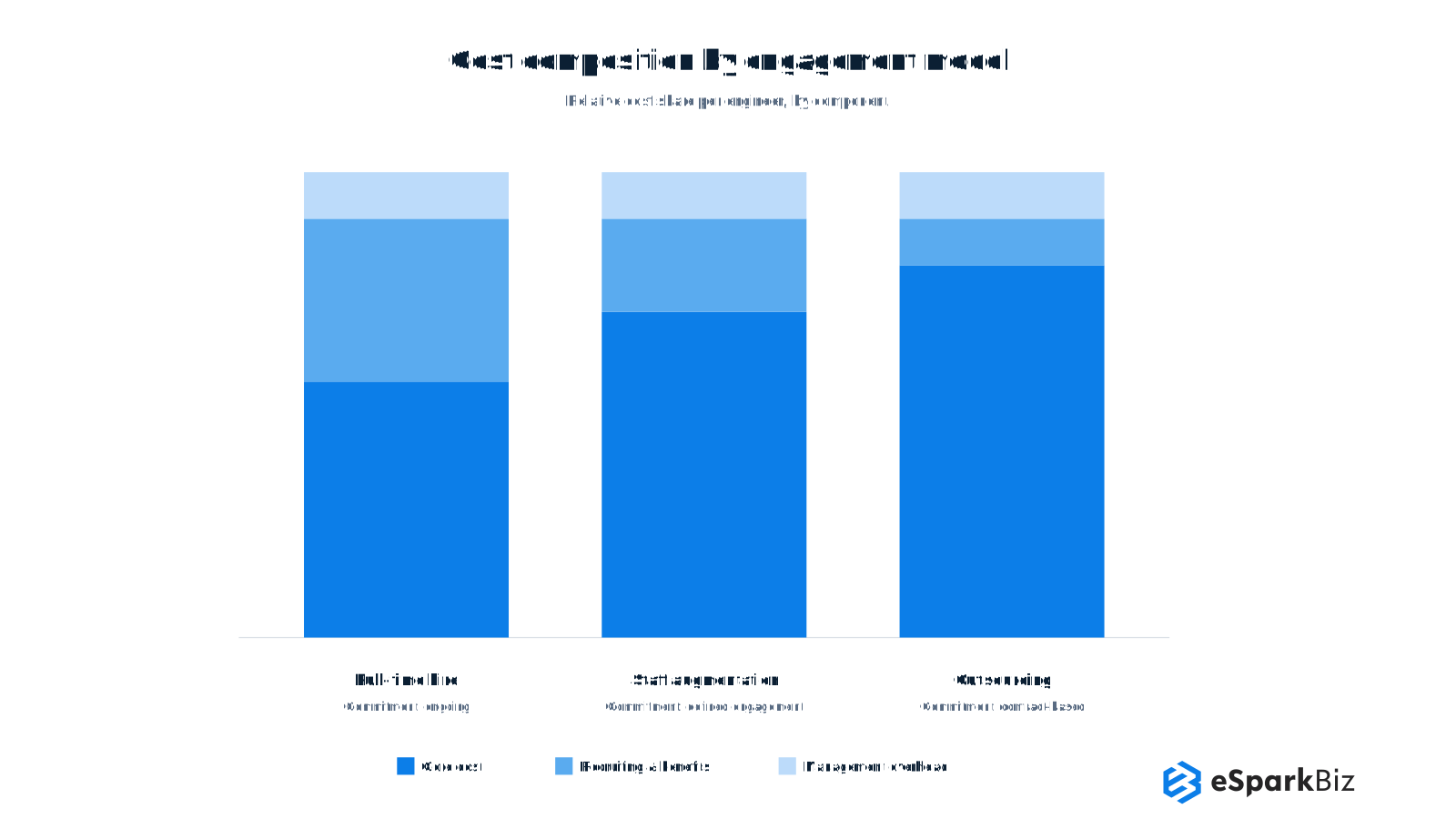
For funded startups the real cost of adding an engineer is more than just salary. Hiring, benefits, payroll costs, work equipment, onboarding and the length of the commitment can make a real difference to the overall cost.
The latest U.S. Bureau of Labor Statistics data puts the median annual wage for software developers at $135,980, based on May 2025 data and published in 2026. That provides a useful salary baseline, but it does not represent the employees total cost to the company.
Monthly Cost Comparison: Staff Augmentation vs. Full-Time Hiring
For U.S. startups, the monthly cost of a full-stack developer depends on experience and hiring model. The estimates below help founders compare employee costs with the cost of adding engineering capacity.
| Hiring model | Estimated monthly cost |
| U.S. full-time developer salary | $11,332 before benefits |
| U.S. full-time developer, including estimated benefits | About $16,165 |
| U.S. senior full-stack staff augmentation | $19,200-$32,000 |
The employee estimates use the BLS median annual software developer wage of $135,980 and the December 2025 average private-industry compensation split. The staff augmentation estimate assumes $120-$200 per hour for 160 hours per month.
Estimated U.S. Full-Stack Developer Rates by Seniority
For initial budgeting, the following U.S. contract-rate ranges provide another reference point. Monthly figures assume 160 billable hours.
| Developer level | Hourly rate | Monthly estimate |
| Junior (1–3 years) | $67-$104 | $10,720-$16,640 |
| Mid-level (3–6 years) | $85 -$135 | $13,600-$21,600 |
| Senior (7–10 years) | $110-$171 | $17,600-$27,360 |
These are planning estimates, not guaranteed staff augmentation quotes. Published contract-rate benchmarks may differ from agency rates, which can include recruiting and account management. Actual prices vary by experience, technical skills, provider, and contract terms.
What you are Actually Paying for
| Cost factor | Full Time Hire | Staff Augmentation | Outsourcing |
| Core cost | Salary + employer costs | Provider rate | Project, or service fee |
| Recruiting | Startup responsibility | Typically provider managed | Typically provider managed |
| Benefits and payroll | Startup responsibility | Typically included in provider cost | Provider responsibility |
| Commitment | Ongoing | Defined engagement | Contract based |
| Day to day management | Startup | Startup | Provider |
| Product and technical control | High | High | Typically lower direct control |
| Best fit | Long term core roles | Temporary capacity, or specialized skills | Defined projects, or outcomes |
For a startup, the key difference is how long you’re locked in. A full-time hire means a long term deal, staff augmentation ties capacity to a specific need and outsourcing means you’ve got to let the provider handle more of the delivery.
The right question isn’t just which rate is lower. It’s which model gives the startup the engineering capacity it needs, with the right balance of cost, commitment, and control.
That cost difference all adds up and its something your board is already keeping an eye on: burn multiple.
Burn Multiple: The Metric Behind Capital Efficiency
For SaaS and other recurring revenue startups, burn multiple shows how much net cash a company burns to generate each dollar of new ARR.
Formula:
Burn Multiple = Net Cash Burn ÷ Net New ARR
For example, $500,000 in net cash burn, and $250,000 in new ARR results in a 2x burn multiple.
Kruze Consulting considers a burn multiple below 2x decent and below 1x best, while noting that the right level varies by startup stage and growth profile.
Expert Perspective
“The most important way to not spend money is by not hiring people.”
Paul Graham – Co-founder, Y Combinator
Why Staff Augmentation Matters for Founders
- Getting the Most out of your Capital: Helps you figure out whether your engineering spending is really driving revenue growth.
- Flexibility in Headcount: Adds capacity without necessarily adding permanent positions to the team.
- Managing your Runway: Makes it easier to line up your temporary engineering needs with the capital you have on hand.
- Giving your Investors a Better View: Gives the board a clear picture of how efficiently you’re using capital.
Staff augmentation won’t magically lower your burn rate. The benefit comes from adding just the right amount of engineering capacity for the right period and then cutting back on unnecessary permanent commitments.
Knowing the Right Metrics Matters. And so does knowing your Stage
When to Use IT Staff Augmentation, by Funding Stage
The right staffing model changes as you grow as a startup. IT Staff Augmentation for Funded Startups is usually most useful when you need extra engineering muscle but aren’t ready to make every role a permanent hire yet.
Is Staff Augmentation a Better Fit before Making Permanent Hires?
What Community Members Said on r/AppDevelopers: A recent discussion highlights just how useful temporary engineering capacity can be for early stage startups while they figure out what technical skills they’ll need down the line.
“Most early startups don’t actually need ‘employees’ yet. They need temporary leverage. Big difference.”
| Funding stage | Best use of staff augmentation | Runway focus |
| Pre Seed | Fill a narrow skills gap, like getting an MVP up and running or a short term specialist on board. | Keep the engagement small and protect that limited runway. |
| Seed | Add some extra engineers when the core team needs a hand to hit product or customer milestones. | Tie that engagement to specific milestones and available cash, so everyone knows what to expect. |
| Series A | Add more engineering capacity for product growth, specialized skills, or accelerated delivery. | Use augmentation where permanent hiring would lock you in to more commitment than you actually need. |
| Series B+ | Bring in some specialized expertise or handle the temporary demand from major releases, migrations or expansion. | Use flexible capacity for short term needs instead of permanently growing the team. |
A Simple Decision Rule
- Need a specialist for a defined period? Staff augmentation can be a strong fit.
- Need extra engineers to hit a near term milestone? Consider augmentation.
- Need a role permanently tied to your core product? Build that capability in-house.
- Have limited runway? Keep engagements time bound and connected to measurable outcomes.
Example: Should a SaaS Startup Augment Two AI Engineers Before Series B?
Consider a 20-person SaaS startup with $2.8 million in cash, 14 months of runway, and $200,000 in monthly net burn. It needs two AI engineers before Series B.
Assume an estimated full-time cost of $18,000 per engineer per month, including employer costs, and an estimated augmentation rate of $140-$220 per hour for 160 hours per engineer per month.
| Metric | Current | Full-time hires | Augmented engineers |
| Monthly net burn | $200,000 | $236,000 | $244,800-$270,400 |
| Estimated runway | 14 months | 11.9 months | 10.4–11.4 months |
| Burn multiple* | 1.0x | 1.18x | 1.22x–1.35x |
Assumes quarterly net new ARR remains $600,000 in every scenario. All costs are illustrative estimates, not verified quotes.
Which option fits best? Augmentation may suit short-term AI projects, while full-time hiring may suit long-term core needs. Compare actual costs, runway, and expected product value before deciding.
The funding stage provides context, but the real decision comes down to runway, urgency, skill requirements, and how long you expect to need the capability.
Once the stage fits, here’s exactly how to run the engagement.
Watch: Building Engineering Teams for Sustainable Growth
Learn how technology leaders can structure engineering teams, culture, and processes to support sustainable growth from startup to scale-up.
Step by Step: How to Scale Using IT Staff Augmentation
Once you know augmentation fits your funding stage, the next challenge is getting it right. Follow a structured process to add engineering capacity without losing control over delivery, budget, or technical decisions.
1. Define the Scope
Start with the work you need done, not simply the number of engineers you want.
- Roles and skills: Identify the engineering roles, technologies, and experience required.
- Responsibilities: Define what the augmented engineers will own and who will approve their work.
- Duration and outcomes: Set the engagement length, expected deliverables, and success metrics.
- Review and exit criteria: Set a review date to check progress and define when to extend or end the engagement.
2. Choose the Right Provider
It’s easy to get sucked in by low hourly rates, but that’s not the most important thing. What matters most is the provider’s ability to deliver the right talent.
- Look into their technical screening & vetting process.
- Check out references from other startups in similar funding situations.
- Compare engagement terms, what to expect when a contractor leaves, and contract flexibility.
3. Interview and Approve
The provider can source candidates, but your technical team should make the final call.
- Assess technical skills and problem-solving ability.
- Evaluate communication and collaboration with your existing team.
- Keep final approval and veto power with your CTO or engineering lead.
4. Onboard into your Workflow
Augmented engineers should follow your existing development process from day one. Give them the context, access, and team support they need to contribute effectively.
- Set up access: Provide the required repositories, documentation, tools, and development environment.
- Share product context: Explain your product goals, user needs, and how their tasks support the roadmap.
- Include them in team rituals: Add them to daily standups, sprint planning, retrospectives, and regular demos.
- Encourage code ownership: Assign clear responsibilities and follow the same coding standards, testing, and code review process as your in-house team.
- Review progress by Day 10: Check code quality, task progress, and communication. Get feedback from your in-house team and address any issues early.
5. Review and Adjust
This is no set and forget arrangement, keep this an active business decision.
- Track delivery, quality, collaboration & milestone progress.
- Scale up when demand remains strong and scale back when it goes quiet.
- Extend or replace contractors when the need changes.
The goal is simple: add the engineering capacity you need while keeping product ownership & technical control inside your startup.
Now that you’re clear on the process…
Which IT Roles should Startups augment first?
When you’re funded, the role to augment usually is the one holding you back, or where you’ve got a specialist skill gap. Begin with the ability you’re going to need to crush the next product milestone.
- Backend & Full Stack Engineers: Fill up the development capacity when the delivery of features is becoming bottlenecked.
- DevOps Engineers: Bring in expertise on cloud infrastructure design, CI/CD, deployment automation, or reliability work.
- QA Engineers: Scale up testing during times of pressure on quality or regression coverage in releasing faster.
- AI/ML Engineers: Bring in a few unique skills related to machine learning, generative AI, data pipelines or AI powered features.
What is the best option: Onshore, Nearshore or Offshore?
This depends on your budget, timezone, communication needs, and talent availability.
- Onshore: Closest working-hour and communication alignment, typically at a higher cost.
- Nearshore: A balance of geographic proximity, collaboration, and cost.
- Offshore: Broader global talent access and potentially lower costs, with more time-zone coordination required.
Select a location according to the model of work and collaboration, not only cost.
With roles and geography cleared up, let’s take a look at how the model fares compared to each of the alternatives.
Staff Augmentation vs. Outsourcing vs. Dedicated Team vs. In-House
Choosing an engineering model is ultimately a question of control, accountability, speed, and long-term commitment. The right option depends on what your startup needs to own internally and what it needs to add temporarily.
| Model | Who manages the work? | Who owns the outcome? | Typical onboarding | Best for |
| Staff Augmentation | Your startup | Your startup | Fast | Extra capacity, or specialized skills |
| Outsourcing | Provider | Provider | Moderate | Defined projects, or deliverables |
| Dedicated Team | Shared, depending on setup | Usually shared | Moderate | Larger initiatives needing an extended external team |
| In-house | Your startup | Your startup | Slower | Long term, business critical capabilities |
Staff Augmentation is the middle ground between hiring and outsourcing for funded startups: you add engineers to your team but retain control over day to day management and technical direction.
The decision should come after the work.
The temporary nature of the capacity favors augmentation, the delivery of defined results favors outsourcing, sustained external delivery favors a dedicated team, and permanent core capabilities favor in-house hiring.
Whichever model you pick, go in aware of the real risks.
Risk Governance: Controls for IT Staff Augmentation
Adding external engineering capacity introduces operational, intellectual property and management considerations. Clear controls protect product continuity, proprietary assets and internal accountability throughout the engagement.
| Risk Area | Key Consideration | Recommended Control |
| Knowledge Continuity | Critical technical knowledge may leave with an external engineer. | Require documentation for architecture, technical decisions, code changes and operating procedures. |
| Intellectual Property and Confidentiality | External engineers may access proprietary code and product information. | Include confidentiality obligations and explicit IP assignment clauses in the agreement. |
| Engineering Governance | External engineers still need technical direction and performance oversight. | Assign a technical lead to manage priorities, review work & maintain engineering standards. |
The objective is not to eliminate every risk. It is to establish practical controls before those risks become expensive problems.
Common Staff Augmentation Mistakes Funded Startups Should Avoid
Funded startups can waste money when they hire more engineers than needed, delay decisions, or continue engagements without clear results. Avoid these five mistakes to protect your runway.
| Common Mistake | How to Avoid It |
| 1. Hiring too many engineers: Extra engineers may sit idle when the workload is low. | Start with the capacity needed for upcoming milestones and add more engineers when demand increases. |
| 2. Underestimating ramp-up time: New engineers need time to understand the codebase and team processes. | Allow time for learning and onboarding when planning budgets and deadlines. |
| 3. Tracking activity instead of results: Hours worked do not always mean useful product progress. | Measure completed milestones, working features, and delivery progress. |
| 4. Keeping a poor-fit engineer too long: Delayed action can waste time and money. | Set clear expectations, review progress early, and replace the engineer if problems continue. |
| 5. Extending engagements without checking demand: Keeping engineers after the need has passed increases costs. | Review upcoming work before renewing contracts or extending the engagement. |
The key takeaway: Tie every staff augmentation engagement to a clear business need, measurable progress, and a defined budget. Review results regularly to avoid spending your runway on work that no longer supports your goals.
How this Strengthens your Next Funding Round
The next funding round is easier to defend when your startup can show what the last round produced, not simply how much it spent. Investors want a credible connection between capital, execution and measurable progress.
A disciplined staffing model can support that story:
- Controlled burn: Avoid turning every short term engineering need into permanent payroll.
- Milestone delivery: Use external capacity to help ship product, reach technical milestones, or address critical skill gaps.
- Capital efficiency: Keep spending tied to specific business needs rather than expanding headcount ahead of demand.
- Stronger fundraising narrative: Show how capital translated into product progress while maintaining financial discipline.
The connection is straight: lower unnecessary burn + meaningful product progress = a stronger capital efficiency story. Staff augmentation can support that outcome when you use it selectively and tie each engagement to a clear business need.
None of this works without tracking the right numbers and picking the right partner.
Real-World Example: How the New York Public Library Used External Cloud Expertise
The Challenge:
The New York Public Library (NYPL) was beginning its cloud journey with limited technical expertise and needed external support.
The Approach:
NYPL worked with AWS partner Control Group to add cloud expertise to its small systems engineering team through external technical support.
The Result:
According to the AWS case study, this additional expertise helped NYPL advance its cloud journey and reduce infrastructure delivery time from months to days.
What Funded Startups Can Learn:
Startups with lean engineering teams can use staff augmentation to fill skill gaps, access specialized expertise, and move projects forward without immediately adding permanent employees. The key is to define clear responsibilities and outcomes before bringing in external engineers.
KPIs to Measure Engagement Performance
- Time to First Commit: Measures how quickly an engineer moves from onboarding to meaningful code contribution.
- Burn Multiple Trend: Shows whether additional engineering spend is supporting growth efficiently.
Partner Due Diligence Criteria
- Intellectual Property & Confidentiality: Confirm ownership of all work produced and protection for proprietary code and information.
- Engagement Flexibility & Exit Terms: Review notice periods and the ability to increase, reduce, or end capacity as needs change.
- Client Track Record & References: Speak with a startup client to verify the provider’s developer skills, code quality, and reliability.
- Practical Skills Assessment: Ask developers to complete a live coding task relevant to your project and explain their technical decisions.
- Trial Period & Replacement Terms: Check whether a paid trial is available, how performance will be assessed, and whether an unsuitable developer can be replaced under the agreed terms.
How eSparkBiz Works with Startup Product Teams
For startups that need extra engineering support, eSparkBiz offers staff augmentation. Developers can join an existing team and work with its tools, workflows, and priorities. The startup retains control of project management and technical decisions.
Day-to-day collaboration can include:
- Sprint planning: Align tasks with the startup’s priorities.
- Team communication: Coordinate through agreed communication channels and regular meetings.
- Code reviews: Follow the startup’s coding standards and review process.
- Flexible team size: Adjust engineering support as project needs change.
Frequently Asked Questions
How quickly can a startup hire engineers using staff augmentation?
The process of hiring engineers is likely to be quicker when a startup uses staff augmentation, considering that the service provider will take care of the sourcing and screening of the candidates.
Is it possible for augmented engineers to collaborate with the startup's current team of engineers?
Yes. Augmented engineers are able to operate in the same existing environment as that of the startup’s engineers, including its source control, communication platforms, coding tools, and sprints.
What should be included in a staff augmentation contract for a startup?
Properly drafted agreement helps both parties in delineating their responsibilities, cost structure, ownership, flexibility, and security requirements.
| Contract Area | What to Specify |
| Scope | Roles, responsibilities, deliverables |
| Commercials | Pricing, billing, and engagement terms |
| IP & Confidentiality | Intellectual property rights and confidentiality |
| Flexibility | Replacement, scaling, notice, and termination terms |
| Security | Access, data protection obligations |
How would you onboard remote augmented engineers?
Onboarding of the vetted remote engineers will help them to know more about the product, processes, roles & responsibilities and expectations from the team.
- Make sure that the engineer has access to all necessary repositories, tools and documentation.
- Communicate architectural details, coding conventions, processes, and security requirements to them.
- Allocate an internal technical owner for the engineer.
- Give the engineer an important assignment along with the communication protocol.
Can a startup scale up or down augmented engineering capacity based on evolving priorities?
Yes. Augmentation allows startups to modify external capacity based on workload or priorities, as per terms of the contract. Augmentation is ideal where the need for engineering cannot be predicted accurately.
What happens if an augmented engineer is not a good fit?
The startup should try and solve the problem internally by engaging the provider and the technical lead within the startup. The process of engagement must include the provision of a replacement plan.
How can startups ensure that augmented engineers are aligned with product objectives?
Assigning them definite responsibilities, giving them the relevant product knowledge, setting clear deliverables, and allowing them access to the same planning and reviews as the internal team can be effective in ensuring that they remain aligned.
Can augmented engineers contribute directly to production code for a startup?
Yes. Augmented engineers can contribute to production code provided the startup gives them access to the correct repositories.
What are the best IT staff augmentation companies for venture-backed startups that need engineers fast?
The best IT staff augmentation provider depends on your required skills, budget, and hiring timeline. Compare providers such as eSparkBiz based on developer expertise, startup experience, candidate availability, onboarding speed, and contract flexibility. Before choosing a partner, confirm how quickly it can provide qualified engineers and whether they can meet your technical and delivery needs.
How can a startup transition an augmented engineer’s work back to the internal team?
Startups should document all technical decisions made during the engagement, share knowledge, write down procedures, and organize formal knowledge transfer before scaling down the external capabilities.


 August 14, 2026