

A project may need an AI specialist today, a cloud expert next quarter and stronger security skills soon after. That kind of pace can be difficult for traditional hiring especially when organizations also need to keep fixed workforce costs under control.
Talent as a Service addresses this gap by providing access to skills as demand changes. Its market is projected to reach USD 2,003.82 million by 2036 while banking accounts for 33% of end users in 2026.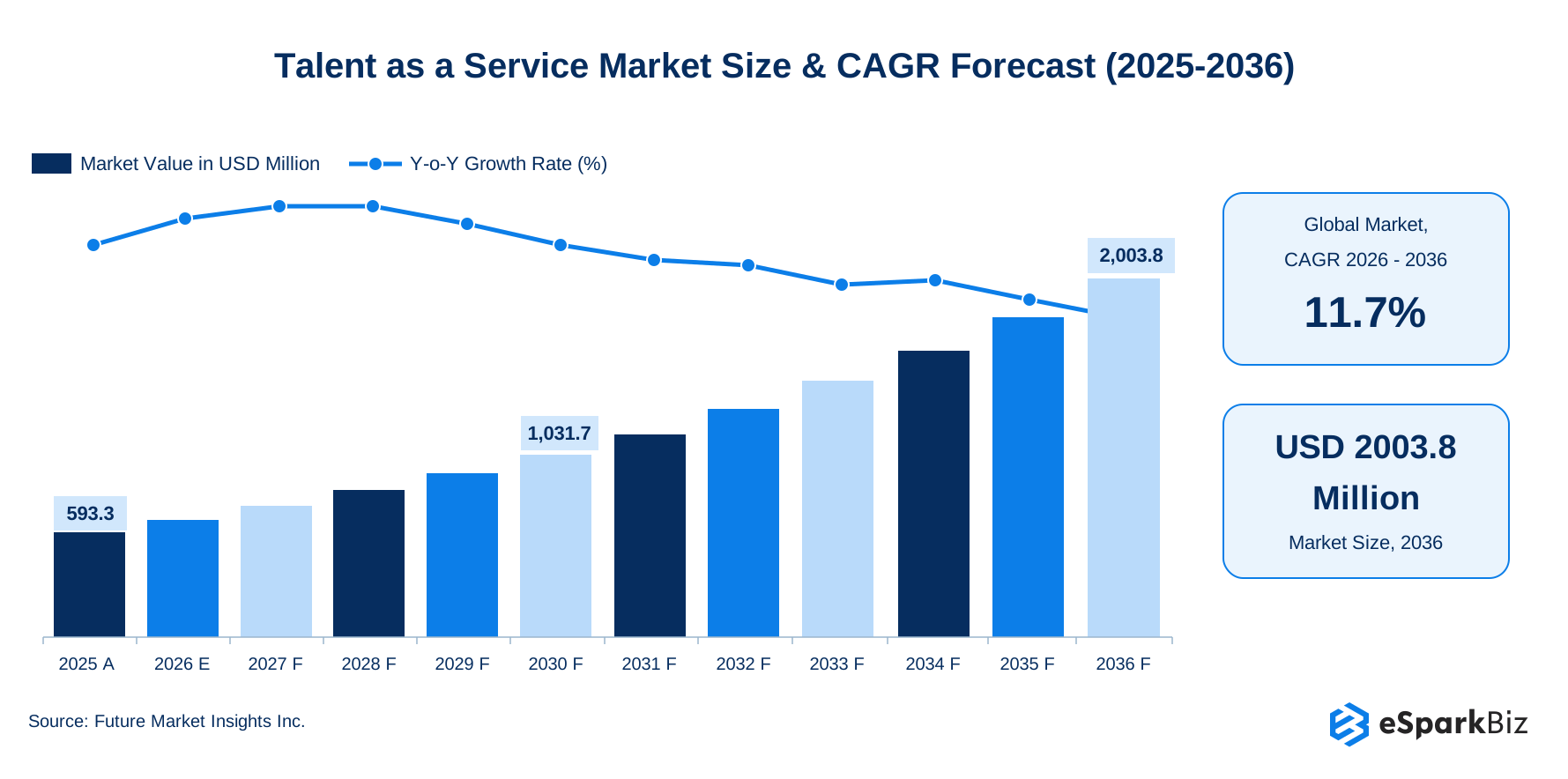
The idea sounds simple but what does it look like in practice? Here is what Talent as a Service actually means for an organization and where it can be the right fit.
What Is Talent as a Service (TaaS) and How Does It Work?
Talent as a Service (TaaS) is a workforce model that gives businesses access to vetted professionals when specific skills are needed, without requiring permanent hires for every role. Depending on the provider, it can include talent sourcing, screening and engagement management to meet changing project requirements.
Unlike staff augmentation, which typically adds professionals to an existing team, TaaS may include broader talent management. Freelance platforms connect clients with independent workers but vetting and accountability vary by platform and agreement.
What Talent as a Service Looks Like in Practice
A TaaS engagement typically involves three steps:
- Identify the need: Define the required skills, experience, and capacity.
- Match the talent: Source and assess professionals who fit the requirement.
- Manage the engagement: Coordinate responsibilities and support according to the agreed terms.
This approach helps businesses address skills gaps as priorities change without treating every new requirement as a permanent hiring decision.
For organizations that need coordinated team capabilities rather than individual professionals, Team as a Service may be another suitable option.
Case Study: TCS and the Talent Cloud
TCS uses a skills focused talent cloud to match projects with employees or contractors based on capabilities rather than fixed roles or locations. The approach highlights how skills based matching can help businesses to access specialized talent when traditional hiring pools fall short.
TaaS Takeaway: Skills based matching and flexible talent access are central concepts shared with Team as a Service.
How Talent as a Service Works: From Need to Delivery
A TaaS engagement follows a practical lifecycle that starts with defining the business need and ends when the work is completed, extended or handed back to the internal team.
1. Define the Requirement
The organization identifies the skills, experience and level of authority required to close the gap and defines the required scope of work and time frame.
2. Source and Match Talent
The provider searches for its talent network, evaluates relevant capabilities and matches suitable professionals to the requirement.
3. Select and Onboard
Once the talent is selected, onboarding covers responsibilities, tools, access, processes & the context needed to start contributing.
4. Integrate into the Workflow
Part time experts need more than access to tools and meetings to deliver effectively. They need context about the product, business goals, technical architecture, existing decisions and team workflows.
Before work begins, provide relevant documentation, define deliverables and decision making authority, assign an internal point of contact and arrange knowledge transfer sessions. This helps external experts to understand priorities, work effectively with the team and deliver against agreed expectations.
5. Execute and Monitor
Work begins while progress, communication and changing requirements are reviewed throughout the engagement.
6. Review and Decide What comes next
At the end of the engagement the business can roll off the talent when the requirement is complete or extend the engagement if additional support is needed.
The process gives businesses a clear path from talent needs to delivery without treating every new requirement as a permanent hiring decision.
Also Read: Straight Guide to Team Extension
What “Pre-Vetted Talent” actually means
Being called “pre-vetted” does not necessarily mean someone is qualified for your specific requirement. What matters is how the talent was assessed and what checks were carried out before they were presented to you.
A provider may assess talent in several ways:
Technical or skills assessment: Does the professional have the skills and capabilities that are needed for the role?
Work history verification: Does their professional background support the experience they have presented and does it match what the role requires?
Reference checks: Where appropriate, can their previous work or professional performance be confirmed or verified through relevant references?
Practical evaluation: For certain roles, has the person shown what they can do through a paid trial or a scoped test project and does the result meet the role’s requirements?
The answer can also depend on who conducts the assessment. Some providers handle the vetting internally while others use third party assessment services or involve the client through interviews and additional testing.
Most importantly the vetting should match the role because the checks used for an AI engineer should not be the same as those used for a support agent. The skills and responsibilities are different so the assessment should reflect that.
For buyers the simplest test is to ask the provider to explain what sits behind the claim: What was assessed? Who assessed it? What was verified? And how does that evidence relate to the role you need to fill?
Community Insight
A Reddit discussion about a proposed Talent as a Service startup points to a common challenge such as how is TaaS really different from recruitment? Some commenters questioned how closely the model resembled traditional agencies while others saw value in technology based screening and more targeted talent matching.
Breaking Down the Pricing Approach for Talent as a Service
The cost of Talent as a Service (TaaS) depends on the skills you need, the engagement length, and the pricing model you choose. Unlike a staff augmentation pricing model, TaaS may include broader talent sourcing and management services. Understanding these differences helps you to compare costs and choose the right option for your project.
Three common pricing structures are:
| Pricing Model | How It Works | What Affects Cost |
| Subscription | Pays for agreed talent access or support over a set period | Seniority, skill scarcity, location and subscription terms |
| Project based | Charges for a defined scope or deliverable | Complexity, milestones and scope changes |
| Time and materials | Charges for actual hours or resources used | Hourly rate, hours worked and additional requirements |
Example: Six Month Cost of a Senior Data Engineer
The following figures are hypothetical examples for comparing pricing structures, not verified market rates or eSparkBiz quotes.
| Pricing Model | Illustrative Pricing | Six Month Cost |
| Subscription | $8,000/month | $48,000 |
| Project based | $50,000 for defined deliverables | $50,000 |
| Time and materials | $100/hour × 160 hours/month | $96,000 |
Assumptions: One senior data engineer, six months of work, and 160 billable hours per month for time and materials. Taxes and additional fees are excluded.
In this example, subscription pricing has the lowest total cost. However, the cheapest option depends on the scope included hours, deliverables and contract terms. Project based pricing may provide greater cost certainty for clearly defined work while time and materials may suit changing requirements.
Other factors also affect the final quote. Scarce skills and senior professionals typically command higher rates while location and engagement length can influence pricing.
Before choosing a model, compare quotes based on equivalent skills, working hours, deliverables and service commitments. Verify actual provider rates before treating illustrative figures as market estimates.
The Compliance Risks Buyers should consider in Team as a Service
A TaaS engagement can provide flexibility, but unclear responsibilities can lead to legal issues, IP disputes, security gaps and poor delivery. Buyers should pay attention to four areas before external talent starts working.
- Worker classification: Misclassifying workers or overlooking applicable legal obligations can create compliance risks. Clarify the responsibilities of the provider and the client.
- IP ownership: Failing to define who owns the work can lead to disputes over software, designs, documents and other deliverables. Include clear IP assignment terms in the agreement.
- Data and security access: Giving excessive access or failing to assign responsibility for quality checks can expose sensitive information and weaken oversight. Set appropriate permissions and designate an accountable lead.
- Offboarding and exit planning: Ending an engagement without knowledge transfer, credential removal or a secure handover can disrupt delivery and leave security gaps. Agree on an exit process before work begins.
These risks are easier to manage when responsibilities are defined from the start. Clarify worker classification, document IP ownership, assign a delivery owner, control system access and agree on an exit plan before the engagement begins.
Talent as a Service Market Size and Growth Outlook
Market numbers are useful but only when the category behind them is clear. For TaaS, one Future Market Insights estimate reports USD 662.72 million for 2026 with banking accounting for 33.0% of end users. The research also places the preceding market valuation at USD 593.3 million.
So, should this be treated as the definitive TaaS market size? Not necessarily.
Before comparing market figures check these below four things:
- Definition: What does the source include under TaaS?
- Scope: Which services & workforce categories are covered?
- Geography: Which markets does the estimate cover?
- Methodology: How was the figure calculated?
These details can be changed as per the reported market size. Broader staffing and contingent workforce data from Staffing Industry Analysts (SIA) can provide additional market context but it should not be confused with a direct Talent as a Service measurement.
The number matters but the definition behind the number matters just as much.
Why the US Talent Gap is driving Talent as a Service Demand
According to ManpowerGroup’s 2026 US Talent Shortage Survey, 69% of employers report difficulty finding the skilled talent they need.
By Industry
- Information – 72%
- Professional, Scientific & Technical Services – 72%
- Finance & Insurance – 68%
By Company Size
- 1,000-4,999 employees – 76%
- 5,000+ employees – 75%
- 250-999 employees – 74%
This highlights how talent shortages affect both specialized industries and larger organizations.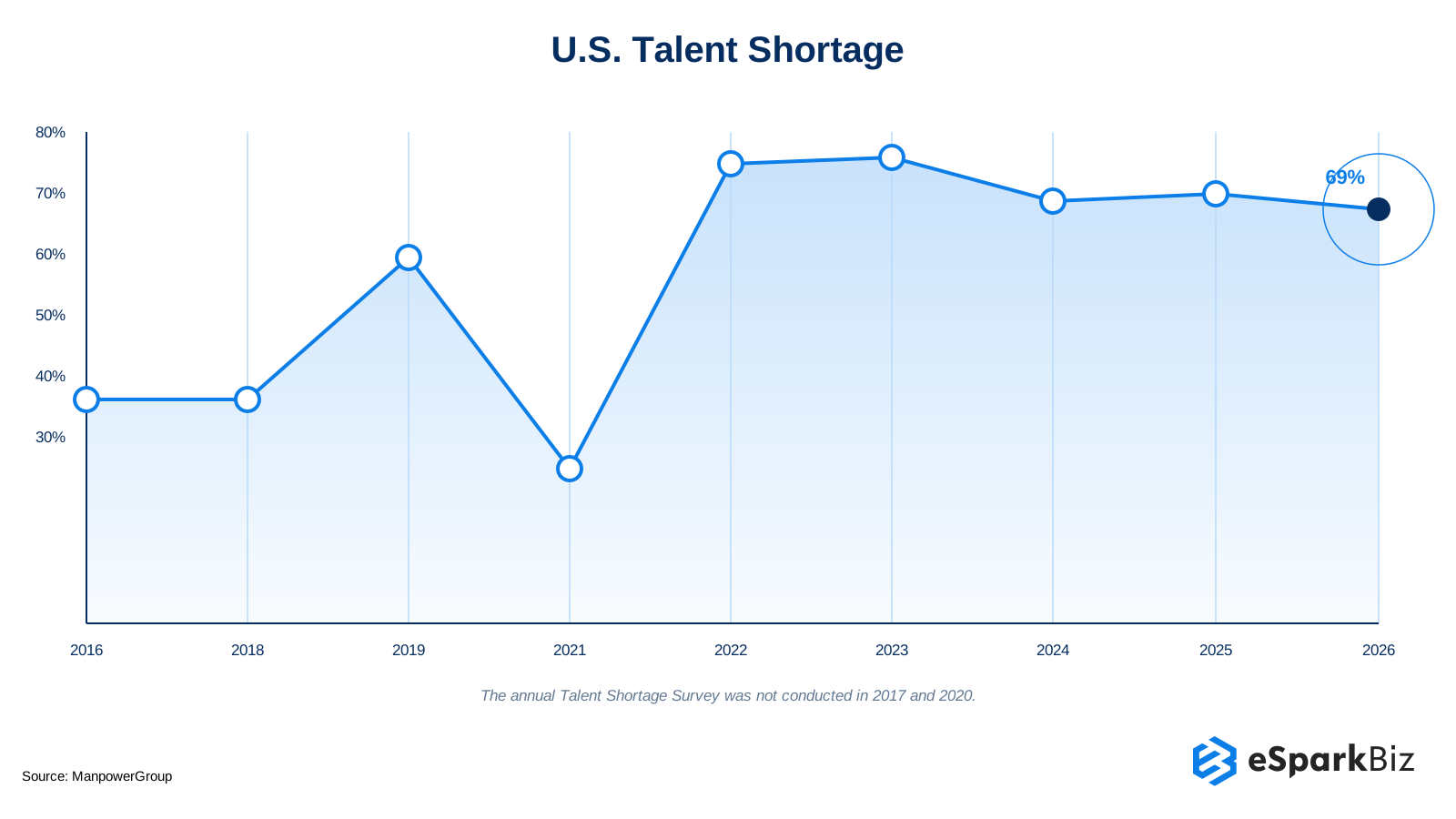
Did you know?
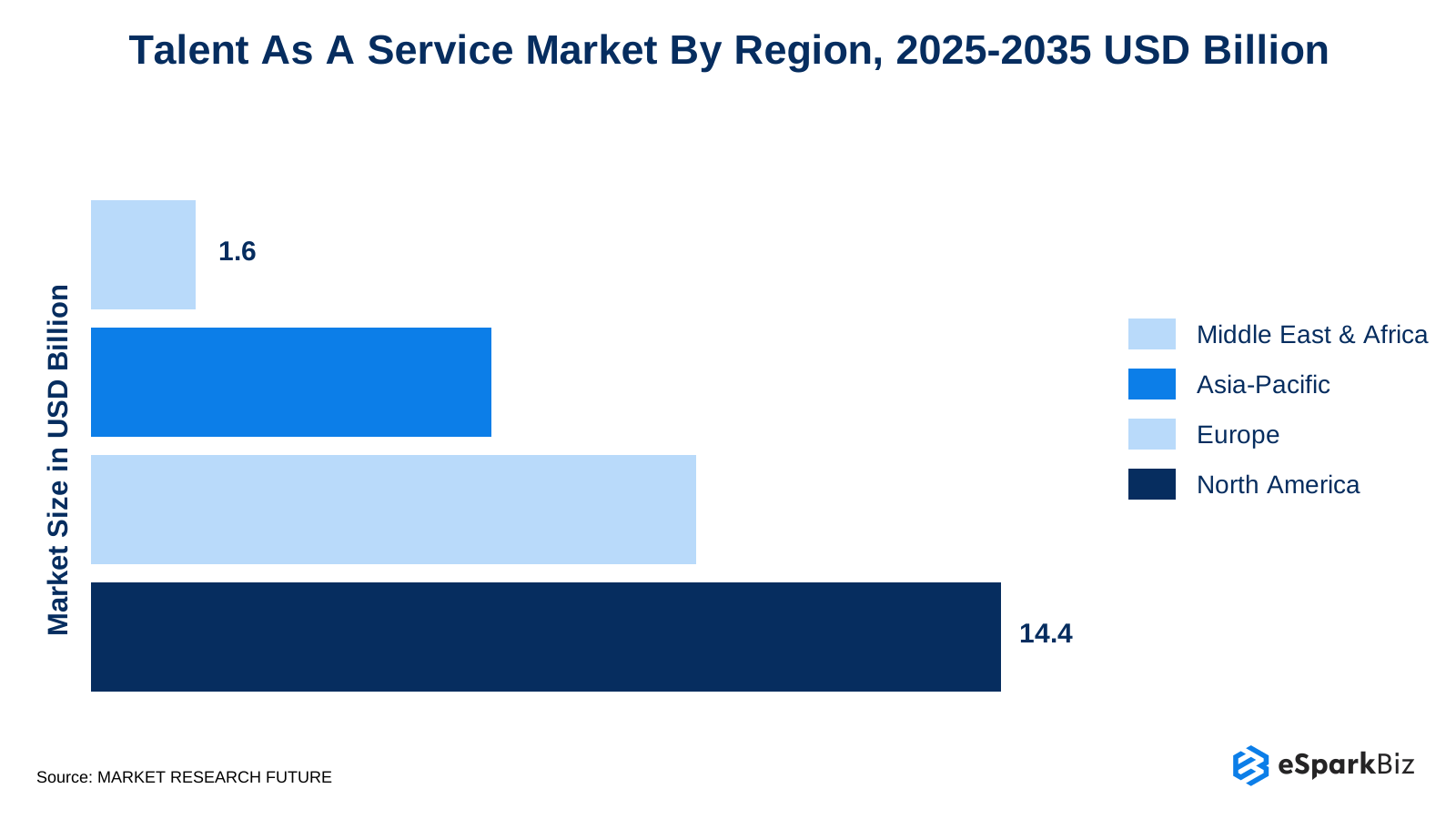
The Global TaaS Market is concentrated across the four major regions with North America holding the largest share:
- North America: ~45%
- Europe: ~30%
- Asia Pacific: ~20%
- Middle East & Africa: ~5%
Talent as a Service vs. Team as a Service vs. Dedicated Team: Which Fits Your Needs?
Imagine your product company needs two ML engineers to build an AI feature. Should you hire flexible talent, engage a coordinated team or build a long term development unit? The answer depends on your delivery needs.
| Comparison Factor | Talent as a Service | Team as a Service | Dedicated Team |
| Primary focus | Access to vetted skills | Coordinated team capabilities | Ongoing product development |
| Team structure | Professionals matched to changing needs | A team aligned with the required work | A team committed to your project |
| Management | Depends on the engagement | May include team coordination | Ongoing collaboration with your business |
| Duration | Short term or ongoing | Project based or ongoing | Usually longer-term |
| Best suited for | Changing skill requirements | Projects requiring multiple skills | Continuous product development |
Which Model Fits Your ML Hiring Needs?
- Choose TaaS if you need two ML engineers and expect your skill requirements to change.
- Choose Team as a Service if the AI project also requires coordinated data engineering, cloud or testing capabilities.
- Choose a Dedicated Team if AI is central to your product roadmap and requires continued development.
Before deciding, confirm availability, onboarding time, pricing, management responsibilities and contract terms. These models can overlap so evaluate the provider’s actual offering rather than relying on the model name alone.
When Talent as a Service is the Wrong Choice
Talent as a Service can help address skills gaps but it is not the right fit for every business problem. Before bringing in external talent, identify what is actually holding your team back.
Start by identifying the gap:
- Skills gap: Your team lacks specific expertise. On-demand talent may help fill it.
- Capacity gap: Your team has the right skills but insufficient time. Additional support may help manage the workload.
- Process gap: Delays stem from unclear workflows, repeated tasks, or poor coordination. Fixing the process may be more effective than adding talent.
Once you identify the problem, consider whether TaaS fits the role. It may be a poor choice when:
| Situation | Why TaaS May Not Fit |
| Long term core role | The role requires deep knowledge of the product, systems, or customers. |
| Permanent ownership | The work requires consistent accountability over time. |
| Highly regulated work | External access may not meet the required security, audit, or regulatory controls. |
| High coordination needs | Managing external talent may create more work than it saves. |
For example, a fintech company may use TaaS for regulated work if appropriate access controls, audit logs and responsibilities are in place. If external access cannot meet regulatory requirements, keeping the work in-house may be more suitable.
Ultimately, choose TaaS when the problem is a skills or capacity gap that external talent can address. If the issue lies in the process or requires lasting internal ownership, another solution may be more effective.
When Should You Move from Talent on Demand to an Augmented Team?
Talent on demand works well when you need specialized skills for a specific task or a short term requirement. But when workloads become ongoing and external professionals need to work closely with your in-house developers, an augmented team may be a better fit.
Consider moving to an augmented team when:
- Demand becomes continuous: You need the same skills across multiple project cycles.
- Coordination increases: External professionals need to participate in daily workflows and team decisions.
- Delivery requires continuity: Long term collaboration and retained product knowledge become important.
The right choice depends on how long you need the skills, how closely the professionals must work with your team and who will manage delivery.
A Thought on Talent
“Talent without effort is wasted talent. And while effort is the one thing you can control in your life, applying that effort intelligently is next on the list.”
How to choose the Right Talent as a Service Provider
The right Talent as a Service provider should make a talent gap easier to manage instead of just adding more complexity. So, look beyond talent availability and consider how well the provider fits your business needs.
Start with the actual cost. The quoted rate is only a piece of the puzzle. Think of onboarding, coordination, time of management, tools, security and what happens if the engagement is extended or ends early.
Clarify responsibility. Know who handles worker classification, IP, data access, security & compliance.
Check relevant expertise. A large talent network does not always mean having strong skills in the area you need. Ask about their experience with the specific skills that your team needs.
Assess operational readiness. Talent should be able to work within your systems, workflows, communication practices and security environment.
Prioritize continuity and quality. Choose a provider that supports stable talent assignments, clear ownership and measurable quality standards such as code reviews, defect rates and delivery milestones. This helps maintain accountability, retain product knowledge and reduce inconsistent results.
Ask these questions before choosing a provider:
- How do you verify engineers’ technical skills and project experience?
- What time-zone overlap and communication support can you provide for a US-based team?
- What are your replacement terms, IP ownership provisions and security practices?
Ultimately, choose a provider based on four factors: total cost, clear responsibilities, relevant expertise and the ability to work effectively with your team.
TaaS in Practice: Hiring AI and Cloud Specialists for 3 Months
A US company building an AI powered feature needs an AI engineer and a cloud specialist for three months. A technology services provider offering Talent as a Service can help source professionals matched to these requirements.
What should the company verify?
- Technical screening and relevant project experience
- Availability for the three month engagement
- US time zone overlap and security requirements
- Responsibilities, pricing and contract terms
When is another model worth considering?
If your internal team can manage external specialists, TaaS may be sufficient. If the project requires coordinated work across multiple roles consider an engagement model that supports closer team integration.
Is eSparkBiz a Reliable Talent as a Service Provider?
For US businesses evaluating eSparkBiz, talent quality, IP ownership, security and contractual clarity are key considerations.
- Talent vetting: eSparkBiz states that it assigns senior engineers with relevant project experience and avoids substitutions after signing.
- Replacement policy: Confirm replacement eligibility, timelines, and any associated costs in your service agreement.
- IP and NDA protection: eSparkBiz states that clients retain ownership of code and project IP from the first commit with NDAs protecting confidential information.
- Security and time zone alignment: eSparkBiz offers collaboration across 11+ time zones alongside security practices such as access controls and multi factor authentication helping US clients to coordinate work across distributed teams.
Before choosing eSparkBiz as your Talent as a Service provider, verify its talent vetting process, replacement policy, IP ownership terms and security controls. Clear contractual terms help US businesses to assess provider reliability, protect intellectual property, and manage engagement risks.
Frequently Asked Questions
Which is safer for IP and compliance: TaaS, staff augmentation or freelance marketplaces?
No model is automatically safer. IP ownership, worker classification and replacement terms depend on the contract, working arrangement and applicable laws. Review these terms before choosing a provider.
Is TaaS the same as gig work?
No. TaaS is a structured talent model with defined engagement responsibilities while gig work typically connects businesses with independent professionals for individual assignments.
TaaS places greater emphasis on pre-vetting, management, engagement structure and accountability rather than simply matching a business with available talent.
How does TaaS pricing work?
TaaS pricing can vary based on the type of engagement. Common models include:
- Subscription: A recurring payment for ongoing access to talent or services
- Project based: Pricing based on a defined project or outcome
- Time and materials: Payment based on the talent's time and resources used
Factors such as seniority, skills, location and engagement length can also affect the overall cost.
Who is responsible for compliance in a TaaS engagement?
Compliance usually involves a shared responsibility of the Provider and buyer with different roles and responsibilities depending on how the agreement is structured. The parties should determine their responsibilities prior to commencing the job.
What skills are best suited to a TaaS model?
TaaS can be useful when a business needs experts for a specific or changing period. Common areas include:
- Artificial Intelligence and Machine Learning
- Cloud
- Data
- Cybersecurity
- Software Development
It usually works well when a business needs flexibility instead of creating a permanent role.
How does a TaaS engagement work?
A typical engagement follows a practical lifecycle:
Requirement definition → Talent matching → Selection → Onboarding → Delivery and monitoring → Extension or roll off
Each stage helps to connect the required expertise with the business need while keeping the engagement structured from start to finish.
What does pre vetted talent mean in TaaS?
Pre-vetted talent means the provider has checked professionals against a set of standards before presenting them for an engagement. This may include skills such as assessments, technical tests, work history checks, reference checks, interviews or trial work depending on the provider and role.
When is TaaS not the right choice?
Talent as a Service may not be an appropriate choice when a role needs long term continuity and deep knowledge of the business. It may also be less appropriate when:
- The role is part of the permanent core team
- The work needs stable internal ownership
- Compliance requires ongoing internal responsibility
- Managing flexible talent takes more time and effort than it saves
Is eSparkBiz a suitable TaaS and staff augmentation partner for US companies?
eSparkBiz offers software development and staff augmentation services, with collaboration across 11+ time zones. Before engaging, US companies should verify:
- Time zone overlap: Available US working hours and response times
- Contract terms: Contracting entity and engagement responsibilities
- IP and security: Code ownership, confidentiality, and data protection
- Replacement policy: Eligibility, timelines, and associated costs
These checks help assess whether eSparkBiz fits the company's technical, operational, and compliance requirements.


 August 14, 2026