
 Last update date:



Quick Summary :-
ReactJS is best suited for large, complex applications that demand ecosystem flexibility and long term scalability. VueJS is the preferred choice for teams that value simplicity, faster onboarding and an opinionated out of the box structure. The right framework is not decided by popularity alone, it is determined by project scale, team experience and maintenance goals.| Choose ReactJS if… | Choose VueJS if… |
|
|
Why This Decision Has Real Stakes
Every year, millions of developers are asked the same question that quietly shapes product roadmaps and hiring budgets: React or Vue? According to the Stack Overflow Developer Survey, ReactJS is used by 44.7 of professional developers, making it the most widely used web framework in the world. VueJS, though smaller, is used by 17.6% and is consistently rated among the most loved frameworks.
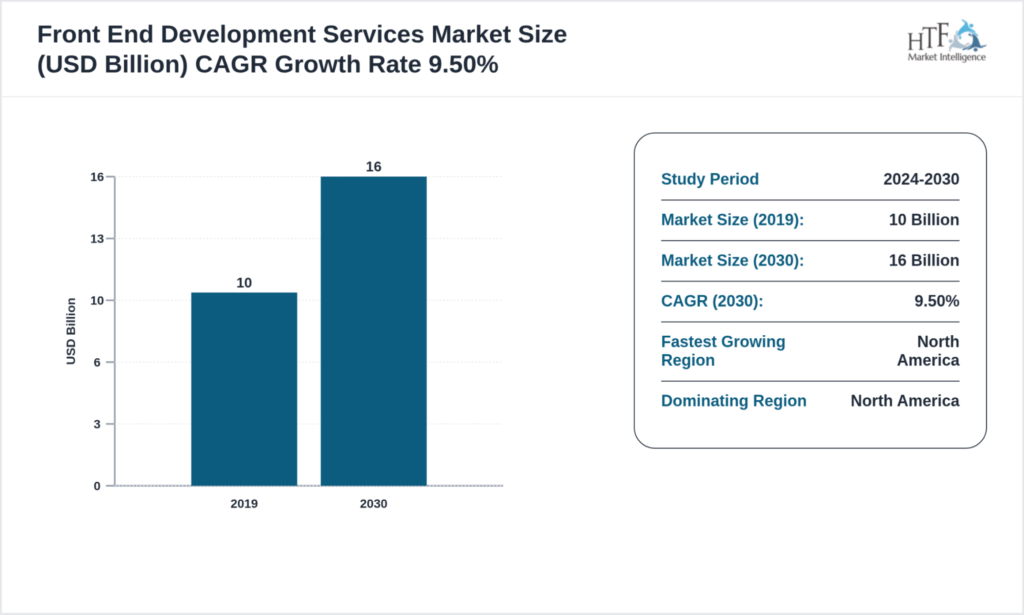
The Front End Development Services market, valued at $10B, is set to reach $16B by 2030, growing 10% annually, CAGR 9.5%.
React leads every category of websites by leaps and bounds as already determined by the StateOfJS data. VueJS is slowly growing in popularity and shows great potential for the future.
ReactJS is used by a total of 9.6 million websites globally. VueJS is used by a total of 1.6 million websites globally.
Choosing between these two frameworks is not a trivial preference it is a decision that directly affects development velocity, code maintainability, long term hiring and product scalability. A wrong choice early can cost months in refactoring or talent acquisition later.
ReactJS: Power, Flexibility and a Steep Learning Curve That Pays Off
ReactJS was open sourced by Meta in 2013 and has since been adopted by some of the most traffic heavy platforms on earth. The framework is based on a component driven architecture meaning that every piece of a user interface is broken into reusable, self contained units that can be composed and maintained independently.
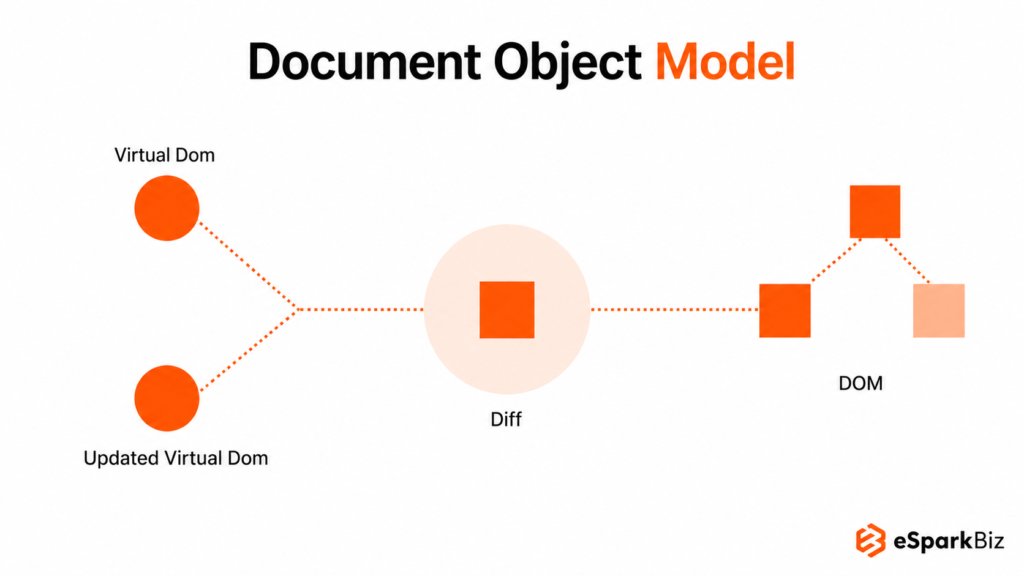
At its core, React introduced the world to a paradigm shift: the idea that the UI should be treated as a function of state. When state changes, React’s Virtual DOM efficiently determines the minimal set of real DOM updates required a mechanism that has been validated at the scale of platforms like Instagram, Airbnb and Atlassian.
It is important to understand that React is deliberately described as a “library” and not a full framework. This distinction matters enormously in practice.
Key Features of ReactJS
- Virtual DOM:
Efficiently reconciles UI changes without touching the real DOM on every update, keeping large applications fast. - Component Based Architecture:
Every UI element is encapsulated in a component with its own logic and rendering enabling large teams to work in parallel. - JSX Syntax:
HTML like syntax inside JavaScript, which initially feels unfamiliar but results in highly readable, co-located UI logic. - Unidirectional Data Flow:
State flows in one direction, making debugging significantly easier in complex applications. - React Hooks (since v16.8):
useState, useEffect and custom hooks replaced class components, modernising React’s mental model considerably. - Ecosystem Depth:
React Native for mobile, Next.js for SSR/SSG, Remix for full stack the ecosystem is the broadest in frontend development.
Where React Excels Real World Evidence
Meta’s own family of apps Facebook, Instagram, WhatsApp Web are built on React. Netflix uses React for its web UI. Atlassian’s Jira and Confluence are powered by React, as is Airbnb’s entire frontend stack. These are not small scale prototypes they are products serving hundreds of millions of users, simultaneously.
Honest Limitations of ReactJS
React’s freedom is a double edged sword. Because it is only a UI library, every architectural decision routing (React Router or TanStack Router?), state management (Redux, Zustand, Jotai, Recoil?), data fetching (React Query, SWR, Apollo?) must be made separately by the team.
This configuration overhead can significantly slow down a team’s initial velocity. Junior developers frequently struggle with the sheer number of choices before a single component is even written. The learning curve is real and it should be factored into project timelines honestly.
- React’s boilerplate requirements are heavier than Vue’s for equivalent functionality.
- Class components (pre Hooks era) left behind a large body of legacy code that many teams still maintain.
- Context API misuse can lead to performance regressions that require careful profiling to diagnose.
VueJS: Elegant Simplicity That Scales Further Than You Expect
VueJS was created by Evan You in 2014, notably after he had worked at Google using AngularJS. He set out to extract only the parts he found genuinely useful and build something lighter, cleaner and more approachable. The result was a framework that manages to feel intuitive from day one while still being powerful enough for production applications at Alibaba and GitLab scale.
Vue 3 brought the Composition API, improved TypeScript support and a significant performance uplift over Vue 2. With the Composition API, Vue’s architecture converged meaningfully with React’s Hooks model, making the conceptual gap between the two frameworks smaller than it has ever been.
One of Vue’s most cited advantages is its progressive adoption model a Vue component can be dropped into an existing HTML page with a single script tag, making it uniquely accessible to teams migrating incrementally from legacy jQuery or server rendered codebases.
Key Features of VueJS
- Single File Components (SFCs):
Template, script and style are co located in a single .vue file a pattern that is almost universally praised for its readability. - Reactive Data Binding:
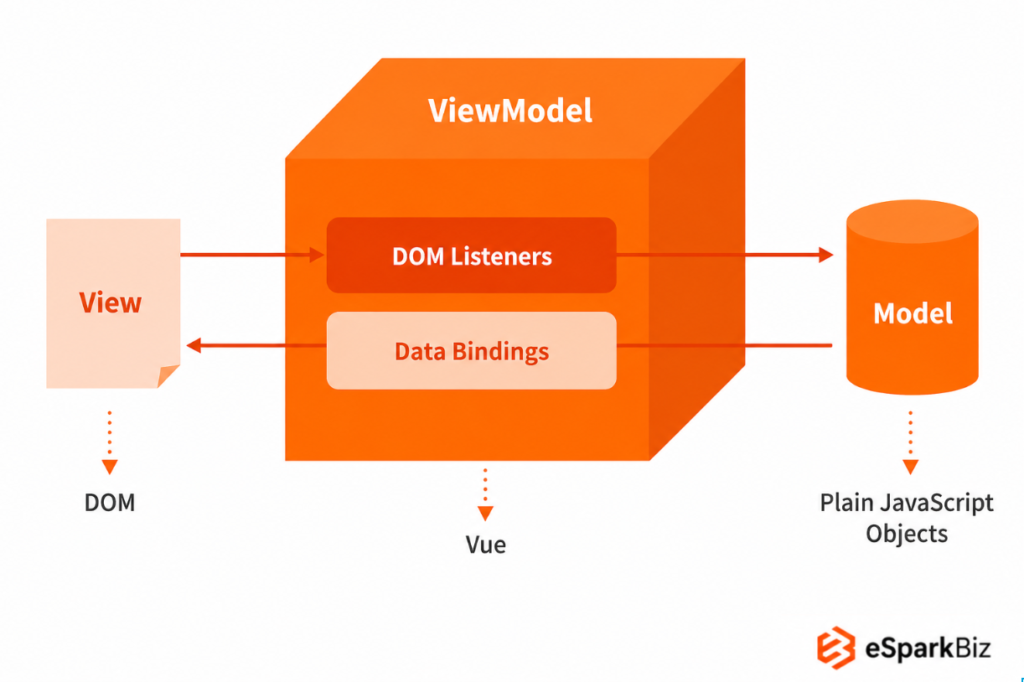
Vue’s reactivity system tracks dependencies automatically, making state management feel natural with very little boilerplate. - Built in Directives:
v if, v for, v model and v bind reduce the cognitive load of conditional rendering and form handling considerably. - Vue Router + Pinia:
Official, first party tools for routing and state management are maintained by the Vue core team, ensuring long term compatibility. - Composition API (Vue 3):
Logic can be organised into composable functions a pattern comparable to React Hooks and superior to Options API for complex components. - Gentle Learning Curve:
Teams report production ready proficiency in days rather than weeks when compared with React.
Where Vue Excels Real World Evidence
Alibaba one of the world’s largest e commerce platforms uses VueJS extensively across its product suite. Xiaomi’s official website and device management apps are built on Vue. GitLab migrated its frontend from jQuery to Vue and has documented the productivity gains publicly. Grammarly’s browser extension leverages Vue’s lightweight footprint for performant DOM injection.
Honest Limitations of VueJS
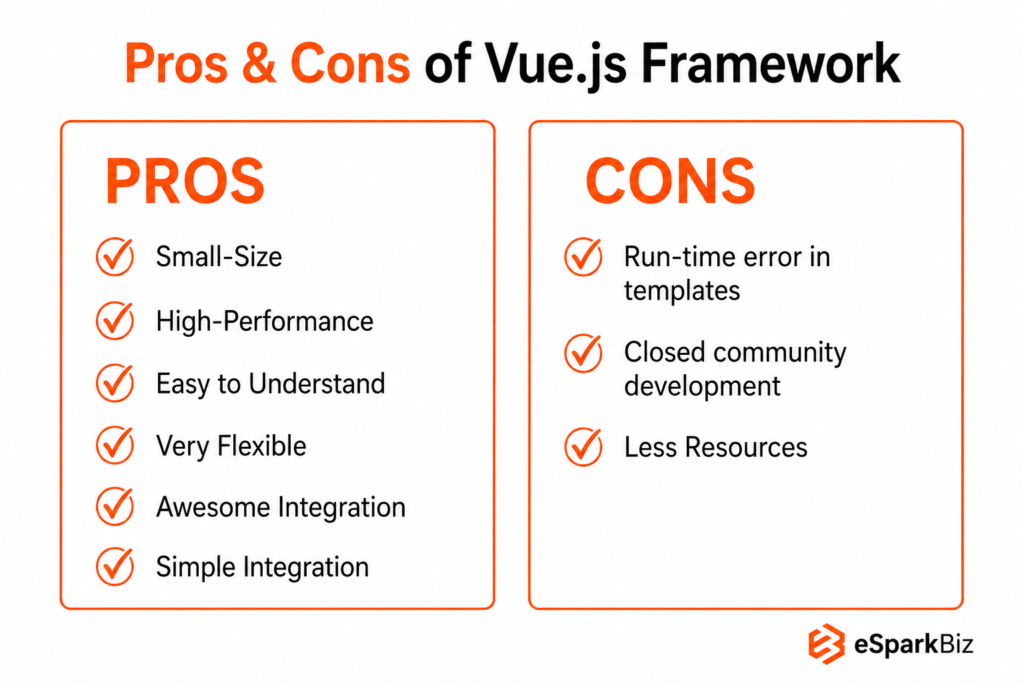
Vue’s smaller ecosystem is a genuine constraint for teams building in domains where deep library support is required financial data visualisation, advanced animation, accessibility tooling or AR/VR interfaces. The React ecosystem has a measurable advantage in the breadth and maturity of third party integrations.
The job market reality also cannot be ignored. According to the Stack Overflow Developer Survey 2024, React developers are listed in significantly more job postings globally than Vue developers a factor that should weigh on hiring managers building teams for the long term.
- Vue’s component library ecosystem (e.g., Vuetify, PrimeVue) is maturing but still trails React’s (Material UI, Ant Design, Chakra UI) in enterprise adoption.
- Nuxt.js (Vue’s Next.js equivalent) is excellent but has a smaller community and fewer case studies than the Next.js ecosystem.
- TypeScript support, while improved significantly in Vue 3, remains less natural than in React for complex generic component patterns.
ReactJS vs VueJS: A Parameter by Parameter Analysis
The comparison below is not based on synthetic benchmarks or personal preference. It is grounded in documented engineering decisions, Stack Overflow survey data, npm download statistics and community reported developer experience.
| Parameter | ReactJS | VueJS |
|---|---|---|
| Learning Curve | Steeper ecosystem knowledge needed | Gentler ideal for quick onboarding |
| Performance | Virtual DOM; optimised for complex UIs | Virtual DOM; lightweight & fast |
| Scalability | Excellent for enterprise scale projects | Good when structured correctly |
| Community | Massive 220k+ GitHub stars | Strong 210k+ GitHub stars |
| Flexibility | High choose your own tools/libraries | Moderate opinionated defaults |
| State Management | Redux, Zustand, Recoil (external) | Vuex / Pinia (official, built in) |
| Mobile | React Native (mature) | NativeScript / Ionic (growing) |
| Job Market | Larger global talent pool | Smaller but growing pool |
| Enterprise Adoption | Meta, Airbnb, Netflix, Atlassian | Alibaba, Xiaomi, GitLab, Grammarly |
| Best For | Large teams, complex apps, long term scale | Smaller teams, rapid prototyping |
Learning Curve
VueJS was deliberately designed so that a developer familiar with HTML, CSS and basic JavaScript can write a working component within an hour. Its template syntax mirrors standard HTML so closely that the transition feels natural rather than jarring.
ReactJS requires a meaningful investment before productivity is achieved. JSX must be understood, the concept of controlled vs. uncontrolled components must be internalised and the correct state management approach must be selected often before a single business feature is built. This overhead is well documented in bootcamp feedback and engineering team retrospectives.
Performance
Both frameworks achieve excellent rendering performance for the vast majority of real world use cases through their virtual DOM implementations. Raw benchmark comparisons (such as those maintained at js framework benchmark.github.io) consistently show Vue 3 performing marginally faster than React in several test scenarios a difference that is imperceptible to end users in typical applications.
The performance conversation becomes more nuanced at scale. React’s concurrent rendering features (Suspense, useTransition, useDeferredValue) introduced progressively since React 18 provide fine grained control over rendering priority that Vue does not yet match. For applications where perceived responsiveness under heavy load is critical, React’s concurrency model is a material advantage.
Scalability
Scalability is not just a technical question it encompasses team scalability, codebase scalability and operational scalability. ReactJS has been proven at the highest levels of traffic and team size the industry has observed, which is why it dominates the enterprise frontend conversation.
VueJS is not unscalable Alibaba’s platform serves hundreds of millions of users on Vue. However, the tooling, architectural patterns and community knowledge for large scale Vue applications are less mature and less widely documented than React equivalents.
Applications Built on ReactJS vs VueJS
Notable ReactJS Powered Products
- Facebook & Instagram
- Netflix
- Airbnb
- Atlassian (Jira, Confluence)
- WhatsApp Web
- Dropbox
Notable VueJS Powered Products
- Alibaba
- GitLab
- Xiaomi
- Grammarly Behance (Adobe)
- Font Awesome
When to Choose ReactJS vs VueJS: A Decision Framework
The framework selection decision should be treated as a strategic product decision, not a technical preference. The following framework is based on real world project archetypes and team compositions not vendor marketing.
Choose ReactJS When:
- The product is expected to scale to enterprise level within 12–24 months.
- The team is composed of senior or mid level engineers who can navigate ecosystem decisions independently.
- Mobile applications are planned React Native eliminates the need to maintain a separate mobile codebase.
- The hiring pool must be wide React talent is significantly more available in most global markets.
- The product requires deep integration with third party services (analytics, commerce, auth, BI) where React libraries are more mature.
- Server side rendering or static generation via Next.js is a technical requirement.
Choose VueJS When:
- The development team is small (2–5 engineers) and onboarding speed is a critical constraint.
- The project scope is a single page application, admin panel or content driven site with moderate interactivity.
- A legacy codebase (jQuery, server rendered PHP/Laravel) needs incremental modernisation Vue’s progressive adoption model is purpose built for this.
- Time to market is the primary business priority over long term ecosystem depth.
- The team lead has prior Vue experience and can establish architecture patterns quickly.
- The product roadmap does not include native mobile applications in the near term.
Lifecycle Management and Ecosystem Maturity
Understanding how each framework manages component lifecycle is critical for developers building features that interact with APIs, animations, subscriptions or cleanup logic. The lifecycle model directly affects how bugs are introduced and how they are debugged.
React Lifecycle with Hooks
Since React 16.8, the lifecycle has been managed through hooks. useEffect replaces componentDidMount, componentDidUpdate and componentWillUnmount with a unified model a change that was initially confusing but is now widely regarded as a significant improvement in composability.
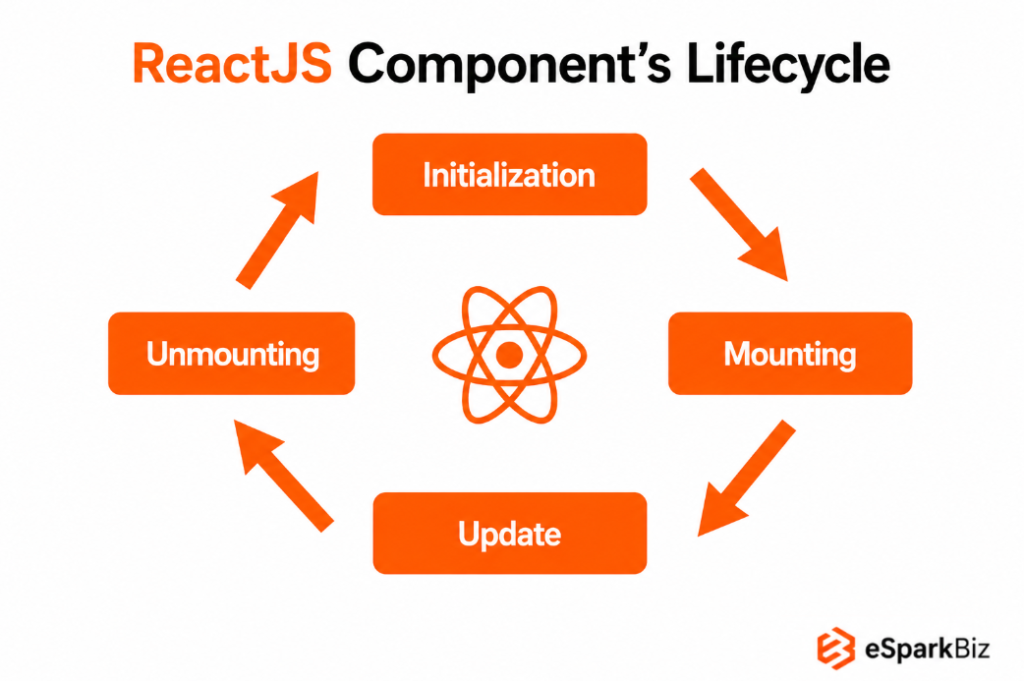
- Mounting: useEffect with an empty dependency array runs once after the first render.
- Updating: useEffect with specified dependencies runs when those values change.
- Unmounting: The cleanup function returned from useEffect runs before the component is removed.
- Custom Hooks: Logic can be extracted into reusable hooks, dramatically reducing code duplication across components.
Vue Lifecycle with Composition API
Vue’s lifecycle hooks are more explicitly named and arguably easier to reason about for developers new to frontend frameworks. onMounted, onUpdated, onUnmounted and onBeforeMount map directly to lifecycle stages without the abstraction overhead of React’s useEffect dependency model.
- onMounted: Runs after the component has been mounted to the DOM equivalent to React’s componentDidMount.
- onUpdated: Fires after reactive data causes a DOM re render.
- onUnmounted: Clean up subscriptions, timers or event listeners before the component is destroyed.
- watchEffect / watch: Reactive side effects that automatically track dependencies a pattern many developers find more intuitive than useEffect.
Frequently Asked Questions
Is ReactJS better than VueJS in 2026?
Neither framework is categorically better. ReactJS leads in ecosystem depth, enterprise adoption and hiring availability. VueJS leads in onboarding speed, code simplicity and structured defaults. The right answer depends entirely on project scale and team composition.
Which frontend framework is easier to learn?
VueJS is widely considered easier to learn. Its HTML based template syntax and officially maintained tooling reduce the number of decisions a developer must make before becoming productive. React requires familiarity with JSX, Hooks and ecosystem selection before velocity is achieved.
Which framework is faster for development?
VueJS enables faster time to first feature for small to medium projects. React's mature patterns and abstractions (Next.js, Remix) often result in faster development for large, complex applications once the initial setup investment has been made.
Which is better for scalable applications?
ReactJS has a more documented track record at enterprise scale. However, VueJS scales well when proper architecture decisions are made early as evidenced by Alibaba's platform. The bottleneck in scalability is rarely the framework itself but rather the team's experience and architectural discipline.
Can both frameworks be used for the same type of project?
Yes. Both frameworks are capable of building any modern web application. The selection should be driven by team familiarity, long term hiring plans, ecosystem needs and maintenance preferences not technical constraints.