


Maintaining control over the organization is key when making large enterprise app decisions. React JS appeals to enterprise applications because it allows users to build complex applications, but only with a strong governance structure.
- Complex business applications
- Consistent development
- Needed architectural standards
This is a comprehensive overview of enterprise level React JS adoption.
Selecting a front-end framework isn’t a one-time technical decision; it’s a years-long process. Bad decisions lead to costly migrations and fractured teams. React JS fits in with enterprise frameworks; however, there are caveats. There are pros and cons to the trade offs for React JS:
- Flexible architecture + a lot of governance = benefits
- Obsolescence of employees
- Complex implementation required
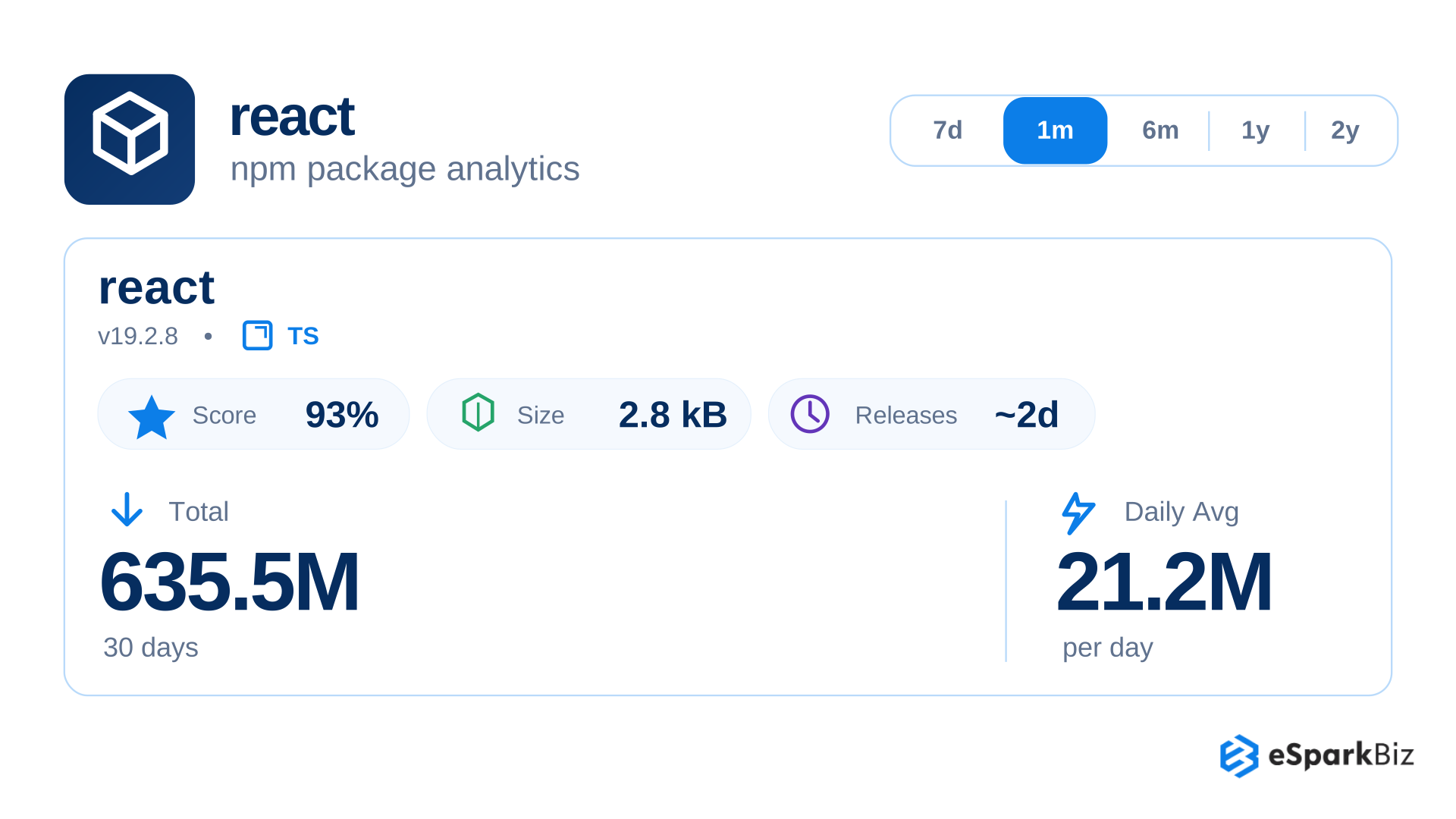
React JS had 635.5 million npm downloads in the 30 days from August 1 to August 30, 2026.
The analysis below documents the advantages, disadvantages, and considerations leadership should evaluate before choosing to adopt React JS framework.
What “Enterprise-Ready” Actually Means in 2026
Being ‘Enterprise Ready’ isn’t just a gimmick. Technology is classified as ‘Enterprise Ready’ when it is reliable, scalable, and can fulfill governance and compliance requirements, and has a good cost benefit analysis for its lifespan. ReactJS’ assessment is under these parameters.
The Executive Evaluation Lens
A pragmatic framework for evaluating React JS against criteria that are most important to enterprise leadership.
| Criterion | Why It Matters |
| Performance | Business continuity |
| Governance | Architectural consistency |
| Hiring | Talent availability |
| Compliance | Risk control |
| TCO | Cost predictability |
The following criteria will constitute the benchmark against which sections that follow will be assessed, and will shift the focus from technical capability towards business sustainability:
- Invariant operations across teams and business units
- Controlled technical and financial risk
- Guaranteed Access to Integral Workforce
- Architecture that is aligned with long-term business objectives
- Defined costs of ownership and maintenance
In the context of enterprise adoption, React JS must be assessed as part of the overall operating model of the organization, and not as an individual technology choice.
Four Reasons ReactJS Now Outperforms Its Old Reputation
The main reason to use ReactJS in an enterprise setting is the competitive edge it provides to businesses, rather than its popularity. This is evidenced by a number of features that include architecture reusability, optimization, automatic server side rendering, and its rich ecosystem.
Component Reusability at Scale
Enterprise applications typically involve multiple software systems. ReactJS facilitates businesses in developing common software components. This eliminates the need for businesses to develop similar software components.
A well formulated component strategy is capable of creating measurable operational value:
- Less duplication: Teams reuse established interface patterns.
- Greater consistency: Shared components result in similar experiences.
- Simpler maintenance: Changes made to a single component used by many applications result in a controlled change.
- Faster value delivery: Teams can build quickly.
The discrepancy is what really matters: ReactJS provides the potential; governance is what dictates if reuse is actually valuable.
The ReactJS Compiler: Performance Without Manual Tuning
In traditional programming, performance has developers dealing with redundant renderings and looking for optimizations. One of the two components of this framework has been greatly improved with the introduction of the ReactJS compiler.
This automation decreases performance optimization code by a large margin for enterprise teams. With this code considered, the performance choices developers have to make are reduced.
What this means operationally:
More development time can be allocated to the specifics of the business logic while the compiler takes care of the optimization opportunities.
This is not a cure to performance engineering. Usability can still be impacted due to the behavior of the network, the application architecture, data access, and the underlying infrastructure.
ReactJS Server Components as the Default Architecture
Server Components in React JS provides an important new angle when considering the division of work for an application’s development between the server and the client. With Server Components some of the rendering work can be done as well as some of the dependencies.
That said, the “default architecture” should be treated with caution. While ReactJS supports Server Components, the concerned implementation is dependent on the specific framework used. ReactJS encourages the development community to follow best practices and use a framework when developing new applications.
Ecosystem Depth That Extends Beyond UI
ReactJS’s ecosystem gives it an advantage in the marketplace. The npm package shows that there are 215,310 dependent packages. This demonstrates the extent of the software built around ReactJS.
The level of market advantage of ReactJS is due to the ecosystem that is built around it. That shows the amount of software built around ReactJS.
For enterprise leaders, that breadth means options for:
- UI and design systems
- Data fetching and state management
- Testing and developer tooling
- The TanStack ecosystem
- React Native for cross-platform applications
That means enterprises can use the tools that meet the business needs instead of forcing every application to use a single technology stack.
From Capability to Business Value
The table below shows how core capabilities connect to everyday enterprise problems.
| ReactJS Strength | Enterprise Payoff |
| Component reuse | Lower duplication |
| React Compiler | Less manual tuning |
| Server Components | Efficient rendering |
| Ecosystem depth | More technology choices |
| React Native | Cross platform delivery |
It is only when all of these qualities are combined with good architecture and governance that the true enterprise value will be realized. Otherwise, it can be the weakness, not strength, of ReactJS’s flexibility.
ReactJS vs Angular vs Vue – The Honest 2026 Comparison
Deciding on a frontend framework should not depend on choosing a winner framework as much as it depends on where control is prioritized. By 2026, each of the Big Three (ReactJS, Angular, and Vue) will have matured. How they handle the areas of control, architectural styles, people, and ownership will be the main differentiators among them.

ReactJS is most popular among the three, having 44.7% of the developers using it over ReactJS, AngularJS, and VueJS.
Three Mature Options, Three Operating Models
The following table outlines some features that can help leadership with its strategic framework decisions without claiming any technology to be the best.
| Criterion | ReactJS | Angular | Vue |
| Governance | Flexible standards | Built-in structure | Moderate structure |
| Learning curve | Moderate | Steeper | Gentler |
| Hiring pool | Very large | Large | Smaller |
| Compliance fit | Governance led | Structure led | Governance led |
| 2026 rendering model | Hybrid/server | Hybrid | SSR/SSG |
| TCO signal | Tool dependent | Predictable stack | Moderate stack |
Performance Has Converged. Philosophy Has Not.
The gap in performance is not the only consideration for leadership in regard to frontend frameworks. All three mature frameworks are capable of supporting modern rendering techniques such as server side rendering and hybrid systems. For example, Angular supports CSR, SSR, and prerendering. Vue supports SSR, and React supports Server Components and React JS Compiler.
The biggest difference is how much responsibility the organization wants for their choice of architecture.
- ReactJS: More flexibility in architecture, but greater burden put on internal standards.
- Angular: More decisions made in a traded framework.
- Vue: Simplified development architecture with a smaller enterprise talent demand.
Expert Quote:
“I believe the culture and energy of the ReactJS community is the reason for ReactJS’s massive success.”
~ Jordan Walke, Creator of ReactJS
What This Means for Leadership
Enterprises that value a diverse ecosystem and a flexible architectural framework over a standardized framework will likely prefer ReactJS over Angular. For enterprises that prioritize simplicity, Vue may be a better framework option than either ReactJS or Angular.
The decision should hinge more on an organization’s governance model, talent strategy, compliance requirements, and the expected long-term ownership of at least five years rather than the popularity of frameworks.
Did You Know?
ReactJS is the most popular framework at 61.4%, followed by Angular at 25.6% and Vue at 12.9%.

Where ReactJS Falls Short: The Trade-Offs Competitors Don’t Mention
The flexibility of ReactJS is both a relative advantage and relative disadvantage over other frameworks. Within an enterprise, while the flexibility enables development to move quickly, it becomes problematic from an enterprise standardization perspective.
Architectural Freedom Becomes Organizational Risk
With ReactJS, there are no pre-set choices on architectural design. Developers have a good deal of leeway in design of the app in the areas of routing, data storage, state management, testing, and helper libraries. This is a positive if one has a strong team. However, it can lead to an architecture that is fragmented and dispersed.
The enterprise risk occurs when:
- Different development teams establish innovation patterns
- Common elements develop with indeterminate ownership
- Standardization of technology choice becomes more difficult
- Developers create new teams and encounter multiple and/or inconsistent project structures
- The cost of maintenance becomes a burden across many codebases
Though, with good architecture governance, such risks can be minimized as architecture governance becomes more of an organizational concern as opposed to a framework-provided automatic activity.
Security Is Ecosystem Dependent, Not Built-In
Security should be a consideration for every single react JS app built. The component based architecture makes them relatively easy to build and results in a large number of third party API dependencies.
It goes beyond the framework used in enterprise applications. Control is required for dependency management, input processing, authentication, authorization, a content security policy, and secure deployment.
In contrast, Angular works to protect applications against XSS and other related attacks. The documentation for Angular emphasizes the importance of application security measures. Vue also auto HTML escapes and templates and warns against using untrusted templates.
When Angular or Vue Is the Safer Bet
ReactJS isn’t always the best option for enterprises. Angular is conservative compared to ReactJS, and is the better option for projects with greater focus on security and frameworks that use established patterns and features.
Vue JS should be considered when a simple development approach is preferred within an organization, with limited requirements for applications, as long as governance and security frameworks are in place.
The use of ReactJS at an enterprise level is described in the following table.
| ReactJS Fits When | ReactJS Doesn’t When |
| Governance is strong | Governance is weak |
| Teams are experienced | Teams need prescriptive structure |
| Ecosystem flexibility matters | Standardization dominates |
| Shared standards exist | Teams work independently |
| Long term ownership is defined | Ownership remains unclear |
🎥 Watch: Every ReactJS Concept Explained in 15 mins
The leadership takeaway: With ReactJS, enterprise value can be realized with a disciplined approach to flexibility. Organizations that do not have the discipline to use ReactJS will require a more directive approach.
Community Insights:
According to a Quora post, ReactJS’s lean view layer approach offers flexibility, clearer HTML structure and good update performance. However, it requires additional JavaScript and may not suit developers who prefer separating HTML templates from JavaScript logic.
Case Study: Meta Rebuilt Facebook.com with ReactJS
Challenge
Rapid growth caused Facebook’s technology to become layered and slow to maintain. It became difficult to scale Facebook as demanded. Therefore, a new architecture was needed to offer a more robust, scalable and efficient product.
Solution
Meta built Facebook based on ReactJS and Relay. This iteration of Facebook included code splitting, incremental resource loading, intermittent data fetching via GraphQL and route pre-fetching with parallel data and code delivery. This new architecture focused on performance and long-term flexibility, while also allowing developers the ability to standardize their practices.
Results
- Use of Atomic CSS has reduced the homepage CSS by 80%.
- The page can render progressively through JavaScript delivered in stages.
- Parallel fetches of code and data have all but eliminated unproductive round trips.
- A standardized tech stack facilitated scale and speeds up the development of both engineering and product offerings.
Turning ReactJS’s Flexibility From a Risk Into an Advantage
ReactJS is the choice of technology. Proper use of it is the choice of organization. Early decisions regarding architecture, tools and governance will become easier to manage as leadership begins to think of these as enterprise wide capabilities.
Build the Platform Before Scaling the Teams
ReactJS cannot entirely solve all of the production challenges a business will face, although ReactJS does suggest that a framework should be applied when a new application is built, as it provides more structure to the process.
A strong enterprise setup should establish:
- Platform Engineering: Built in patterns for deployment and tooling with the addition of observability and improved workflows for developers.
- Coding Conventions: Allow the use of standards approved libraries in conjunction with project and coding standards as well as defined DevOps workflows and rendering.
- Governance: Designated ownership for architecture, and additional considerations such as security, decision making on tech, and dependencies.
Did You Know?
ReactJS was used by 82% of respondents in the latest survey, reinforcing its position as a leading frontend technology entering 2026.
Create a Governance Blueprint
Governance should enable teams. Allow product teams to make local decisions as long as they don’t cross the line without approval.
| Governance Layer | Leadership Focus |
| Architecture | Approved patterns |
| Platform | Shared capabilities |
| Security | Risk controls |
| Dependencies | Lifecycle ownership |
| Standards | Team consistency |
The Enterprise Operating Model
Think of this as progressive. Set the standards and use the platform capabilities to measure success. This can be in terms of reliability, performance, the results of security checks and assessments of maintenance efforts.
This balance is avoiding the flexibility of ReactJS, which gives teams the freedom to design as they wish and enables and empowers the teams to thrive. Without guardrails, unchecked freedom leads to fragmentation in the architecture and drift that becomes a long-term cost to the business.
Frequently Asked Questions
Is ReactJS enterprise ready in 2026?
Yes. ReactJS can be called an enterprise-ready technology when it has framework, architecture, security, and governance. The flexibility of ReactJS necessitates this.
What are ReactJS's real enterprise disadvantages?
The main dangers include architectural freedom, disparate tools, governance burden and dependency management. Without standardization, various teams may have entirely different solutions for the same business issue.
ReactJS or Angular for regulated industries?
When it comes to regulatory constraints, Angular tends to provide more inherent structure whereas ReactJS allows for more flexibility. Both Angular and ReactJS have different benefits based on organizational needs.
Does ReactJS flexibility cause long term technical debt?
It can. Flexibility becomes technical debt when teams make independent architectural decisions without shared standards.
- Different patterns multiply
- Dependencies become harder to control
- Maintenance becomes inconsistent
- Migration costs increase
When does ReactJS's lack of structure become risky?
If there are many teams using common platforms, common developers, and common critical business parts without any architectural standards, then risks get higher. Flexibility could lead to inconsistency at that point.
Do Server Components replace a Backend for Frontend (BFF) layer?
No. Server Components help make data access and server-side rendering easy, but that doesn’t mean that they automatically make a BFF unnecessary. Some tasks related to enterprise integration and security orchestration may require a BFF.
Is a ReactJS team cheaper than Angular's?
Not necessarily. The cost for a team is much more about the availability of talent, the architecture, productivity, tools, and maintenance rather than the actual framework itself.
What's needed before scaling ReactJS enterprise wide?
Before enterprise wide adoption, establish:
- Architecture standards
- Design system governance
- Security and dependency policies
- Testing and release controls
- Clear ownership across teams


 August 20, 2026
