

A team promises six months. Ten months later, the product still has not shipped and the budget line has moved twice.
Founders don’t remember the long meeting in which the number was stated confidently. They remember the moments of realizing that the actual reason for the lack of product delivery was not the result of poor software engineering, but of building custom software development timelines based on hope rather than scope.
Since time and cost go hand in hand, an inaccurate estimation at the beginning causes the budget line to shift before the first product is delivered. This article provides an explanation of how a defensible number is actually built, tier by tier and method by method.
How to Estimate Software Development Time Without the Guesswork
Software development time estimation is the practice of forecasting how long a project will take. Teams list the requirements, break them into tasks and size each task with a suitable method. Three-point estimation, story-point analysis and function point analysis are common choices, while larger legacy-heavy systems often add a parametric model such as COCOMO.
In order to provide a defensible time estimate, an estimate must state its assumptions, name the real tasks and flag what is still unknown. Without that breakdown, a timeline is a guess and the whole team ends up working to a number nobody can defend once reality shifts.
Only Three in Ten Projects Hit Every Target
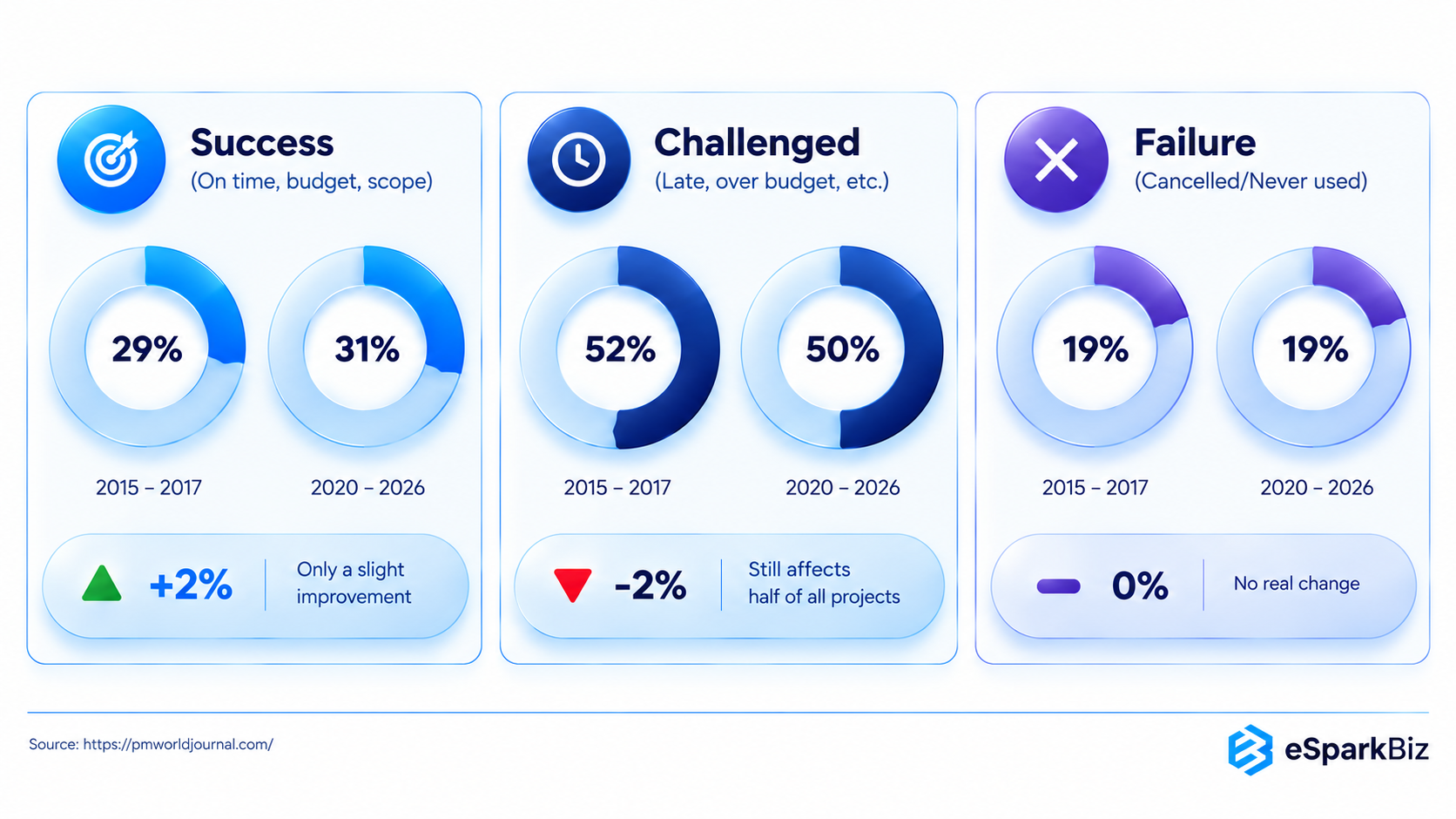
Research published in the PM World Journal found that only 31% of IT projects finished on time, on budget and within their original scope.
This research provides insight as to why software estimates must be made with some degree of flexibility. The scope, budget and schedule must be considered as a whole to provide a commitment that can be legally defended.
Getting Your Software Development Time Estimates Right Matters More Than the Deadline
A time estimate is more than a detail in software development. It shapes your budget, launch date and team before anyone writes a line of code. It also feeds the cost estimate, which has to be settled before a release date can even be discussed.
Five habits cause most of the damage:
- Single-point guesses: one confident number hides the range and the risk behind it
- No buffer: nothing absorbs the first surprise, so the budget line moves
- Ignored integration: third-party systems and data migration get sized as an afterthought
- Skipped QA time: testing and fixes get squeezed in after the build
- Scope drift: a new mid-build requirement arrives with no change to the timeline
These problems are rarely just about coding speed. They often come from underestimating the work involved or failing to account for uncertainty. The following ranges provide a starting point for comparing timelines, team sizes, buffers and costs across common software builds.
| Build Type | Typical Timeline | Typical Team | Suggested Buffer | Cost Range (USD)* |
| MVP | 6–16 weeks | 3–5 people | 2–4 weeks | $10,000–$100,000 |
| SaaS (v1) | 3–6 months | 4–7 people | 3–6 weeks | $25,000–$75,000 |
| Custom product (6 to 9 months) | 6–9 months | 5–8 people | 4–8 weeks | $50,000–$150,000 |
| Enterprise platform | 12+ months | 8–15+ people | 2–3 months | $50,000+ (scope-dependent) |
*Treat these figures as planning ranges, not fixed quotes. Actual timelines and costs depend on the product’s scope, integrations, technical complexity and team setup.
Three Project Complexity Types and What Each Means for Your Timeline
Some tasks are easier to estimate than others. Sort work into three groups based on complexity, risk and how much buffer it needs.
| Tier | What it Means | Typical Example | Risk Level | Typical Buffer |
| Known | Requirements are defined and the team has built the pattern before | Adding a standard login screen to an app or building an MVP module in a familiar framework | Low | Small, under 10% |
| Knowable | Requirements are defined, though some of them require research to be estimated | Integrating payment with a vendor providing little or no documentation | Medium | Moderate, with research time built in |
| Complex | Requirements and the related work are new to the team and need more definition | Building a recommendation system | High | Largest, with the widest range |
Sorting tasks into tiers is what keeps a six-month estimate from turning into ten. If the team has never built anything similar, treat the whole project as complex and start with a discovery sprint. A typical spike plan picks the riskiest unknown, builds the thinnest prototype that tests it, records what took longer than expected and re-estimates the remaining work as a range.
Which Software Estimation Method Fits the Work?
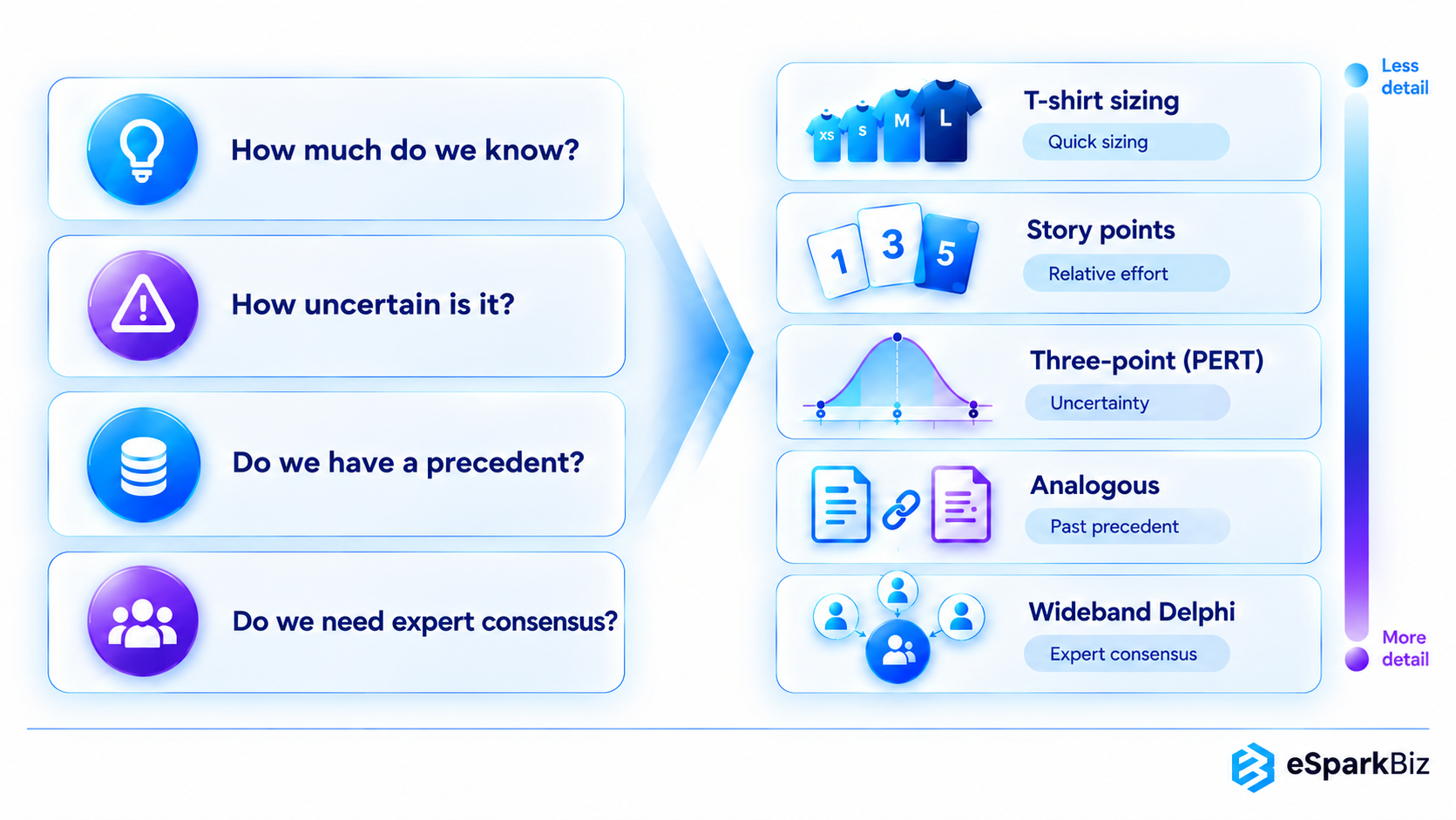
Different limitations require different approaches and no single approach is adequate to cover a whole project. The most defensible estimates combine at least two methods, one for each broad level of work.
Software Development Estimation Techniques That Actually Help
- T-shirt sizing groups work into small, medium and large sizes and suits early scoping.
- Story points signify effort, not time. They become meaningful only after a team builds a track record to compare against.
- Three-point estimation, also known as PERT, combines an optimistic, a most likely and a pessimistic view. It suits tasks with real uncertainty.
- Analogous estimation only works when the team has a similar past project to compare against.
- Wideband Delphi pools estimates from several senior engineers and works toward consensus. It suits work where one person’s view isn’t enough.
- Function-point analysis and COCOMO are parametric options for large or legacy-heavy systems.
Software Estimation Techniques Compared: Speed vs. Accuracy
The table compares each method by when it works best, how quickly teams can use it and what limits its accuracy. Use it to narrow down the options based on your project’s needs.
| Method | Best Fit Stage | Speed | Accuracy | Main Limitation |
| T-shirt sizing | Early scoping | Fast | Low | Too rough for a final number |
| Story points | Active build | Fast | Medium | Needs a calibrated team |
| Three-point (PERT) | Uncertain tasks | Moderate | Medium to high | Slower to produce |
| Analogous | Familiar work | Fast | Medium | Weak without a true precedent |
| Wideband Delphi | High-value tasks | Slow | High | Needs several senior reviewers |
| Function points | Large or legacy-heavy systems | Slow | Medium to high | Needs consistent counting rules |
| COCOMO | Large systems with history | Moderate | Medium | Needs calibrated historical data |
Reducing Variability at the Source
“The only way to reduce the variability in the estimate is to reduce the variability in the project.”
– Steve McConnell, Author of Software Estimation: Demystifying the Black Art
How Does the Five-Step Software Development Time Estimation Process Work?
Once the tier and the method are chosen, the rest of the process is mostly about discipline. Each step builds on the one before it and skipping ahead is where most estimates begin to go off track.
- Define the boundary first: Write down what counts as included, what stays out of scope and what marks the work as done, before sizing a single task.
- Break the work down: Split the requirements into a work breakdown structure (WBS) where each task can be finished in a reasonable amount of time.
- Match a method to each unit: Known tasks move rapidly through T-shirt sizing or story points. Complex tasks earn PERT or Wideband Delphi instead.
- Layer in named buffers: Add a technical-debt buffer, a scope buffer and an integration buffer separately, instead of one blended buffer no one can later justify.
- Package the range, not a point: Include the assumptions behind it, so that any change later feels like a planned update rather than a broken promise.
Teams skip the fifth step first when pressure builds, yet it matters most. Handing everyone one fixed number hides the uncertainty, and none of that nuance survives the handoff.
How to Turn Software Effort Estimates Into a Timeline
Once individual tasks carry a number, the full project total follows some simple formulas.
Estimated Effort = Task Effort + Risk Allowance + Delivery Overhead
Estimated Calendar Duration = Estimated Effort / Effective Team Capacity (limited by dependencies and the critical path)
- Task effort: The combined effort estimated for individual tasks
- Risk allowance: Extra effort added to account for uncertainty such as unknown technology, ambiguous requirements or integration risk
- Delivery overhead: Time and effort for reviews, setup, meetings and other work required to support delivery
Let’s say a project needs 400 hours of base task effort. A 12% risk allowance adds 48 hours and a 10% delivery overhead adds 40 hours, which gives 488 hours of estimated effort.
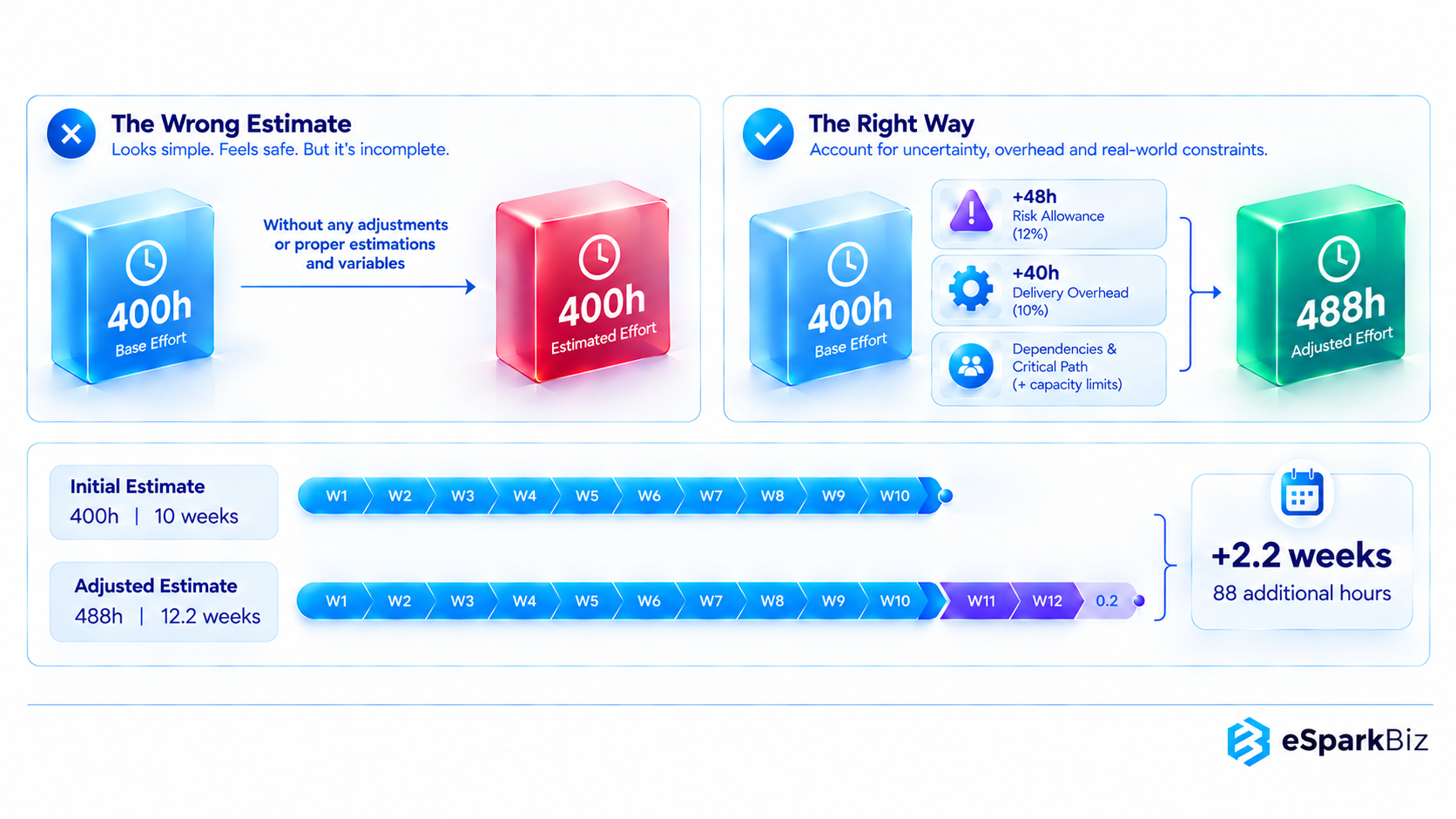
Divided by 40 effective hours per week, the output of one full-time developer comes to 12.2 weeks against the 10 weeks the first guess implied. A three-person team would divide by 120 hours instead, though dependencies rarely let work split that cleanly.
The gap of 88 hours, over two weeks, is what a single overconfident number hides.
Quick Question
How does software development time affect cost?
Software development cost follows estimated effort, team capacity and duration. A longer timeline raises labor cost, but adding developers does not always shorten it because dependencies and coordination limit how much work can run in parallel.
Why the Team Behind the Estimate Can Change Your Software Development Timeline
The same task can take very different amounts of time depending on who is tasked with the job. Technical ability, project familiarity and team dynamics can all affect the time that it takes to complete a task.
- Skill fit: The right technical experience can matter more than seniority alone.
- Project familiarity: Teams that know the codebase spend less time figuring things out.
- Task complexity: Unfamiliar or technically demanding work needs more time and wider estimates.
- Team dynamics: Handoffs and unclear ownership can add time that task estimates miss.
The following video example illustrates how large this gap can be, as some of the experienced developers took much longer to complete simple tasks, whereas a well matched team developed a much larger system in a significantly shorter period of time.
Watch the discussion:
In summary, it is important to not only consider the developed features, but also the work and the conditions of the team when estimating.
Case Study: Estimating a Complex Enterprise AI Platform Build
eSparkBiz collaborated with an enterprise AI team on the build and scale of a governed AI management platform for 7+ months. Development estimates acted as a guide to the team for planning cycles, allocating resources and finalizing release schedules. The team structured the delivery of the project with a design that consisted of:
- Modular architecture with clearly separated platform services
- Phased development cycles with feature gating and automated testing
- Canary rollouts with rollback safety for controlled releases
The design enabled a deployment that was performed at a 45% faster cycle time and achieved 99.9% application stability.
How Much Can AI Really Reduce Software Development Time?
AI-based development techniques can accelerate certain parts of development but not the whole process. Tasks like writing boilerplate code, code scaffolding and coding repetitive patterns are done much faster with the assistance of AI.
Architecture decisions, security reviews and unfamiliar technical work still require senior engineers to review the code carefully. Applying one flat percentage reduction to the entire estimate makes the same mistake as using a flat buffer. Real gains come from reducing the estimate only for tasks AI can actually speed up, while keeping senior review time in place.
What Working Engineers Say about Estimating
The r/SoftwareEngineering community on Reddit suggests treating the construction of task estimations as a range that accounts for uncertainty and is revised every time development requirements and project conditions change.
How to Know If a Software Estimate Is Realistic
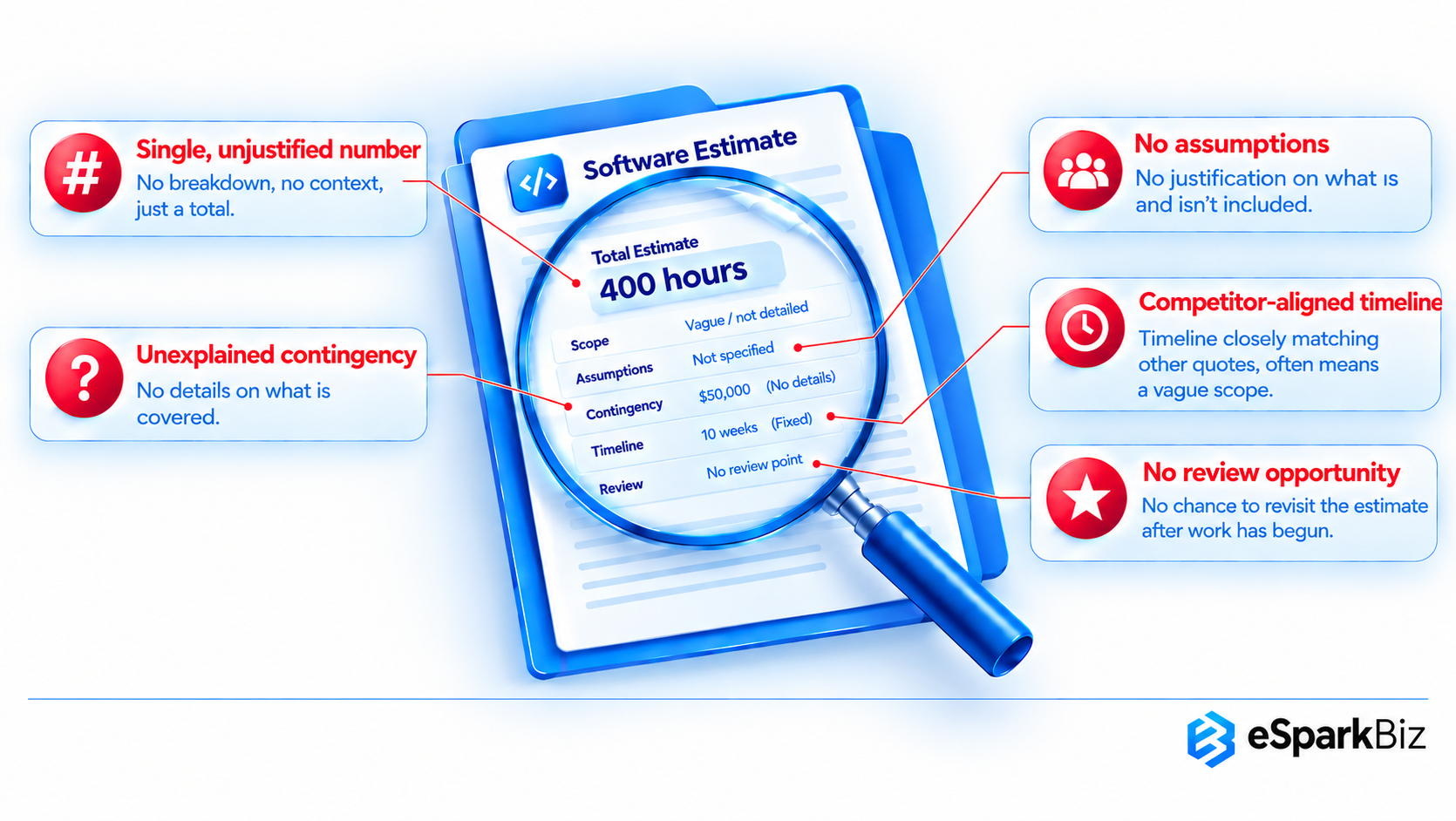
An estimate handed over with no breakdown is a guess wearing a suit. Before you talk budget, look for these warning signs:
- A single, unexplained number
- No stated assumptions about what is and is not included
- A “contingency” line item with no explanation of what it covers
- No chance to review the number once work begins
- A timeline almost identical to other vendors’ quotes, which usually means nobody defined the scope
An estimate with clear justification is easier to trust and is considered defensible by the vendor. If a vendor cannot justify the number, padding it wouldn’t fix it and the estimate should be considered a placeholder rather than a work plan.
How eSparkBiz Builds Estimates You Can Defend
- Define the scope: Break requirements into features, integrations and delivery phases so both sides understand what is included.
- Identify dependencies and risks: Account for third-party systems, technical unknowns, data migration and other factors that can affect delivery.
- Build a realistic timeline: Estimate the work across development, testing and deployment, allowing for integration challenges and revisions.
- Review assumptions as work progresses: Revisit estimates when requirements or technical findings change, making the impact on cost and schedule clear.
For businesses considering software development outsourcing, a transparent estimation process helps set realistic expectations, compare proposals and understand the resources required before committing to a development partner.
A useful estimate should explain how the team arrived at the numbers, what assumptions they depend on and what could change them. This gives clients a stronger basis for comparing proposals, planning budgets and making decisions as the project moves forward.
See Also: How to Build an Effective Remote Team with a Strong Company Culture
Frequently Asked Questions
What exactly do you mean by time estimate in the context of software development?
Software development time estimates project duration by analyzing each requirement and task and breaking them further into smaller tasks and applying the appropriate estimation sizes and risk buffers instead of providing a single-figure estimate.
We’ve estimated similar projects before. Why can’t we seem to get this one within a reliable range?
Similar is not identical. A new integration, team or technology can push work into a higher complexity tier, so the range must widen until those unknowns are tested.
Our developers keep talking in story points, but the business needs to know when the project will be done. How do those two estimates connect?
They connect through velocity, the number of points a team finishes per sprint.
|
Story Points |
Time Estimate |
|
|
Measures |
Relative effort |
Actual duration |
|
Depends on |
Team history |
Method and buffers |
|
Useful once |
Tasks are broken down |
A number is needed for finance |
What happens if the estimate looks right today but the scope changes halfway through development?
Rather than treating the original estimate as a hard deadline, reassess the work and update the timeline.
- Revisit the effort: Reassess the changed requirements.
- Check dependencies: See how the change affects capacity and the original goal.
- Revise the range: Use the buffer only for small changes. Larger changes may require a revised estimate.
- Match the contract to the uncertainty: Fixed-price contracts suit known work with a frozen scope, while time-and-materials contracts suit knowable or complex work where the scope may change. Either way, write change control into the contract.
We’re estimating a large enterprise project with different kinds of work. Do we really need different estimation methods for each stage?
Yes, because different work carries different risks. Light estimates are enough for early or low-risk work, but a detailed range is needed once money or dates depend on it.
|
Situation |
Method That Fits |
|
Early scoping or low-risk work |
T-shirt sizing |
|
Active build with a stable team |
Story points |
|
Budget, contract or launch date at stake |
Detailed three-point range |
We gave the project a timeline months ago and we’re already behind. Where did the original estimate go wrong?
The original estimate may have been based on limited information or missed dependencies and changes in scope. Reassess the remaining work rather than relying on the original numbers.
- Early estimates: They are made with little information, so treat them as starting ranges.
- Re-baseline the scope: List what is done, what remains and what changed.
- Re-estimate remaining work as ranges: Use complexity tiers and suitable methods, not the old numbers.
- Reset the buffer: Name the risks still open and size each one separately.
Before we sign a contract with an outsourcing partner, how can we tell if their estimate is realistic or they’ve simply padded the numbers?
An honest estimate from a software outsourcing partner shows a range, stated assumptions, itemized buffers with no unexplained contingencies and the method behind each major task.
Are there companies that can help my team estimate software development time before we commit to a project?
Multiple software engineering companies offer outsourced time estimation and project planning support such as eSparkBiz, Tapptitude, Litslink, Glorium Technologies and Edvantis.



 August 17, 2026