


Regulatory compliance is becoming increasingly difficult for financial services. Most companies experience slow onboarding, manual review processes, data fragmentation and increasing compliance costs.
RegTech (Regulatory Technology) software development companies help answer these problems by improving customer verification as well as monitoring and making reporting easier.
The demand for Regulatory Technology reflects this need. Future Market Insights projects the global RegTech market will grow from USD 20.1 billion in 2026 to USD 116.7 billion by 2036.
Teams nowadays use RegTech platforms to automate onboarding, monitor transactions and handle reporting across multiple regions. Such RegTech users include:
- Banks
- Fintech companies
- Lenders
- Payment providers
- Insurers
- Other regulated businesses
Choosing the right RegTech partner is not easy. To help narrow the options, we looked at how well each company handles compliance, fraud detection and risk management problems.
What We Looked for Before Ranking These RegTech Software Development Companies
To create this list, we evaluated companies using five evaluation factors that matter most when building compliance software.
We focused on the points compliance teams, tech leaders and buyers usually review before choosing a RegTech partner.
1. Compliance Knowledge
A RegTech partner should understand compliance as well as software development.
Questions we considered:
- Have they delivered Anti Money Laundering (AML) projects?
- Have they built Know Your Customer (KYC) platforms?
- Do they support Customer Due Diligence (CDD) workflows?
- Can they automate Suspicious Activity Report (SAR) generation?
- Have they developed reporting or transaction monitoring systems?
Only companies with proven compliance related experience were included.
2. Financial Services Experience
Banks, lenders, insurers and payment companies all face different compliance rules.
Questions we considered:
- Have they worked with banks or financial institutions?
- Have they built fraud detection or payment monitoring tools?
- Do they have experience in regulated industries?
We chose vendors with financial services experience.
3. Technical Skills
Many RegTech projects involve integrations, legacy systems and large data volumes.
Questions we considered:
- Can they integrate third party compliance tools?
- Can they connect with legacy systems?
- Do they build cloud based compliance platforms?
Only companies with real project experience were considered.
4. Security and Risk Controls
RegTech platforms handle sensitive customer and financial data.
Questions we considered:
- Do they follow recognized security standards?
- Do they implement data protection controls?
- Can they help teams prepare for audits?
We favored vendors that treat security as a primary requirement.
5. Post Launch Support
Compliance needs keep changing even after the software goes live.
Questions we considered:
- Do they provide ongoing support?
- Can they handle regulatory updates?
We preferred companies that can support these platforms after launch.
Side-by-Side Comparison of Leading RegTech Software Development Companies
The table below compares leading RegTech software development companies based on their strengths, target clients and ideal use cases.
| Sr. No. | Company | Hourly Rate | Minimum Project Size | Team Size | Founded | Clutch Rating
(Out of 5) |
Best For | Key RegTech Strength | Compliance Focus | Typical Clients | Location |
| 1 | eSparkBiz | <$25/hr | $10,000+ | 400+ | 2010 | 4.9 |
Custom RegTech platforms | Growth stage to enterprise | AML, KYC, compliance automation, reporting | Growth stage companies, mid market firms, enterprises | Delaware, USA & India |
| 2 | Praxent | $50 – $99 / hr | $25,000+ | 50-249 | 2000 | 4.8 | Digital banking platforms | Established financial institutions | Customer onboarding, banking compliance, financial software | Banks, lenders, wealth management firms | Texas, USA |
| 3 | Edvantis | $25 – $49 / hr | $10,000+ | 250 – 999 | 2005 | 4.8 | Legacy modernization | Financial software integration | Reporting, modernization, integrations | Banks, FinTechs, enterprises | Rzeszów, Poland |
| 4 | Accedia | $50 – $99 / hr | $10,000+ | 250-999 | 2012 | 4.9 | Identity verification solutions | Startups to mid market FinTechs | KYC, onboarding, compliance automation | FinTech companies, lenders, payment providers | Sofia, Bulgaria |
| 5 | Miquido | $50 – $99 / hr | $25,000+ | 50 – 249 | 2011 | 4.9 | Compliance products with AI tools | Startups and growing firms | Risk checks, workflows and monitoring | FinTech companies, digital banking firms | Kraków, Poland |
| 6 | Vates | $25 – $49 / hr | $10,000+ | 250 – 999 | 1991 | 4.9 | Financial software engineering | Mid market to enterprise | Monitoring tools, reporting platforms, modernization | Banks, financial services organizations | Córdoba, Argentina |
| 7 | The Software House | $50 – $99 / hr | $25,000+ | 50 – 249 | 2012 | 4.8 | Custom compliance platforms | SMBs and mid market companies | Workflow automation, integrations, compliance software | Mid market businesses, regulated companies | Gliwice, Poland |
| 8 | Phenomenon Studio | $50 – $99 / hr | $10,000+ | 50 – 249 | 2019 | 5.0 | FinTech product development | Compliance-ready digital products | Onboarding, financial applications | FinTech startups, scale-ups | Chicago, USA |
| 9 | Oak’s Lab | $50 – $99 / hr | $25,000+ | 50 – 249 | 2016 | 5.0 | FinTech startups | Early stage startups to scale-ups | Compliance ready product development, onboarding systems | Startups, growth stage FinTech companies | Prague, Czech Republic |
| 10 | Monterail | $25 – $49 / hr | $10,000+ | 50 – 249 | 2010 | 4.8 | Workflow automation | SMBs and growing regulated businesses | Review Techniques, integrations, internal processes | Mid market firms, regulated businesses | Wrocław, Poland |
Top RegTech Software Development Companies to Consider in 2026
If compliance is a field where you face limitations due to manual procedures, delayed reporting or something else, here are some RegTech software development firms with their unique abilities that match your needs.
1. eSparkBiz: Custom Compliance Builder
Manual checks, slow reporting and disconnected compliance management can become barriers for many growing finance firms. With 15+ years of ISO certified development experience, eSparkBiz builds custom AML, KYC and reporting systems that integrate with existing workflows.
Core challenge: Manual compliance work slows reviews.
Root cause: Legacy tools do not fit.
Solution eSparkBiz provides: Build custom workflows around your process using agile teams.
Core RegTech services:
- AML software
- KYC platforms
- Reporting tools
- Workflow automation
- Custom software
Why choose eSparkBiz: Good fit for teams that want custom builds
Tradeoff: Does not provide freelancers
Client Feedback:
eSparkBiz delivered exactly what we were looking for—a robust Guest Experience Platform built on time, within budget, and with exceptional attention to quality. Their skilled team, responsive communication, and proactive project management made even a complex development process straightforward. They proved to be a trusted partner from start to finish.
2. Praxent: Banking Product Partner
Marketplaces that do not attract many customers and have old banking experiences find it difficult to grow. Praxent is an organization that helps banks improve their customer experience and banking experience without compromising on regulation.
Core challenge: Poor user experience is holding back signups.
Root cause: Old systems were built poorly.
Solution Praxent provides: Create new systems with compliance in mind.
Core RegTech services:
- Banking software
- Financial products
- Onboarding systems
- Digital platforms
Why choose Praxent: Strong choice for bank led projects.
Tradeoff: Less focus on deep AML work.
Client Feedback:
Their deep understanding of our application and our goals was impressive.
3. Edvantis: Enterprise Compliance Systems
Large financial organizations often struggle to modernize legacy systems while meeting evolving compliance requirements. Edvantis helps enterprises build secure software with expertise in cloud modernization, data engineering and regulated industry projects.
Core challenge: Legacy systems slow modernization efforts.
Root cause: Complex enterprise environments and evolving compliance needs.
Solution Edvantis provides: Modernize enterprise platforms with secure engineering teams.
Core RegTech services:
- Enterprise software development
- Cloud modernization
- Data engineering
- Dedicated development teams
Why choose Edvantis: Strong choice for enterprise modernization projects.
Tradeoff: Focuses on engineering services rather than dedicated RegTech products.
Client Feedback:
Edvantis was able to provide developers with specific skills and experiences that aligned well with the project.
4. Accedia: KYC Onboarding Specialist
The problem of slow identity verification might result in onboarding delays and discourage potential customers. As a company working for European and North American customers, Accedia specializes in providing KYC and onboarding services that help to speed up approvals.
Core challenge: Manual identity checks delay onboarding.
Root cause: Review steps are still too slow.
Solution Accedia provides: Automate customer verification from start.
Core RegTech services:
- Identity verification
- KYC workflows
- Onboarding systems
- Compliance automation
Why choose Accedia: Good for faster customer onboarding.
Tradeoff: Narrower scope than fullstack firms.
Client Feedback:
The team is accommodating and always looks for a solution to help deliver the best outcome for customers.
5. Miquido: AI Compliance Builder
Compliance departments may struggle with increasing alert volumes and capacity to review such alerts. Utilizing AI expertise in financial software, Miquido assists in prioritizing risk and minimizing repetitive investigations.
Core challenge: Alert volume slows compliance teams.
Root cause: Manual review cannot keep pace.
Solution Miquido provides: Use automation to sort alerts.
Core RegTech services:
- Compliance platforms
- AI applications
- Workflow automation tools
- Risk analysis
Why choose Miquido: Strong fit for AI heavy work.
Tradeoff: AI projects can cost more.
Client Feedback:
They are able to adapt to our preferences and work independently without having to involve us in all the details.
What Practitioners Say About Modern Compliance Issues
r/legaltech discussions show compliance is now part of onboarding, payments, verification and reporting. This growing workload is one of the reasons why many businesses are investing in RegTech software and compliance automation.
6. Vates: Financial Systems Team
It becomes increasingly difficult to keep up with compliance software due to changes in compliance regulations. Using a team of 500+, Vates assists financial institutions with updates to their compliance systems.
Core challenge: Reporting software becomes hard to maintain.
Root cause: Rules change faster than tools.
Solution Vates provides: Update compliance software as rules change.
Core RegTech services:
- Financial software
- Monitoring tools
- Platform modernization
- Dedicated teams
Why choose Vates: Good for long partnerships.
Tradeoff: Less suited for quick launches.
Client Feedback:
I'm very satisfied with the service provided. Everything was on schedule and very professional.
7. The Software House: Workflow Automation Team
Disorganized workflows and incompatible software are common culprits behind inefficiencies in regulation. The Software House creates tailored software solutions that can be seamlessly integrated into existing systems.
Core challenge: Manual workflows create daily bottlenecks.
Root cause: Standard tools miss key steps.
Solution The Software House provides: Build around your actual process.
Core RegTech services:
- Custom software
- Compliance platforms
- Process automation
- System integration
Why choose The Software House: Good fit for mid size firms
Tradeoff: Needs clear requirements upfront.
Client Feedback:
You only need to give them a small amount of direction and they understand what they need to develop.
8. Phenomenon Studio: Digital Product Development Partner
Building regulated digital products requires balancing compliance, usability and speed. Phenomenon Studio combines product design and software development to help fintech and other regulated businesses launch user-focused digital solutions.
Core challenge: Compliance requirements can reduce product usability.
Root cause: Design and compliance are often handled separately.
Solution Phenomenon Studio provides: Build compliant digital products with user experience in mind.
Core RegTech services:
- Digital product development
- UX/UI design
- MVP development
- Dedicated product teams
Why choose Phenomenon Studio: Good fit for product-focused regulated businesses.
Tradeoff: Broader product development focus beyond RegTech.
Client Feedback:
What stood out most about Phenomenon Studio was their ability to merge sleek design with robust technical execution.
9. Oak’s Lab: FinTech Startup Builder
Startup companies usually face challenges in creating financial products while being compliant with all the regulations. Oak’s Lab helps startup founders create financial products and be compliant with necessary regulations quickly.
Core challenge: Startups need speed and compliance.
Root cause: Small teams juggle too much.
Solution Oak’s Lab provides: Build a usable product fast.
Core RegTech services:
- FinTech development
- Compliance integration
- Product development
- MVP delivery
Why choose Oak’s Lab: Good for early stage FinTech.
Tradeoff: Less fit for enterprise work.
Client Feedback:
They were great at digging deep and understanding our business from a revenue model perspective.
10. Monterail: Compliance Workflow Builder
Repetitive compliance duties take up valuable time and also mask a host of different issues. With the help of workflow tools and integration, Monterail assists teams in saving time.
Core challenge: Repetitive tasks waste team time.
Root cause: Manual steps create bottlenecks.
Solution Monterail Provide: Automate core compliance workflows.
Core RegTech services:
- Workflow automation tools
- Compliance software
- Platform development
- System integration
Why choose Monterail: Good for fixing slow processes
Tradeoff: Best for workflow focused projects.
Client Feedback:
We’re extremely impressed by their development capabilities. They developed everything we wanted.
Case Study: How HSBC Uses AI Based RegTech Software for AML Monitoring
HSBC worked with Google Cloud to build a custom RegTech solution for AML compliance using AI based risk scoring. The Dynamic Risk Assessment system replaced rule based monitoring, helping reduce false alerts by over 60% and improving fraud detection speed. This shows how banks rely on RegTech software developed to strengthen regulatory control.
Why More Businesses Are Turning to RegTech Solutions
Complying with AML, KYC and anti fraud rules has become difficult for financial institutions. Most teams continue to use manual processes.
Where Firms Often Struggle
- Delayed client onboarding process
- Manual KYC procedures
- Costs rising due to compliance
- Late reporting
- Fraud detection inefficiencies
- Audit readiness concerns
- Incomplete data visualization
What Happens When These Problems Build Up
These problems often lead to:
- Increased operating costs
- Slow customer acquisition
- Missing deadlines
- Reduced efficiency
- Compliance risks
How Do RegTech Platforms Help
RegTech platforms bring compliance work into one system. They automate repetitive work, help teams see compliance issues sooner and reduce reliance on spreadsheets and manual reviews.
Benefits RegTech Customers Enjoy
- Faster onboarding
- Better reporting accuracy
- Reduced manual work
- Improved risk management
- Stronger audit readiness
- Better visibility into daily operations
Should You Build or Buy RegTech Software?
The right choice depends on how your team works and the systems you already use.
| Factor | Off-the-Shelf Software | Custom Development |
| Launch Speed | Faster | Longer |
| Flexibility | Limited | High |
| Integrations | Predefined | Custom |
| Compliance Workflows | Generic | Tailored |
| Feature Control | Limited | Full |
| Regulatory Changes | Vendor Dependent | Business Controlled |
Build Custom RegTech Software When:
- The workflow is unique
- Different systems are integrated
- There are regional regulations
- Current software limits options
- The compliance requirements change
Buy Existing Software When:
- You have simple requirements
- Rapid deployment is important
- Limited internal resources are available
- Budget is the main concern
- Standard functionality is enough
Banks, FinTech firms and payment solution providers often opt for custom software development when existing options do not meet their needs.
RegTech Software Development Companies: Pricing and Delivery Models Compared
Beyond technical expertise, pricing structure and engagement models play an important role when selecting a RegTech software development partner. Use the comparison below to identify the option that best aligns with your budget, project size and delivery expectations.
| Sr. No. | Company | Engagement Model | Hourly Rate | Pricing Position | Typical Project Size | Contract Flexibility | Delivery Model | Pricing Transparency |
|---|---|---|---|---|---|---|---|---|
| 1 | eSparkBiz | Dedicated teams, Fixed scope, Time & Material | <$25 | Cost-effective | Small to Enterprise | High | Offshore | High |
| 2 | Praxent | Project-based, Dedicated teams | $50–$99 | Premium | Mid-size to Enterprise | Medium | Onshore | Medium |
| 3 | Edvantis | Dedicated teams, Staff augmentation | $25–$49 | Mid-range | Mid-size to Enterprise | High | Offshore | Medium |
| 4 | Accedia | Dedicated teams, Project-based | $50–$99 | Mid-range | Small to Mid-size | Medium | Hybrid | Medium |
| 5 | Miquido | Product teams, Dedicated teams | $50–$99 | Mid-range | Mid-size to Enterprise | High | Nearshore | Medium |
| 6 | Vates | Dedicated engineering teams | $25–$49 | Mid-range | Mid-size to Enterprise | Medium | Nearshore | Medium |
| 7 | The Software House | Product teams, Dedicated teams | $50–$99 | Mid-range | Small to Mid-size | High | Nearshore | Medium |
| 8 | Phenomenon Studio | Product teams, Project-based | $50–$99 | Mid-range | Startup to Mid-size | High | Nearshore | Medium |
| 9 | Oak’s Lab | Startup-focused product teams | $50–$99 | Mid-range | Startup to Mid-size | High | Nearshore | Medium |
| 10 | Monterail | Agile teams, Project-based | $25–$49 | Mid-range | Small to Mid-size | High | Nearshore | Medium |
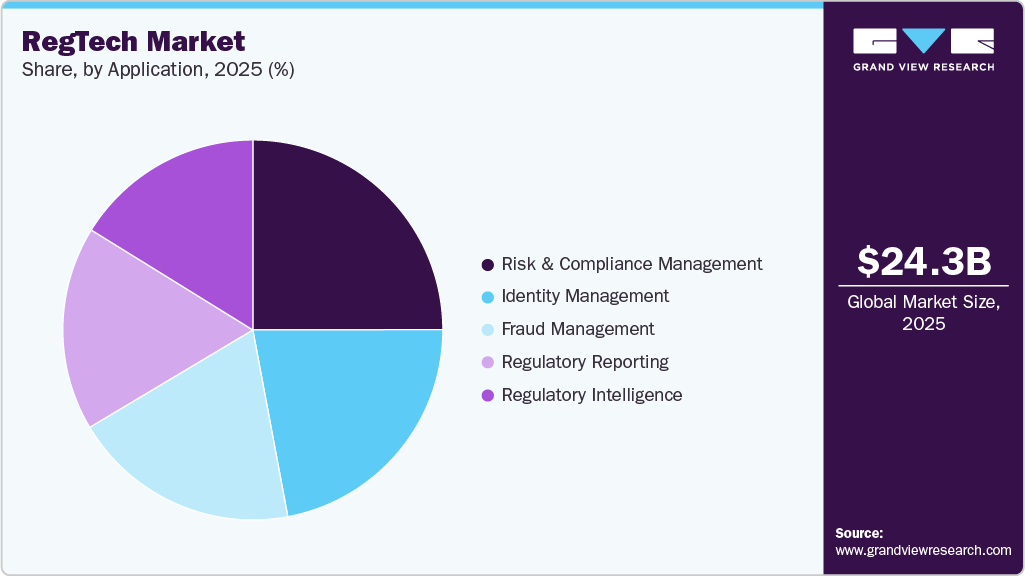
RegTech Market Share
More than two-thirds of the RegTech market specializes on compliance, identity and fraud management, according to Grand View Research’s estimates.
How to Choose the Right RegTech Software Development Company
The right RegTech partner depends on your compliance problems, business size and project goals.
A startup building a lending platform may prioritize speed and budget. A bank handling millions of transactions may need deeper regulatory experience and experience handling large projects.
Before making a decision, evaluate vendors using the following criteria:
| Evaluation Factor | Why It Is Required |
| Compliance Knowledge | Helps avoid costly compliance mistakes |
| Industry Expertise | Reduces learning curves and delays |
| Security Practices | Protects sensitive financial data |
| Integration Experience | Connects with existing systems |
| Working model | Matches project vision and resources |
| Ongoing Support | Supports future changes in regulations |
Questions to Ask Before Hiring
- Have they built AML systems before?
- Do they have KYC project experience?
- Can they integrate legacy systems?
- What security standards do they follow?
- Do they provide ongoing support?
- Have they worked with financial firms?
Quick Selection Guide
The best choice is rarely the company with the largest team or strongest brand. Look for the vendors that have solved problems similar to yours and can support your compliance needs as regulations evolve.
| If You Need… | Consider… |
| Custom RegTech development | eSparkBiz |
| Enterprise compliance platforms | DataArt |
| Digital banking expertise | Praxent |
| KYC and onboarding solutions | Accedia |
| AI assisted compliance tools | Miquido |
| Ongoing engineering support | Vates |
| Workflow tools platforms | Monterail |
| Flexible custom development | The Software House |
| Regulated digital products | Infinum |
| Startup focused delivery | Oak’s Lab |
Security and Compliance Checks to Make Before Hiring a RegTech Software Development Partner
RegTech platforms handle customer identities, financial records and transaction data every day. Poor security controls can create regulatory, financial and reputational risks.
| Area | Why It Matters |
| GDPR | Protects customer privacy and data rights |
| SOC 2 | Validates security and operational controls |
| ISO 27001 | Supports information security management |
| FATF | Helps support AML and financial crime compliance needs |
| PCI DSS | Secures payment related information |
| Audit Trails | Improves investigations and regulatory reviews |
| DevSecOps | Embeds security throughout development and deployment |
| Role Based Access Control (RBAC) | Restricts unauthorized access to sensitive data |
| Zero Trust Security | Verifies users and systems before granting access |
| Data Encryption | Protects data at rest and in transit |
| Activity Monitoring | Helps detect suspicious behavior and compliance issues |
Compliance Solved. What Comes Next?
After addressing KYC, AML and reporting needs, many teams focus on improving customer onboarding and product experience.
RegTech Software Development: Industry Use Cases
Different industries face different compliance difficulties. The table below shows common use cases and the development partners best suited for each scenario.
| Industry | Common Problem | RegTech Solution | Business Outcome | Best Choice | Alternatives | Why These Firms Fit |
| Banking | High transaction volumes | AML monitoring & reporting | Stronger compliance oversight | eSparkBiz | Praxent, Edvantis | Experience building AML, KYC and banking compliance platforms |
| FinTech | Rapid customer growth | Automated onboarding & KYC | Faster customer onboarding | Oak’s Lab | eSparkBiz, Miquido | Startup-focused delivery with FinTech and compliance expertise |
| Payments | Fraud & identity risks | Transaction monitoring & verification | Reduced fraud exposure | Accedia | eSparkBiz, Miquido | Strong KYC, identity verification and compliance automation capabilities |
| Wealth Management | Complex reporting obligations | Reporting & compliance automation | Lower manual effort | Edvantis | Praxent, Vates | Enterprise financial software and regulatory reporting experience |
| Lending | Lengthy customer verification | Digital onboarding & KYC | Faster loan approvals | Accedia | Praxent, eSparkBiz | Proven onboarding, verification and workflow automation expertise |
| Insurance | Manual compliance workflows | Process automation & platform modernization | Improved operational efficiency | Phenomenon Studio | The Software House, Vates | Expertise in regulated digital products, workflow modernization and enterprise applications |
How AI Is Changing the RegTech Software Development Industry
Artificial Intelligence is helping compliance teams review alerts and spot risk faster. It supports compliance teams instead of replacing them.
Emerging RegTech Trends
- AI supported compliance reviews
- Live risk monitoring
- Continuous KYC verification
- Automated reporting workflows
- Predictive fraud detection
As regulations get more complex, many organizations use AI for monitoring, investigations, reporting and customer checks while still keeping human supervision at all stages.
The Business Impact due to AI use case
| AI Use Case | Business Impact |
| Transaction Monitoring | Faster risk detection |
| Risk Scoring | Better investigation focus |
| Fraud Detection | Reduced fraud exposure |
| Alert Prioritization | Less review time needed |
| Document Review | Faster processing speed |
| Regulatory Reporting | Reduced manual work |
Are you looking for Financial Technology Partners?
Building compliance software is only one part of the equation. If you are also evaluating broader financial technology vendors, our guide to Top FinTech Software Development Companies can help.
AI-Powered RegTech Explained: How Financial Institutions Automate Compliance in 2026
This video explains how AI-powered RegTech platforms help financial institutions automate regulatory compliance using technologies such as natural language processing (NLP), machine learning and large language models (LLMs), showing how modern RegTech platforms reduce manual effort while improving risk detection and regulatory readiness.
Frequently Asked Questions
What is a RegTech software development company?
A RegTech software development company builds compliance software for AML, KYC, reporting, fraud detection, monitoring and regulatory risk management.
How much does custom RegTech software development cost?
RegTech software costs depend on several factors, including:
- Required features and modules
- Third-party integrations
- Compliance requirements
- Data volume and complexity
- Development approach
How long does a RegTech software development project take?
Project timelines vary according to implementation complexity:
| Project Stage | Typical Timeline |
| Small Solutions | Around 3-4 months |
| Mid-sized Platforms | Around 4-6 months |
| Enterprise Implementations | Around 6-9 months or longer |
Which industries benefit most from RegTech solutions?
Banks, FinTech companies, lenders, insurers, payment providers and wealth management firms commonly use RegTech software to manage compliance.
What integrations are commonly required in a RegTech platform?
Most RegTech platforms integrate with:
- Banking and core financial systems
- Payment platforms
- Identity verification services
- AML and KYC data providers
- Regulatory reporting tools
My customer onboarding process is slow. What should I do?
You can improve onboarding efficiency by:
- Automating KYC verification
- Using digital identity verification
- Standardizing onboarding workflows
I spend too much time preparing compliance reports. What should I do?
Reporting automation can collect compliance data, generate reports faster and reduce manual effort across regulatory reporting activities.
I am considering outsourcing a RegTech project. What risks should I watch for?
Evaluate vendors carefully before outsourcing regulated software projects:
| Risk | Why It Matters |
| Limited Regulatory Experience | May increase compliance risks |
| Security Weaknesses | Can expose sensitive financial data |
| Poor Long-term Support | Makes regulatory updates more difficult |
How can I improve AML monitoring and suspicious activity detection?
Transaction monitoring, risk scoring and automated alerts help compliance teams identify suspicious behavior faster and more consistently.
How can I keep up with changing regulations?
Custom RegTech platforms allow compliance workflows, reporting rules and monitoring processes to be updated as regulations evolve.
Can a RegTech Company build a custom AML monitoring platform?
Yes. RegTech Companies can develop custom AML systems with monitoring, risk scoring, alert management, reporting and investigation workflows.
I need a custom KYC solution. How can a RegTech development company help?
A RegTech development company can help by:
- Automating identity verification
- Supporting customer due diligence
- Integrating KYC data providers
- Simplifying compliance checks
Can eSparkBiz automate manual compliance workflows?
Yes. eSparkBiz develops workflow automation tools that reduce repetitive tasks, improve visibility and support compliance operations.
I need a RegTech platform tailored to my business. How can eSparkBiz help?
eSparkBiz helps organizations by:
- Developing custom RegTech software
- Integrating existing systems
- Automating compliance workflows
- Supporting regulatory requirements
Which are the top RegTech software development companies in 2026?
eSparkBiz, Praxent, Edvantis, Accedia, Miquido, Vates and Phenomenon Studio are among the leading RegTech software development companies in 2026.


 September 03, 2026
