


Creating a fintech application means going beyond implementing technology that answers the operational requirements of the application. Financial technology applications must provide fast and accurate account updates and a seamless and painless KYC process, or users will lose trust.
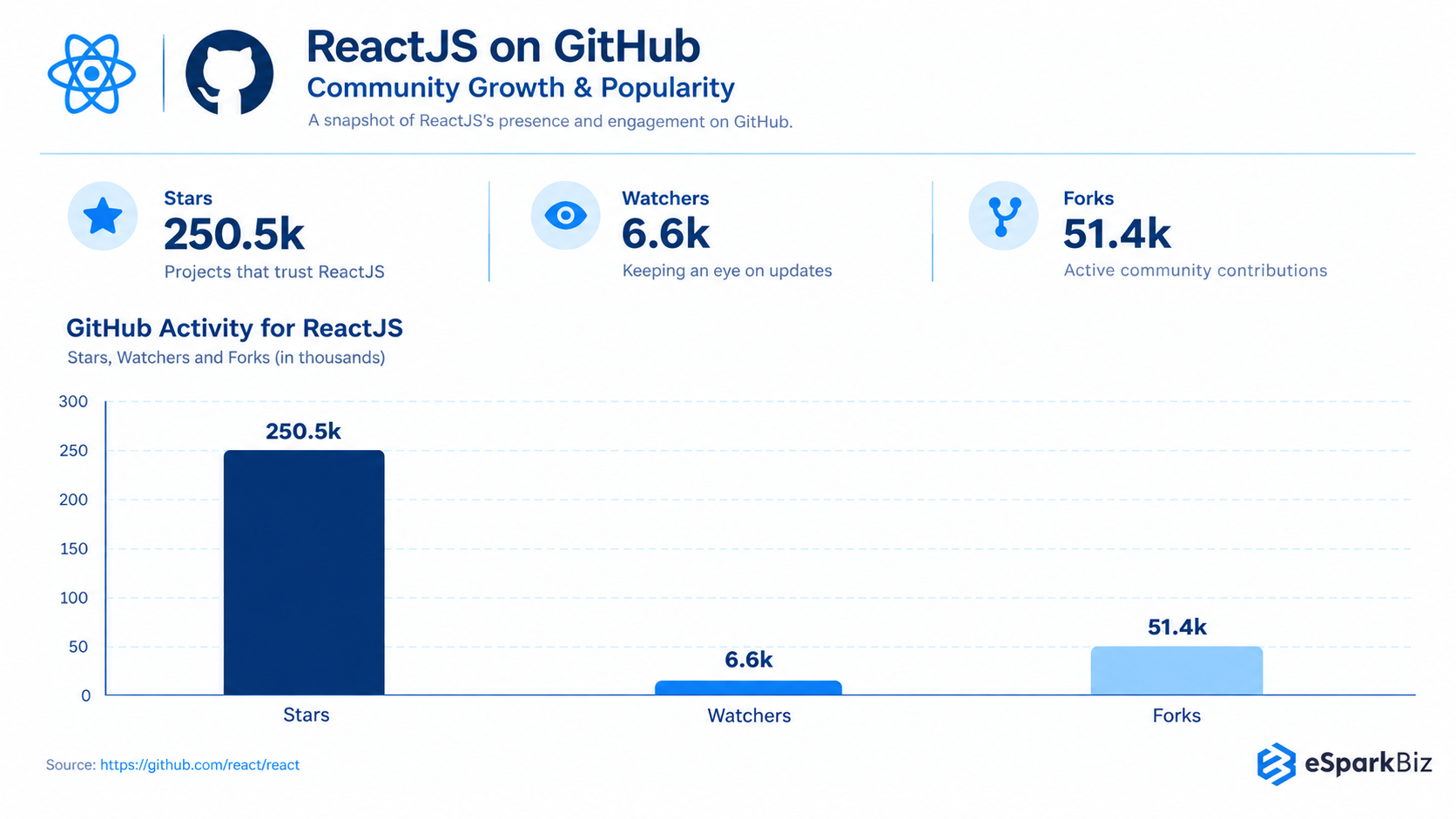
ReactJS has over 250K stars and 51K forks on GitHub illustrating its high adoption by developers and thriving open source ecosystem.
For payment platforms and trading dashboards, ReactJS enables real-time updates to transaction statuses, account balances, and market prices without full-page reloads. Its component-based architecture also helps fintech teams build consistent interfaces, manage complex financial workflows and scale applications efficiently.
I’ve seen fintech apps lose customers when UI lags. Transactions, payments, and even investment checks should all take fractions of a second to complete. Users lose their trust even with increased latencies of a couple of seconds.
How the UI framework offers control and modularity is a key differentiator of the user experience for financial products. Using ReactJS for Fintech provides flexibility because React has a robust library of UX ready UI components.
What makes ReactJS a Strong Fit for Fintech Products
Users love immediate interactions for financial software. The current status of transactions and payments and the latest market data shown on the page, without the user needing to repeatedly refresh the page, define an excellent interface. ReactJS excels optimization of interfaces and uses easily reusable components. It is designed for fast and iterative interface interactions.
Real-Time Data Handling for Trading and Payments
Pairing ReactJS with WebSockets makes it such that data with constant change can quickly be displayed. WebSockets push data continuously and ReactJS optimizes interfaces. Financial applications require constant updates of prices, payment status and transaction data that are constantly changing.
Imagine a constantly updated market board, where information is changed with events rather than refreshes.
Common use cases include:
- Trading and investment dashboards
- Payment status updates
- Transaction updates
- Account balance updates
Example: Managing Live Account Balance Updates in ReactJS
For a banking application, developers can use TanStack Query to manage account balances as server state while WebSockets deliver real-time transaction updates. When a user initiates a transfer, optimistic updates can temporarily reflect the expected balance change in the UI. If the transaction fails, TanStack Query restores the previous cached balance through rollback. After confirmation, refetching the balance from the server ensures accuracy and prevents inconsistencies between displayed and actual funds.
Component Reusability across Banking, Lending and Wallet Modules
With ReactJS, users can build similar user interfaces for various financial tasks. Creating interfaces for these financial tasks using ReactJS means that developers can create these financial system products and services with less code as the convenient and familiar UI for these workflows can be reused.
The following components can be made reusable:
- KYC verification forms
- Login forms
- Account dashboards
- Payment forms
- Transactions history
The 2026 ReactJS Architecture Shift Fintech Teams should know
ReactJS Development has moved beyond its original client-side framework. By 2026, fintech end-users will see two major changes: with the introduction of the React Compiler, frontend performance tuning will no longer be necessary, and with the introduction of React Server Components, frontend developers will be able to use server side code to construct user interfaces with more data and interactivity.
React Compiler and Automatic Performance Optimization
The development of the React Compiler in the previous year will bring the optimization of components and values using memoization to its first stable release. This Compiler empowers frontend developers to forgo using the hooks useMemo, useCallback, and React.memo to achieve the memoization of values and components.
Vetted ReactJS Developers are able to create more optimized dashboards and analyze more information as presented in a fintech dashboard with routinely updated data. Developers can focus on the product behavior and the optimizations of the compiler during routine rendering.
Imagine React Compiler as a type of cruise control for performance optimization: Developers are still responsible for the functionality of the product as a whole, and the system adjusts optimizations automatically.
Server Components and what they mean for Fintech UIs
React Server Components render on a server before a React application reaches the browser. Server Components are able to fetch data for rendering. They are then able to send the rendered output along with Client Components. While Server Components were stabilized in React 19, functionally, Server Components were expanded in React 19.3.
I’ve noticed the complexity of frontend experiences increases with every screen treated as similarly interactive. RSC provides a different solution: having server-side, data-centric content and client-side code for the interactive pieces that are actually required.
For fintech applications, RSC can suit:
- Account and portfolio overviews
- Transaction and statement views
- Data heavy financial summaries
- Server fetched customer information
🎥 Watch: ReactJS vs AngularJS | Which Frontend Should You Choose?
Did You Know?
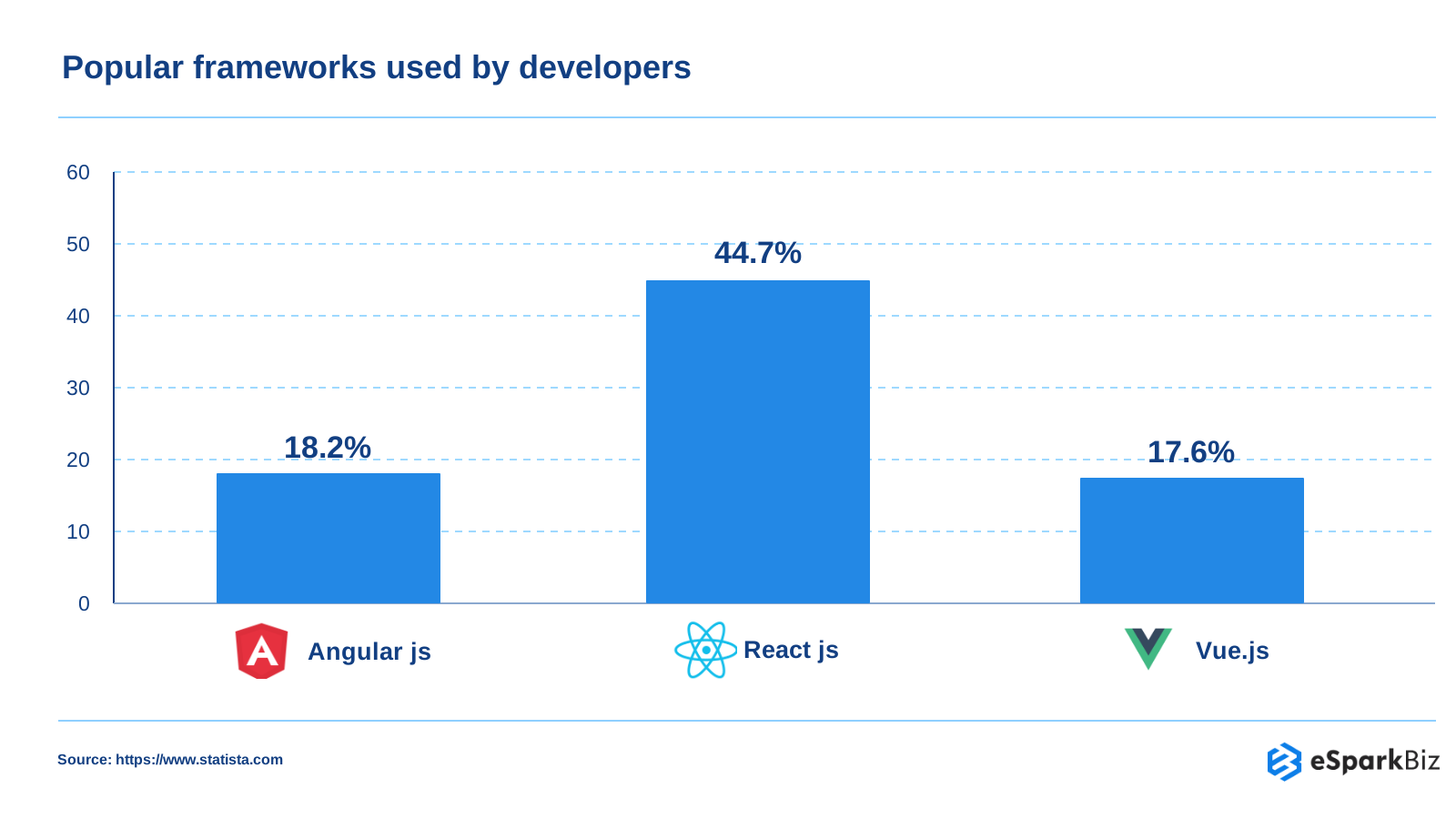
ReactJS is most popular among the three, having 44.7% of the developers using it over ReactJS, AngularJS, and VueJS.
Security and Compliance: Where ReactJS fits PCI DSS
ReactJS is only a small part of a compliant fintech application. There are a lot of other factors like architecture, controls, and processes. It is worth noting that your choice of a frontend will impact the protective measures you can apply to user data and interactions.
Token Storage, CSP and Input Sanitization basics
When building fintech interfaces, security needs to start with what can to the browser and what the browser can execute. To that end, you can employ the use of HTTP only cookies for session tokens, a web standard called Content Security Policy (CSP) and some input sanitization to defend against XSS.
Think of compliance like building security: the framework sets the rules, while each frontend control acts as a lock, camera or access check.
Key frontend controls include:
- HTTP only, secure, SameSite cookies
- Content Security Policy headers
- Input validation and sanitization
- Controlled third party scripts
Common Mistakes to Avoid
- localStorage Tokens: Storing sensitive tokens in localStorage increases exposure to XSS attacks.
- Missing CSP: Weak or absent CSP headers allow unauthorized script execution.
- Unsanitized HTML: Rendering untrusted HTML without sanitization creates XSS vulnerabilities.
- Third-Party Scripts: Unverified scripts on payment pages increase security and PCI DSS compliance risks.
Fintech-Specific ReactJS Best Practices for Security and Reliability
Beyond general ReactJS optimization, fintech applications require additional safeguards to protect financial data and maintain user trust. Key practices include:
- Audit Logs for UI Actions: Record sensitive actions such as fund transfers, profile changes, and payment approvals through secure backend audit logging.
- Idle Session Timeouts: Automatically expire inactive sessions and require reauthentication before sensitive transactions.
- Masked Sensitive Fields: Hide account numbers, card details, and personal information by default, revealing them only when necessary.
- Transaction Confirmation: Require explicit confirmation for high-risk financial actions to prevent accidental transfers.
- Secure Error Handling: Display clear error messages without exposing sensitive financial data, authentication tokens, or internal system details.
How to make a ReactJS Fintech Application PCI DSS v4.0.1 Ready
PCI DSS v4.0.1 is the current standard in 2026, with its future-dated requirements having taken effect on March 31, 2025. For ReactJS fintech applications handling payment information, frontend security must address token storage, data transmission, script integrity, and unauthorized modifications. The PCI Security Standards Council specifically addresses payment page scripts through Requirements 6.4.3 and 11.6.1.
Here is a practical checklist for aligning ReactJS frontend security with PCI DSS v4.0.1:
- Secure Token Storage (Requirement 8.3): Avoid storing sensitive authentication tokens in localStorage. Use Secure, HttpOnly, and SameSite cookies where appropriate, alongside session expiration and reauthentication controls.
- Protect Data Transmission (Requirement 4.2.1): Enforce HTTPS and strong TLS configurations to protect payment information exchanged between the ReactJS frontend and backend services.
- Prevent Cross-Site Scripting (Requirement 6.2.4): Use ReactJS’s default output escaping, validate inputs, and avoid unsafe HTML rendering to minimize injection vulnerabilities.
- Manage Payment Page Scripts (Requirement 6.4.3): Maintain an inventory of authorized payment page scripts, document their business justification, and implement integrity verification mechanisms such as Subresource Integrity (SRI) where applicable.
- Configure Content Security Policy Headers (Requirement 6.4.3): Apply restrictive CSP headers to limit unauthorized script execution. CSP can support payment page script security but does not independently satisfy every element of Requirement 6.4.3.
- Detect Unauthorized Changes (Requirement 11.6.1): Implement tamper-detection mechanisms to monitor payment page scripts and security-impacting HTTP headers, with alerts for unauthorized changes.
For secure ReactJS-based fintech application development, these controls must align with the application’s defined PCI DSS scope rather than the frontend framework alone. Compliance readiness depends on the payment architecture, cardholder data environment, and applicable assessment requirements.
Expert Quote
“React is ‘value UI’. Its core principle is that UI is a value, just like a string or an array.”
~ Dan Abramov, React core team member
The Hiring Advantage: ReactJS Talent Pool and Time-to-Market
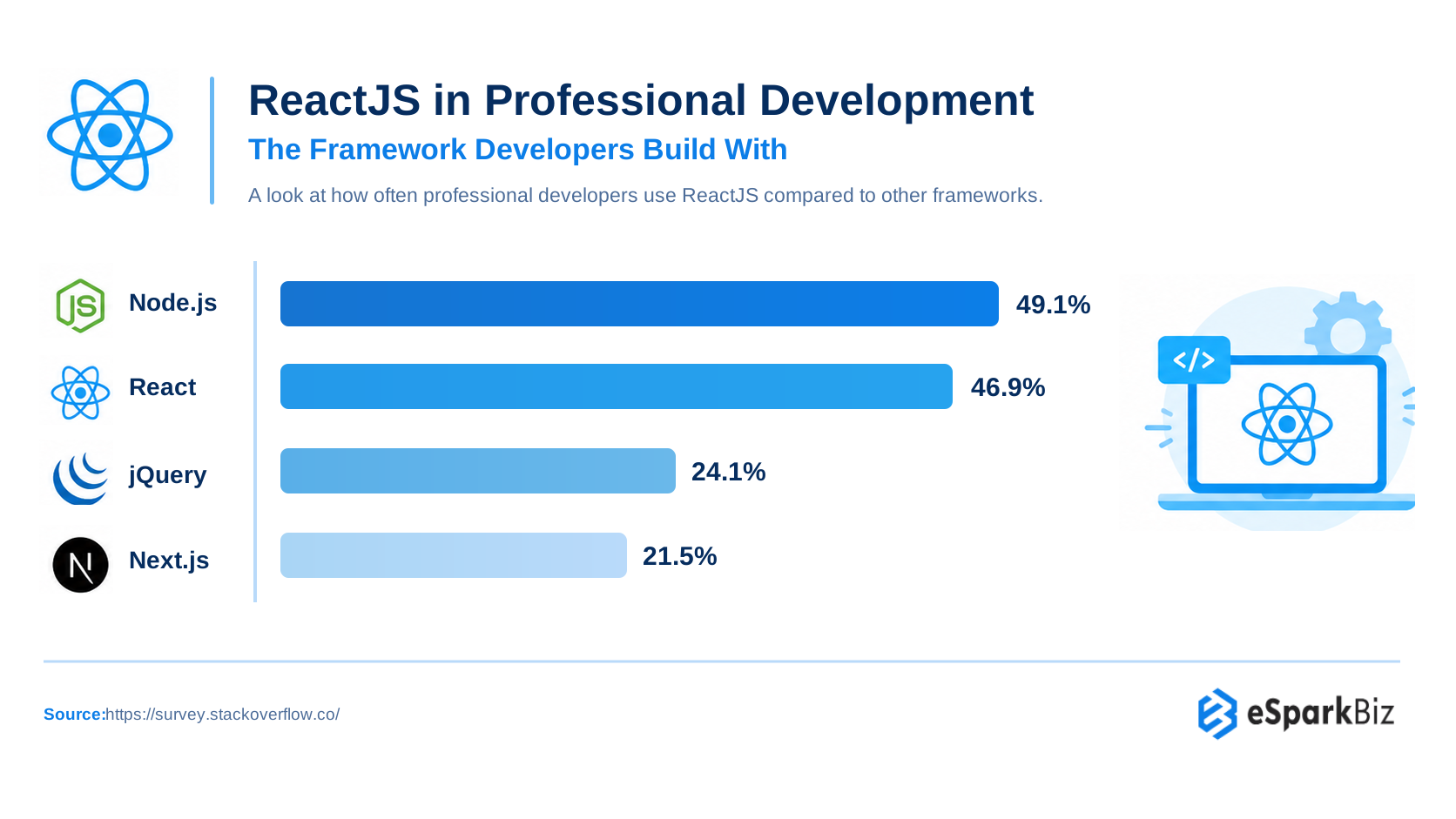
A fintech product needs a growing frontend. ReactJS allows a product to tap into a large developer ecosystem. According to Stack Overflow’s Developer Survey, React exceeded Angular and Vue, combined with Svelte, as the most used framework by developers at 46.9%.
The demand for development talent is evident in the rest of the software market, too. The U.S. Bureau of Labor Statistics sees rapid employment growth for software developers along with QA analysts and testers and expects to have approximately 185,400 positions for these careers by 2034.
From my experience, talent availability becomes a strategic advantage when fintech products need to move quickly.
Why this reduces delivery risk:
| Hiring factor | Business impact |
| Larger talent pool | Faster staffing |
| Familiar ecosystem | Easier onboarding |
| Team flexibility | Simpler scaling |
| Wider expertise | Lower keyperson risk |
For leadership teams, ReactJS can make workforce planning more predictable while supporting faster product delivery.
How ReactJS meets Fintech build requirements
A framework decision connects technical capabilities to real user needs. This checklist provides a quick assessment for fintech teams to determine how ReactJS fits into user experience, performance, security, hiring, and web and mobile experiences.
| Capability | Fintech Requirement it Satisfies |
| Componentbased architecture | Consistent UI across banking, lending, wallet modules |
| React Compiler (2026) | Less manual optimization for performance critical dashboards |
| Server Components | Efficient rendering for account and statement views |
| HTTPonly cookie storage | Secure session handling aligned with PCI DSS controls |
| Large talent pool | Faster hiring, lower delivery risk |
| React Native shared code | Unified web/mobile logic for omnichannel products |
The Honest Trade-Off: When Server Components aren’t the Right Fit
React Server Components bring significant value to fintech screens primarily used for data presentation. However, these components may not work well for frequent user interface interactions with data that are constantly changing. Live trading, real time charts and order management systems extensively use client-side JavaScript for real time interactions.
Choosing a server or client rendering architecture for an entire application is reductive. The model to choose is dependent on the screen.
Where RSC makes sense
Think server side rendering when the screen primarily presents information retrieved from a central location.
- Account summaries
- Transaction histories
- Statements and reports
- Portfolio overviews
Where Client-Side Rendering Wins
Keep more logic on the client when users need continuous interaction:
- Live trading screens
- Real time market charts
- Order entry interfaces
- Rapid state changes
I have seen fintech products become more complicated to use because they used the same architecture for every workflow. It is important to analyze how the user will be interacting with the screen, and choose the optimal rendering strategy accordingly.
Think about a control room example. Reports can be drawn and presented centrally, but live operations require controls actually in the operator’s control.
ReactJS powered Fintech Platform for Smarter Investment Management
Challenge: The client was using emails, spreadsheets and multiple products across devices for different steps in the investment process. Founders and investors were looking for easier onboarding, opportunity discovery, communication, meeting scheduling and payment management across devices.
Solution: eSparkBiz developed a Fintech platform using ReactJs and Next.js on the frontend with Laravel APIs, MySQL, and AWS. The platform integrated investment opportunities, real-time communication, scheduling, membership payments, and investor matching in a single platform.
Result
- 98% platform stability and uptime
- 80% higher concurrent user capacity
- 70% improvement in operational efficiency
- 42% reduction in onboarding time
For enterprise decision makers, established fintech adoption reduces the concern that ReactJS is an untested choice for serious financial applications.
Community Insights
According to a Quora post, ReactJS is ideal for developing fintech applications because of its combination of scalability, flexibility, developer efficiency, robust performance and utilization of complex user interfaces that require class handles for data and can have unpredictable user experiences.
When should a Fintech Team bring in a ReactJS Development Partner?
Fintech teams should consider a ReactJS development partner when building payment applications, trading dashboards, or banking platforms requiring specialized security and real-time data expertise. While in-house teams offer long-term control, outsourcing can accelerate development and provide access to developers experienced in PCI DSS, KYC workflows, and financial integrations.
ReactJS Fintech Development Cost and Timeline
Development costs depend on project complexity, security requirements, and third-party integrations.
| Project Scope | Estimated Cost | Timeline |
| Fintech MVP | $40,000 – $90,000 | 3 – 5 months |
| Trading or Payment Dashboard | $50,000 – $120,000 | 3 – 6 months |
| Full Fintech Platform | $150,000 – $500,000+ | 6 – 12+ months |
These are indicative estimates, not verified project delivery figures.
Key cost drivers include PCI DSS security controls, KYC/AML integrations, real-time WebSocket infrastructure, authentication, and compliance testing.
How to Choose the Right ReactJS Fintech Partner
- Verify Fintech Experience: Review previous banking, payment, and trading projects.
- Assess Security Expertise: Check knowledge of PCI DSS, KYC, and secure payment integrations.
- Evaluate Technical Skills: Confirm experience with real-time dashboards, API integrations, and ReactJS performance optimization.
- Review Delivery Practices: Assess development timelines, testing, NDA terms, and post-launch support.
How eSparkBiz Accelerates Fintech Innovation with ReactJS
At eSparkBiz, we develop ReactJS-powered fintech applications that address the evolving needs of digital banking, investment management, and payment platforms. Our development approach combines responsive financial interfaces, real-time data processing, and security-focused engineering to deliver reliable digital financial experiences. We help fintech businesses streamline financial workflows, improve customer engagement, and bring innovative financial products to market faster.
- Real-Time Financial Dashboards: Develop interactive dashboards displaying live market trends, account balances, investment portfolios, and transaction updates.
- Digital Banking Solutions: Create intuitive banking interfaces for fund transfers, account management, and transaction tracking.
- Simplified KYC and Onboarding: Build user-friendly verification workflows that reduce onboarding friction and improve customer experiences.
- Secure Payment Interfaces: Integrate payment gateways and implement frontend security controls aligned with applicable financial security requirements.
- Investment Management Platforms: Develop ReactJS-based solutions for portfolio monitoring, investor communication, and financial data visualization.
With our ReactJS development expertise, fintech businesses can deliver efficient, user-centric financial applications while maintaining flexibility for future innovations.
Frequently Asked Questions
Is ReactJS secure enough for fintech applications?
Yes, as long as security is built into ReactJS, it's just as secure as other frameworks. Fintech products should use HTTP only cookies, CSP, input sanitization and controlled scripts while ensuring the security controls comply with PCI DSS v4.0.1 and SOC 2.
Does ReactJS work well for real-time financial data like live trading or payments?
Yes. ReactJS is efficient for real time development of interfaces through the continuous delivery of data via WebSockets. With ReactJS, these interfaces can be developed quicker for:
- Trading dashboards
- Fraud alerts
- Balance updates
Our fintech dashboard lags every time transaction data updates; how can a ReactJS development partner fix this?
A partner can analyze the render path, find render updates that aren't needed, use the React Compiler for automatic memoization and make updates to the state ensuring that a lot of transaction changes cause DOM updates only to the needed components for the users.
What's the difference between React Compiler and React Server Components?
React Compiler makes rendering optimizations by automatically applying memoization. React Server Components are able to render on the server and send the results to client components making it optimal for data intensive screens. Both of these options become standard by 2026.
Is it hard to hire ReactJS developers for a fintech project?
Hiring ReactJS developers for fintech requires evaluating both technical expertise and financial application security knowledge. Follow these three steps:
- Assess ReactJS Skills: Evaluate experience with real-time dashboards, API integrations, and state management.
- Verify Fintech Security Knowledge: Check familiarity with PCI DSS, secure authentication, and sensitive data handling.
- Conduct Practical Assessments: Test candidates with payment workflows, transaction handling, and error recovery scenarios.
Businesses can also hire ReactJS developers with relevant fintech development experience.
We keep discovering compliance gaps late in our ReactJS build; how can a development partner prevent this?
Plan for compliance early within the architecture phase. A partner can align frontend controls to related requirements of PCI DSS v4.0.1 and SOC 2, and can provide evidence and test security controls before the controls are released instead of addressing the control gaps later.
Can ReactJS power both the web and mobile app for a fintech product?
Yes. Since React Native can support shared logic and development across the web and mobile, it allows fintech products to reuse components, business logic and workflows across banking, lending and wallet experiences when appropriate.
Are React Server Components always the right choice for a fintech interface?
No. RSC fits broadcasting data heavy screens with minimal interaction like statements or account overviews. More client side rendering would be needed for trading applications to manage state and maintain interactive experiences and trading screens.
Our onboarding and KYC flow has a high drop-off rate; can a ReactJS partner help redesign it?
Yes. With a Partner, you can completely restructure the onboarding process and build functional components that allow users to receive validation and begin the KYC process in real time, resulting in less friction.
Do any major fintech companies actually use ReactJS in production?
Yes. Coinbase and Robinhood list React in production roles for their Financial products. React supports a front end that is capable of supporting large scale financial products with fast changing user experiences and complex workflows.
How much does it cost and how long does it take to build a ReactJS fintech MVP?
A ReactJS fintech MVP typically costs $10,000 - $100,000 and takes 3 to 12 months, depending on features, payment integrations, security requirements, and regulatory compliance.
Does eSparkBiz offer US contracts, overlapping work hours, and NDAs for fintech projects?
Yes. eSparkBiz offers US-based contracting, 4 to 12 hours of timezone overlap, NDA protection, and project-specific agreements. Terms depend on engagement requirements.

 August 20, 2026