

A GCC can certainly appear to be a growth engine on paper, yet depending on vendors can quietly limit who controls the people, priorities and decisions that shape its future.
By 2030, India is expected to host over 2,400 GCCs with projections suggesting the number could surpass 2,500 as the country strengthens their position as a global technology & services hub.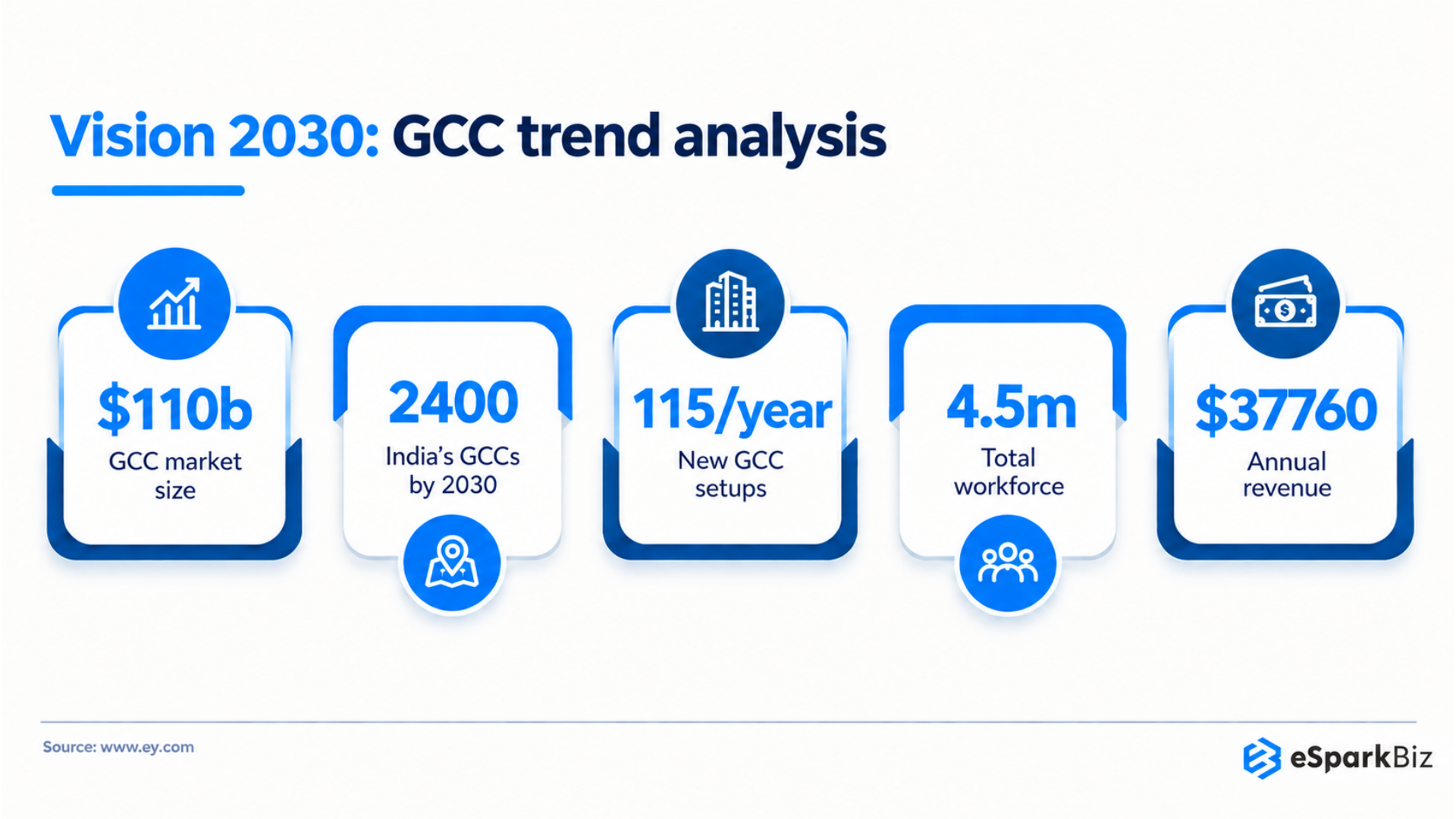 That shift makes India more than an offshore destination. where setting up a GCC enables organizations to position critical functions of their business closer to their own teams, strengthen talent access and create dedicated technology operations. The real question is how to build the one that helps to achieve meaningful business value from the ground up.
How This Article Was Created: This article was developed using GCC industry reports, market statistics and research on GCC setup, operating models, costs and governance. The content was reviewed for clarity and practical value to help business leaders make informed GCC decisions.
What is a Global Capability Center?
A Global Capability Center (GCC) is an organization owned unit that delivers technology, engineering, analytics and business functions for its parent company.
In India, GCCs operate via locally established entities that manage functions such as software engineering, cybersecurity, data science, finance, research and software product development.
Their local teams work with global business units, report by the parent company’s leadership structure and contribute to shared technology, product and business objectives.
Top reasons to set up a GCC in India include access to operational control and proximity to growing technology ecosystems. These benefits explain why companies are building centers in India and other offshore locations to support global operations.
Key Factors Companies Look at When Setting Up a GCC
- Business goals and the functions the center will manage.
- Location selection based on talent, operating costs and infrastructure.
- Operating model such as captive, BOT or hybrid.
- Talent availability and local leadership experience.
- Setup and operating costs including hiring, office space and technology.
- Legal and compliance requirements for registration, taxation and employment.
- Technology and infrastructure for daily business operations.
- Governance structure covering decision rights, reporting and performance measures.
Understanding the Terms – GCC vs Captive vs GIC vs ODC
| Term | Ownership Structure | Primary Function | Major Distinction |
| GCC | Controlled by the parent organization | Technology, engineering, analytics & business functions | Modern term for an organization owned global delivery center |
| Captive Center | Controlled by the parent organization | Dedicated internal operations | Highlights direct organizational ownership as opposed to third party service delivery |
| GIC | Controlled by the parent organization | Global business & technology services | Commonly used for Global In house Center |
| ODC | Usually operated for a client by a service provider | An Offshore development and delivery | Typically linked to an outsourcing arrangement instead of the parent company ownership |
The terms vary by company & market. The operating structure matters more than the label.
Also Read: Managed GCC vs Captive GCC
India’s GCC Market Size and Growth in 2026: The Numbers that Matter
India’s GCC market has demonstrated growth in both organizational scope and operational responsibilities. Companies increasingly use Indian centers for product development, engineering, analytics, finance, cybersecurity and other strategic functions beyond their traditional role as service delivery facilities.
India’s Global Capability Center count has reached 1,700 while the sector’s revenue stands at US$64.6 billion highlighting a 40% increase. India is recognized as the world’s most ‘balanced’ GCC ecosystem.
According to the report, India’s domestic GCC market is projected to achieve US$110 billion by 2030. The India GCC industry is forecasted to expand its employment base to exceed 4.5 million people representing growth from the existing workforce of approximately 1.9 million.
For an executive conducting market assessment, three metrics matter first: the quantity of GCCs operating within India, the workforce volume they employ, and the financial value they contribute to the economy.
GCCs now account for 22.5% of India’s total AI talent demand, highlighting their central role in enterprise AI strategy rather than peripheral experimentation.
More than 126,000 AI professionals are integrated within Fortune 500 GCCs in India, working in areas such as Generative AI, advanced analytics, intelligent automation and AI-driven software development. This concentration of Artificial Intelligence expertise enables enterprises to move faster from pilots to production and expand AI solutions.
Why do Enterprises choose India for a Global Capability Center (GCC)
The decision to establish GCC operations in India typically begins with workforce considerations and despite that it does not end here. For a CTO or CIO, the location decision has to answer a more practical question, Can this market support the work the company wants to own five years from now?
1. Deep Technology Talent
India provides access to an extensive STEM workforce with well established expertise in software, cloud, data, cybersecurity, product development and finance.
India maintains the world’s most deepest & diverse technology talent pool graduating over 1.5 million STEM graduates annually.
2. Cost Economics
While compensation represents a significant factor, leadership should evaluate the complete cost structure rather than focusing exclusively on salary. The analysis should encompass:
- Hiring & recruitment
- Office space
- IT infrastructure
- Employee benefits
- Leadership costs
- Compliance
- Technology licenses
- Retention programs
- Vendor and administrative expenses
3. English Language Business Communication
English is the default language in India’s technology and corporate sectors. This makes it a whole lot easier to cut the communication barriers when collaborating with international teams, whether you’re working with global product, engineering and business groups.
4. Time Zone Coverage
India’s working hours fall neatly between North America, Europe and Asia. This means businesses can just about get everything sorted including product launches, customer service, infrastructure management and global business processes.
5. Government and State Level Support
The Indian government’s Digital India initiative has strengthened the country’s broader digital ecosystem. Several states have also introduced policies and investment incentives designed to attract multinational enterprises.
For location selection, executives should review the current policy position of each state rather than assume that every incentive applies to every company.
The strongest location is usually the one where talent availability, operating cost, leadership hiring & policy conditions match with the center’s mandate.
Smart Companies are Betting on these Indian Cities for a GCC
India does not have one GCC location that fits every company. City selection should follow the work mandate.
Bengaluru has a strong technology and product engineering ecosystem. Hyderabad has built substantial strength in technology, life sciences & corporate operations. Pune has a deep engineering and technology base with strong automotive and industrial links.
Chennai has created engineering, manufacturing & technology talent. NCR provides access to technology, financial services and corporate talent. Mumbai remains important for the financial services and business functions.
Ahmedabad and Coimbatore also deserve consideration when a company wants access to growing talent markets with different cost structures.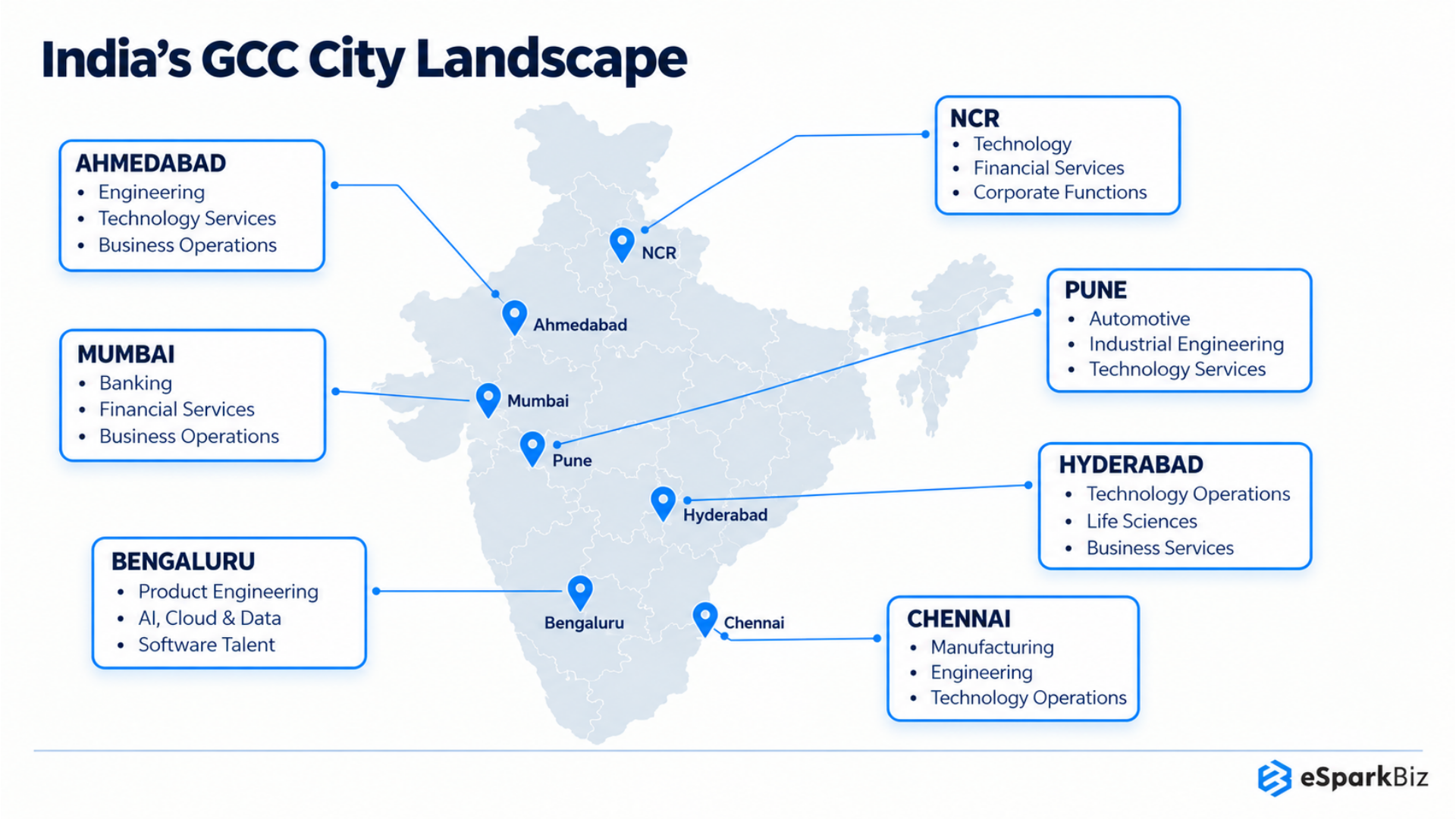
The Top GCC Cities in India Right Now
| City | Dominant Sector | Notable Advantage |
| Bengaluru | Technology, engineering, Software product development | A deep technology talent pool |
| Hyderabad | Technology, life sciences, business services | Strong corporate & technology ecosystem |
| Pune | Engineering, automotive, technology | An established engineering talent |
| Chennai | Manufacturing, engineering, technology | Strong industrial & engineering base |
| NCR | Technology, finance, business services | Large corporate talent market |
| Mumbai | Financial services, business functions | The strong financial services ecosystem |
| Ahmedabad / Coimbatore | Engineering, technology, business services | Emerging alternatives to the major GCC hubs |
City level counts can differ by the research methodology. Use one source consistently when comparing cities and clearly identify the fiscal year.
GCC Operating Models: Captive, BOT, Outsourcing and GCC as a Service
Selecting the appropriate GCC operating model determines how much control the parent company keeps and the extent of operational responsibility sits with a partner.
There is no universal structure. An organization developing a foundational product engineering function may require complete ownership. A company testing the GCC concept may prefer a lighter entry model.
GCC Operating Model Comparison
| Operating Model | Ownership | Control Level | Upfront Investment | Best Fit Scenario |
| Captive GCC | Parent company | High | High | Companies seeking direct ownership & strategic control |
| BOT | Partner initially, then transferred based on agreement | Medium to High | Medium | Companies wanting to build operations before taking ownership |
| Outsourcing | Service provider | Contract based | Lower | Companies needing defined services without building an internal center |
| GCC as a Service | Provider supported structure | Shared | Lower to Medium | Companies testing a GCC model before building a larger internal operation |
Captive GCC
A captive GCC gives the parent company direct control over hiring, governance, technology decisions & operating priorities.
The trade off is the upfront work. The parent organization must create the legal entity, hire leadership, build infrastructure and internal processes.
Build Operate Transfer
A Build Operate Transfer (BOT) arrangement lets a partner not only set up a centre but also run it for a while before the owner takes over. The handover happens in line with an agreed plan and timeline.
This approach lets the parent company ease into operation while giving them a clear roadmap for how to get to a place of direct ownership.
Outsourcing
Outsourcing means the service provider actually delivers the service while you just define what you need & what you’re willing to pay. You get to manage the commercial terms while the provider manages the delivery organization.
This model makes sense for companies that need access to some extra expertise without having to set up a separate corporate entity.
GCC as a Service
When you think about GCC as a Service, it’s really all about combining partner led setup and operational support with a structure that actually meets your own business needs. For decision makers, the core question is simple.
How much control do we need and how much setup responsibility are we prepared to take on? That answer should guide the model.
Budget Smart, Not Blind: Know about GCC Investment before you Spend
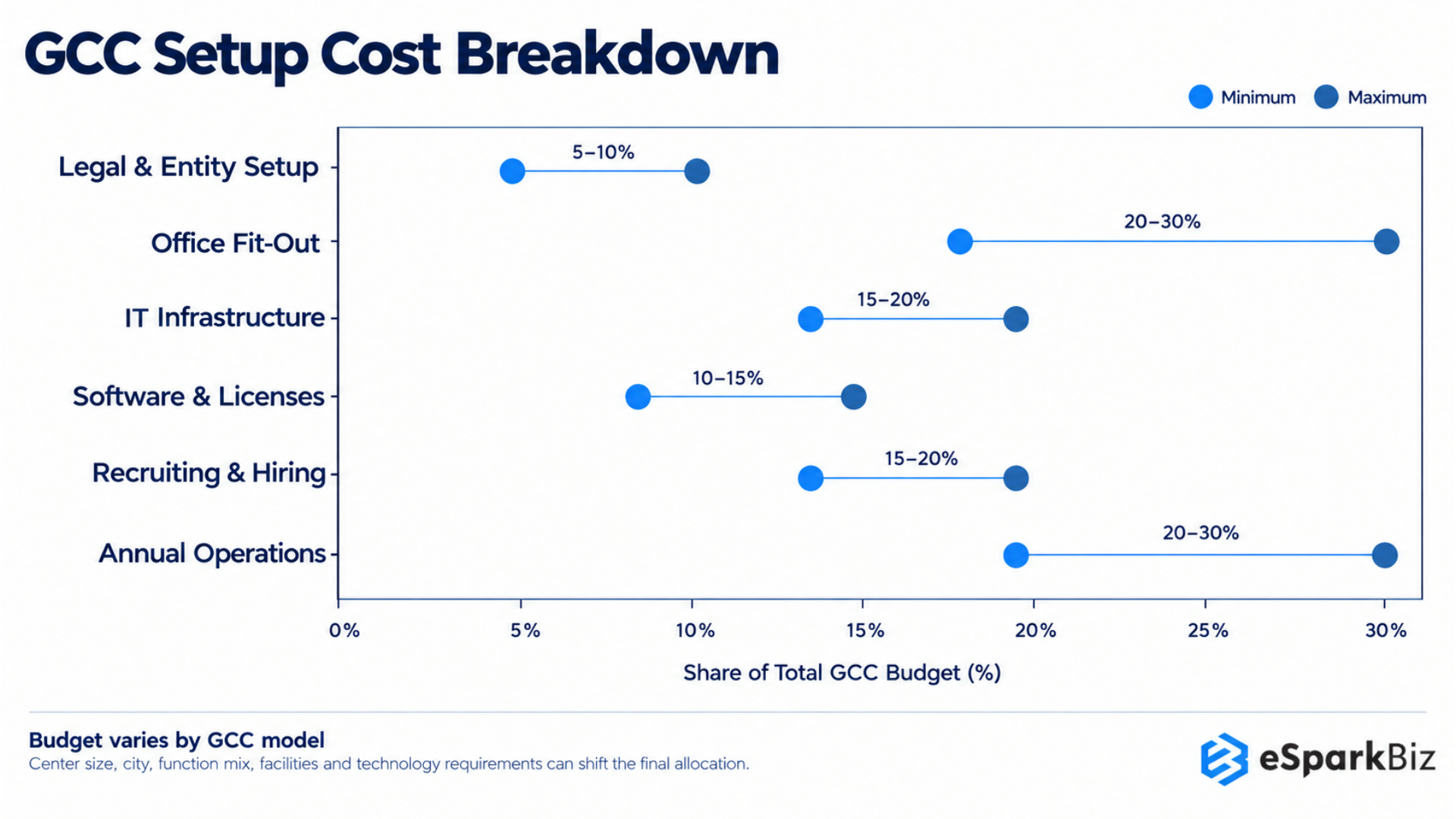
The cost of building a Global Capability Center in India depends on the GCC size, city, function mix, office strategy, technology requirements in GCC and a hiring plan. A small technology pilot will have a very different cost profile from a center with hundreds of employees & dedicated leadership.
The budget should separate one time setup expenses from the recurring operating expenses.
GCC Setup Cost Breakdown
| Cost Category | Share of Total GCC Setup Budget |
| Legal and entity setup | 5 to 10% |
| Office fit out | 20 to 30% |
| IT infrastructure | 15 to 20% |
| Software and licenses | 10 to 15% |
| Recruiting & hiring | 15 to 20% |
| Annual operations | 20 to 30% |
Sample First Year Budget for a 50 Person GCC
| Cost Category | Estimated First Year Cost (USD) |
| One time setup and recruitment | $50,000 – $100,000 |
| Salaries and benefits | $600,000 – $900,000 |
| Office and facilities | $50,000 – $100,000 |
| Technology and software | $30,000 – $60,000 |
| Legal, compliance and administration | $20,000 – $40,000 |
| Estimated first year total | $750,000 – $1.2 million |
For a meaningful budget, avoid using one headline number. Separate employee costs, facilities, technology, compliance & management expenses. Then model the first year cost separately from the steady operating cost.
The location also changes the economics. Bengaluru and Mumbai may carry different real estate costs from the emerging cities such as Ahmedabad or Coimbatore. The talent mix can change the calculation just as much.
Which Steps actually matter When Setting Up a GCC in India
A GCC setup in India works better when the company treats it as an operating design decision in place of a real estate exercise.
1. Define the GCC Mandate
Decide what work the center will own along with their first year scope, headcount and leadership structure.
Typical duration: 1 – 2 weeks.
2. Select the Operating Model
Choose between a captive GCC, BOT, outsourcing arrangement or GCC as a Service based on ownership, investment and responsibility.
Typical duration: 2 – 4 weeks.
3. Pick your City and Set Up Shop
Take a close look at the office costs, infrastructure, talent and state policies before selecting the location & legal compliance structure.
Typical duration: 4 – 8 weeks.
4. Get Legal and Governance Framework
Work out who’s in charge of what, financial controls, data responsibilities, and how you’ll handle things like staff recruitment, employee benefits, and decision making right.
Typical duration: 4 – 8 weeks.
5. Hire GCC Leadership
Recruit the right leaders for the GCC, engineering, HR, finance, security and other areas depending on what your new centre needs.
Typical duration: 4 – 8 weeks.
6. Build the Operating Environment
Set up the office and all the tech and tools you need to sort out including security controls, development environments, access management & internal workflows.
Typical duration: 4 – 8 weeks.
7. Launch with a Defined Scope
Start off with a clear plan of what you want to achieve and a measure of how well you’re doing by looking at ownership, governance, workflows and collaboration in preference to headcount alone.
Typical duration: 2 – 4 weeks.
Total timeline: A typical GCC setup may take 4 – 9 months, depending on the operating model, legal requirements, hiring needs and infrastructure readiness. Steps can overlap, so individual durations should not be added together.
Planning a GCC setup in India? A structured assessment of the operating model, city, entity structure & first year mandate can help leadership define the right starting point before committing any major resources.
Legal Entity and Governance Considerations
A Global Capability Center (GCC) can be structured as a wholly owned subsidiary or branch office with the choice depending on the organization’s strategic objectives and applicable legal requirements. A Build Operate Transfer (BOT) arrangement introduces a different ownership path because an external partner may establish and operate the center before a later transition.
A private limited company is a common choice for a wholly owned GCC, while a branch office requires applicable approvals. Before hiring, plan for incorporation or branch approval, PAN, TAN, bank setup, GST where applicable and state-level registrations.
Transfer pricing becomes relevant when the Indian entity delivers services to its parent organization or other related entities. Companies must maintain comprehensive documentation and apply appropriate pricing methodologies consistent with applicable GCC tax incentive.
Data management necessitates additional governance considerations. India’s Digital Personal Data Protection Act, 2023, combined with other sector specific obligations, should be integrated into the governance framework discussion involving personal data processing.
Entity incorporation and initial registrations may take around 2 – 6 weeks; branch approvals can take longer. The appropriate legal structure varies based on the facts of each organization. Companies are advised to engage qualified Indian legal compliance and tax professionals before establishing their entity.
Running a GCC isn’t Easy: The Hidden Challenges nobody talks about
A Global Capability Center can give you a strong foundation for growth & operations but leadership teams still need to plan for several pitfalls.
- To keep strong talent retention require with clear career paths, competitive compensation, learning programs and internal mobility opportunities.
- Tax rules, employment law & data protection are all adding to the regulatory complexity that leadership must manage from day one.
- With office costs and talent competition trying to make infrastructure and location are important factors when selecting a GCC city.
- Having a clear set of decision rights, reporting lines and communication routines strengthen parent company integration from the beginning.
Common GCC Mistakes and How to Avoid Them
| Mistake | How to Avoid It |
| Treating the GCC as a cost center | Assign product outcomes, decision rights and ownership of defined business metrics. |
| Limiting teams to ticket-based work | Move teams toward feature ownership, roadmap input and release responsibility. |
| Delaying governance and compliance planning | Define decision rights, data controls and reporting lines before launch. |
| Underinvesting in talent development | Create career paths, learning plans and internal mobility opportunities. |
A clear maturity path helps GCCs move beyond cost focused delivery and build greater responsibility for taking decisions. The journey to product ownership has four stages.
- Service Delivery: Handle assigned tickets with clear service levels, quality standards and response targets.
- Outcome Ownership: Measure product adoption, quality and business results, with teams accountable for agreed outcomes.
- Feature Ownership: Give teams responsibility for defined product features, testing, releases and maintenance.
- Product Decisions: Involve GCC leaders in roadmap planning, technical choices and prioritization with the parent company.
Did You Know?
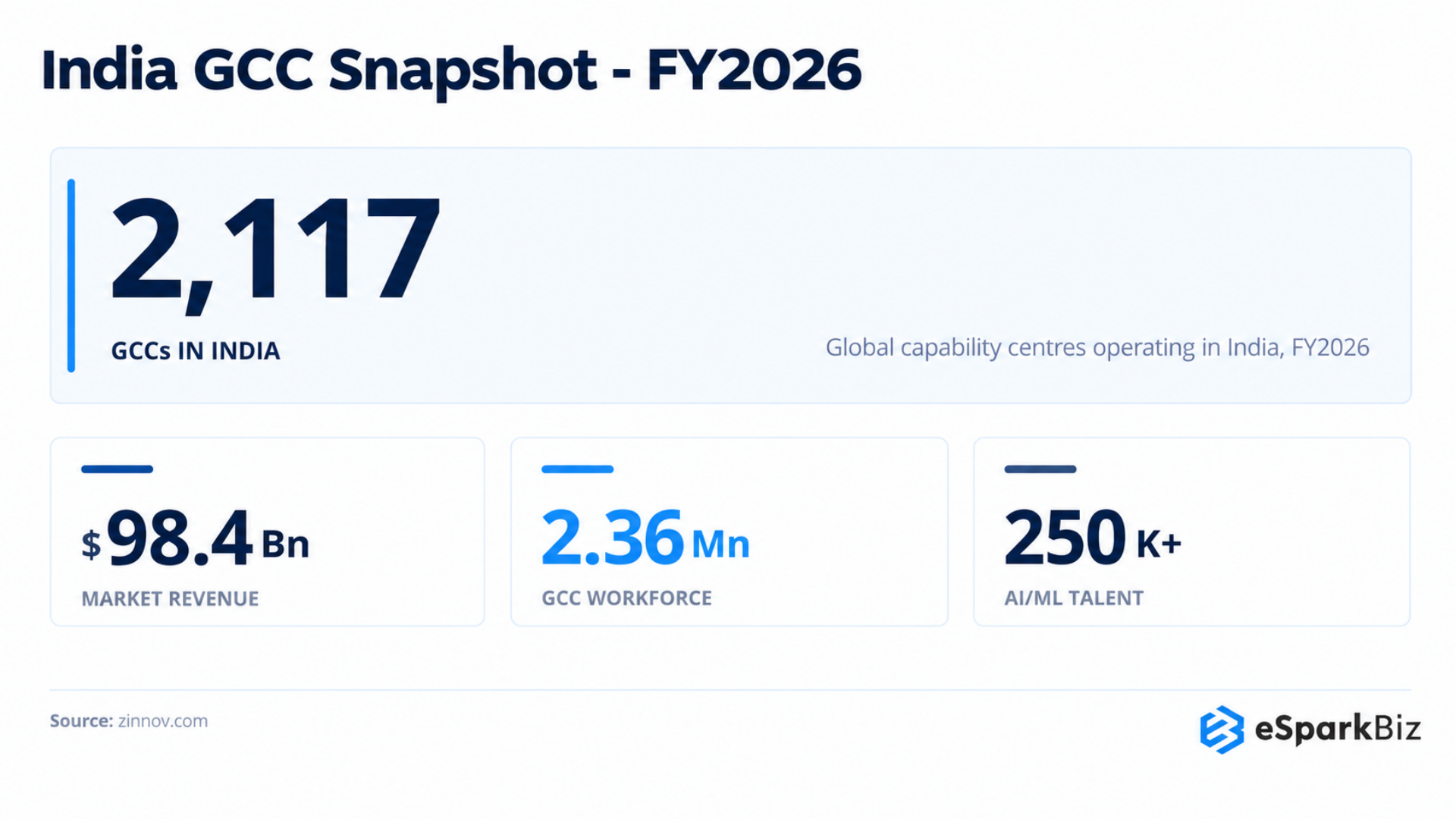
India’s GCC workforce reached approximately 2.36 million professionals in FY2026 highlighting the depth of talent supporting GCC operations.
India vs Other GCC Locations: A Strategic Comparison
When it comes to choosing global GCC locations, the decision increasingly centers on long term value, scalability and the potential for innovation not short term cost savings.
While regions such as Eastern Europe, Southeast Asia & Latin America have some advantages in certain areas, India is still well ahead when it comes to delivering on big enterprise requirements.
| Metric | India | Eastern Europe | Southeast Asia | Latin America |
| Talent Quality & Scale | A large, highly skilled, diverse | Moderate, mostly IT | The growing, limited high end tech | Moderate & limited |
| Productivity & Innovation | High, Artificial Intelligence & product led | Medium, execution focused | Medium, smaller scale | Medium, cost focused |
| Infrastructure & Policies | An advanced, cloud ready applications | Good, less mature | Developing | Moderate & limited support |
| Time Zone Advantage | US, Europe, APAC aligned | Europe aligned | APAC all easy to reach | US aligned |
| Cost Efficiency | Competitive with high ROI | Lower labor cost, medium productivity | A moderate | A moderate |
A Global Capability Center (GCC) is a company owned team in another country that handles work such as technology, development and business operations. In India, a US company can start with a small team and grow as its needs increase.
Make the Right Call: Selecting a GCC Model for Your Business
Setting up a GCC in India requires the right operating model, a clear budget and a realistic hiring plan. US companies should assess setup partners, transfer terms and operational readiness before deciding to build a full GCC.
Choosing a GCC Setup Partner
For a mid size US company considering a build operate transfer (BOT) model, assess partners against five criteria:
- Entity setup: Legal structure and local compliance support.
- Hiring speed: Time to recruit the first team.
- Compliance: Data security, employment law and financial controls.
- Transfer terms: Ownership of IP, systems, contracts and staff.
- References: Verified GCC or offshore development center (ODC) projects.
A two year transfer can be defined in the contract with milestones for operations, documentation, team readiness and final handover.
Is a GCC Too Early for a 300 Person US SaaS Company?
A 300 person company does not automatically need a full GCC. Start with a dedicated team when ownership, hiring needs or demand remain uncertain. Consider a GCC when the company has a clear executive sponsor and plans to build a permanent team.
Readiness checklist
- A defined 12 – 24 month hiring plan
- A leader accountable for product outcomes
- A stable workload for an initial 10 – 20 person team
- Budget for local leadership, compliance and operations
- Clear ownership of product decisions and IP
If these conditions are partly in place, start small with a BOT model and agree on the milestones required before transferring operations to your company.
How eSparkBiz helps you Set Up a GCC in India?
Setting up a GCC in India can be complex – you have to bring in the right talent acquisition, infrastructure, compliance and technology integration. At eSparkBiz, we help enterprises accelerate GCC setup while maximizing lasting value, ensuring your center becomes a strategic make sure the impact it has is lasting, rather than just an operational unit.
Our BOT (Build Operate Transfer) approach works like this :
- Build (Months 1 – 6): We establish the GCC infrastructure, implement technology systems and hire the right GCC talent to make sure it all runs with your enterprise strategy.
- Operate (Months 7 – 21): We manage day to day operations, ensure legal compliance and optimize processes while making sure things are running accurately to focus on productivity and innovation.
- Transfer (Months 22 – 24): Once the GCC is fully operational and delivering real value, ownership is gradually handed over to the enterprise while allowing a smooth transition.
This 24 month timeline is an illustrative plan; the final schedule depends on the agreed scope, hiring pace and transfer requirements.
During handover, the transfer plan should cover,
- People and leadership: Team structure, roles and leadership responsibilities.
- Technology and IP: Source code, repositories, architecture records, licenses and access.
- Operations and governance: Processes, compliance records, budgets and performance reports.
- Knowledge transfer: Training sessions, milestones and sign off criteria.
For US leadership, weekly delivery reviews help track progress and resolve blockers. Monthly operating reviews cover budgets, hiring and risks while quarterly strategy reviews match with investment priorities.
eSparkBiz GCC example: In a published case study of a US product company, eSparkBiz reports helping establish a GCC in India and grow the engineering team from 10 to 50 engineers in 12 months with a reported 40% reduction in engineering costs. This demonstrates GCC setup and team growth.
Partnering with us allows enterprises to reduce GCC setup challenges, accelerate time to market & focus on innovation while optimizing the cost to set up GCC in India. Our expertise make sure GCCs deliver measurable ROI, talent optimization, and strategic business impact from day one.
Frequently Asked Questions
How can companies assess the business value created by GCC beyond headcount and operating costs?
Companies can evaluate business value by monitoring product ownership, innovation output, decision making influence, impact on revenue and identifying improvements in critical business processes.
What makes India a strong location for companies building technology-led GCC functions?
India presents a compelling choice of deep technology talent, well established tech hubs, strong English communication and a mature ecosystem designed to support technology dependent business functions.
Can data privacy requirements shape how companies structure their GCC operations?
Yes, data privacy requirements significantly influence how companies structure their GCC operations. Privacy regulations affect data access protocols, systems architecture and data handling procedures.
- Define clear data access rules.
- Separate sensitive data where needed.
- Apply strong security controls.
- Set clear compliance responsibilities.
- Review the data practices regularly.
When does a GCC in India move from a delivery center to a strategic business function?
A Global Capability Center in India assumes a strategic role when its teams take ownership of critical products, influence decisions, driving innovation and influencing measurable business results.
What should companies evaluate before moving critical product responsibilities into GCC?
Review whether the team has the necessary experience, capable leadership and product knowledge. Prioritize assessment in these domains:
- Ownership readiness
- Leadership depth
- Knowledge of product
- Decision rights
Why is the GCC mandate becoming more important than simply increasing team size?
A well defined mandate gives GCC teams with meaningful responsibility, stronger ownership and greater business impact instead of measuring success using headcount alone as a success metric.
Are GCC teams equipped to maintain consistent quality when handling critical global work?
Yes, GCC teams can maintain consistent quality when they follow to clear standards and implement measurable delivery practices. At eSparkBiz, the approach combines defined processes with regular reviews & a clear ownership.
|
Quality Area |
Approach |
|
Standards |
To set clear delivery benchmarks |
|
Reviews |
Conducting regular quality checks |
|
Ownership |
Assign accountability to teams |
|
Tracking |
Monitor the quality metrics consistently |
Where should executive leadership draw the boundary between global oversight and local GCC decision making?
Set global direction at the parent level while granting local leaders authority in execution decisions. Transparent decision authority eliminates overlap.
- Product ownership
- Team decisions
- Process management
- Delivery priorities

 August 17, 2026