

Enterprises choose .NET app development because one platform handles web, APIs and cloud, so releases keep moving when business needs change faster than old systems.
According to Verified Market Reports, the global .NET development service market is expected to reach USD 1,939.1 billion by 2034, growing at a 15% CAGR. These conditions make application architecture an important business decision as opposed to an engineering decision.
In 2026, .NET app development is clearly worth a look for organizations that want faster, steadier delivery of new applications.
This guide covers architecture, performance, security, integration, modernization and the application lifecycle, so technology leaders can see where .NET fits their business needs and plan the move smoothly.
Why Is .NET App Development the Best Base for Enterprise Software?
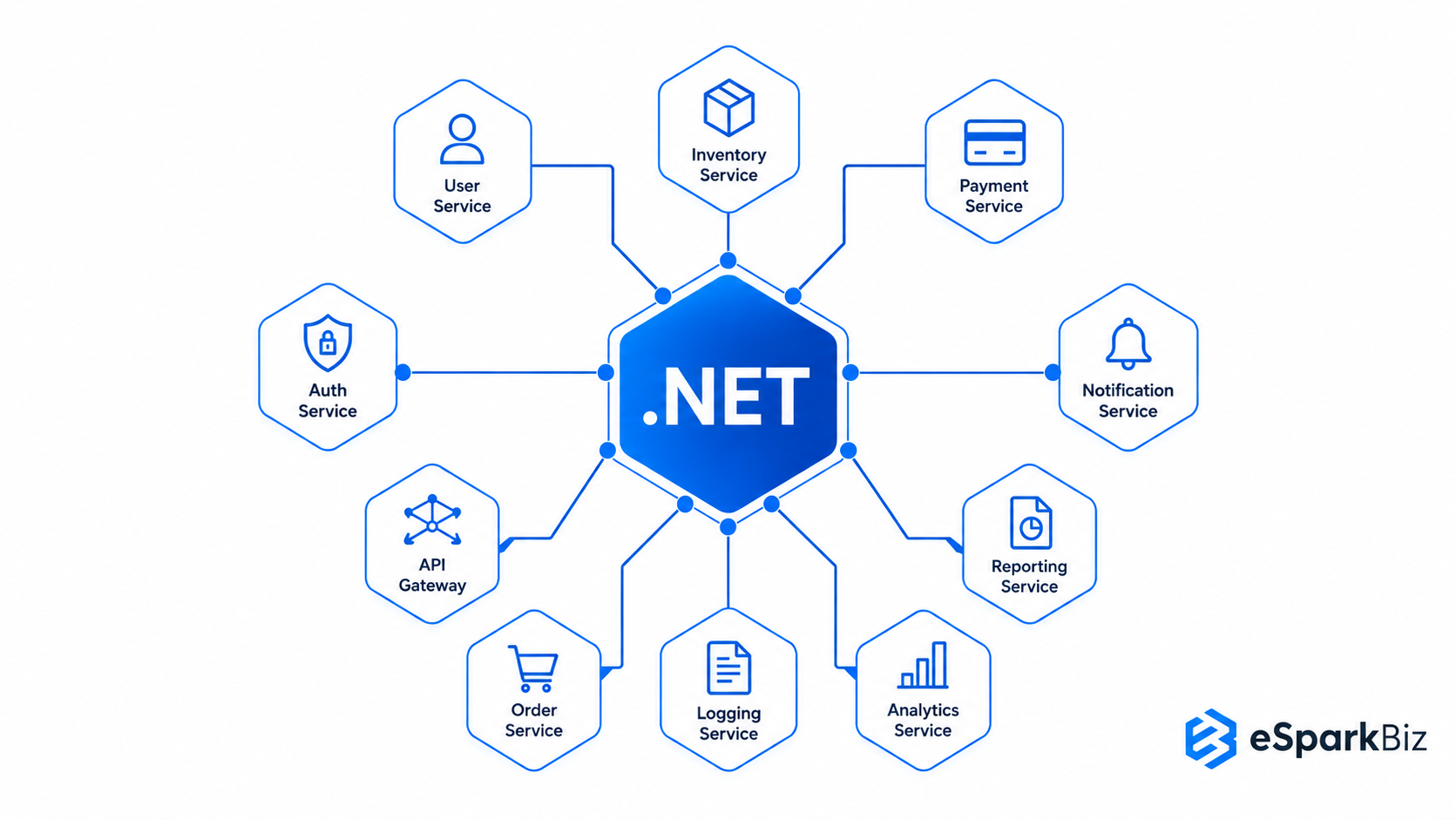
.NET builds enterprise-grade software by unifying development, cross-platform deployment and the core needed for the complex systems of modern businesses.
Unified Platform for Web, API and Cloud
Teams build web apps, APIs, background services & cloud workloads in one ecosystem, cutting fragmentation and simplifying deployment and maintenance.
| Workload | Common .NET Use | Watch For |
| Web applications | ASP.NET Core portals | Secure config, monitoring |
| REST APIs | Internal and External Facing Services | Versioning and Authorization |
| Background services | Scheduled Jobs and Event Processing | Logging and Retries |
| Cloud workloads | Containers, serverless | Scaling, cost control |
Object-Oriented Architecture with C#
C# supports the development of modular applications and, through the CLR it provides execution in a cross-platform environment and manages memory.
- Encapsulation: Keeps business logic organized
- Inheritance and interfaces: Enable reusable, replaceable components
- Managed execution: CLR handles memory and runtime services
- Cross platform: Runs on Windows, Linux and macOS
Scalability, Integration and Governance
.NET provides support for microservices and message queues and integration with third-party services, along with standardization of coding, identity & test approaches. However, the level of governance is dependent on competent teams and disciplined architecture.
Is .NET the Right Fit for your Organization?
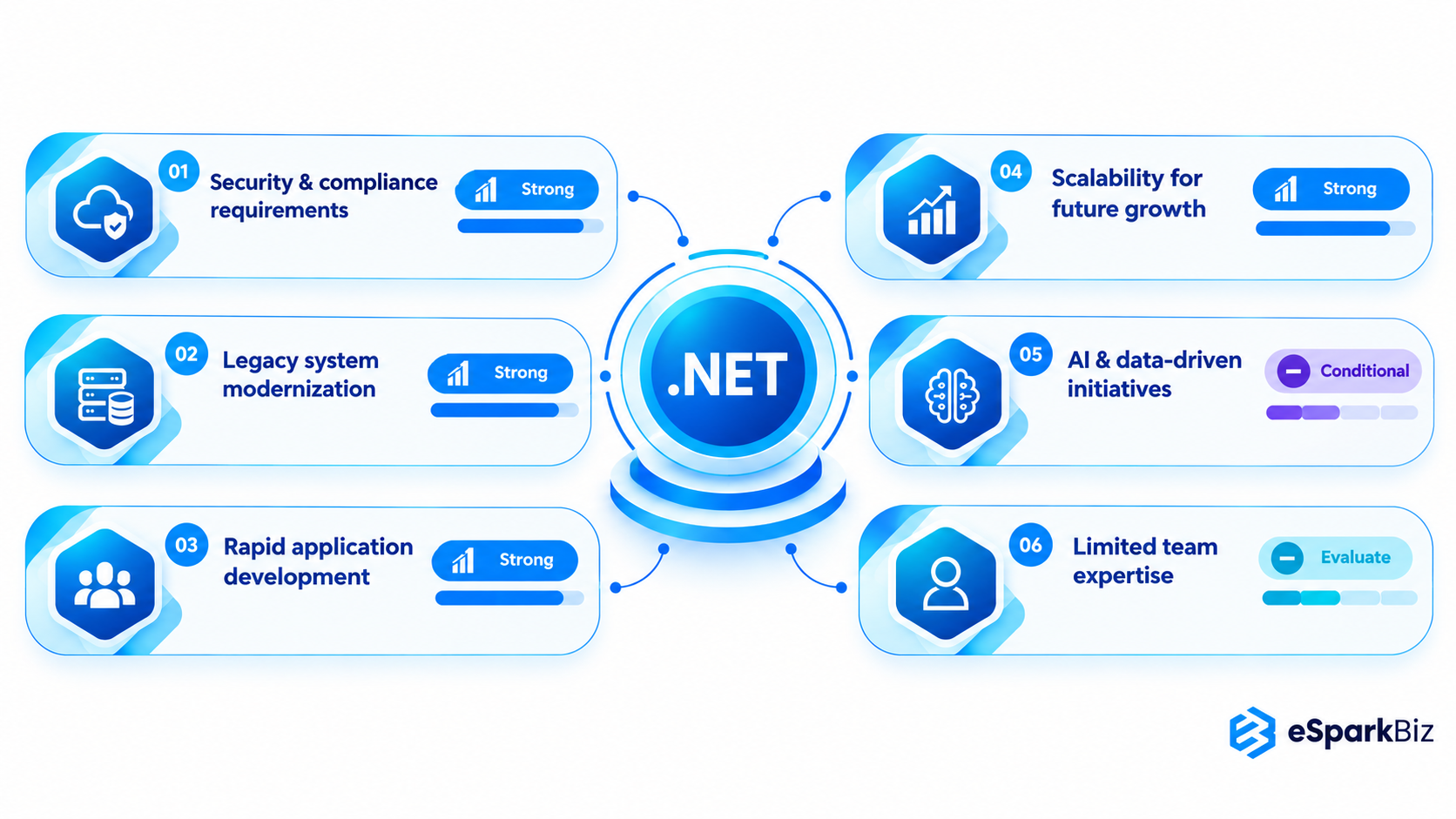
Technology selection reflects main considerations like the business needs and the existing technology investments. Organizations already invested in Microsoft technologies may have a stronger economic and operational case for .NET, while other environments may benefit from a different stack.
| Situation | .NET fit | Leadership consideration |
| Existing Microsoft technology estate | Strong | Reduces platform fragmentation |
| Large legacy .NET App | Strong | Preserves valuable business logic during modernization |
| High-Volume Transactions | Strong | Supports scalable application patterns |
| Complex system integrations | Strong | Provides established API and Integration frameworks |
| AI and data first workload | Conditional | May require Python and specialized data platforms |
| Strong Existing Java Ecosystem | Conditional | Switching costs must justify migration benefits |
| Simple application | Evaluate | A Lighter Stack May be Sufficient |
| Limited .NET Expertise | Evaluate | Capability gaps can increase delivery risk |
Executive takeaway: Consider .NET when it aligns well with long-term application strategies and organization capabilities.
.NET Development: Built for Enterprise, Ready for the Future
Reddit conversations highlight that .NET never truly left the enterprise. Today modern .NET provides reliability, performance, cloud readiness and long term support making it a good choice for businesses looking for secure and scalable applications.
What Are the Trade-Offs of .NET App Development for Enterprises?
.NET provides an established enterprise platform, but its advantages do not preclude the presence of architectural, migration, resource, dependency, and governance issues which might impact the permanent project outcomes.
Platform and Ecosystem Considerations
Although .NET has a multitude of features, teams must still evaluate the following:
- Dependencies: Maintenance of libraries and compatibility.
- Integrations: Compatibility of legacy systems and databases.
- Architecture: Design of data and service boundaries and scalability.
- Strategy: Cloud, licensing, infrastructure and vendor commitments.
Complications of Migration
Moving from legacy .NET Framework or another technology to modern .NET takes more than a version update. Expect five phases:
- Assess: Check packages with the .NET Upgrade Assistant.
- Shift features: Move one feature at a time with YARP.
- Share code: Use .NET Standard 2.0 for common libraries.
- Run in parallel: Keep both apps live and compare results.
- Cut over: Move traffic gradually.
Skills and Architecture Decisions
Strong .NET hiring starts with C#, distributed architecture, security, testing, monitoring and cloud skills. Without them, staffing gaps raise delivery risk. Look for:
- Core skills: C# and ASP.NET Core
- Cloud depth: Distributed systems and cloud setups
- Quality habits: Security, testing and monitoring
- Track record: Past migration work
- Team fit: Clear communication and time-zone overlap
Reconsider .NET when skills, dependencies or migration costs outweigh the business value. Evaluate the technology stack against your application needs and existing skills, not its popularity.
.NET vs Java, Node.js and Python: Choosing the Right Platform
No single technology wins every enterprise project. .NET, Java, Node.js and Python differ in runtime model, ecosystem maturity, development strengths, scalability patterns & operational fit.
| Factor | .NET | Java | Node.js | Python |
| Core advantage | Integrated business application ecosystem | Extensive large scale app ecosystem | Fast event-driven app delivery | AI, analytics and automation app ecosystem |
| Market positioning | Microsoft-centric app modernization | Older enterprise tech | JavaScript-based digital services | Data and AI-centered development |
| Performance profile | Balanced application and API workloads | Large-scale, transaction-centric workloads | Intensive workloads and real time workloads | Data and AI workloads |
| Engineering ecosystem | C#, .NET libraries, Visual Studio | Java, JVM and extensive frameworks | JavaScript/TypeScript and npm ecosystem | Python and extensive scientific libraries |
| Cloud strategy | Cloud-native, containers and hybrid environments | Cloud platforms, containers and JVM workloads | Serverless, containers and distributed services | Cloud AI, data platforms and automation |
| Ideal application fit | Business platforms, APIs and distributed systems | Banking and ERP and other transaction and large systems | Real-time platforms, APIs and event-driven services | AI/ML and analytics and data-intensive applications |
| Primary consideration | Needs a mature architecture and .NET experience | May need extensive platform governance | Needs smart architectural design for high CPU workloads | May need other technologies for high concurrency workloads |
Which wins? .NET is great for enterprises who want one cohesive platform for web applications, APIs, cloud services, complex business logic and more.
For big enterprise ecosystems, Java competes with .NET, Node.js excels at I/O intensive and real time workloads and Python leads Artificial Intelligence, data science and automation driven projects.
The right choice depends on so many factors like the existing skills, integration requirements, the characteristics of workloads and what will be the operating costs in the future.
Market Insights
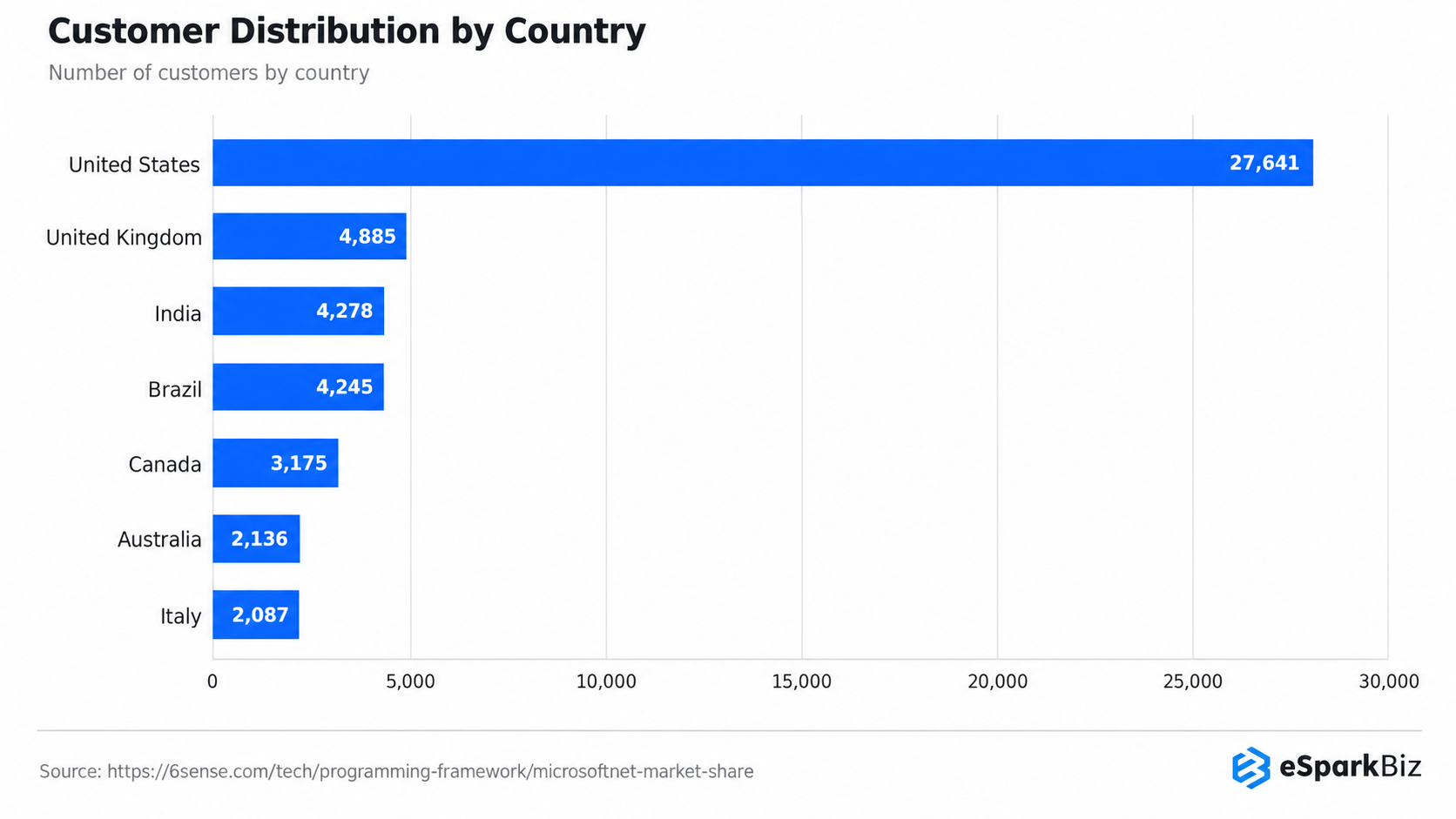
The US has the most .NET adoption with 27,641 customers (51.16%), while the UK has 4,885 (9.04%) and India has 4,278 (7.92%).
Managing the Architectural and Operational Risks of .NET Adoption
Mature ecosystems reduce the threat posed by technology but do not eliminate the architectural, operational, or organizational problems.
| Risk | Potential impact | Mitigation |
| Legacy dependencies | Slower modernization | Dependency assessment |
| Skills shortage | Delivery delays | Capability planning |
| Over engineering | Higher TCO | Architecture assessment |
| Cloud cost growth | Budget pressure | FinOps and workload optimization |
| Integration complexity | Data fragmentation | API and integration governance |
| Technical debt | Rising maintenance costs | Continuous modernization |
Most of the time, the best cases of .NET adoption manage these risks at the initial business decision, instead of addressing them during the development process.
Selecting a .NET App Development Partner for Long-Term Business Value
Picking the right technology to base your projects on is relatively straightforward. You also need to pick a reputable .NET development partner to execute extensible enterprise projects.
Track Record and Certifications
To mitigate risk, it is always better to select a partner with a strong process maturity assessment and certification roadmap. ISO 9001 and CMMI certifications.
eSparkBiz, for example, is an ISO certified product development and AI engineering company with 400+ engineers and over a decade of experience with 300+ global customers, having delivered enterprise-level projects.
That experience shows in ASP.NET enterprise application development, where knowing the framework and the business matters. The same holds for .NET application development for enterprises, helping growing organizations get reliable systems.
Domain and Compliance Experience
Certifications are a good start, but it is equally important to know if the team has resolved your compliance challenges in the past. For example,
- Healthcare: HIPAA compliance with audit resistant architecture. When a healthcare SaaS still runs on an old ASP.NET monolith, refactoring in place usually works best if audit logs and access controls already hold up. Moving to modern .NET makes sense only when the design blocks compliance.
- Fintech: Security focused and highly available platforms
- SaaS: Multi tenant systems designed to scale without rework
eSparkBiz brings this depth in financial services, healthcare and SaaS where .NET compliance and security are the most relevant.
Engagement Model Fit
Based on specific needs, some enterprises may require a full end to end outsourced services model. Others may need just 2-3 embedded senior development resources to fill an immediate talent gap. The best fit partner would offer both models with an even handed approach.
Hiring in-house gives you control but takes months to build a bench, while a .NET development company brings a ready team. Many companies keep core owners in-house and add partner engineers as needed.
The New Direction for .NET
.NET 11 pushes Microsoft to enhance its enterprise platform, introducing a new runtime, library, SDK and ASP.NET Core features along with a variety of possibilities for improving modernization, productivity of engineering activities, operational efficiency and long-term technology strategy.
How eSparkBiz Cut Service Requests by 58% with a .NET Hospitality Platform
A Greek hospitality group ran on disconnected, outdated systems. eSparkBiz built one app on a .NET API layer that connects existing property systems and keeps live operations running.
| Detail | Info |
| Industry | Hospitality |
| Stack | .NET API layer, React, RabbitMQ, Azure |
| Team | 4+ members |
| Timeline | 24+ months |
Approach
- Standardized PMS APIs connected existing systems
- Dashboards routed requests in real time
- BLE smart access and automation cut manual handoffs
Results
- 58% fewer service requests
- 42% more guest digital engagement
- 35% faster response time
- 30% less manual coordination
For more insights like this review the eSparkBiz portfolio.
What Does the Future Hold for .NET App Development?
For technology executives, the essence of the .NET roadmap is not seen in detailed feature lists, but in how .NET helps with modernization, cloud, AI software development and engineering efficiency.
.NET 10 LTS provides organizations with a solid development platform. .NET 11 is the next major release of the platform, including a new .NET runtime, SDK, libraries and ASP.NET Core, with the broader goal of modernizing the platform.
The key consideration now should be combining the .NET platform with a strong architecture, cloud economics, security governance and a sustainable engineering discipline.
Frequently Asked Questions
How much does it cost and how long does it take to build a mid-size enterprise .NET application?
Plan for about 6 to 9 months and $100,000 to $600,000. The final cost depends mostly on integrations, security needs, cloud setup and post-launch support.
How do I migrate our .NET Framework app to modern .NET without freezing product delivery for months?
Move one piece at a time. Check your dependencies first, put old modules behind an API, run both versions side by side, then shift traffic slowly while new features keep shipping.
We finished moving our old app to .NET. What should we fix next so we actually get performance and cost gains?
Start with monitoring to spot slow areas. Then fix heavy queries, review cloud spend and automate releases with CI/CD. As traffic grows, add caching, async calls and containers to keep performance steady.
Which company can modernize our legacy .NET enterprise app to .NET on Azure while the system stays live, with US time-zone overlap?
eSparkBiz modernizes legacy .NET apps to .NET on Azure in phases, so your system stays live. Teams work with daily US time-zone overlap, and most projects start within 48 hours of kickoff.
We are migrating a big .NET Framework 4.8 enterprise app to .NET 8 and keep hitting incompatible libraries. How do I plan this?
Begin by listing every library the app uses. Upgrade or replace the ones that break, run the .NET Upgrade Assistant, and keep stubborn ones behind an interface.
What enterprise .NET development cooperation models are available?
Common models for balancing control, speed and the need for expertise and resources are dedicated teams, staff augmentation, project based development and managed services.
What are the best practices for developing .NET Framework enterprise applications?
Architecture-first design, modular development, secure coding practices, API management, automated testing, CI/CD, cloud cost optimization and lifecycle planning are .NET best practices for framework development.
Is eSparkBiz a good .NET development partner for enterprise projects, and what results have they delivered on .NET modernization?
Yes. eSparkBiz is CMMI Level 3 appraised, with 400+ engineers, 300+ global clients and over a decade of experience delivering .NET modernization for large, business-critical applications.
What are the most common mistakes companies make when building or scaling enterprise .NET applications?
Common mistakes are skipping the dependency check, over-building early, ignoring cloud bills, thin .NET skills and loose API rules. Early planning and clear ownership solve most of them.

 September 29, 2026