

This guide gives leadership a clear, decision focused read on where Python for data science actually stands in 2026 and allowing for understanding of the near term impacts on technology choices:
- What's changed in the stack and what it means for cost and speed.
- When Python optimization works best and when a different stack might be optimal.
- The real costs and risks with the optimal pathway.
Python is emerging as one of the most effective data science solutions for 2026, largely because of the maturity of its surrounding data analysis, machine learning, AI and automation frameworks. However, teams should not consider using Python for data science simply because of its popularity alone.
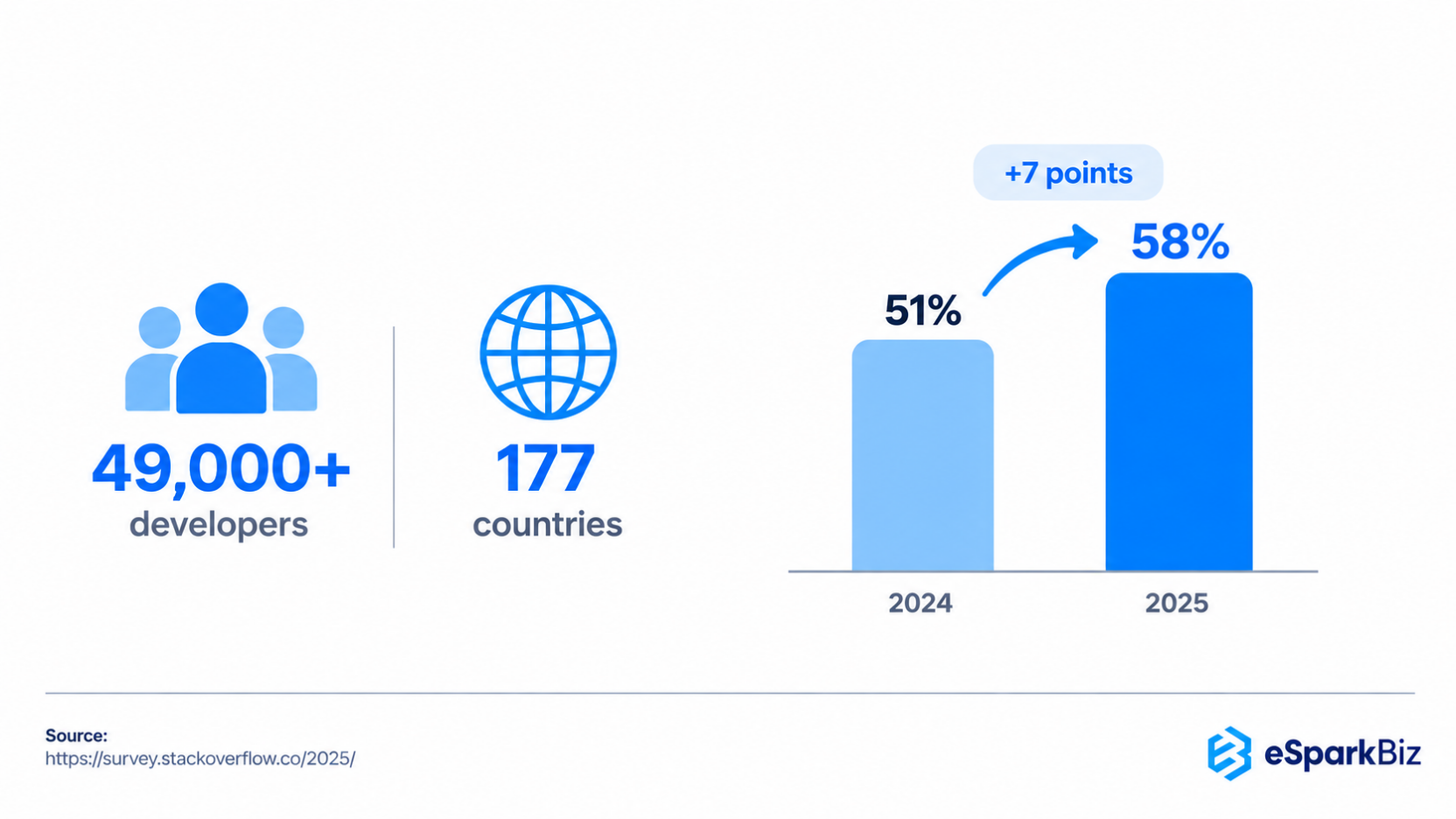
The data makes the reasons behind Python’s growing adoption clear. The Stack Overflow’s Developer Survey, covering over 49,000 developers spanning 177 countries, found Python adoption jumped 7 points in a year, now used by 58% of developers, driven largely by AI and data work.
We have helped build and scale Python based data systems through practical Python Development experience with real clients and have seen where this choice pays off and backfires. Strongly performing teams do not spend the most money, they make smart early decisions around cost and when to use outside data science frameworks.
What Python enables in Enterprise Data Science
Python’s value in enterprise data science comes from what organizations can build around it. Rather than serving a single analytical function, Python can support the data science lifecycle from preparing data and patterns to building predictive models and deploying AI-driven solutions.
| Capability | Enterprise application | Business value | Typical Python tools | Key consideration |
| Data preparation | Cleaning, transforming and combining datasets | Reduces manual data work | Pandas, Polars, NumPy | Ensure data quality |
| Exploratory analysis | Identifying trends, anomalies and relationships | Improves decision quality | Pandas, NumPy, SciPy | Focus on business questions |
| Statistical analysis | Testing hypotheses and measuring relationships | Supports evidence based decisions | SciPy, Statsmodels, Pingouin | Validate assumptions |
| Machine learning | Predicting customer, operational or financial outcomes | Enables smarter decisions and automation | Scikit learn, XGBoost, LightGBM | Monitor model performance |
| Forecasting | Predicting demand, revenue, risk or capacity | Improves planning | Statsmodels, Prophet, Darts | Update models regularly |
| Visualization | Turning analytical results into understandable insights | Accelerates decision making | Matplotlib, Seaborn, Plotly, Bokeh | Match visuals to the audience |
| Automation | Automating repetitive analytical workflows | Improves productivity | Airflow, Prefect, Dagster, Python scripts | Add monitoring and error handling |
| AI applications | Connecting data with predictive and generative AI | Creates new products and workflows | PyTorch, TensorFlow, Transformers, LangChain | Address security and governance |
The strategic advantage is not that Python replaces every other technology. It provides a flexible layer for bringing data, analytics, machine learning and AI capabilities together.
Did you know?
51% of the surveyed Python Developers now work in data exploration and processing, making data science the largest single use of Python today, surpassing traditional development areas
The Hidden Cost of Falling Behind on your Stack
Python’s ecosystem has evolved rapidly over the last two years. Python does not necessarily mean Python is doing every CPU intensive operation itself. You do not need to know Rust to benefit. The outcome is what matters: jobs that once took hours can now finish in minutes on the same hardware.
| Old Setup | Current Setup | What it means for your Business |
| Slower processing tools | Faster, modernized replacements | Same infrastructure, faster results |
| Higher cloud compute time | Less time spent waiting on jobs | Lower infrastructure costs |
| Delayed insights | Faster turnaround on analysis | Decisions made ahead of slower competitors |
| Manual environment setup | Faster, automated setup tools | Less time lost before work even begins |
| Struggles with growing data volumes | Handles larger datasets with ease | Fewer costly workarounds as you scale |
| Rigid, hard to change systems | Modular, adaptable components | Easier to adjust as priorities shift |
The cost of falling behind rarely appears overnight. It shows up through slower workflows, higher costs and more time spent working around outdated systems. This isn’t about adopting every new tool. It’s about asking whether your current stack is still efficient enough for where your business is going.
Logistics Firm Cuts Python Data Pipeline Processing Time by 60%
A logistics firm reduced data processing time by 60% by modernizing its Python data pipeline. The project replaced slow, script-based batch jobs with a faster processing setup, centralized data intake, and reduced manual data cleanup. As a result, teams could access reports sooner without changing their core programming language.
“Faster pipelines, fewer manual fixes.”
Project Details:
- Engagement: Data Platform Modernization
- Duration: 3+ months
- Stage: Live and scaling
- Team Size: 4+ members
- Services: Data Engineering and Pipeline Optimization
Aligning your Stack with your Growth Path
Not every organization needs the same technology. Best choices reflect a few criteria more than personal preference.
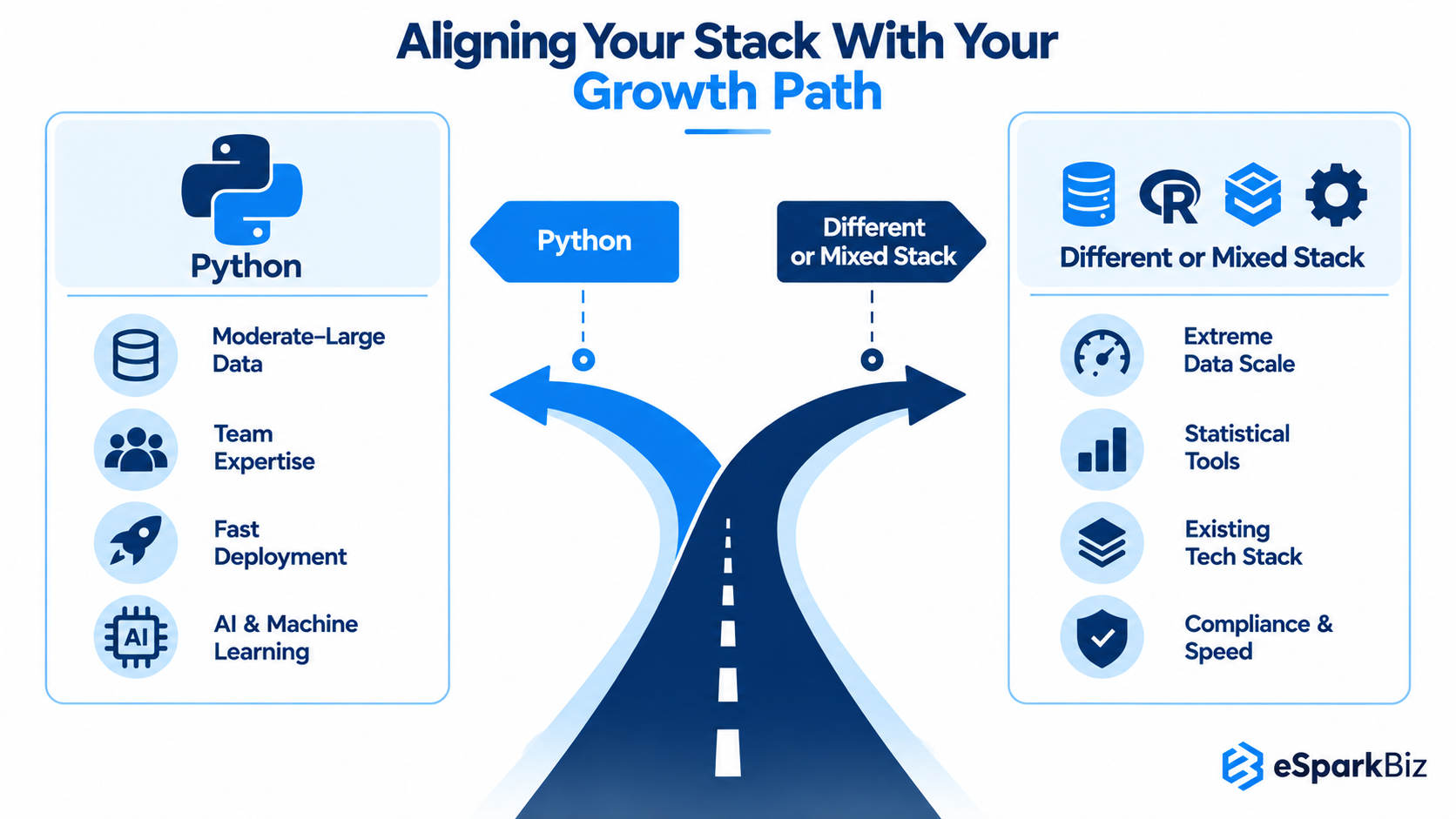
Python is usually the right choice when:
- Your data is moderate to large, but not extreme.
- Your team understands or can easily hire for Python.
- You need to quickly get from testing to deploying.
- AI and machine learning is on your roadmap.
A different or mixed stack may work better when:
- Your data processing can be described as extreme.
- Your field uses tools that rely heavily on stats.
- Your team already works with other technologies
- Compliance or speed requires lower level control
This is not a decision you make once and never revisit. As your data, technology and team grow, review whether your stack still fits every year or two. What served your needs earlier may not serve when your needs grow.
Community Insight
In Discussion, Data science professionals agree that, while Python isn’t the fastest tool in general, it excels with the breadth of its ecosystem and the ability to switch to tools such as Polars when dealing with high volume data or performance concerns.
Where Generative AI Fits into your Data Strategy
Generative AI can integrate with your data and systems easily. The more important question is, how can you integrate it in order to provide the most value to your business?
Common entry points:
| Entry point | What it looks like | Best for | Typical cost | Time to value |
| Adopt existing frameworks | Using pre-built models via API | Fast starts, no research team | Pay per use, low upfront | 2 – 4 weeks |
| Layer on top of your data pipeline | Connecting AI to existing data flows | Teams with clean, structured data | Mid range, tied to data volume | 1 – 3 months |
| Build custom models | Training models on your own data | Unique or sensitive data needs | High, ongoing compute + hires | 6+ months |
| Automate internal reporting | AI generated summaries and drafts | Cutting repetitive internal work | Low, often software only | 2 – 6 weeks |
| Embed AI into customer facing products | AI features inside your product | Product led growth strategies | Scales with usage and users | 3 – 6 months |
| Bring in outside AI specialists | Vendor led AI implementation | No in-house AI expertise yet | Project based, fixed scope | 1 – 2 months |
Most situations are better off starting slowly with a basic model. Based on what you measure, increase investment in broader AI use. Your biggest concern should be what is your overall AI budget and integration goal? That should impact your overall spending of Tech, Data, Security and Staff.
Key Risks to Address Before Scaling Python Data Science
Every tech stack has trade-offs, and Python at scale is no exception. Moving data science workflows from notebooks to production requires structured code, testing, monitoring, and clear ownership. Addressing common issues early helps teams scale without disrupting existing operations.
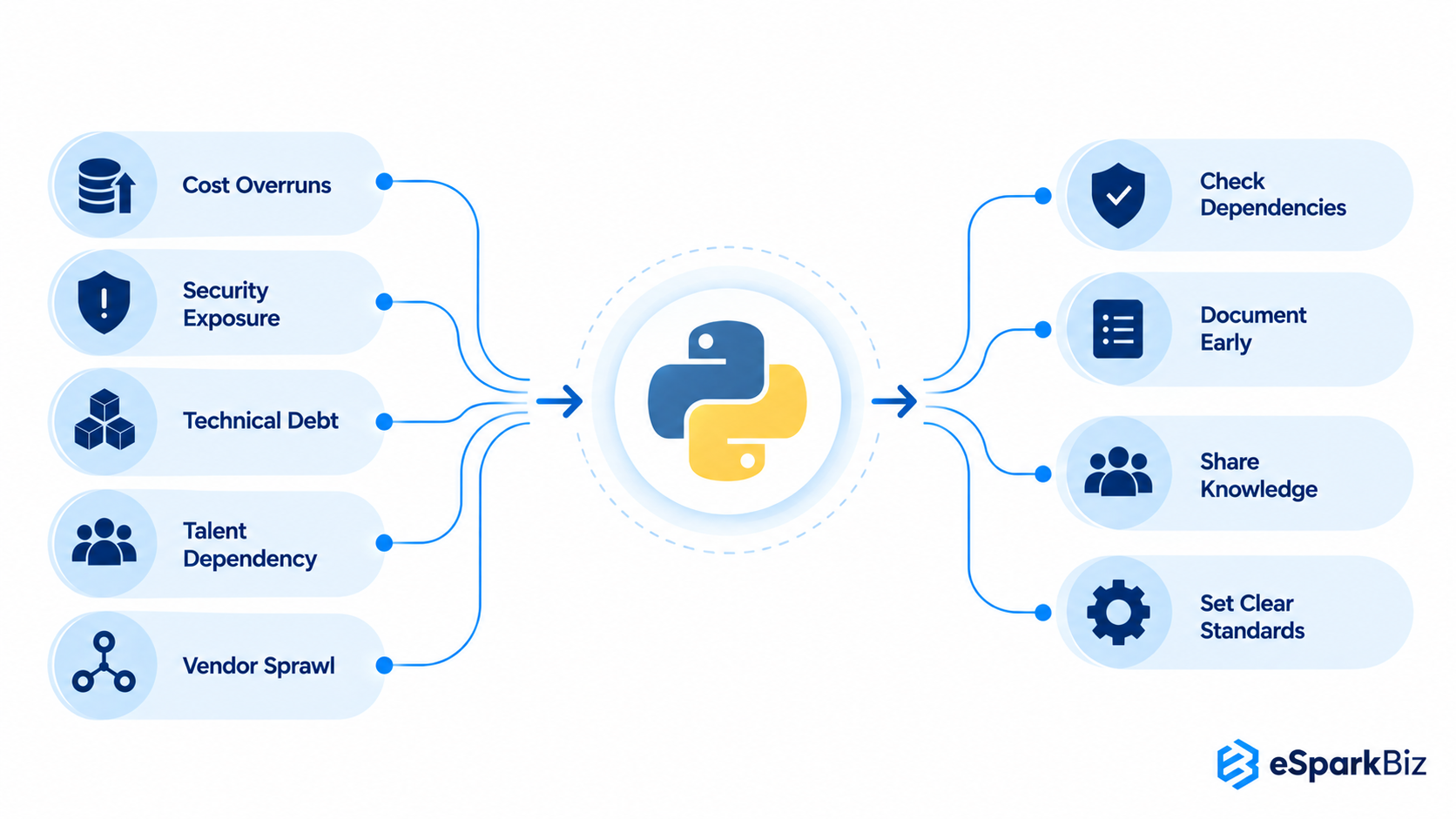
Where things typically go wrong:
- Cost overruns: Unpredictable growth of data causes unexpectedly high cloud expenses.
- Security exposure: unmanaged open source packages can contain security risks, as identified by Sonatype security researchers who found over 450,000 malicious packages in the different ecosystems, leading to breaches and compliance gaps.
- Technical debt: quick fixes build up without proper structure, making development slower over time
- Poor production performance: Unoptimized pandas workflows can slow as datasets grow. Teams can optimize them or switch to Polars, Dask, or PySpark when needed.
- Talent dependency: relying on one or two key people creates operational risk
- Vendor sprawl: too many tools increase costs and make governance harder
These issues often become more visible as data volumes and production workloads grow.
A few guardrails can help:
- Regularly assess dependencies and apply available security patches.
- Turn notebook experiments into modular, tested code before production deployment.
- Profile memory usage and execution time before choosing or replacing data-processing libraries.
- Document systems during development and share knowledge across the team.
- Define tool standards, monitoring requirements, and clear ownership before expanding production workloads.
The Changing Role of Python in 2026
In 2026, while AI/ML engineers will continue to rely on Python, entrepreneurs can now focus first on other AI tools. This trend continues the shift from focusing on memorizing syntax to architectural thinking, algorithmic and systems level reasoning, and debugging.
When to Outsource Python Data Science Instead of Hiring In-House
When internal teams struggle to keep up with Python data pipelines, analytics, and ML projects, outsource data science services can provide specialized skills without expanding permanent headcount. A consulting partner such as eSparkBiz may help with a first ML use case or temporary capacity gaps, while in-house hiring suits ongoing workloads.
Consider outsourcing when you need to:
- Accelerate delivery: Modernize data pipelines or build ML models without delaying existing projects.
- Control costs: Access specialist expertise for a defined project before committing to permanent hires.
- Evaluate providers: Compare eSparkBiz and other consulting companies based on Python expertise, relevant case studies, security practices, US-hours overlap, contract terms, and post-launch support.
Start with a clearly scoped pilot, measurable outcomes, and knowledge-transfer requirements before expanding the engagement.
Roadmap for Adopting or Modernizing your Stack
Modernizing legacy Python data pipelines without interrupting daily reporting requires a phased approach. Introduce changes gradually while keeping existing workflows operational.
- Assess: Evaluate your current pipelines, reporting dependencies, processing delays, and infrastructure costs to identify what needs improvement.
- Prioritize: Start with bottlenecks that affect reporting speed or data quality, while keeping critical reporting workflows unchanged.
- Pilot: Build and test the modernized pipeline alongside the existing one. Compare outputs to verify accuracy before switching production workloads.
- Roll Out: Move workloads in stages, beginning with low-risk pipelines. Keep the existing pipeline available as a fallback until the new version proves reliable.
- Govern: Monitor processing times, data accuracy, and reporting schedules. Document recovery procedures and assign clear ownership for ongoing maintenance.
Skipping the pilot can turn small technical issues into costly production failures. Running old and new pipelines in parallel during testing helps teams catch discrepancies without delaying daily reports.
A phased migration requires careful coordination, but it reduces operational risk and allows teams to modernize their data stack without disrupting business reporting.
Expert’s Quote
“Python is so successful because it’s good for humans. It’s good for humans to write.”
– Wes McKinney, Creator of Pandas
Frequently Asked Questions
Our Python data pipelines are slowing down as data grows. What should we do?
- Identify delays: Find slow processing stages and outdated tools before rebuilding the pipeline.
- Optimize data processing: Profile and optimize pandas code first. If performance remains slow, consider Polars or DuckDB based on data volume and query patterns.
- Get expert support: Hire Python data engineers or a development partner with pipeline modernization experience and US-hours availability.
Choose a partner based on Python expertise, time-zone overlap, and production support to improve performance without disrupting daily reporting.
How can we prevent cloud costs from rising too quickly as Python data science usage grows?
Keep a close watch on how your computer resources are being used. Also, make sure that you are utilizing as much speed up technology as possible. Cost increases are due to inefficient workloads processing for longer durations; Python is not to blame.
Should our analytics team choose Python, R, or SQL-first tools for data science?
Choose the tool that fits your team's needs. Python is useful for machine learning, data processing, and automation. R is good for statistics and research. SQL-first tools help you find and organize data in databases. For teams working with data and machine learning, Python and SQL are a good starting point, while R is useful for specialized statistical work.
How can we reduce the risk of depending on one or two key Python experts?
System documentation should happen during development, not after someone leaves. Also, for critical projects, partner each expert with another team member to improve documentation and ensure knowledge continues to circulate around the team.
Is Python still the best language for data science in 2026?
For most organizations, yes. Its ecosystem, talent availability and tooling remain a strong fit. However, organizations with extreme scale workloads or highly specialized requirements may benefit from a mixed technology stack.
What challenges come with using Python in large scale enterprise applications?
Open source package security must be continuously maintained as must technical debt and performance consistency. With sufficient governance, these challenges can be adequately overcome.
How much does a three-person Python data science team cost, and when can it deliver results?
Hiring a data science consulting company for a six-month Python analytics and ML project may cost $10,000 - $300,000+, depending on team composition, project complexity, and engagement model.
| Team setup | Estimated 3-month cost | Time to first results |
| Lean team using existing data and tools | $10,000 - $30,000 | 2 - 4 weeks |
| Mid-level team building data pipelines and predictive models | $30,000 - $180,000 | 4 - 8 weeks |
| Specialized team developing custom ML solutions | $180,000 - $300,000+ | 8 - 12 weeks or longer |
Headcount is the biggest expense, followed by infrastructure and maintenance. These are planning estimates, not verified consulting-company quotes. Actual costs depend on location, expertise, project scope, and data readiness.
What common code mistakes slow down Python data pipelines?
Python data pipelines often slow down because of inefficient coding practices:
- Row-by-row loops: Replace row iteration with pandas vectorized operations.
- Repeated DataFrame operations: Combine transformations and avoid unnecessary copies or recalculations.
- Inefficient data types: Choose suitable data types and use categorical columns where appropriate to reduce memory usage and processing time.
Profile your pipeline to identify which changes will deliver the greatest performance gains.


 August 19, 2026