

Excel is popular in the financial services industry to perform various tasks including mathematical modeling, mainly because of its flexibility and programmability. Trouble starts when a financial services firm relies on a number of individuals and models developed in Excel and VBA by various staff members for critical firm’s processes and services.
Python is increasingly being adopted for these workloads. The FINOS State of Open Source in Financial Services report found that Python was the most widely used primary language among financial services organizations contributing to open source, accounting for around 18% of contributions.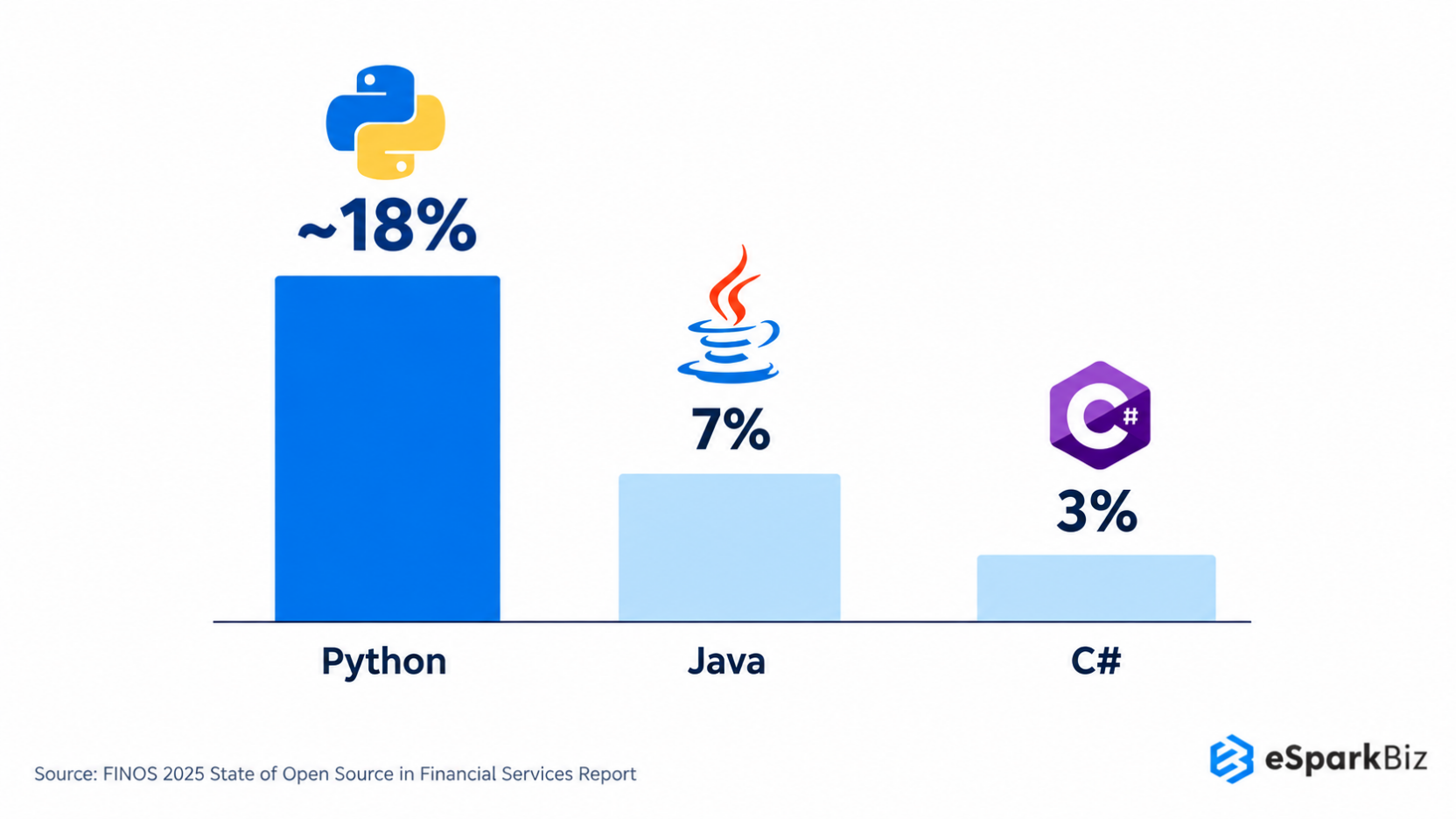
As financial workloads grow, spreadsheet limitations become harder to manage. Large datasets take longer to process. Repeated calculations take more analyst time. Changes become difficult to trace.
It is possible to use Python for finance and economic models, connect them to various data sources and implement controls and processes for financial reporting.The goal is not to fully replace Excel, but improve and automate processes and models.
Python Applications across Financial Operations and Technology
Python supports a broad range of financial workloads, from day to day analysis to quantitative research and risk processes. Its role depends on the complexity of the work, data volume, required speed & practical controls.
| Financial workload | How Python is used | Common tools | Business value | Production consideration |
| Financial analysis | Analyzes financial data and calculates key metrics. | pandas, NumPy | Reduces repetitive analysis. | Data quality and validation |
| Quantitative research | Tests models, strategies and financial hypotheses. | NumPy, SciPy, statsmodels | Enables repeatable research. | Model validation and performance |
| Financial modeling | Builds pricing, valuation and scenario models. | QuantLib, SciPy, pandas | Supports complex financial models. | Version control and testing |
| Risk management | Calculates portfolio and scenario based risks. | NumPy, pandas, SciPy | Automates recurring risk calculations. | Audit trails and governance |
| Forecasting | Builds statistical and predictive forecasts. | statsmodels, scikit learn, XGBoost | Improves repeatable forecasting. | Model monitoring and validation |
| Trading research | Backtests strategies and evaluates signals. | pandas, NumPy, Backtrader | Speeds strategy research. | Data accuracy and latency |
Example: Analyzing Financial Data With Python
Python can help financial teams calculate daily returns and summarize historical market data without manually repeating spreadsheet calculations.
import pandas as pd
# Load historical market data
df = pd.read_csv(“market_data.csv”)
# Calculate daily returns
df[“daily_return”] = df[“close”].pct_change()
# Summarize prices and returns
print(df[[“close”, “daily_return”]].describe())
This example loads market prices, calculates daily percentage returns, and summarizes the results. Before using the output for financial decisions, validate missing values, timestamps, duplicate records, and corporate actions such as stock splits.
Key Industry Insight
A 2026 study of NYSE listed financial institutions found that 76.7% explicitly disclosed Python usage, with pandas, Numpy and scikit learn forming a common technical foundation.
Selecting the Right Technology for Financial Workloads
The technology you choose depends on your financial workload. For instance, a financial services firm may use different applications to perform research, analysis and modelling functions and yet another application to execute the financial transaction.
Choose Excel and VBA
Excel and VBA are good tools to perform analyst functions. Analysts may use these tools to execute a financial process and present the output to users in the format of their choice.
Consider R
A strong option for statistical research and analytical workflows that depend heavily on specialized statistical capabilities.
Use Python
Python can connect financial applications to market data providers, banking APIs, and financial databases to automate reporting, streamline financial processes, and support machine learning and risk analysis.
Use C++
More relevant to latency sensitive components where execution speed is critical, including parts of trading and execution systems.
The practical decision is not about replacing one technology with another. It is about assigning each workload to the technology that matches its performance, control, integration & maintenance requirements.
The Financial Investment Behind Python Based Systems
There are several hidden costs associated with the development of financial applications using Python Development. These costs may include the cost of data and infrastructure, the cost of implementation of security features, the cost of testing and the cost of maintenance.
- Development: Complexity in financial logic increases costs. Certain integrations and testing increase costs.
- Data infrastructure: Market data feeds, databases, APIs & storage add costs as data requirements grow.
- Engineering resources: Supporting financial services applications requires a strong understanding of financial systems, which increases the costs of engineering resources.
- Governance and security: Access controls, audit trails, documentation, testing and model reviews add day to day requirements.
- Ongoing maintenance: Costs of improving the system increase as the demands and usage of the system increase.
Maintaining a simple system to support financial services increases costs of resources and requires continuous maintenance.
Python across the Technology Strategies of Financial Firms
The general purpose nature of Python makes it easy to learn and use and facilitates system integration. It supports a broad range of activities in financial services, from risk and quantitative analysis, trading, to back and front office financial & regulator report generation.
Capital One
By using Python in various aspects of financial analysis and services, from automating processes to machine learning, Capital One employees aligned engineering, data & financial analysis functions.
- Analyst workflows: Repetitive analysis and reporting are automated through Python.
- Data work: Preparation and processing of data are performed using Pandas and NumPy. PySpark is used for large data processing.
- Machine learning: Python supports models built with tools such as scikit learn, XGBoost and TensorFlow.
- Engineering alignment: Analysts, Data scientists and software engineers can work within the same programming environment.
Goldman Sachs
Goldman Sachs maintains GS Quant, a Python toolkit supporting quantitative finance, derivatives pricing, trading strategies, financial analytics & risk management.
- Quantitative finance: GS Quant provides Python based tools for financial analytics.
- Derivatives: The toolkit supports derivatives pricing and analysis.
- Trading strategies: Quantitative developers can build and analyze trading strategies.
- Risk management: GS Quant provides capabilities for financial risk analysis.
- Scale: Goldman Sachs states that its analytics tools are used daily by more than 1,000 quantitative developers.
J.P. Morgan
J.P. Morgan provides Python SDKs through Fusion, allowing investors to access Securities Services data for analysis, reporting, reconciliation & application workflows.
- Data access: Python connects applications with custody, fund accounting and middle office data.
- Investment analysis: Users can bring financial datasets directly into Jupyter notebooks.
- Reconciliation: Python supports the automated reconciliation workflows.
- Application integration: The Fusion API and Python SDK allow data to connect with existing applications.
What these Examples Show
These companies use Python across diverse financial services, including data and quantitative finance. Its adoption requires strong security, testing, data controls, governance and responsible implementation.
Risk Considerations for Python-based Financial Systems
Python has the capacity to provide services to financial services, there are risks that should be addressed and managed. Accuracy, security and continuity should be maintained to prevent loss of data and follow the governing regulations.
Model Integrity and Validation
Strong backtesting results may fail in live trading due to overfitting, look-ahead bias, or unrealistic transaction costs. Validate strategies with out-of-sample data, walk-forward testing, and realistic slippage assumptions before deployment.
Knowledge and Ownership Continuity
If only one person understands a critical model, your team can face problems when that person is unavailable. Documentation, testing and code reviews help reduce that dependency.
Third Party Dependency Security
Python applications often rely on external packages. Untracked, outdated or unsupported dependencies can introduce vulnerabilities and create security or compliance concerns.
Data Governance and Lineage
Data used in models should be from trusted sources. The integrity of data should be maintained. Data validation rules should be set to avoid unexpected financial outcomes.
Auditability and Regulatory Review
To determine how calculations and assumptions are performed to support the outcome of a financial process will be reviewed.
Expert’s Quote
“Technological innovations will be the heart and blood of the banking industry for many years to come and if big banks do not make the most of it, the new players from FinTech and large technology companies surely will.”
– David M Brear, Partner Think Differently Group
Python Libraries Supporting Financial Data and Applications
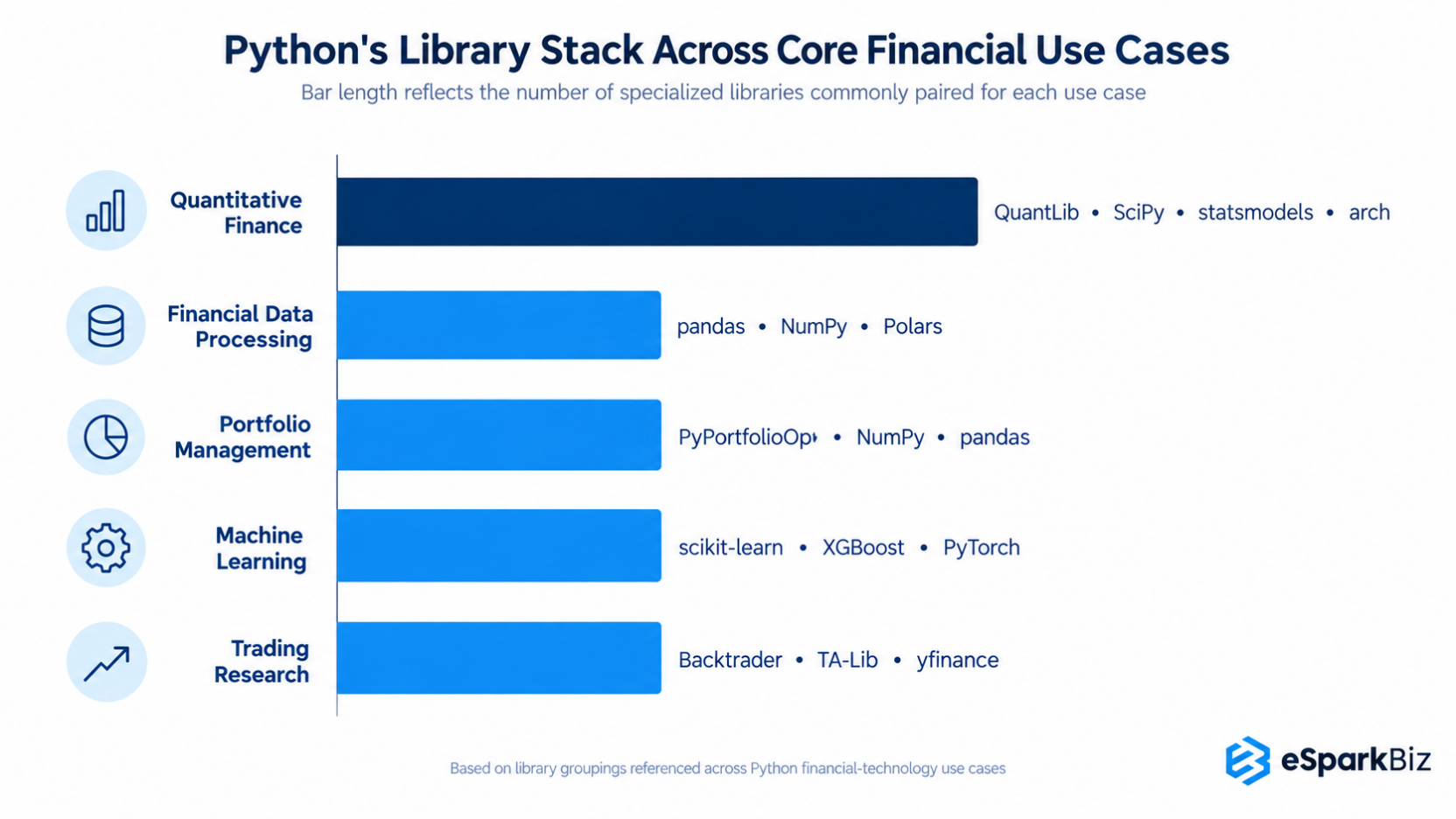
Most financial applications need more than one Python library. The right combination depends on the type of financial work you want to handle.
For Financial Data Processing
pandas · NumPy · Polars
These libraries form the foundation for working with financial datasets. They support data cleaning, transformation, numerical calculations, time series processing and analysis.
Typical uses:
- Market data preparation
- Portfolio calculations
- Financial reporting
- Large dataset processing
For Quantitative Finance
QuantLib · SciPy · statsmodels · arch
These libraries support more specialized financial and statistical workloads. They can be used for valuation, optimization, statistical modeling, volatility analysis & quantitative research.
Typical uses:
- Derivatives pricing
- Risk modeling
- Portfolio optimization
- Time series analysis
For Portfolio Management
PyPortfolioOpt · NumPy · pandas
Portfolio focused workflows can use these libraries to evaluate assets, optimize allocations & analyze portfolio performance.
Typical uses:
- Asset allocation
- Portfolio optimization
- Risk return analysis
- Performance evaluation
For Machine Learning
scikit learn · XGBoost · PyTorch
Machine Learning libraries support predictive applications across financial data. Their use can range from traditional statistical learning to more complex model development.
Typical uses:
- Credit risk modeling
- Fraud detection
- Forecasting
- Customer and transaction analysis
For Trading Research
Backtrader · TA-Lib · yfinance
These libraries are commonly used during market research and strategy development. They help teams work with historical data, technical indicators & backtesting workflows.
Typical uses:
- Strategy backtesting
- Market analysis
- Signal generation
- Historical performance testing
Choosing the Library Stack
Choose libraries based on the work you need to handle, the amount of data involved and where your application will run. A research notebook may need only a few packages, while a production fintech platform requires a broader stack with testing, dependency controls, monitoring & security practices.
Community Insights
A Reddit discussion highlights how teams combine Python with Excel, VBA and existing applications to automate workflows while retaining familiar tools rather than replacing them entirely.
Building Production Ready Financial Models with Python
Moving a financial model from a Jupyter Notebook to a production system requires validated financial logic, controlled data, audit trails, and automated monitoring.
1. Define the Financial Logic
Document the model’s assumptions, inputs, outputs, formulas, and business rules. Use Git to track changes to model logic and maintain a clear history of revisions.
2. Build and Validate the Prototype
Develop the model in Jupyter Notebook and validate its calculations against expected results. Use pytest for automated tests and regression checks before moving the code into production.
3. Control the Data
Validate pandas market data for missing values, duplicates, incorrect timestamps, and time-zone mismatches. Account for corporate actions such as stock splits and dividends, and reconcile prices and volumes against vendor records before calculations run.
4. Refine and Establish Production Controls
Refactor validated code into reusable Python modules. Add automated tests, Git version control, structured logging, audit trails, access controls, and data validation. Use Apache Airflow to schedule jobs and monitor failures for better scalability and auditability.
5. Maintain the Model
Regularly review assumptions, data sources, dependencies, and business requirements. Monitor execution logs, investigate validation failures, and retain versioned records of model inputs and outputs to support audits and reproducibility.
The takeaway: Python provides the modeling foundation, while version control, automated validation, audit logging, and scheduled execution help turn a Jupyter Notebook prototype into a reliable, auditable production system.
Choosing a Python Development Partner for Financial Applications
Choosing a Python development company for fintech or quantitative finance requires more than technical expertise. Providers such as eSparkBiz can be evaluated alongside other firms based on their experience with financial data, risk modeling, reporting automation, security, and auditability.
When comparing providers for US-based projects, consider:
- Financial expertise: Look for developers experienced in portfolio analytics, Excel-based risk models, financial calculations, and data integrations when you hire Python developers.
- Production controls: Verify automated testing, version control, data validation, audit trails, access controls, and monitoring.
- US collaboration: Confirm overlapping working hours, communication processes, contract terms, and data-handling responsibilities.
To convert Excel risk models into production code, shortlist companies with relevant financial modeling experience and validated calculations. Evaluate eSparkBiz alongside other US and offshore providers based on expertise, security, and project requirements.
Frequently Asked Questions
Can Python help reduce the limitations of spreadsheet based financial workflows?
By integrating a repeatable calculation workflow, processing of data and reporting framework, Python can reduce the reliance on manual updates to financial workflows.
How can financial teams manage complex models as data and calculations grow?
Python can support larger datasets and complex calculations through libraries such as pandas, NumPy, SciPy and QuantLib. It can also connect financial models with databases, APIs & automated workflows.
What helps financial models remain reliable after they move beyond a prototype?
Defined data sources, validation, testing, version control, documentation, access controls, monitoring and clear ownership help maintain reliable financial models as data, assumptions and what the business needs change.
What can Python be used for in investment banking?
This guide supports the use of Python in a variety of financial modeling, analysis and valuation functions. The use case is limited by the data and technology infrastructure of the firm.
Can Python be used for quantitative finance?
Python allows for quantitative finance to be done by allowing users to perform activities such as:
- Quantitative research
- Derivatives pricing
- Portfolio analysis and performance
- Statistical analysis
- Strategies research
The above activities can be performed using libraries such as NumPy and SciPy. Other libraries like QuantLib and statsmodels further facilitate the analysis and trading activities.
What is the difference between Python and R for finance?
| Factor | Python | R |
| Primary strength | Financial applications & automation | Statistical analysis |
| Finance use | Modeling, APIs, ML, data processing | Statistics and research |
| Integration | Databases, APIs, applications | Analytical workflows |
| Best fit | Broader financial technology workflows | Statistics focused analysis |
How much does it cost to build a production-ready Python financial model or risk system?
Building a production-ready Python financial model or risk system with an external development team typically costs $10,000 - 100,000+, depending on model complexity, data integrations, automated testing, audit trails, security controls, and reporting requirements. Real-time analytics and regulatory reporting can increase costs further.
Should we build Python finance tools in-house or outsource development?
Building in-house provides greater control but requires specialized talent. Outsourcing offers access to Python expertise and faster development. Choose based on budget, internal skills, security needs, and maintenance requirements. A hybrid approach combines internal financial oversight with external engineering support.


 August 19, 2026